AIBE 21 Registration Begins: Read About Application Form, Exam Date, Syllabus & Eligibility
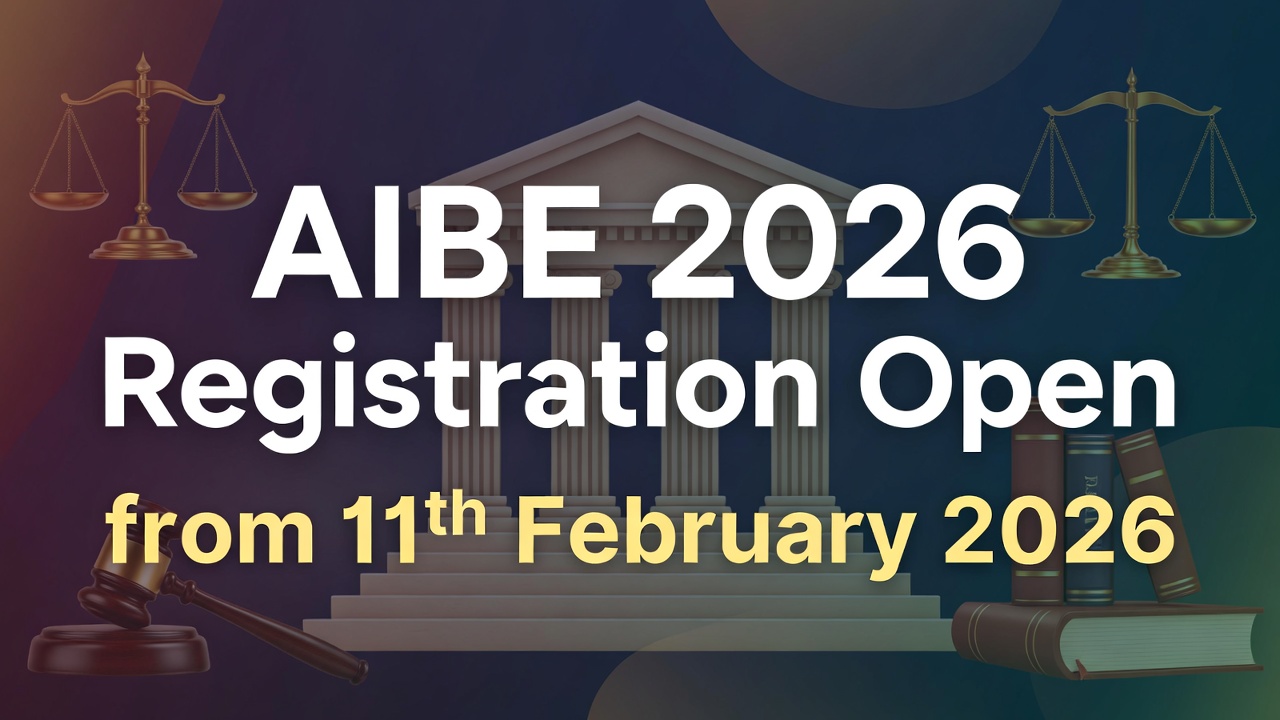
The Bar Council of India (BCI) has officially commenced the registration process for the 21st All India Bar Examination (AIBE XXI). Starting from February 11, 2026, law graduates across the country can submit their applications online through the official portal. This examination is a mandatory requirement for all law graduates who wish to practice law in Indian courts and obtain the Certificate of Practice (CoP).
This full guide details the entire registration procedure, important dates, eligibility criteria, exam pattern, and other crucial information for candidates aspiring to clear the bar exam this year.
Overview and Key Highlights
Exam Name: All India Bar Examination (AIBE 21)
Conducting Body: Bar Council of India (BCI)
Registration Mode: Online
Official Website: www.allindiabarexamination.com
Exam Date: June 7, 2026
Exam Mode: Offline (Pen and Paper – OMR based)
Total Marks: 100
Frequency: Twice a Year (New Policy)
The BCI has introduced significant updates for the 2026 session, including the decision to conduct the examination twice a year to help law graduates. Additionally, final-year law students are now eligible to appear for the exam, subject to certain conditions, marking a progressive step in legal education reforms.
Important Dates Timeline for AIBE 21 (2026)
Candidates must strictly adhere to the schedule announced by the Bar Council of India. Missing deadlines may result in the inability to appear for the examination.
| Event | Date |
|---|---|
| Online Registration Begins | February 11, 2026 |
| Last Date for Registration | April 30, 2026 |
| Last Date for Payment of Fee | April 30, 2026 |
| Correction Window (Tentative) | May 2026 |
| Admit Card Release | May 2026 (Last Week) |
| AIBE 21 Exam Date | June 7, 2026 |
| Answer Key Release | June 2026 (2nd Week) |
| Result Declaration (Tentative) | July 2026 |
What is AIBE and Why is it Mandatory?
The All India Bar Examination (AIBE) is a national-level certification exam conducted by the Bar
Council of India. Its primary objective is to assess the basic capabilities of an advocate to practice the profession of law in India. The exam sets a minimum benchmark for admission to the practice of law.
Passing the AIBE is mandatory for all law graduates graduating from the academic year 2010-11
onwards. Upon clearing the exam, candidates are awarded a Certificate of Practice (CoP) by the BCI,
which permanently authorizes them to practice law in any court in India.
Without clearing this exam, a provisionally enrolled advocate cannot continue to practice law beyond two years from the date of their enrollment with the State Bar Council.
Eligibility Criteria for AIBE 21
Before proceeding with registration, candidates must ensure they fulfill the eligibility criteria mandated by the BCI:
1. Educational Qualification
- Candidates must hold a 3-year LLB or 5-year Integrated LLB degree from a
university recognized by the Bar Council of India. - New Update: Final-year law students (without backlogs) are now eligible to appear for the exam,
provided they submit proof of their academic status and an undertaking.
2. Enrollment with State Bar Council
- Candidates must be enrolled as an advocate with their respective State Bar Council.
- Possession of the Enrollment Number (Provisional or Permanent) is mandatory for filling out the application form.
- Final-year students appearing under the new rule may be exempted from immediate enrollment proof but must fulfill criteria as per specific BCI notifications.
3. Age Limit
- There is no upper or lower age limit to appear for the AIBE exam.
4. Number of Attempts
- There is no limit on the number of attempts. Candidates can appear for the exam as many times as
required to pass.
Application Fee Structure
The application fee must be paid online during the registration process. The fee structure varies based on the
candidate’s category:
| Category | Application Fee (Approx.) |
|---|---|
| General / OBC | ₹ 3,500 (+ Bank Charges) |
| SC / ST | ₹ 2,500 (+ Bank Charges) |
Note: The fee is non-refundable and non-transferable under any circumstances.
Documents Required for Registration
Candidates should keep scanned copies of the following documents ready before starting the online application. Ensure that the files meet the specified size and format requirements (usually JPG/JPEG or PDF).
- Passport Size Photograph: Recent color photograph with a white background.
- Signature: Scanned copy of the candidate’s signature on white paper with black ink.
- Self-Attested Enrollment Certificate: Issued by the State Bar Council (For enrolled advocates).
- Self-Attested Photo ID Proof: Aadhaar Card, Voter ID, PAN Card, Passport, or Driving License.
- Category Certificate: Self-attested copy of SC/ST/OBC/PwD certificate (if applicable).
- Disability Certificate: For PwD candidates seeking scribe assistance or extra time.
Step-by-Step Registration Process
Follow these detailed steps to successfully register for AIBE 21 on the official portal:
Step 1: Online Registration
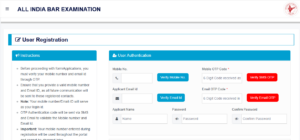
Visit the official website at www.allindiabarexamination.com. Click on the “Registration AIBE-XXI” link. Enter your mobile number and email ID to generate a One Time Password (OTP). Verify the OTP to create your account.
Step 2: Fill Application Form
Log in with your credentials. Fill in your personal details (Name, Father’s Name, DOB, Gender, Category). Enter your contact details (Address, Mobile, Email). Provide your academic qualification details (College, University, Passing Year, Marks). Enter your State Bar Council Enrollment details.
Step 3: Upload Documents
Upload the scanned copies of your photograph, signature, and self-attested documents as per the prescribed format.
Step 4: Select Exam Center and Language
Choose your preferred exam centers (usually three preferences). Select the language in which you wish to attempt the exam (AIBE is conducted in 11+ languages).
Step 5: Fee Payment
Proceed to the payment gateway. Pay the application fee using Net Banking, Credit Card, Debit Card, or UPI.
Step 6: Final Submission
Review the entire form carefully. Once submitted, some details cannot be changed. Submit the form and download the confirmation page/receipt for future reference.
Exam Pattern and Marking Scheme
AIBE XXI Official Exam Schedule
Understanding the exam pattern is crucial for preparation. The AIBE is an open-book exam (restricted to Bare Acts without notes) designed to test analytical skills.
| Parameter | Details |
|---|---|
| Mode of Exam | Offline (Center-based Pen & Paper) |
| Duration | 3 Hours 30 Minutes |
| Type of Questions | Multiple Choice Questions (MCQs) |
| Total Questions | 100 |
| Total Marks | 100 |
| Marking Scheme | +1 Mark for each correct answer |
| Negative Marking | No Negative Marking |
| Reference Material | Bare Acts (without notes/comments) are allowed |
Syllabus Overview
The syllabus for AIBE 21 covers subjects from the 3-year and 5-year LLB curriculum. The weightage varies across subjects:
| Subject | Number of Questions |
|---|---|
| Constitutional Law | 10 |
| Indian Penal Code (IPC) | 8 |
| Criminal Procedure Code (CrPC) | 10 |
| Code of Civil Procedure (CPC) | 10 |
| Evidence Act | 8 |
| Alternative Dispute Resolution (ADR) | 4 |
| Family Law | 8 |
| Public Interest Litigation (PIL) | 4 |
| Administrative Law | 3 |
| Professional Ethics & Cases of Misconduct | 4 |
| Company Law | 2 |
| Environmental Law | 2 |
| Cyber Law | 2 |
| Labor & Industrial Law | 4 |
| Law of Tort, Motor Vehicles Act & Consumer Protection Law | 5 |
| Law Related to Taxation | 4 |
| Law of Contract, Specific Relief, Property Laws, Negotiable Instrument Act | 8 |
| Land Acquisition Act | 2 |
| Intellectual Property Laws | 2 |
| Total | 100 |
Passing Criteria
To qualify the AIBE exam, candidates must secure the minimum qualifying marks prescribed by the BCI. The exam is qualifying in nature, meaning there is no ranking or topper list.
- General / OBC Category: 45% (45 Marks out of 100)
- SC / ST / PwD Category: 40% (40 Marks out of 100)
Certificate of Practice (CoP) Details
Upon successfully passing the AIBE 21 exam, candidates will be issued a Certificate of Practice (CoP). This certificate is sent to the respective State Bar Council. Candidates must collect their CoP from their State Bar Council office. This certificate validates the advocate’s right to practice law in Indian courts indefinitely.
Important Updates for AIBE 21
1. Twice a Year Frequency: The Bar Council of India has decided to conduct the AIBE twice a year to
ensure that law graduates do not lose valuable time waiting for the exam.
2. Eligibility for Final Year Students: In compliance with recent Supreme Court observations,
final-year law students are now permitted to take the exam, provided they can furnish proof of their academic standing and pass their law degree subsequently.
Preparation Tips for AIBE 21
- Understand the Bare Acts: Since Bare Acts are allowed in the exam hall, learn how to navigate the
index and sections quickly. - Focus on High-Weightage Subjects: Constitutional Law, CrPC, CPC, IPC, Evidence Act, and Family Law
constitute nearly 50% of the paper. Prioritize these subjects. - Practice Previous Papers: Solving past years’ question papers is the best way to understand the
difficulty level and question trends. - Time Management: You have roughly 2 minutes per question. Practice finding answers from Bare Acts
swiftly. - Legal Maxims and Case Laws: Brush up on landmark judgments and important legal maxims as direct
questions often appear from these areas.

📰 More Education News
- RBSE Class 12th results out: Check pass percentage for Science, Commerce & ArtsMar 31, 2026 • Amay Mathur
- Delhi DoE Result 2026 for Class 9, Class 11 Released at edudel.nic.in; Direct Link HereMar 30, 2026 • Simran
- UPPSC PCS Final Result 2024 Declared: Download Roll Number Wise PDF, Check Merit List & Cut OffMar 30, 2026 • Simran
- BSEB Bihar Board 10th Result 2026 Out: Check Time, Direct Link, Scorecard Download & Toppers ListMar 30, 2026 • Simran