B.Tech Aerospace Engineering in India: Colleges, Fees, Syllabus, and Career Opportunities
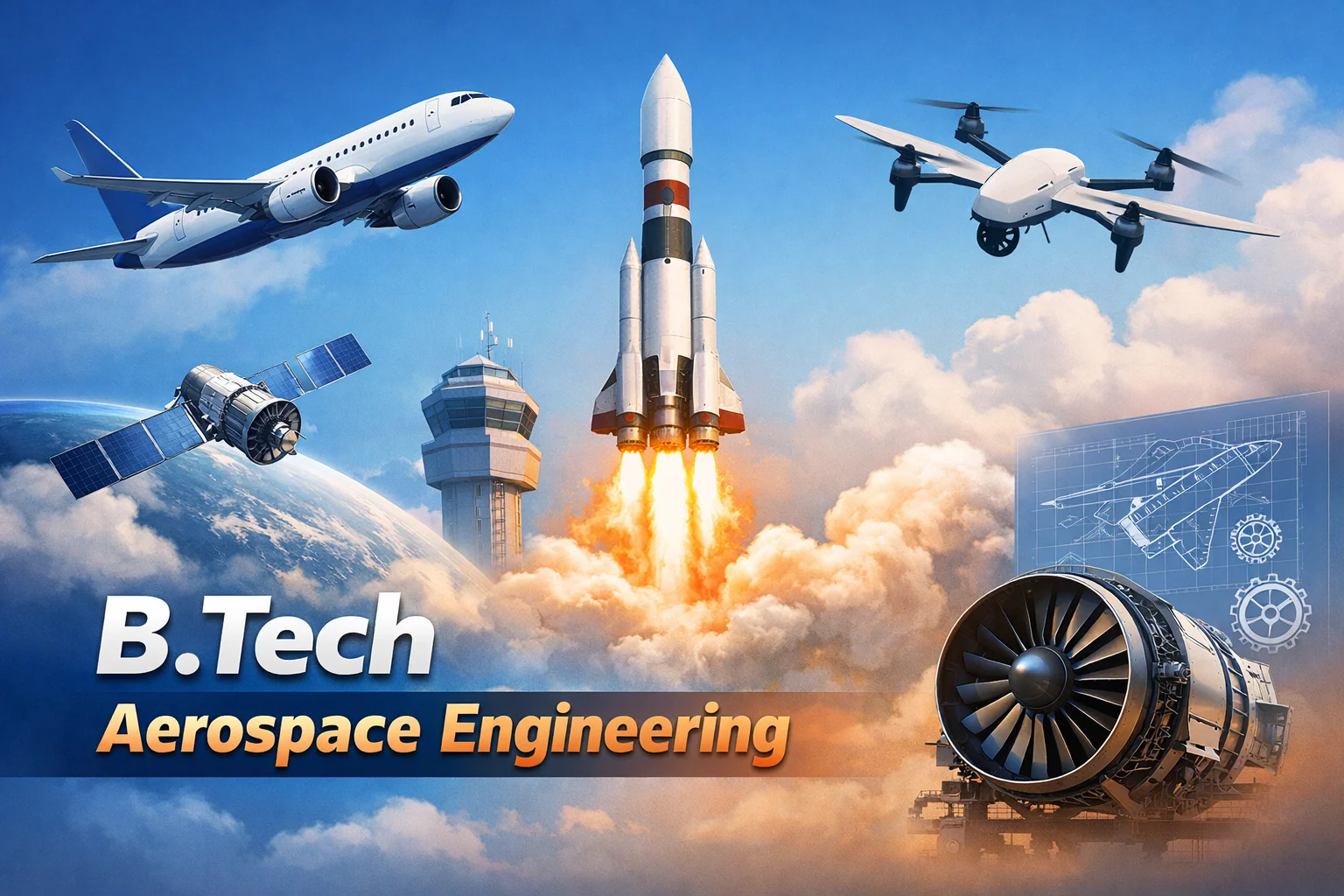
B.Tech Aerospace Engineering is a four-year undergraduate program focusing on aircraft and spacecraft design, propulsion systems, and aerodynamics. The course offers strong career opportunities in aviation, defence, research, and space organisations in India and abroad.
With growing advancements in aviation, satellite technology, and space exploration, B.Tech Aerospace Engineering has emerged as a promising career choice in India. This four-year undergraduate programme focuses on the design, development, and testing of aircraft, spacecraft, and related systems. Students must complete 10+2 with Physics, Chemistry, and Mathematics (PCM), typically securing at least 60% marks, along with qualifying entrance exams such as JEE Main, JEE Advanced, or university-level tests. The curriculum covers aerodynamics, propulsion systems, avionics, flight mechanics, structures, and spacecraft engineering. Graduates find opportunities in aviation companies, defence organisations, research institutions, and space agencies, making aerospace engineering a dynamic and future-oriented field.
B.Tech Aerospace Engineering: Course Overview
B.Tech Aerospace Engineering is a four-year undergraduate engineering programme that focuses on the design, development, testing, and operation of aircraft, spacecraft, satellites, missiles, and unmanned aerial systems. The course integrates concepts from mechanical engineering, electronics, materials science, and computational technologies to prepare students for careers in aviation, defence, and space research sectors.
Admission generally requires 10+2 with Physics, Chemistry, and Mathematics (PCM) along with qualification in entrance exams such as JEE Main, JEE Advanced, CUET, or university-level entrance tests. Government institutes provide affordable technical education, while private universities emphasize advanced laboratories, internships, and industry exposure.
| Feature | Details |
|---|---|
| Degree Level | Undergraduate (B.Tech) |
| Course Duration | 4 Years (8 Semesters) |
| Eligibility | 10+2 with Physics, Chemistry & Mathematics (PCM) |
| Minimum Marks Required | 60%–75% aggregate (varies by institution) |
| Admission Process | Entrance exam + counselling + seat allotment |
| Major Entrance Exams | JEE Main, JEE Advanced, CUET, LPUNEST, VITEEE, SRMJEEE |
| Average Fees – Government Colleges | INR 50,000 – 2,00,000 per year |
| Average Fees – Private Colleges | INR 1,50,000 – 5,00,000 per year |
| Core Subjects | Aerodynamics, Propulsion Systems, Flight Mechanics, Aircraft Structures, Thermodynamics, Avionics, Control Systems, Spacecraft Technology |
| Specialization Scope | Aircraft Design, Space Technology, UAV/Drone Systems, Rocket Propulsion, Satellite Engineering |
| Scope of the Course | Aerospace engineering, aviation industry, defence technology, satellite development, space exploration, research & innovation |
| Employment Areas | Aircraft manufacturing companies, defence organisations, airlines, DGCA, ISRO-related projects, R&D centres, academia, private space startups |
| Internship & Training | Aircraft maintenance exposure, simulation labs, research internships, industry projects |
| Average Starting Salary | INR 5 – 10 LPA (higher for premier institutes) |
| Higher Study Options | M.Tech Aerospace Engineering, MS Abroad, MBA Aviation Management, Space Engineering Specializations |
B.Tech Aerospace Engineering Eligibility Criteria in India
Admission to B.Tech Aerospace Engineering programmes in India requires students to have a strong academic background in Physics, Chemistry, and Mathematics (PCM) at the 10+2 level. Eligibility requirements vary slightly across institutions; however, entrance exam performance remains the primary selection criterion.
| College Name | Minimum Marks in 10+2 | Mandatory Subjects | Entrance Exams Accepted | Age Limit |
|---|---|---|---|---|
| Indian Institute of Technology Madras | 75%+ (General Category) | PCM | JEE Advanced | As per JEE rules |
| Indian Institute of Technology Bombay | 75%+ | PCM | JEE Advanced | As per JEE rules |
| SRM Institute of Science and Technology | 60%–75% | PCM | SRMJEEE / JEE Main | University norms |
| Amity University Haryana | 60%+ | PCM | JEE Main / Amity JEE / Merit | University norms |
| University of Petroleum and Energy Studies | 60%+ | PCM | JEE Main / UPESEAT | University norms |
| Indian Institute of Space Science and Technology | 75%+ | PCM | JEE Advanced | As per JEE rules |
| R.V. College of Engineering | 60%–65% | PCM | KCET / COMEDK / JEE Main | State norms |
| International Institute of Aerospace Engineering and Technology | 60%+ | PCM | JEE Main / MHT CET | State norms |
B.Tech Aerospace Engineering Admission Process
Admission to B.Tech Aerospace Engineering programmes in India is primarily entrance-exam based, followed by counselling and seat allotment. Some private universities may also offer merit-based admission.
Step-wise Admission Process
- Appear for relevant entrance examinations such as JEE Main, JEE Advanced, KCET, COMEDK, SRMJEEE, UPESEAT, or university-level tests.
- Obtain a valid qualifying score/rank in the entrance examination.
- Register on official counselling portals or university admission portals.
- Fill out college application forms and upload required documents.
- Participate in centralised or institutional counselling, selecting preferred colleges and specialisations.
- Seat allotment is conducted based on rank, category, availability, and preferences.
- Complete document verification and pay admission fees to confirm the seat.
- Report to the allotted institute and complete enrolment formalities.
Important Points for Applicants
- Eligibility typically requires minimum 60% aggregate marks in PCM (higher for IITs and IIST).
- For admission to Indian Institute of Space Science and Technology, candidates must qualify JEE Advanced and meet institute-specific cutoffs set annually.
- Admission may be:
- Entrance-based (most government and top private institutions)
- Merit-based (select private universities)
- Students planning postgraduate studies often prepare for GATE during their undergraduate years.
- Applicants should review official websites regularly for updated deadlines, counselling schedules, and cutoff announcements.
Top Government Colleges for B.Tech Aerospace Engineering in India
Government institutions in India offering B.Tech Aerospace Engineering are known for strong academic frameworks, advanced laboratories, funded research opportunities, and excellent placement outcomes in aviation, defence, and space sectors. Admission to most government colleges is primarily based on JEE Advanced or JEE Main scores followed by centralised counselling.
The table below highlights leading government institutes offering Aerospace Engineering or closely related aerospace specialisations. Fees and rankings are approximate and subject to periodic revision.
| College Name | Location | NIRF Ranking (Engineering) | Approx. Total Fees (INR) | Accepted Entrance Exams |
|---|---|---|---|---|
| Indian Institute of Technology Madras | Chennai, Tamil Nadu | 1 | 8,50,000 – 9,00,000 | JEE Advanced |
| Indian Institute of Technology Bombay | Mumbai, Maharashtra | 3 | 8,50,000 – 9,00,000 | JEE Advanced |
| Indian Institute of Technology Kanpur | Kanpur, Uttar Pradesh | 4 | 8,50,000 – 9,00,000 | JEE Advanced |
| Indian Institute of Technology Kharagpur | Kharagpur, West Bengal | 5 | 8,60,000 – 9,20,000 | JEE Advanced |
| Indian Institute of Engineering Science and Technology Shibpur | Howrah, West Bengal | 20–25 Range | 5,00,000 – 5,80,000 | JEE Main |
| Indian Institute of Space Science and Technology | Thiruvananthapuram, Kerala | 60+ Range | ~5,00,000 | JEE Advanced |
| Punjab Engineering College Chandigarh | Chandigarh | 40–50 Range | ~5,50,000 | JEE Main |
| National Institute of Technology Delhi | New Delhi | Not Ranked Separately | ~5,00,000 | JEE Main |
Top Private Colleges for B.Tech Aerospace Engineering in India
Private universities offering B.Tech Aerospace Engineering provide modern infrastructure, industry collaborations, international exposure, and specialised laboratories focused on aeronautics and space technology. Admission is typically through JEE Main or university-level entrance examinations, with some institutes also considering merit-based admissions.
The following table presents prominent private colleges offering Aerospace Engineering or related aerospace specialisations in India.
| College Name | Location | NIRF Ranking (Engineering) | Approx. Total Fees (INR) | Accepted Entrance Exams |
|---|---|---|---|---|
| SRM Institute of Science and Technology | Chennai, Tamil Nadu | 40–50 Range | 12,00,000 – 13,00,000 | JEE Main, SRMJEEE |
| SASTRA Deemed University | Thanjavur, Tamil Nadu | 50–60 Range | ~10,00,000 | JEE Main, SAEEE |
| Amity University Haryana | Gurugram, Haryana | Not Ranked | ~9,50,000 | JEE Main, Amity JEE |
| University of Petroleum and Energy Studies | Dehradun, Uttarakhand | 60+ Range | 14,00,000 – 15,00,000 | JEE Main, UPESEAT |
| Chandigarh University | Mohali, Punjab | 50–55 Range | ~7,00,000 | JEE Main, CUCET |
| Kalinga Institute of Industrial Technology | Bhubaneswar, Odisha | 20–25 Range | 13,00,000 – 14,00,000 | KIITEE, JEE Main |
| Alliance University | Bengaluru, Karnataka | Not Ranked | ~12,00,000 | AUSAT, JEE Main |
| Dev Bhoomi Uttarakhand University | Dehradun, Uttarakhand | Not Ranked | ~6,00,000 | JEE Main, DBUUET |
B.Tech Aerospace Engineering Subjects and Syllabus
The B.Tech Aerospace Engineering programme in India is a four-year undergraduate degree divided into eight semesters, designed to build strong foundations in engineering sciences, aerodynamics, propulsion systems, aircraft structures, and space technology. The curriculum progresses from basic engineering principles in the first year to advanced aerospace design, avionics, and spacecraft engineering in later semesters.
Students also undertake laboratory work, simulation training, internships, and a final-year major project. Electives allow specialization in areas such as spacecraft systems, UAV technology, propulsion engineering, and avionics systems.
| Year | Semester | Core Subjects | Elective Subjects (Indicative) |
|---|---|---|---|
| Year 1 | Semester 1 | Engineering Mathematics-I, Engineering Physics, Engineering Graphics, Basic Mechanical Engineering, Programming Fundamentals | — |
| Semester 2 | Engineering Mathematics-II, Engineering Chemistry, Basic Electronics, Workshop Practice, Environmental Studies | — | |
| Year 2 | Semester 3 | Thermodynamics, Fluid Mechanics, Strength of Materials, Numerical Methods | Introduction to Aerospace Engineering |
| Semester 4 | Aerodynamics-I, Aircraft Structures-I, Materials Science, Measurements & Instrumentation | Computational Methods | |
| Year 3 | Semester 5 | Heat Transfer, Propulsion-I, Aircraft Structures-II, Flight Dynamics | UAV Design, Aerospace Materials |
| Semester 6 | Flight Mechanics, Control Engineering, Propulsion-II, Aerospace Manufacturing | CFD, Satellite Technology | |
| Year 4 | Semester 7 | Aircraft Design, Space Mechanics, Avionics Systems, Aerospace Vehicle Design Lab | Rocket Design, Spacecraft Systems |
| Semester 8 | Rocket Propulsion, Spacecraft Dynamics, Major Project, Industrial Training | Hypersonic Flight, Guidance & Navigation |
Check the B.Tech Aerospace Engineering syllabus here.
B.Tech Aerospace Engineering Fee Structure
The fee structure for B.Tech Aerospace Engineering varies widely depending on whether the institution is government-funded or privately managed. Government institutes offer subsidised education, while private universities generally charge higher tuition due to infrastructure investment, global collaborations, and advanced laboratories.
| College Type | College Name | Location | Approx. Annual Fees (INR) |
|---|---|---|---|
| Government | Indian Institute of Technology Madras | Chennai | 1,00,000 – 2,00,000 |
| Government | Indian Institute of Technology Bombay | Mumbai | 1,00,000 – 2,20,000 |
| Government | Indian Institute of Space Science and Technology | Thiruvananthapuram | 30,000 – 1,50,000 |
| Government | National Institute of Technology Tiruchirappalli | Tiruchirappalli | 80,000 – 1,80,000 |
| Private | SRM Institute of Science and Technology | Chennai | 2,50,000 – 6,50,000 |
| Private | Amity University Haryana | Gurugram | 2,00,000 – 4,50,000 |
| Private | University of Petroleum and Energy Studies | Dehradun | 3,00,000 – 7,00,000 |
| Private | Hindustan Institute of Technology and Science | Chennai | 1,80,000 – 3,60,000 |
| Private | Manipal Institute of Technology | Manipal | 2,50,000 – 5,00,000 |
| Private | Birla Institute of Technology and Science Pilani | Pilani | 2,80,000 – 5,60,000 |
Factors Affecting Fees
- Infrastructure and research facilities
- Industry partnerships
- International collaborations
- Hostel and laboratory charges
- Scholarships and financial aid availability
Entrance Exams for B.Tech Aerospace Engineering in India
Admission to B.Tech Aerospace Engineering programmes primarily depends on national, state, or university-level entrance examinations assessing Physics, Chemistry, and Mathematics proficiency.
| Exam Name | Conducting Body | Exam Level | Eligibility Criteria |
|---|---|---|---|
| Joint Entrance Examination Main (JEE Main) | NTA | National | 10+2 with PCM |
| Joint Entrance Examination Advanced (JEE Advanced) | IITs | National | JEE Main Qualified Candidates |
| AIE CET | AIE CET Authority | National | 10+2 PCM |
| Amity Joint Entrance Examination | Amity University | University | 10+2 PCM |
| Lovely Professional University National Entrance and Scholarship Test (LPUNEST) | LPU | University | 10+2 PCM |
| Maharashtra Common Entrance Test (MHT CET) | State CET Cell | State | 10+2 PCM |
| Karnataka Common Entrance Test (KCET) | KEA | State | Karnataka Students (PCM) |
| COMEDK UGET | COMEDK | State/Private | 10+2 PCM |
B.Tech Aerospace Engineering Jobs and Career Opportunities in India
A B.Tech Aerospace Engineering degree opens opportunities across aviation, defence, space research, manufacturing, and emerging drone technologies. Graduates can work in both government organisations and private aerospace companies.
Popular Job Roles
- Aerospace Engineer
- Aircraft Design Engineer
- Flight Test Engineer
- Propulsion Engineer
- Avionics Engineer
- Satellite Systems Engineer
- Aerodynamic Analyst
- UAV/Drone Engineer
- Maintenance Engineer
- Research Scientist
Employment Areas
- Aircraft Manufacturing Companies
- Defence and Military Aviation
- Space Research Organisations
- Airlines and Aviation Authorities
- Drone and UAV Industry
- Research & Development Centres
- Private Aerospace Startups
- Academic and Research Institutions
Major Recruiters
- Indian Space Research Organisation (ISRO)
- Defence Research and Development Organisation (DRDO)
- Hindustan Aeronautics Limited (HAL)
- National Aerospace Laboratories
- Air India
- Boeing
- Airbus
Salary Expectations in India
| Experience Level | Average Salary |
|---|---|
| Fresh Graduates | INR 4 – 8 LPA |
| 3–5 Years Experience | INR 8 – 15 LPA |
| Senior Engineers/Researchers | INR 18 – 30+ LPA |
Career Growth Options
- M.Tech in Aerospace Engineering
- MBA in Aviation Management
- Research through GATE/PhD
- Pilot or aviation certification pathways
- Space technology and satellite engineering specialisation
This structured pathway makes Aerospace Engineering one of the most promising engineering careers aligned with India’s expanding aviation and space ecosystem.
Frequently Asked Questions (FAQs)
Q1. What is the duration of the B.Tech Aerospace Engineering course in India?
The B.Tech Aerospace Engineering course in India is 4 years long. This course focuses on the design and development of spacecraft and flight vehicles. The key topics covered in this course include Aerodynamics, Propulsion systems, and Materials science.
Q2. What are the eligibility criteria for B.Tech Aerospace Engineering in India?
To be eligible for B.Tech Aerospace Engineering in India, candidates must have completed 10+2 with PCM subjects. They must also qualify for relevant entrance exams such as JEE Main, JEE Advanced, CUET, or LPUNEST. Additionally, some colleges may require a minimum of 60% marks in PCM subjects.
Q3. What is the admission process for B.Tech Aerospace Engineering in India?
The admission process for B.Tech Aerospace Engineering in India involves appearing for relevant entrance exams, qualifying with a valid score, and applying to colleges that accept the entrance exam score. Candidates must also participate in the counseling process and meet the minimum eligibility criteria set by the college. Admission is secured based on merit or cutoff ranks.
Q4. What are the core subjects covered in the B.Tech Aerospace Engineering syllabus?
The core subjects covered in the B.Tech Aerospace Engineering syllabus include Aerodynamics, Propulsion, Dynamics and Control, Flight Mechanics, Structural Mechanics, Control Systems, and Thermodynamics. In the third year, students also take two elective courses in addition to the core subjects.
Q5. What is the minimum fee for B.Tech Aerospace Engineering in private colleges in India?
The minimum fee for B.Tech Aerospace Engineering in private colleges in India is INR 1,40,000. However, fees may vary depending on the college and location. Government colleges like the Indian Institute of Space Science and Technology (IIST) may have different fee structures.