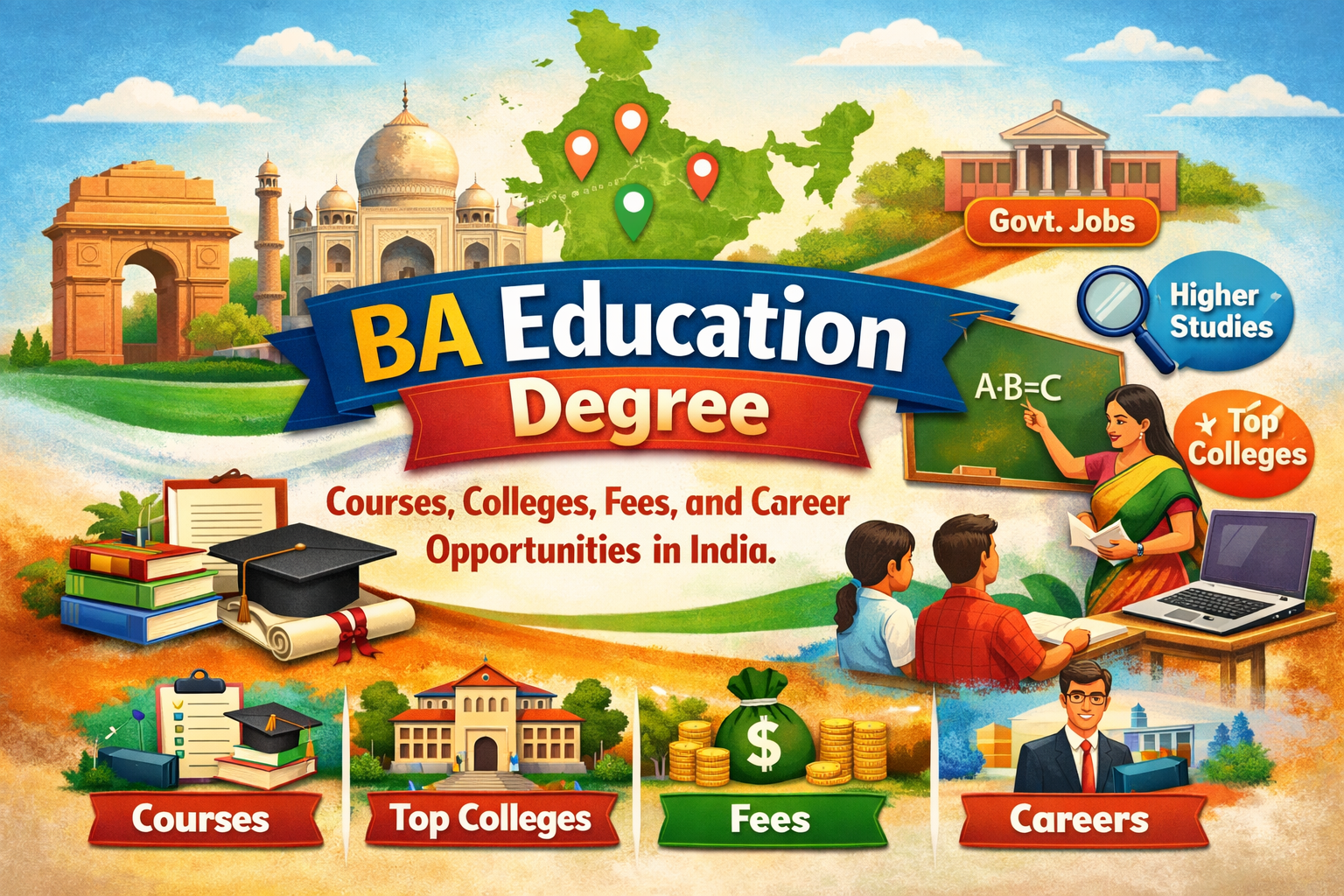
BA Education Degree: Courses, Colleges, Fees, and Career Opportunities in India
A BA Education degree is an increasingly popular choice for those seeking to become educators. This 3-year program blends educational theory with practical application, providing a strong foundation in educational principles, psychology, and curriculum development. Admission typically requires a 10+2 or equivalent qualification from a recognized board with 45% to 50% aggregate marks, though specific requirements vary by institution.
Graduates with a BA Education degree can pursue careers as teachers, education counselors, and curriculum developers, with starting salaries ranging from ₹2.5 to ₹4 LPA. The degree cultivates critical thinking, communication, and organizational skills, making graduates attractive to both public and private sector employers. Admission is generally merit-based or through entrance exams.
This article provides a detailed overview of the BA Education degree, including courses, colleges, fees, and career opportunities in India.
BA Education Course Highlights
| Feature | Details |
|---|---|
| Course Name | BA Education |
| Level | Undergraduate (UG) |
| Duration | 3 years (6 semesters) |
| Eligibility | 10+2 (any stream) from a recognized board |
| Admission Process | Merit-based or entrance exam (varies by college) |
| Course Type | Full-time |
| Medium of Instruction | English / Regional language (depends on college) |
| Core Subjects | Educational Psychology, Teaching Methodologies, Curriculum Design, Educational Technology, Assessment & Evaluation |
| Practical Training | Teaching practice, classroom observation, internships in schools |
| Career Opportunities | Teacher, Educational Counselor, Curriculum Developer, Academic Researcher, Education Administrator |
| Higher Studies Options | M.Ed, MA Education, PhD in Education, Educational Leadership Programs |
| Skills Developed | Communication, Pedagogy, Classroom Management, Critical Thinking, Research Skills |
Why Choose BA Education?
BA Education is an undergraduate program designed for students who want to pursue a career in teaching, educational administration, curriculum development, or research in education. The course not only provides theoretical knowledge of educational principles but also emphasizes practical training and teaching methodologies. Choosing BA Education equips students with a strong foundation in pedagogy, child psychology, classroom management, and modern teaching tools, making them ready for both teaching roles and higher studies in education.
Key reasons to choose BA Education:
-
Prepares for teaching careers in schools, colleges, and educational institutions.
-
Offers a strong foundation for higher studies like M.Ed, MA Education, or PhD in Education.
-
Enhances understanding of educational psychology, learning theories, and pedagogy.
-
Opens opportunities in curriculum planning, educational research, and administration.
-
Integrates practical teaching training with theoretical learning.
BA Education Eligibility Criteria
To be eligible for BA Education programs in India, candidates must have completed their 10+2 education from a recognized board (CBSE, ICSE, or state boards) with 45% to 50% aggregate marks. While an arts or humanities stream is generally preferred, some colleges may consider other streams. There are generally no age limits, but domicile requirements may apply for state-level colleges. Admission is either merit-based or through entrance exams. The following table outlines the detailed eligibility criteria for BA Education programs in India.
| Criteria | Details | Specific Requirements |
|---|---|---|
| Minimum Qualification | Academic requirement for admission | 10+2 or equivalent from a recognized board like CBSE, ICSE, or state boards |
| Minimum Percentage | Required percentage in 10+2 | Typically 45% – 50% aggregate marks, but can vary by institution |
| Required Subjects | Specific subjects needed in 10+2 | Arts/Humanities stream preferred, but other streams may be considered |
| Age Limit | Upper or lower age restrictions | Generally, no upper age limit for BA Education programs |
| Entrance Exams | Exams required for admission | Some colleges may conduct their own entrance tests or consider national level exams |
| Domicile | Requirement for state-level colleges | May be required for certain government colleges, especially for quota seats |
| Application Process | Steps to apply for BA Education | Fill out the application form, submit required documents, and appear for counseling or entrance exams as needed |
| Document Requirements | Documents needed for admission | Mark sheets, certificates, ID proof, and sometimes domicile certificate |
| Admission Fee | Fee for securing admission | Varies by institution, but typically ranges from INR 500 to INR 5,000 |
| Tuition Fee | Annual fee for the program | Can range from INR 3,000 to INR 50,000 or more, depending on the college |
BA Education Admission Process
The admission process for a BA Education degree in India starts with verifying the eligibility criteria of the chosen college or university, including the minimum 10+2 marks of 45% – 50%. Some colleges conduct their own entrance tests. The application process involves completing the application form (online or offline) and submitting documents like mark sheets, certificates, and ID proof.
- Check eligibility criteria, including minimum marks and subject requirements, before applying to colleges like Lady Shri Ram College For Women or Miranda House, which have specific requirements.
- Fill out the application form accurately and completely, ensuring all necessary documents are attached, such as for Christ University or Loyola College, which may have additional requirements.
- Submit required documents, including mark sheets and certificates, to colleges like Hindu College or Presidency College, which may have different document verification processes.
- Appear for entrance exams, if applicable, such as those conducted by Amity University or Madras Christian College, which use these exams as part of their admission criteria.
- Attend counseling sessions, if shortlisted, to finalize the admission process, as seen in the processes of Government Arts College or other government institutions.
- Pay admission fees to confirm the seat; fees vary significantly between government colleges like Lady Shri Ram College For Women (INR 20,000) and private institutions like Amity University (INR 90,000).
- Verify documents at the college to ensure all paperwork is in order, a step that is mandatory for all colleges, including private ones like Christ University or Loyola College.
- Understand the difference in admission processes for regular and distance education programs, as some colleges may offer both, like the University of Delhi or IGNOU.
- Research the college’s NIRF ranking, location, and annual fees, such as Miranda House (ranked 1, fees INR 18,000) or Presidency College (fees INR 5,000), to make an informed decision.
After these steps, students are formally admitted to the BA Education program. Researching the specific admission requirements for each college is crucial, as they can vary significantly.
BA Education Syllabus
The BA Education syllabus is designed to provide students with a balanced mix of theoretical knowledge, practical training, and professional skills necessary for a career in education. The curriculum is usually spread across 3 years (6 semesters) and covers subjects related to pedagogy, psychology, teaching methods, and educational management.
Typical BA Education Syllabus Includes:
Semester-wise Overview:
| Semester | Key Subjects / Topics |
|---|---|
| Semester 1 | Introduction to Education, Philosophy of Education, Child Development and Learning, English / Language Skills |
| Semester 2 | Educational Psychology, Sociology of Education, Fundamentals of Teaching, History of Education in India |
| Semester 3 | Teaching Methodologies, Curriculum Design and Development, Assessment & Evaluation Techniques |
| Semester 4 | Educational Technology, Inclusive Education, Guidance & Counseling in Education, Research Methods in Education |
| Semester 5 | Classroom Management, Comparative Education, Educational Planning and Administration, Practical Teaching / Internship |
| Semester 6 | Project Work / Research Project, Advanced Teaching Methods, Contemporary Issues in Education, Internship / Practicum |
Other Components:
-
Practical Training: Observing classrooms, teaching practice sessions in schools.
-
Assignments and Projects: Focused on lesson planning, curriculum analysis, and educational research.
-
Workshops / Seminars: To enhance practical skills and exposure to modern educational trends.
This syllabus ensures that students are not only academically equipped but also professionally prepared for careers in teaching, counseling, and education administration.
Skills Required for BA Education Students
BA Education students need a combination of academic, interpersonal, and professional skills to succeed in both studies and future careers in education. The course is heavily student-centered, emphasizing communication, creativity, and adaptability.
-
Communication Skills:
Ability to explain concepts clearly and interact effectively with students, parents, and colleagues. -
Pedagogical Skills:
Understanding various teaching methodologies and applying them effectively in diverse classroom settings. -
Classroom Management:
Ability to maintain discipline, manage multiple learning needs, and create a conducive learning environment. -
Critical Thinking and Problem-Solving:
Analyze educational challenges, develop solutions, and adapt to changing educational scenarios. -
Research Skills:
Conduct educational research, evaluate data, and apply findings to improve teaching methods and learning outcomes. -
Creativity and Innovation:
Design engaging lesson plans, use innovative teaching tools, and apply modern educational technology. -
Empathy and Patience:
Understanding students’ diverse learning needs, supporting them emotionally, and guiding them effectively. -
Organizational Skills:
Planning lessons, managing time effectively, and coordinating educational activities. -
Technological Literacy:
Use digital tools, educational software, and online platforms for teaching and learning purposes. -
Teamwork and Leadership:
Collaborate with colleagues, mentor junior students, and contribute to school or educational projects.
Career Scope After BA Education
A BA in Education equips students with foundational knowledge in pedagogy, teaching methodologies, educational psychology, and curriculum planning. Graduates can pursue careers in teaching, educational administration, and related sectors. The career scope is broad, including schools, educational institutions, NGOs, and government agencies. Here’s a detailed look:
1. Teaching Profession
-
Schools and Colleges: Graduates can teach at primary, secondary, or higher secondary levels after obtaining a B.Ed (Bachelor of Education).
-
Coaching Centers & Tutoring: Private coaching and online tutoring are in high demand.
2. Educational Administration
-
Roles include school coordinators, academic counselors, education officers, and program managers in both government and private institutions.
3. Government Jobs
-
Graduates can appear for teaching exams like CTET (Central Teacher Eligibility Test), State TETs, and administrative exams in educational departments.
-
Positions in educational research, policy planning, and curriculum development are also available.
4. Higher Studies & Specializations
-
M.A. In Education: Focus on advanced pedagogy, curriculum design, or special education.
-
M.Ed (Master of Education): Opens opportunities in teaching at higher levels and educational leadership.
-
Specializations: Educational technology, special needs education, educational counseling, etc.
5. Corporate & Private Sector Roles
-
Corporate training & development: Designing training modules and educational content for employees.
-
EdTech companies: Roles like content developer, instructional designer, and learning consultant.
6. Non-Governmental Organizations (NGOs)
-
Work in literacy programs, child development initiatives, and educational awareness projects.
Salary After BA Education
Salary depends on the job role, location, experience, and further qualifications like B.Ed or M.Ed. Here’s a detailed breakdown:
| Job Role | Entry-Level Salary (INR per month) | Average Salary (INR per month) | Experienced Salary (INR per month) |
|---|---|---|---|
| Primary/Secondary School Teacher | 12,000 – 20,000 | 25,000 – 40,000 | 50,000+ |
| Academic Coordinator | 15,000 – 25,000 | 30,000 – 45,000 | 60,000+ |
| Educational Content Developer (EdTech) | 20,000 – 30,000 | 35,000 – 50,000 | 70,000+ |
| Corporate Trainer | 25,000 – 40,000 | 45,000 – 70,000 | 1,00,000+ |
| NGO Educational Officer | 12,000 – 20,000 | 25,000 – 35,000 | 50,000+ |
| Educational Researcher | 18,000 – 25,000 | 30,000 – 45,000 | 60,000+ |
Note: Salaries increase significantly with higher qualifications (M.Ed, PhD), certifications (TEFL, special education), and experience. Private institutions and urban locations often offer higher pay than government schools in rural areas.
Higher Studies After BA in Education
After completing a BA in Education, students have multiple options for higher studies to enhance their qualifications and career prospects. Higher studies not only open opportunities in teaching and administration but also in research, counseling, and corporate sectors.
| Higher Study Option | Duration | Eligibility | Career Opportunities |
|---|---|---|---|
| B.Ed (Bachelor of Education) | 1-2 years | BA in Education or any UG degree | School Teacher, Academic Coordinator, Curriculum Developer |
| M.A. In Education | 2 years | BA in Education or related UG degree | Educational Researcher, Lecturer, Curriculum Planner |
| M.Ed (Master of Education) | 2 years | B.Ed | School Principal, Educational Administrator, Policy Maker |
| Diploma in Special Education | 1 year | BA in Education | Special Educator, Inclusive Education Specialist |
| M.Phil/PhD in Education | 2-5 years | M.Ed/M.A. In Education | Academic Researcher, University Faculty, Policy Analyst |
| Certificate Courses | 6 months – 1 year | BA in Education | Online Tutor, EdTech Content Developer, Corporate Trainer |
| MBA in Education Management | 2 years | BA + relevant experience | School Administrator, Educational Consultant, HR in Education |
Key Insight:
-
Pursuing B.Ed or M.Ed is essential for teaching in schools.
-
Specialization courses like Special Education, Educational Technology, or Counseling can boost employability in niche areas.
Government Jobs After BA in Education
BA Education graduates are eligible for various government positions, primarily in teaching, educational administration, and policy implementation. Many of these roles require qualifying exams such as CTET, State TET, SSC, or UPSC.
| Job Role | Eligibility | Exam/Selection | Average Salary (INR per month) |
|---|---|---|---|
| Primary/Secondary School Teacher | BA + B.Ed | CTET, State TET | 25,000 – 50,000 |
| Educational Officer / Admin | BA in Education + M.Ed preferred | State PSC / UPSC | 40,000 – 70,000 |
| Teacher in Navodaya / Kendriya Vidyalaya | BA + B.Ed | KVS/NVS Exam | 35,000 – 60,000 |
| Education Research Officer | M.A./M.Ed in Education | UPSC / State PSC | 40,000 – 70,000 |
| Educational Inspector / Coordinator | BA + B.Ed or M.Ed | State Education Department Exam | 35,000 – 60,000 |
| Government NGO Officer | BA in Education | Direct Recruitment | 25,000 – 50,000 |
| Library / Academic Officer | BA + Special Diploma (Library Science) | State/University Recruitment | 25,000 – 45,000 |
Key Insight:
-
CTET is mandatory for teaching in central schools (KVS, NVS).
-
State-level TETs qualify you for teaching in government schools.
-
Higher qualifications like M.Ed, M.A. In Education, or PhD can lead to administrative and policy-making roles with higher salaries.
Top Colleges for BA Education in India
Pursuing a BA in Education from a reputed college can provide quality teaching, practical exposure, and better career opportunities. These colleges are known for their experienced faculty, strong pedagogy, and placement support in both teaching and educational administration roles.
| College Name | Location | Average Fees (INR per year) | Highlights |
|---|---|---|---|
| Lady Irwin College | New Delhi | 1,50,000 | Affiliated with Delhi University, strong focus on education & teaching methods |
| Christ University | Bengaluru, Karnataka | 1,20,000 – 1,50,000 | Offers interdisciplinary education, practical exposure, research opportunities |
| Tata Institute of Social Sciences (TISS) | Mumbai, Maharashtra | 2,00,000 | Known for educational research, pedagogy, and social work integration |
| Banaras Hindu University (BHU) | Varanasi, Uttar Pradesh | 50,000 – 70,000 | Offers strong BA Education programs, access to BHU’s extensive research resources |
| Jamia Millia Islamia (JMI) | New Delhi | 40,000 – 60,000 | Central university, offers modern pedagogy and teacher training exposure |
| Christ Church College | Kanpur, Uttar Pradesh | 30,000 – 50,000 | Focus on teacher training, curriculum development, and educational psychology |
| Lady Doak College | Madurai, Tamil Nadu | 25,000 – 40,000 | Well-known for women’s education and holistic learning programs |
| St. Xavier’s College | Kolkata, West Bengal | 50,000 – 80,000 | Offers interdisciplinary BA Education, strong focus on teaching practice |
| University of Delhi (DU) | New Delhi | 30,000 – 60,000 | Offers BA Education via affiliated colleges, recognized for academic excellence |
| Christ College, Bangalore | Bengaluru, Karnataka | 1,00,000 – 1,20,000 | Good industry tie-ups, emphasis on modern educational techniques |
Key Insights:
-
Fees vary depending on the institution being private or government.
-
Central and state universities usually offer affordable education with strong academic standards.
-
Private institutions like Christ University and TISS provide modern teaching practices, research exposure, and industry connections.
Advantages of Studying BA Education
Studying BA Education equips students with the knowledge, skills, and professional training necessary for a successful career in teaching, education administration, and research. Here are the key advantages:
-
Career Opportunities: Opens doors to teaching, educational counseling, curriculum design, and school administration.
-
Foundation for Higher Studies: Prepares students for advanced programs like M.Ed, MA Education, or PhD in Education.
-
Practical Exposure: Combines theoretical learning with practical teaching experience through internships and classroom observations.
-
Skill Development: Enhances communication, critical thinking, research, and classroom management skills.
-
Understanding of Education Systems: Provides deep insights into pedagogy, child psychology, and modern teaching methodologies.
-
Flexibility in Career Path: Graduates can work in schools, NGOs, educational research institutions, or even ed-tech companies.
-
Contribution to Society: Empowers students to contribute to shaping future generations through quality education.
Challenges in BA Education
While BA Education offers many opportunities, students may face certain challenges during the course and in their professional journey:
-
Limited Job Availability in Some Regions: Teaching positions may be competitive or fewer in smaller towns.
-
Salary Variations: Entry-level salaries in schools may be modest compared to other professional fields.
-
Need for Continuous Learning: Teachers must keep updating their skills with modern teaching methods and technology.
-
High Responsibility: Managing diverse classroom needs and student behavior can be demanding.
-
Practical Dependence: Success often depends on hands-on teaching experience and internships, which can vary in quality.
-
Stress and Pressure: Handling administrative duties, lesson planning, and classroom management simultaneously can be challenging.
BA Education vs B.Sc Education
BA Education and B.Sc Education are both undergraduate programs but focus on different aspects of learning and career preparation. The table below provides a detailed comparison:
| Aspect | BA Education | B.Sc Education / B.Sc in Education-Related Subjects |
|---|---|---|
| Full Form | Bachelor of Arts in Education | Bachelor of Science in Education-related subjects |
| Focus | Pedagogy, teaching methodologies, educational psychology | Science education, research, and technical aspects of education |
| Duration | 3 years (6 semesters) | 3 years (6 semesters) |
| Eligibility | 10+2 in any stream | 10+2 with Science (Physics, Chemistry, Biology/Mathematics) |
| Core Subjects | Educational Psychology, Teaching Methods, Curriculum Design | Science teaching, Laboratory methods, Educational Technology |
| Career Opportunities | Teacher, Counselor, Curriculum Developer, Education Admin | Science Teacher, Lab Instructor, Educational Researcher |
| Higher Studies | M.Ed, MA Education, PhD in Education | M.Sc Education, PhD in Science Education, Educational Research |
| Skills Developed | Communication, Pedagogy, Classroom Management, Research | Scientific reasoning, Laboratory skills, Data Analysis, Pedagogy |
| Practical Training | Teaching practice, classroom observations, internships | Laboratory work, practical experiments, teaching internships |
| Salary Potential | Moderate initially, increases with experience and higher studies | Moderate initially, can be higher in research or specialized fields |
| Job Market | Schools, NGOs, Educational Institutions, Ed-tech companies | Schools, Colleges, Research Labs, Ed-tech, Government Science Education |
FAQs
What is BA Education?
BA Education, or Bachelor of Arts in Education, is an undergraduate program that prepares students for careers in teaching, educational administration, and research. It combines theoretical knowledge of pedagogy with practical training to develop competent educators.
What is the duration of BA Education?
The BA Education course typically spans three years, divided into six semesters. Each semester includes a combination of theoretical subjects, practical teaching exercises, projects, and internships, providing students with both academic understanding and hands-on experience in the field of education.
What are the eligibility criteria for BA Education?
To pursue BA Education, candidates must have completed 10+2 or equivalent from a recognized board. Students from any stream—Arts, Science, or Commerce—are eligible, although some colleges may require minimum marks. Entrance exams may also be conducted for admissions.
Which subjects are taught in BA Education?
BA Education covers subjects like Educational Psychology, Teaching Methodologies, Curriculum Design, Assessment and Evaluation, Classroom Management, Inclusive Education, Guidance and Counseling, Educational Technology, and practical teaching internships. These subjects aim to equip students with professional teaching knowledge and skills.
What career opportunities are available after BA Education?
After completing BA Education, students can pursue teaching in schools or colleges, work as educational counselors, curriculum developers, academic researchers, or education administrators. Opportunities also exist in NGOs, ed-tech companies, and government education departments, depending on skills and experience.
Can I pursue higher studies after BA Education?
Yes, BA Education graduates can pursue higher studies such as M.Ed, MA Education, or a PhD in Education. These programs provide specialization in pedagogy, educational research, and leadership, enhancing career prospects in teaching, administration, or educational research.
Is practical training included in BA Education?
Yes, BA Education includes practical training like teaching practice, classroom observations, internships, and project work. These components give students real-world teaching experience, improve classroom management skills, and prepare them to apply theoretical knowledge effectively in schools and educational institutions.
What skills will I gain from BA Education?
Students gain essential skills such as effective communication, classroom management, critical thinking, pedagogical knowledge, teaching strategies, research techniques, empathy, leadership, problem-solving, and digital literacy. These skills ensure they are ready for careers in teaching, administration, and educational research.
Which colleges offer BA Education in India?
BA Education is offered by top universities and colleges such as Delhi University, Jamia Millia Islamia, IGNOU, Banaras Hindu University, and regional state universities. Admission may be merit-based or through entrance exams, depending on the institution’s admission policy.
Is BA Education suitable for a teaching career?
Yes, BA Education is highly suitable for a teaching career, as it combines theoretical knowledge of education, practical teaching experience, and skill development. Graduates are well-prepared