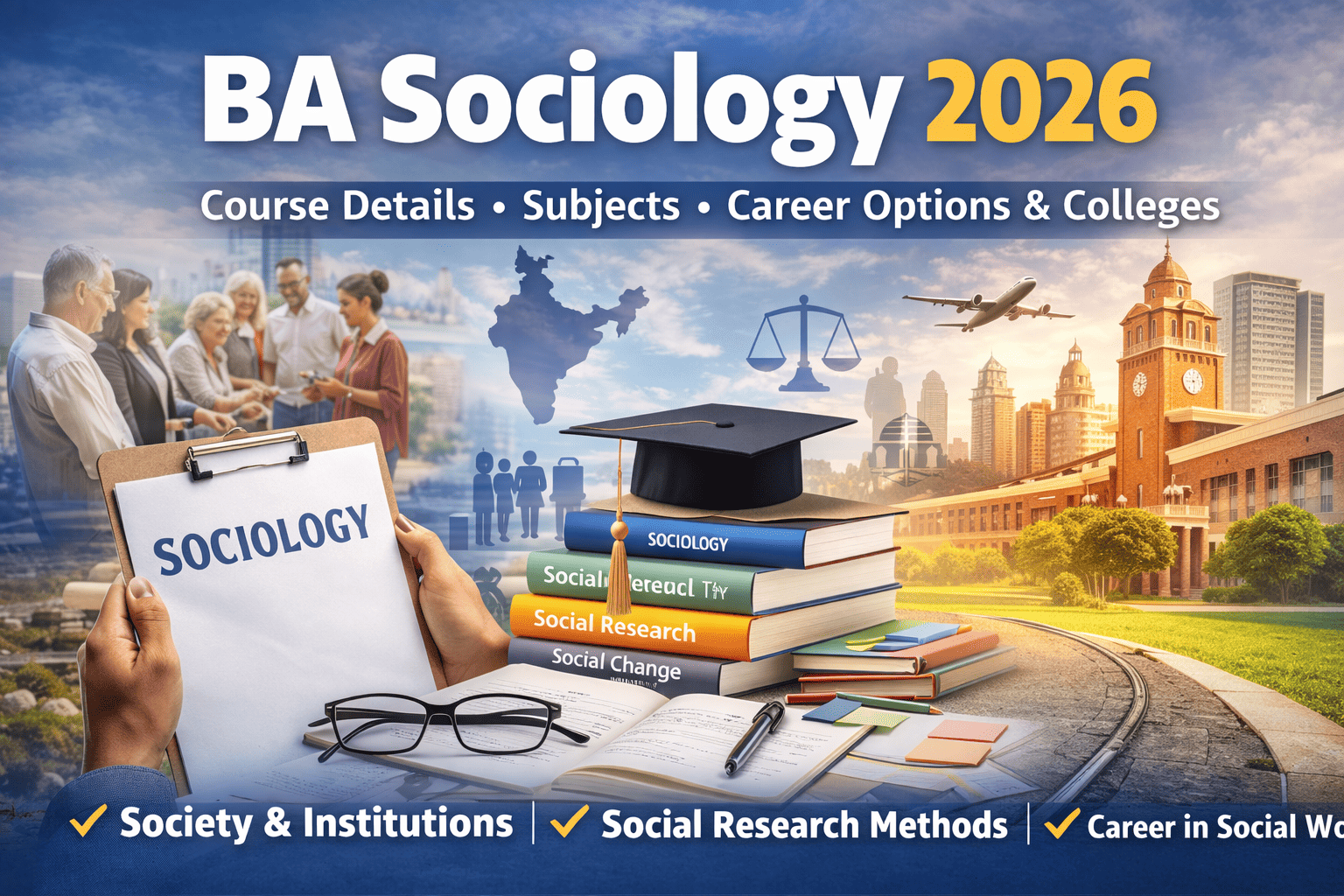
BA Sociology 2026: Course Details, Subjects, Career Options & Colleges
BA Sociology 2026 is a three-year undergraduate program that explores human society, social behavior, institutions, culture, and social change. It helps students understand the structure of society, social problems, and relationships within communities.
The course combines theoretical knowledge with practical research, preparing graduates for careers in social work, research, policy-making, education, and government services. Students can pursue this program after completing Class 12 from any stream, with most colleges offering merit-based or entrance exam admissions.
This blog gives complete details about the course, subjects, career options, top colleges, and admission process.
BA Sociology Degree 2026: Overview
The BA Sociology degree is an intellectually stimulating undergraduate program. It provides you with a systematic framework to examine how societies function, evolve, and transform. In 2026, this three-year program is particularly relevant as India addresses rapid urbanization, digital transformation, and complex social inequalities.
The discipline goes beyond textbook definitions to cultivate critical thinking abilities. These abilities enable you to dissect power structures, cultural norms, and institutional behaviors. You will develop research methodologies, from ethnographic fieldwork to statistical analysis. These skills are increasingly sought after by employers across sectors. The program’s interdisciplinary nature connects sociology with economics, political science, and psychology, creating versatile professionals capable of addressing contemporary challenges. Whether analyzing caste dynamics in rural Maharashtra or studying migration patterns in Delhi’s slums, you’ll gain practical insights into human behavior and social systems.
Here are twelve dimensions that capture what makes this degree distinctive and valuable for Indian students in 2026:
- Foundational Social Analysis: The program trains you to examine how institutions like family, education, and religion shape individual lives and collective behavior, using both classical theories and contemporary Indian case studies.
- Research Methodology Mastery: You gain hands-on experience with quantitative surveys, qualitative interviews, and ethnographic observation—essential tools for careers in policy research and social development.
- Indian Social Structure Focus: Specialized modules examine caste hierarchies, religious pluralism, and regional diversity, providing context-specific knowledge applicable to India’s unique social landscape.
- Globalization and Social Change: The curriculum addresses how digital technologies, migration, and economic liberalization reshape communities from Kerala’s Gulf-return households to Bangalore’s IT corridors.
- Gender and Social Justice: Dedicated coursework explores patriarchal systems, women’s movements, and LGBTQ+ rights, preparing you for roles in advocacy organizations and government initiatives.
- Urban-Rural Dynamics: You analyze rapid urbanization patterns, studying phenomena like Delhi’s unauthorized colonies or Mumbai’s Dharavi to understand spatial inequality and development challenges.
- Communication Skills Development: Through presentations, report writing, and group projects, you refine your ability to translate complex social analysis into accessible language for diverse audiences.
- Policy Analysis Capabilities: The degree equips you to evaluate government schemes like MNREGA or PM Awas Yojana, assessing implementation gaps and social impact.
- Fieldwork and Practical Exposure: Most programs require community-based projects, allowing you to work with NGOs in Chennai, research institutes in Hyderabad, or government departments in Delhi.
- Data Interpretation Proficiency: Training in statistical software and survey tools enables you to handle large datasets from Census operations, NSSO reports, or market research assignments.
- Cultural Competency Building: Comparative study of India’s diverse communities builds sensitivity essential for careers in human resources, journalism, and international development.
- Higher Education Pathway: The degree provides seamless progression to MA Sociology, MSW programs, or interdisciplinary fields like development studies, with top institutions like JNU and BHU offering specialized tracks.
BA Sociology Subjects and Semester-Wise Breakdown 2026
The BA Sociology curriculum follows a structured six-semester framework. It is designed to progressively build theoretical foundations and practical research competencies. Indian universities, especially those under the Choice Based Credit System (CBCS) and the more recent NEP 2020 guidelines, have restructured their syllabi. They offer greater flexibility through core courses, discipline-specific electives, and generic electives. This evolution reflects the discipline’s growing interdisciplinary relevance. It prepares you to analyze complex social phenomena ranging from caste dynamics to digital transformation.
The following table presents a detailed subject breakdown across all six semesters. It illustrates how foundational concepts mature into specialized knowledge areas.
| Semester | Subject Code | Subject Name | Brief Description | Credits | Type |
|---|---|---|---|---|---|
| 1 | SOC101 | Introduction to Sociology | Foundational concepts including social structure, culture, socialization, and major theoretical perspectives from Comte to Parsons | 4 | Core |
| 1 | SOC102 | Introduction to Social Anthropology | Comparative study of human societies, kinship systems, and cultural evolution with fieldwork methodology basics | 4 | Core |
| 1 | AECC101 | English Communication Skills | Academic writing, presentation skills, and professional communication for social science research contexts | 2 | AECC |
| 2 | SOC103 | Sociology of India I: Structure | Analysis of caste, class, tribe, and religious communities in Indian society with historical formation perspectives | 4 | Core |
| 2 | SOC104 | Social Institutions | full study of family, marriage, education, religion, and economy as fundamental social organizing principles | 4 | Core |
| 2 | AECC102 | Environmental Studies | Environmental sociology, sustainable development, and ecological challenges with Indian policy frameworks | 2 | AECC |
| 3 | SOC201 | Social Research Methods I | Quantitative research design, survey methods, sampling techniques, and SPSS software introduction | 4 | Core |
| 3 | SOC202 | Sociology of India II: Change | Modernization, globalization impacts, social movements, and development trajectories in contemporary India | 4 | Core |
| 3 | GE201 | Indian Political System | Constitutional framework, federalism, party systems, and governance structures as interdisciplinary foundation | 3 | GE |
| 4 | SOC203 | Social Research Methods II | Qualitative methods including ethnography, in-depth interviews, focus groups, and participatory action research | 4 | Core |
| 4 | SOC204 | Classical Sociological Thinkers | In-depth analysis of Marx, Weber, Durkheim, and Simmel with their contemporary relevance to Indian society | 4 | Core |
| 4 | GE202 | Indian Economic Development | Post-independence economic policies, poverty measurement, and structural transformation of Indian economy | 3 | GE |
| 5 | SOC301 | Contemporary Sociological Theories | Post-structuralism, feminism, postcolonial theory, and globalization theories from Giddens to Bourdieu | 4 | Core |
| 5 | SOC302 | Sociology of Development | Theories of modernization, dependency, sustainable development, and critique of neoliberal policies | 4 | Core |
| 5 | DSE301 | Urban Sociology | Urbanization patterns, migration, slums, smart cities, and spatial inequality in Indian metropolitan contexts | 4 | DSE |
| 6 | SOC303 | Gender and Society | Feminist theory, patriarchal structures, women’s movements, and intersectionality in Indian context | 4 | Core |
| 6 | SOC304 | Social Stratification and Inequality | Theories of class, status, power, social mobility, and persistent inequalities in contemporary India | 4 | Core |
| 6 | DSE302 | Media and Society | Digital sociology, social media effects, fake news, and media representation of marginalized communities | 4 | DSE |
BA Sociology 2026 Eligibility Criteria
The eligibility criteria for BA Sociology 2026 are designed to ensure that students have the foundational knowledge and academic background needed to succeed in this social science degree. While specific requirements may vary slightly between universities and colleges in India, most institutions follow similar guidelines.
1. Educational Qualification
To apply for BA Sociology, candidates must have completed Class 12 (10+2) from a recognised board such as CBSE, ISC, or any State Board. Students from Science, Commerce, or Arts streams are generally eligible, although Arts stream students may find some subjects easier.
2. Minimum Marks Required
Most colleges require applicants to secure a minimum aggregate score in their Class 12 examinations. This cutoff typically ranges from 40% to 50% (varies by college and category). Some universities may have higher cutoffs for competitive admissions.
3. Subject Requirements
There are no strict subject prerequisites at the 10+2 level for BA Sociology in most institutions. However, having studied Social Sciences, History, Psychology, or Economics can be beneficial for understanding sociology concepts early in the program.
4. Age Criteria
There is no specific age limit for admission into BA Sociology in most Indian universities. Candidates of all age groups who meet the academic qualification can apply.
5. Entrance Exams (If Applicable)
While many colleges offer direct merit-based admission, some universities conduct entrance exams for BA programs. For example:
-
DUET (Delhi University Entrance Test) for Delhi University
-
University-level entrance tests in certain states
Performance in these exams, along with Class 12 marks, may determine final admission.
6. Reservation and Relaxation
Government institutions follow reservation policies as per Indian government norms for SC/ST/OBC/EWS categories. Relaxations in minimum marks or cutoff may apply based on state and central reservation rules.
7. Document Requirements
Applicants must provide:
-
Class 10 and Class 12 mark sheets
-
Transfer Certificate (TC) / Leaving Certificate
-
Identity proof (Aadhar/Passport)
-
Category certificate (if applicable)
| Parameter | Requirement |
|---|---|
| Academic Qualification | Passed Class 12 (10+2) from recognised board |
| Minimum Marks | Usually 40%–50% aggregate (varies) |
| Required Subjects | No specific subject requirement |
| Age Limit | None in most universities |
| Entrance Exam | Depends on university (optional/required) |
| Reservation | Applicable as per govt norms |
| Documents Needed | Mark sheets, ID, TC, Category proof |
BA Sociology 2026 Admission Process
The admission process for BA Sociology 2026 in India is designed to be student-friendly, transparent, and based either on academic merit or entrance exams, depending on the university or college. Most institutions follow standard procedures that include application forms, document verification, and seat allocation.
1. Check Eligibility
Before applying, students must ensure they meet the eligibility criteria—typically passing Class 12 from a recognised board with the required minimum marks.
2. Application Form
Colleges and universities release online or offline application forms for BA Sociology admissions. Students should fill in personal details, academic records, and course preferences carefully before submitting within the deadline.
3. Merit-Based Admission
Many colleges admit students strictly based on Class 12 marks. Once the application period ends, institutions prepare a merit list using the applicant’s qualifying exam scores. Students whose names appear on the list move to the next step.
4. Entrance Exam (If Applicable)
Some universities conduct their own entrance tests for BA programs, including Sociology. For example, Delhi University conducts DUET, and other state or private universities have similar exams. Candidates must register, appear for the test, and achieve the required cutoff to qualify.
5. Counselling / Seat Allotment
After merit lists or entrance exam results, colleges invite students for counselling or seat allocation. Here, candidates choose preferred colleges, and seats are allotted based on rank, availability, and reservation norms.
6. Document Verification
Selected candidates must report to the allotted college with original documents for verification. Commonly required documents are Class 10 and 12 mark sheets, certificates, identity proof, photographs, and category certificates (if applicable).
7. Fee Payment & Confirmation
Once documents are verified, students pay the admission fees to confirm their seat. After fee submission, they receive an admission confirmation letter or ID.
8. Commencement of Classes
Finally, students attend orientation and begin their academic sessions as per the college schedule, usually in June–July.
Top Universities Offering BA Sociology Programs 2026
Selecting the right institution for your BA Sociology degree profoundly shapes your academic journey and professional trajectory. India’s higher education field offers exceptional choices. These range from central universities with solid research infrastructure to autonomous colleges known for specialized curriculum design.
The 2026 admission cycle sees heightened competition for seats in sociology programs. This is driven by growing recognition of the discipline’s relevance in addressing contemporary social challenges. You must weigh factors beyond rankings. Faculty expertise, research opportunities, internship networks, and fee structures all demand careful consideration.
| University/College Name | Location | NIRF Ranking | BA Sociology Program Highlights | Approximate Fees (per year) | Admission Process |
|---|---|---|---|---|---|
| Delhi University | New Delhi, Delhi | Rank 11 | Three-year honors program with interdisciplinary electives; 20+ constituent colleges offering specialization tracks | ₹15,000 – ₹25,000 | CUET-UG scores followed by centralized counseling |
| Jawaharlal Nehru University | New Delhi, Delhi | Rank 2 | Research-intensive curriculum with fieldwork component; access to Centre for the Study of Social Systems | ₹1,200 – ₹2,500 | JNUEE entrance examination; interview for final selection |
| Banaras Hindu University | Varanasi, Uttar Pradesh | Rank 5 | Integration of Indian sociological traditions with contemporary theory; rural fieldwork in Varanasi region | ₹8,000 – ₹15,000 | BHU UET entrance test; merit-based seat allocation |
| University of Hyderabad | Hyderabad, Telangana | Rank 10 | Semester system with research methodology focus; collaboration with Tata Institute of Social Sciences | ₹10,000 – ₹18,000 | CUET-UG scores; departmental interview for shortlisted candidates |
| Jamia Millia Islamia | New Delhi, Delhi | Rank 12 | Strong emphasis on minority studies and urban sociology; dedicated Centre for North East Studies | ₹12,000 – ₹20,000 | Jamia Entrance Test; 50% weightage to 12th board marks |
| Aligarh Muslim University | Aligarh, Uttar Pradesh | Rank 18 | Historical sociology focus with archival research training; AMU Museum fieldwork opportunities | ₹9,000 – ₹16,000 | AMU Entrance Examination; separate testfor external candidates |
| Presidency University | Kolkata, West Bengal | Top 50 | Oldest sociology department in India (est. 1907); intensive tutorial system with 1:10 faculty-student ratio | ₹4,500 – ₹8,000 | PUBDET entrance examination; West Bengal domicile preference |
| Loyola College | Chennai, Tamil Nadu | Top 6 (Colleges Category) | Jesuit education model with social immersion programs; mandatory NGO internship in final year | ₹35,000 – ₹55,000 | Merit-based on 12th marks; online application through college portal |
| Christ University | Bangalore, Karnataka | Top 100 | Choice-based credit system with global exchange programs; specialization in development sociology | ₹65,000 – ₹95,000 | Christ University Entrance Test; micro presentation and personal interview |
| Fergusson College | Pune, Maharashtra | Top 50 (Colleges Category) | Autonomous curriculum with Pune University affiliation; strong industry linkages for applied sociology | ₹25,000 – ₹40,000 | Merit-based admission; 12th percentage cutoff varies by category |
| Miranda House | New Delhi, Delhi | Rank 1 (Colleges Category) | Women-only institution with feminist sociology focus; active Gender Studies Cell and research projects | ₹18,000 – ₹28,000 | CUET-UG scores; Delhi University centralized counseling |
| St. Xavier’s College | Mumbai, Maharashtra | Top 10 (Colleges Category) | Mumbai-centric urban sociology research; collaboration with TISS for postgraduate pathways | ₹45,000 – ₹70,000 | Xavier’s online entrance test; interview and 12th performance weightage |
| University of Madras | Chennai, Tamil Nadu | Rank 44 | Dravidian sociology specialization; Department of Sociology established 1912 with extensive archival resources | ₹6,000 – ₹12,000 | Merit-based on 12th marks; online application through university portal |
Career Paths After BA Sociology: Opportunities and Scope 2026
A BA Sociology degree opens diverse professional avenues across India’s expanding economy. Sociology graduates are increasingly valued for their ability to analyze complex social dynamics and human behavior patterns. The Indian job market in 2026 shows strong demand for professionals who can interpret demographic trends, design inclusive policies, and manage diverse workforces across corporate, government, and non-profit sectors.
From grassroots community development to corporate boardrooms, sociology graduates bring essential perspectives on social equity, cultural competence, and systemic analysis. The growing emphasis on corporate social responsibility (CSR), evidence-based policymaking, and inclusive business practices has created new opportunities that especially use sociological training. Skill development through internships, certifications, and practical research experience significantly enhances employability and starting salary prospects in this competitive landscape.
| Career Path | Job Role Examples | Potential Employers | Skills Required | Salary Expectations |
|---|---|---|---|---|
| Social Work & Community Development | Project Coordinator, Field Officer, Community Mobilizer | SEWA, Pratham, CRY, Smile Foundation, Government Rural Development Departments | Community needs assessment, Program implementation, Stakeholder engagement, Report documentation | INR 3.2-5.8 LPA |
| Human Resources & Talent Management | HR Executive, Diversity & Inclusion Specialist, Employee Relations Manager | TCS, Infosys, Wipro, Deloitte India, Hindustan Unilever, Accenture India | Recruitment analytics, Conflict mediation, Policy formulation, HRIS platforms | INR 4.5-8.5 LPA |
| Market & Consumer Research | Qualitative Researcher, Consumer Insights Analyst, Survey Specialist | Nielsen India, Kantar IMRB, Ipsos India, Godrej Consumer Products, Marico | SPSS/Excel proficiency, Focus group facilitation, Questionnaire design, Trend interpretation | INR 4.8-7.5 LPA |
| Public Policy & Governance | Policy Research Associate, Legislative Assistant, Program Officer | NITI Aayog, State Planning Commissions, PRS Legislative Research, Centre for Policy Research | Policy document analysis, Stakeholder consultation, Data visualization, Legislative tracking | INR 5.5-10 LPA |
| Journalism & Content Development | Social Affairs Correspondent, Feature Writer, Content Strategist | The Hindu, Indian Express, Scroll.in, The Wire, Newslaundry, Quint Digital | Investigative reporting, Interview techniques, SEO content optimization, Editorial calendar management | INR 3.5-6.5 LPA |
| Academia & Teaching | Assistant Professor (after NET/SET), School Teacher, Curriculum Developer | Delhi University, JNU, State Universities, Kendriya Vidyalaya, Private International Schools | Pedagogical methods, Academic writing, Classroom management, Research publication | INR 4.2-9 LPA |
| Urban & Regional Planning | Junior Planner, Slum Rehabilitation Officer, Transport Planning Assistant | Delhi Development Authority, MHADA, Bangalore Development Authority, Tata Consulting Engineers | GIS mapping, Census data analysis, Stakeholder workshops, Environmental impact assessment | INR 5-8.5 LPA |
| Corporate Social Responsibility | CSR Coordinator, Sustainability Reporting Analyst, Impact Assessment Manager | Reliance Foundation, Tata Trusts, ITC Limited, Mahindra & Mahindra, Adani Foundation | Project monitoring, Beneficiary tracking, Sustainability frameworks, Compliance reporting | INR 5.5-9.5 LPA |
| Public Relations & Communications | PR Executive, Corporate Communications Associate, Crisis Communications Specialist | Edelman India, Weber Shandwick, Genesis BCW, Adfactors PR, Corporate Communications Divisions | Media relations, Press release drafting, Reputation management, Stakeholder mapping | INR 4-7.5 LPA |
| Data Analytics & Social Statistics | Junior Data Analyst, Demographic Researcher, Social Data Scientist | Office of Registrar General & Census Commissioner, UNFPA India, IDFC Institute, McKinsey Global Institute India | R/Python programming, Statistical modeling, Data cleaning, Predictive analytics | INR 6-11 LPA |
| Healthcare & Public Health Administration | Health Program Officer, Patient Advocate, Hospital Administration Executive | AIIMS, Fortis Healthcare, Max Healthcare, PATH India, Bill & Melinda Gates Foundation India | Health systems analysis, Patient communication, Program evaluation, Epidemiological basics | INR 4.5-8 LPA |
| Legal & Human Rights Advocacy | Legal Researcher, Rights Documentation Officer, Paralegal Assistant | Human Rights Law Network, Amnesty International India, PUCL, National Human Rights Commission, Supreme Court Advocates | Case documentation, Legal research databases, Victim interviewing, Policy brief preparation | INR 4-7 LPA |
| Environmental & Climate Action | Climate Justice Coordinator, Environmental Educator, Sustainability Consultant | Centre for Science and Environment, WWF India, TERI, Indian Youth Climate Network, State Pollution Control Boards | Community-based adaptation planning, Environmental sampling, Grant writing, Campaign mobilization | INR 4.2-7.8 LPA |
| Media & Entertainment Research | Audience Research Analyst, Content Researcher, Social Media Insight Specialist | Netflix India, Amazon Prime Video, Star India, Zee Entertainment, Ormax Media | Audience segmentation, Content performance metrics, Social listening tools, Cultural trend analysis | INR 5-9 LPA |
FAQs
1. What is BA Sociology course?
BA Sociology is an undergraduate degree that focuses on the study of society, social relationships, institutions, culture, inequality, and social change. It helps students understand human behaviour and social problems at local and global levels.
2. What is the duration of BA Sociology 2026?
BA Sociology is a three-year undergraduate programme divided into six semesters. The course includes theory papers, internal assessments, projects, and practical research work depending on the university curriculum.
3. Who is eligible for BA Sociology in 2026?
Students who have passed Class 12 from a recognised board in any stream—Arts, Science, or Commerce—are eligible. Most colleges require 40%–50% aggregate marks for admission.
4. What subjects are taught in BA Sociology?
BA Sociology covers subjects like sociological theory, Indian society, social research methods, gender studies, rural and urban sociology, social stratification, family, religion, and contemporary social issues.
5. Is BA Sociology a good career option?
Yes, BA Sociology is a good career option for students interested in social issues, research, policy, and public service. It builds analytical, communication, and critical thinking skills useful in many fields.
6. What are the career options after BA Sociology?
After BA Sociology, graduates can work as social workers, NGO coordinators, research assistants, community development officers, content writers, or prepare for government exams like UPSC and state PSCs.
7. What is the average salary after BA Sociology?
The average starting salary after BA Sociology ranges from ₹2 lakh to ₹5 lakh per year. Salary depends on job role, organisation, location, skills, and whether the student pursues higher studies.
8. Can I do MA after BA Sociology?
Yes, students can pursue MA Sociology or related subjects like Social Work, Public Policy, Development Studies, or Anthropology to gain specialisation, improve career prospects, and enter teaching or research fields.
9. Which colleges offer BA Sociology in India?
Top colleges offering BA Sociology include Delhi University colleges, Jawaharlal Nehru University, Banaras Hindu University, University of Mumbai, and reputed state and private universities across India.
10. Is BA Sociology useful for competitive exams?
Yes, BA Sociology is very useful for competitive exams like UPSC, SSC, and state PSCs. The syllabus overlaps with General Studies and Sociology optional, helping in better conceptual understanding.