B.El.Ed in India: Admission, Syllabus, Colleges & Career Scope
B.El.Ed is a 4-year integrated program that trains students in pedagogy, child development, and teaching skills, preparing them for careers as primary and upper-primary school educators.
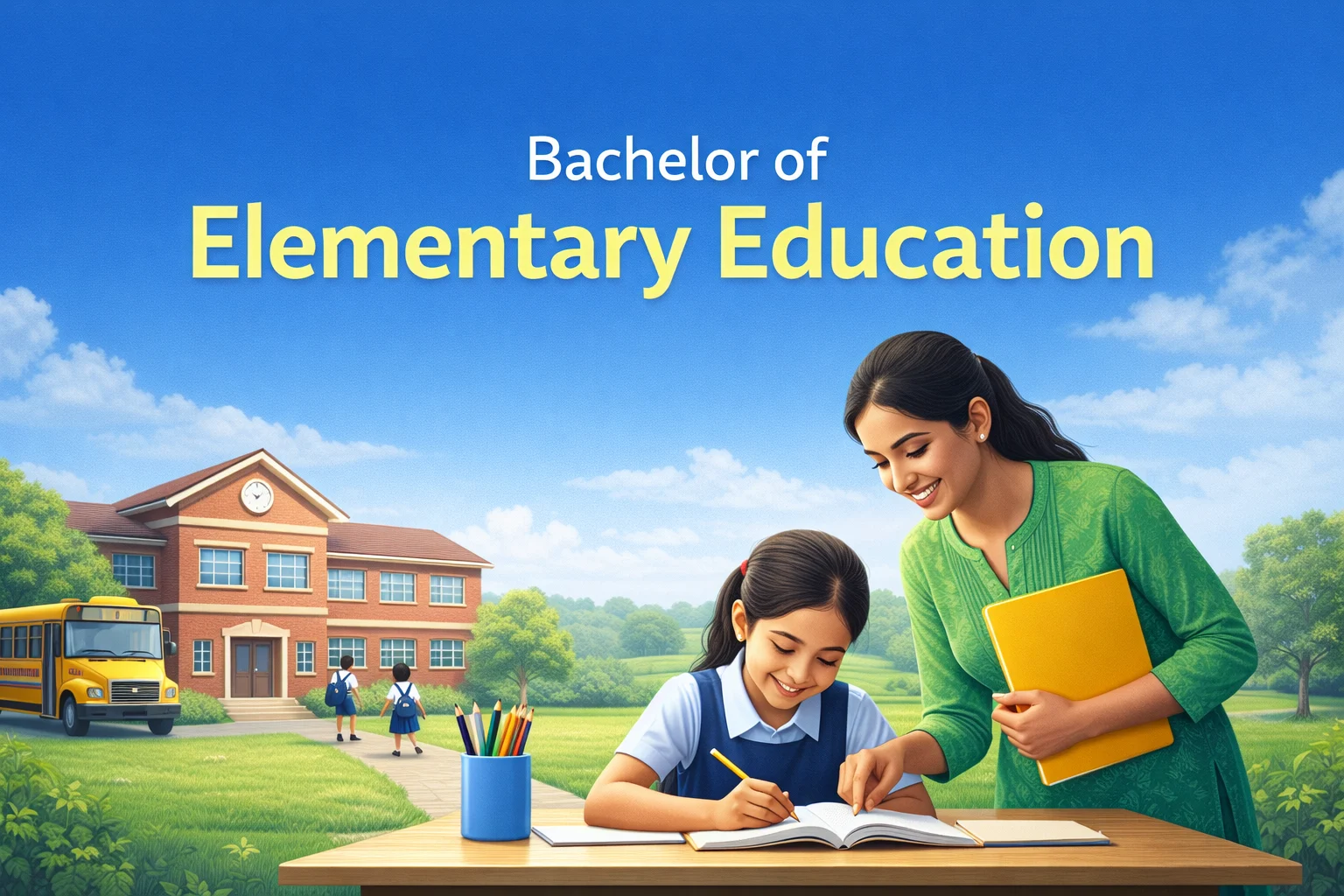
The Bachelor of Elementary Education (B.El.Ed.) is a four-year undergraduate program in India designed to prepare aspiring educators to teach students from classes I to VIII. This integrated professional course combines theoretical and practical training, covering essential areas such as child development, educational psychology, curriculum design, pedagogy, and teaching methodologies. Eligibility generally requires candidates to have completed their 12th standard or equivalent with a minimum of 50% marks. Graduates can pursue careers as teachers in government and private schools, or explore opportunities in educational administration, curriculum planning, and policy-making. Tuition fees typically range from ₹20,000 to ₹1,00,000 per annum, depending on the college. This article provides a full overview of the B.El.Ed. Course in India, including eligibility, colleges, fees, and career prospects.
Bachelor of Elementary Education (B.El.Ed) Course Overview in India
🔔 Admission Alerts 2026
- Application Extended: UP B.Ed Admission 2026 last date extended. Apply now!
- Admit Card Soon: UP B.Ed JEE 2026 admit card expected April 20, 2026.
- Eligibility Check: UP B.Ed JEE 2026 requires Bachelor’s/Master’s degree.
- Exam Process: UP B.Ed JEE 2026 includes Written Exam, Counselling, Document Verification.
- University Exams: Many universities conduct their own B.Ed entrance exams 2026.
The Bachelor of Elementary Education (B.El.Ed.) is a 4-year integrated professional undergraduate program in India designed to train students to teach classes I to VIII. The curriculum emphasizes child development, educational psychology, curriculum design, pedagogy, and teaching methodologies, providing both theoretical knowledge and practical classroom experience. All B.El.Ed programs must be approved by the National Council for Teacher Education (NCTE) to ensure adherence to national quality standards for teacher education.
Eligibility generally requires completion of 12th standard or equivalent with a minimum of 50% marks. The course is offered by various government and private colleges across India, with fees ranging from INR 25,552 to INR 4,40,000 per annum, depending on the institution. Graduates can pursue careers as elementary school teachers, education consultants, curriculum developers, or educational administrators, with average salaries between INR 3,00,000 and INR 6,00,000 per annum.
| Feature | Details |
|---|---|
| Course Name | Bachelor of Elementary Education (B.El.Ed) |
| Duration | 4 years |
| Eligibility | 12th pass or equivalent with minimum 50% marks |
| Focus | Training teachers for classes I to VIII |
| Approval | National Council for Teacher Education (NCTE) |
| Average Fees | INR 25,552 (Government) – INR 4,40,000 (Private) |
| Course Type | Integrated Professional Degree |
| Curriculum | Classroom lectures, practical sessions, theory & practical courses, elective subjects |
| Key Skills Developed | Child development, educational psychology, curriculum design, pedagogy |
| Career Options | Elementary school teacher, education consultant, curriculum developer, educational administrator |
| Average Salary | INR 3,00,000 – INR 6,00,000 per annum |
B.El.Ed Course Eligibility Criteria in India
To be eligible for the Bachelor of Elementary Education (B.El.Ed.) program in India, candidates must have completed 10+2 or an equivalent examination from a recognized board with a minimum of 50% marks. Some colleges may specify required subjects such as Physics, Chemistry, Mathematics, Biology, or Computer Science. Age limits and entrance exam requirements may also apply depending on the institution.
| Criteria | Details | Specifics |
|---|---|---|
| Minimum Qualification | 10+2 or equivalent | Recognized board with at least 50% marks (e.g., KR Mangalam University) |
| Minimum Percentage | 50% | Some colleges may require higher marks, e.g., 75% for certain government colleges |
| Required Subjects | Physics, Chemistry, Mathematics | Some colleges may also require Biology or Computer Science |
| Age Limit | Below 25 years | Certain colleges may have different limits, e.g., 22 years for some government colleges |
| Other Requirements | Entrance Exam Qualification | Valid scores in JEE Main, DU B.El.Ed Entrance Exam, or other college-specific exams |
| Minimum Qualification After Graduation | Graduation in any stream | Some private colleges require at least 50% marks in graduation |
| Entrance Exam | DU B.El.Ed Entrance Exam | Conducted by Delhi University for admission to its B.El.Ed program |
| Application Process | Online or offline | Application fees vary, e.g., INR 500 in some government colleges |
| Counseling/Interview | Counseling or interview rounds | Conducted by certain colleges as part of the final selection |
| Reservation | SC/ST/OBC categories | As per government norms, varying seat percentages reserved |
B.El.Ed Admission Process in India
The admission process for B.El.Ed in India typically combines merit-based and entrance-based selection. Key steps include:
- Verify Eligibility: Check minimum academic requirements, such as passing 12th standard or equivalent with at least 50% marks. Confirm subject and age requirements for the chosen college.
- Application Submission: Apply online or offline according to the college’s procedure. Application fees may vary.
- Entrance Exam (if applicable): Appear for entrance exams like DU B.El.Ed, JEE Main, or other university-specific tests. Many colleges also admit students based on merit.
- Counseling/Interview: Participate in counseling or interview rounds if required for final selection.
- Check Cutoffs: Review cutoffs of top B.El.Ed colleges to understand required marks and competitive scores.
- Seat Confirmation: Secure admission based on merit or entrance exam results. Scholarships may be offered to deserving candidates.
- Accreditation Verification: Ensure the college and program are recognized by NCTE and other relevant authorities.
- Fee Payment: Consider tuition and other fees, which range from INR 25,552 in government colleges to around INR 1,10,000 in private institutions.
- Curriculum Review: Understand course structure, including child development, educational psychology, teaching methodologies, and pedagogy.
- Facilities Check: Evaluate infrastructure such as libraries, labs, and playgrounds.
Top Government Colleges for Bachelor of Elementary Education (B.El.Ed) in India
Choosing the right institution is crucial for aspiring elementary school teachers pursuing a Bachelor of Elementary Education (B.El.Ed.). Factors such as NIRF ranking, fees, admission mode, and infrastructure should be considered. Government colleges typically offer lower fees, rigorous curriculum, and recognized degrees. Admission is generally merit-based or through entrance exams like DUET (Delhi University Entrance Test). The average annual fees for government colleges range from INR 10,665 to INR 31,885.
| College Name | City | NIRF Ranking | Average Annual Fees | Admission Mode |
|---|---|---|---|---|
| Delhi University | Delhi | 11 (University) | ₹25,552 | Through DUET, merit-based selection |
| Lady Shri Ram College for Women | Delhi | 4 (College) | ₹30,100 | Merit-based (12th marks) |
| Gargi College | Delhi | 16 (College) | ₹28,195 | Admission through DUET |
| Miranda House | Delhi | 1 (College) | ₹25,552 | Merit-based for B.El.Ed |
| Jesus and Mary College | Delhi | 37 (College) | ₹31,885 | Merit + entrance test performance |
| Institute of Home Economics | Delhi | 42 (College) | ₹30,100 | Admission through DUET, merit + entrance |
| Maulana Azad National Urdu University | Hyderabad | 31 (University) | ₹10,665 | Entrance test-based admission |
| Jamia Millia Islamia | Delhi | 10 (University), 6 (University category) | ₹12,000 | Entrance test + merit |
| Central Institute of Education, University of Delhi | Delhi | Part of DU, ranked 11 (University) | ₹25,552 | DUET admission, merit + entrance |
| NCERT (National Council of Educational Research and Training) | Delhi | Not applicable | No fees (research-based) | Selection based on research proposals & academic background |
Top Private Colleges for Bachelor of Elementary Education (B.El.Ed) in India
Private colleges offering the B.El.Ed program provide modern infrastructure, experienced faculty, and a full curriculum. Admission is usually merit-based or entrance exam-based, followed by counseling or interviews. Fees in private colleges are higher, ranging from INR 80,000 to INR 2,00,000 per year.
| College Name | City | NIRF Ranking | Average Annual Fees | Admission Mode |
|---|---|---|---|---|
| Sanskriti University | Mathura | Not ranked | ₹90,000 | Merit/Entrance Exam (as applicable) |
| Bhagwati College of Education | Meerut | Not ranked | ₹80,000 | Merit/Entrance Exam |
| Teerthanker Mahaveer University | Moradabad | Not ranked | ₹1,20,000 | Merit/Entrance Exam |
| K.R. Mangalam University | Gurugram | Not ranked | ₹1,10,000 | Merit/Entrance Exam |
| IIMT University | Meerut | Not ranked | ₹90,000 | Merit/Entrance Exam |
Bachelor of Elementary Education (B.El.Ed) Subjects and Syllabus in India
The B.El.Ed is a 4-year undergraduate program, divided into eight semesters, designed to prepare students for teaching classes I to VIII. The curriculum combines core and elective subjects, emphasizing child development, pedagogy, curriculum planning, and practical teaching experience. Students also engage in internships, school visits, and research projects to gain hands-on experience in classroom management and instructional methods.
| Year | Semester | Core Subjects | Elective Subjects |
|---|---|---|---|
| Year 1 | Semester 1 | Introduction to Education, Child Development, Educational Psychology | English, Hindi, Mathematics |
| Year 1 | Semester 2 | Curriculum Development, Pedagogy, Teaching Methodologies | Science, Social Science, Environmental Studies |
| Year 2 | Semester 3 | Foundations of Education, Educational Technology, Classroom Management | Language Arts, Mathematics Education, Science Education |
| Year 2 | Semester 4 | Assessment and Evaluation, Educational Research, Statistics | Social Science Education, Environmental Education, Health Education |
| Year 3 | Semester 5 | Compulsory Internship, Teaching Practice, School Experience | Special Education, Educational Leadership, Teacher Education |
| Year 3 | Semester 6 | Curriculum Planning, Instructional Design, Educational Media | English Language Teaching, Hindi Language Teaching, Mathematics Education |
| Year 4 | Semester 7 | Advanced Educational Psychology, Educational Sociology, Philosophy of Education | Science Education, Social Science Education, Environmental Education |
| Year 4 | Semester 8 | Dissertation, Research Project, Viva Voce | Elective Courses, Specialization Courses, Professional Development |
Check out the Bachelor of Elementary Education (B.El.Ed) syllabus.
B.El.Ed Fee Structure in India: Government vs Private Colleges
The fee structure for the B.El.Ed program varies widely across government and private colleges, influenced by college ranking, infrastructure, and city location.
| College Type | Minimum Annual Fees | Maximum Annual Fees | Average Annual Fees | Factors Influencing Fees |
|---|---|---|---|---|
| Government College (e.g., Miranda House) | ₹25,552 | ₹50,000 | ₹37,776 | College ranking, location, infrastructure |
| Private College (e.g., KR Mangalam University) | ₹80,000 | ₹200,000 | ₹140,000 | College reputation, faculty, facilities |
| Delhi University | ₹30,000 | ₹60,000 | ₹45,000 | Curriculum, internship opportunities |
| IP University | ₹40,000 | ₹100,000 | ₹70,000 | Accreditation, placement records |
| State Government Colleges | ₹20,000 | ₹40,000 | ₹30,000 | Government subsidies, scholarships |
| Private Colleges in Metro Cities | ₹100,000 | ₹250,000 | ₹175,000 | Urban location, modern infrastructure |
| Private Colleges in Non-Metro Cities | ₹50,000 | ₹150,000 | ₹100,000 | Rural location, limited facilities |
| Deemed Universities | ₹80,000 | ₹200,000 | ₹140,000 | University reputation, research opportunities |
| Autonomous Colleges | ₹60,000 | ₹180,000 | ₹120,000 | College autonomy, flexible curriculum |
Entrance Exams for B.El.Ed Admission in India
Admission to B.El.Ed programs often requires passing entrance exams that evaluate aptitude, knowledge, and teaching potential.
| Exam Name | Conducting Body | Exam Type | Eligibility Criteria |
|---|---|---|---|
| CUET | National Testing Agency (NTA) | National Level | 10+2 pass or equivalent |
| UP B.Ed JEE | Mahatma Jyotiba Phule Rohilkhand University | State Level | 10+2 pass or equivalent |
| KREE | Kerala University | State Level | 10+2 pass or equivalent |
| Delhi University B.El.Ed Entrance Exam | Delhi University | University Level | 10+2 pass with minimum 50% marks |
| Jamia Millia Islamia B.El.Ed Entrance Exam | Jamia Millia Islamia University | University Level | 10+2 pass with minimum 50% marks |
| IGNOU B.El.Ed Entrance Exam | Indira Gandhi National Open University | National Level | 10+2 pass or equivalent |
| BHU B.El.Ed Entrance Exam | Banaras Hindu University | University Level | 10+2 pass with minimum 50% marks |
| IPU B.El.Ed Entrance Exam | Guru Gobind Singh Indraprastha University | University Level | 10+2 pass with minimum 50% marks |
Career and Job Prospects after B.El.Ed
Graduates of the B.El.Ed program can explore a wide range of opportunities in teaching, administration, research, and educational consulting. The degree equips students with the skills to work in both government and private schools, educational organizations, and digital learning platforms. Career paths vary based on specialization, experience, and type of institution, with salaries generally ranging from ₹3,00,000 to ₹6,00,000 per annum.
| Career Role | Job Description | Average Salary (INR) |
|---|---|---|
| Elementary School Teacher | Teaching students in classes I to VIII in schools | 3,00,000 – 4,50,000 |
| Curriculum Developer | Designing educational programs, syllabi, and lesson plans | 4,00,000 – 5,50,000 |
| Education Consultant | Advising schools or organizations on teaching methods and learning outcomes | 4,50,000 – 6,00,000 |
| Special Education Teacher | Teaching and supporting children with learning disabilities or special needs | 3,50,000 – 5,00,000 |
| Educational Administrator | Managing school operations, teacher training, and academic programs | 5,00,000 – 6,00,000 |
| Researcher / Academic Faculty | Conducting research in pedagogy, child development, and educational psychology | 4,00,000 – 6,00,000 |
| Online Educator / Instructional Designer | Creating digital learning content for e-learning platforms | 3,50,000 – 5,50,000 |
Frequently Asked Questions (FAQs)
Q1. What is the course level and duration of Bachelor of Elementary Education in India?
The Bachelor of Elementary Education in India is an undergraduate course that lasts 4 years. It prepares elementary school teachers for classes I to VIII through classroom lectures, practical sessions, theory, practical courses, and elective subjects.
Q2. What are the minimum academic qualification and other requirements for B.El.Ed course eligibility in India?
To be eligible for the B.El.Ed course in India, you need to have passed 12th or equivalent with a minimum of 50% marks. You also need a basic understanding of education and pedagogy, including child development and teaching methodologies.
Q3. What is the admission process for Bachelor of Elementary Education in India?
The admission process for the Bachelor of Elementary Education in India includes checking the eligibility criteria, applying online or offline, appearing for entrance exams (if required), participating in counseling or interviews (if applicable), and securing admission based on merit or entrance exam scores.
Q4. What is the average annual fee for Bachelor of Elementary Education in government and private colleges in India?
The average annual fee for the Bachelor of Elementary Education in government colleges in India is around INR 25,552, as seen at Miranda House College. The average annual fee for private colleges is approximately INR 110,000, based on KR Mangalam University’s total fee.
Q5. What are the key areas of study in the Bachelor of Elementary Education course in India?
The Bachelor of Elementary Education course in India focuses on child development, educational psychology, curriculum development, pedagogy, and teaching methodologies. These subjects are taught through classroom lectures, practical sessions, theory, practical courses, and elective subjects.
Frequently Asked Questions (FAQs)
Q: What is the typical duration of a B.El.Ed program in India?
The Bachelor of Elementary Education (B.El.Ed) is a four-year professional degree program in India. It is designed to prepare teachers for the elementary level (Classes I-VIII) and is offered by various universities and colleges across the country, adhering to NCTE guidelines.
Q: What are the estimated fees for a B.El.Ed course in India for 2026?
For 2026, the estimated annual fees for a B.El.Ed program in India can range from INR 20,000 to INR 1,00,000, depending on the institution (government vs. private) and its location. Government colleges generally have lower fees compared to private universities.
Q: Are there any national-level entrance exams for B.El.Ed admissions in India?
While there isn’t a single national-level entrance exam like NEET or JEE for B.El.Ed, many universities conduct their own entrance tests. Some states also have common entrance exams for teacher education programs. Always check the specific university’s admission criteria.
Q: What is the career scope after completing a B.El.Ed degree in India?
After B.El.Ed, graduates primarily work as elementary school teachers (Classes I-VIII) in government or private schools. Opportunities also exist as curriculum developers, educational content writers, or even pursuing higher education like M.Ed for academic roles or administrative positions in education.
Q: What is the average starting salary for a B.El.Ed graduate in India (2026 figures)?
For 2026, a B.El.Ed graduate’s average starting salary in India can range from INR 2.5 LPA to INR 4.5 LPA. This varies significantly based on the type of school (government vs. private), location, and experience. Government school teachers generally have better pay scales and benefits.
Q: Is there scope for B.El.Ed graduates to work abroad?
Yes, B.El.Ed graduates can explore teaching opportunities abroad, particularly in countries with demand for elementary educators. However, they may need to fulfill specific local certification requirements, language proficiency tests, and sometimes additional qualifications or experience as mandated by the respective country’s education system.