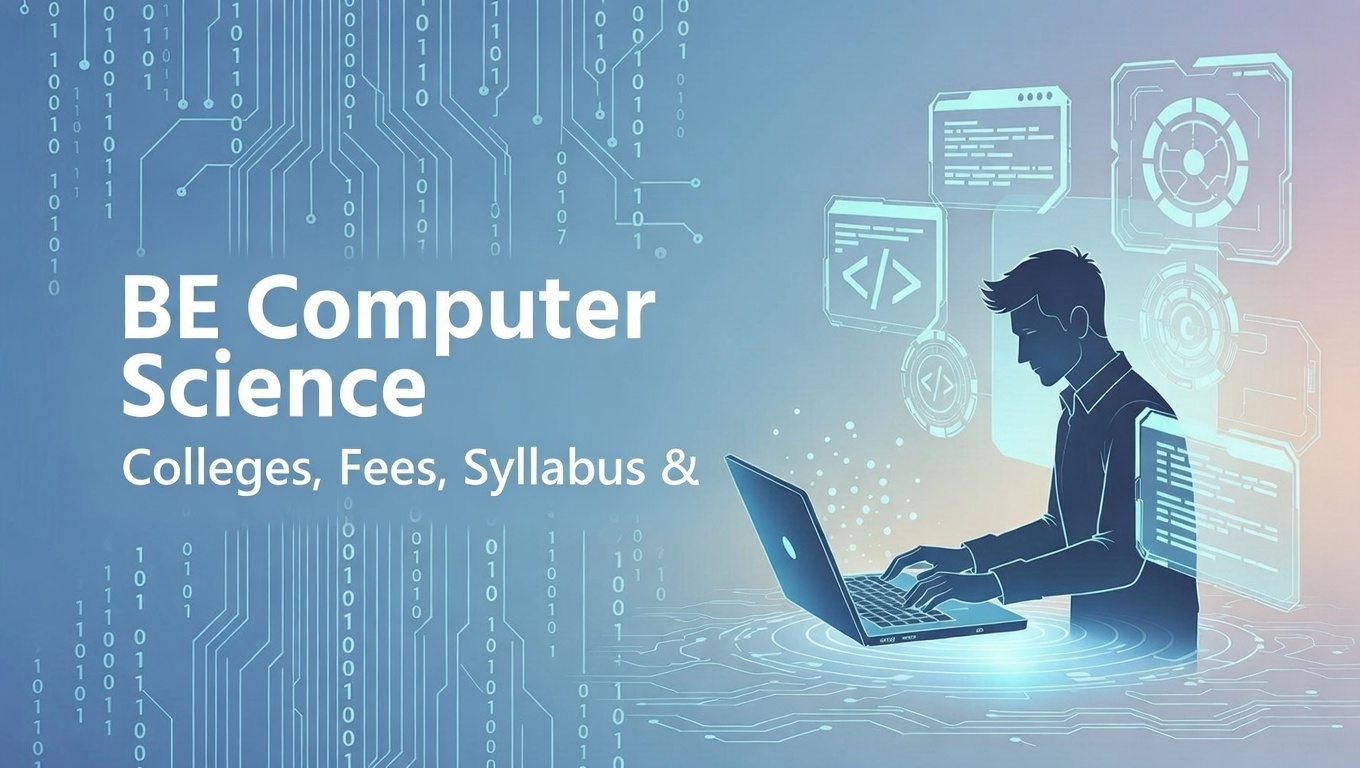
BE Computer Science: Courses, Colleges, Fees, Syllabus, and Career Opportunities in India
Bachelor of Engineering in Computer Science is a popular 4-year undergraduate degree. Find its complete details here, including entrance, eligibility, syllabus, colleges, jobs and more.
The demand for skilled computer science professionals is soaring, making a Bachelor of Engineering in Computer Science (BE Computer Science) a highly desirable degree in India. This four-year undergraduate program provides a strong foundation in computer science principles, including data structures, algorithms, and operating systems. To be eligible, students typically need to have completed their 10+2 education with physics, chemistry, and mathematics, securing a minimum of 45% to 60% marks, though this varies by college.
🔔 BE Computer Science Admission Alerts 2026
- BCA Application Deadline: Applications for BCA courses are open until March 30, 2026.
- CUSAT B.Tech CSE Ranking: India Today Engineering ranking 2020 placed CUSAT at 30 out of 30 in India.
- BMSCE National Ranking: According to Collegedunia Engineering Ranking 2025, BMSCE ranks 96 out of 500 colleges in India.
- Bharati Vidyapeeth National Ranking: India Today Engineering ranking 2025 placed Bharati Vidyapeeth at 40 out of 269 in India.
A BE Computer Science degree opens doors to diverse career opportunities, with average salaries ranging from INR 3 LPA to INR 15 LPA. Graduates can find roles as software engineers, data scientists, and web developers. Program fees vary by college type, ranging from INR 6,000 to INR 15,00,000 per year. This article provides a full overview of the BE Computer Science program in India, covering top colleges, syllabus, fees, admission process, and career opportunities.
BE Computer Science: An Overview of the Program in India
The Bachelor of Engineering in Computer Science (BE CSE) is a four-year undergraduate program in India. The curriculum covers the fundamentals of computer science and engineering through theoretical and practical courses. Take a detailed overview of the course here:
| Degree Full Form | Bachelor of Engineering in Computer Science |
| Degree Type | Undergraduate Program |
| Typical Duration | 4 Years |
| Eligibility (India) | 10+2 with Physics, Chemistry, and Mathematics |
| Common Entrance Exams (India) | Competitive entrance exams based on college |
| Average Annual Fees (India) | ₹400,000 (BMSCE, 2026) |
| Top Colleges (Sample) | CUSAT (Rank 30, 2020), Bharati Vidyapeeth (Rank 40, 2025), BMSCE (Rank 96, 2025) |
| Career Options | IT, AI & Data Science, Software Engineer, Data Scientist, Web Developer |
| Average Starting Salary (India) | INR 3 LPA – INR 15 LPA (General range) |
| Current Status | Applications open till March 30, 2026 (BCA, indicative) |
BE Computer Science Eligibility Criteria in India
Admission to BE Computer Science programs in India is based on performance in 10+2 examinations and entrance exams like JEE Main. Requirements include a minimum aggregate percentage in Physics, Chemistry, and Mathematics (PCM) at the 10+2 level, varying from 45% to 75% depending on the institution. Some colleges may require a valid JEE Main score or have a minimum age limit. Diploma holders in computer science, information technology, or related fields can be eligible for lateral entry into the second year, provided they meet the institution’s criteria.
| Criteria | Details | Specific Requirements |
|---|---|---|
| Educational Qualification | Completion of higher secondary education | 10+2 or equivalent from a recognized board |
| Minimum Percentage | Aggregate percentage required in 10+2 | Typically 45% – 75% (varies by college) |
| Required Subjects | Core subjects required in 10+2 | Physics, Chemistry, and Mathematics |
| Age Limit | Upper age limit for admission | No age limit in most colleges, but some may have restrictions |
| Diploma Holders | Eligibility for lateral entry | Diploma in Computer Science, Information Technology, or related fields with a minimum of 45% marks |
| Entrance Exam | Qualifying entrance exam | JEE Main, State CETs, or college-specific exams like BITSAT, VITEEE |
BE Computer Science Admission Process in India: A Step-by-Step Guide
To secure admission to a BE Computer Science program in India, candidates must follow these steps:
- Check the eligibility criteria for desired colleges, including minimum aggregate percentage and mandatory subjects.
- Appear for relevant entrance exams, such as JEE Main or state-level CETs, and obtain a valid score.
- Register for counseling based on entrance exam scores, which may involve online registration and payment of counseling fees.
- Fill out college application forms, providing personal and academic details, and upload required documents.
- Participate in the counseling process, which may involve online or offline rounds, and choose preferred colleges based on availability and ranking.
- Attend document verification, where original documents such as 10+2 mark sheet, entrance exam scorecard, and identity proof are verified.
- Pay admission fees, which may range from INR 6,000 to INR 15,00,000 per year, depending on the college.
- Confirm admission and begin classes, which may involve attending orientation programs and completing other formalities.
- Apply for scholarships or financial aid, if eligible, to support tuition fees and living expenses.
- Join college clubs or organizations to develop soft skills and networking opportunities.
Entrance Exams for BE Computer Science Admission in India
Admission to BE Computer Science programs in India requires qualifying for various entrance exams.
| Exam Name | Primary College/Institutes | Tentative Exam Date (2026) |
|---|---|---|
| JEE Main | NITs, IIITs, GFTIs, and qualifier for JEE Advanced (IITs) | Session 1: January 21–29, 2026 (already held) Session 2: April 2–9, 2026 |
| JEE Advanced | IITs (Indian Institutes of Technology) | Typically May/June 2026 (exact date TBA) |
| BITSAT | BITS Pilani, Goa, Hyderabad | Session 1: April 15–17, 2026 Session 2: May 24–26, 2026 |
| VITEEE | VIT Vellore (and other VIT campuses) | April 28 – May 3, 2026 |
| SRMJEEE | SRM Institute of Science and Technology (various campuses) | Phase 1: April 23–28, 2026 Phase 2: June 10–15, 2026 Phase 3: July 4–5, 2026 |
| MHT CET | Colleges in Maharashtra (e.g., COEP, VJTI, etc.) | Session 1 PCM: April 11–19, 2026 Session 2 PCM: May 14–17, 2026 |
| KCET | Colleges in Karnataka (e.g., RVCE, BMSCE, etc.) | April 23–24, 2026 |
| COMEDK UGET | Private engineering colleges in Karnataka | Typically May 2026 (exact date TBA) |
| MET (Manipal Entrance Test) | Manipal Academy of Higher Education (MAHE) | Typically May/June 2026 (exact date TBA) |
| AEEE | Amrita Vishwa Vidyapeetham (Amrita campuses) | Typically February & May 2026 phases (exact TBA) |
Top Government Colleges for BE Computer Science in India
The following government colleges in India offer BE Computer Science programs. Take a look at their location, total course fees and admission mode:
| College Name | Location | Total Course Fees (Approx) | Admission Mode |
|---|---|---|---|
| IIT Madras | Chennai, Tamil Nadu | ₹8–9 Lakhs | JEE Advanced (via JoSAA) |
| IIT Delhi | New Delhi | ₹8–9 Lakhs | JEE Advanced (via JoSAA) |
| IIT Bombay | Mumbai, Maharashtra | ₹8–9 Lakhs | JEE Advanced (via JoSAA) |
| IIT Kanpur | Kanpur, Uttar Pradesh | ₹8–9 Lakhs | JEE Advanced (via JoSAA) |
| IIT Kharagpur | Kharagpur, West Bengal | ₹8–10 Lakhs | JEE Advanced (via JoSAA) |
| IIT Roorkee | Roorkee, Uttarakhand | ₹8–9 Lakhs | JEE Advanced (via JoSAA) |
| IIT Guwahati | Guwahati, Assam | ₹8–9 Lakhs | JEE Advanced (via JoSAA) |
| NIT Tiruchirappalli (Trichy) | Tiruchirappalli, Tamil Nadu | ₹5–6 Lakhs | JEE Main (via JoSAA) |
| NIT Karnataka (Surathkal) | Surathkal, Karnataka | ₹5–6 Lakhs | JEE Main (via JoSAA) |
| NIT Warangal | Warangal, Telangana | ₹5–6 Lakhs | JEE Main (via JoSAA) |
| IIIT Hyderabad | Hyderabad, Telangana | ₹12–14 Lakhs | JEE Main / UGEE / Special modes |
| Jadavpur University | Kolkata, West Bengal | ₹20,000–50,000 | WBJEE |
| Delhi Technological University (DTU) | Delhi | ₹7–9 Lakhs | JEE Main |
Top Private Colleges for BE Computer Science in India
The following private colleges in India offer BE Computer Science programs. Take a look at their location, total course fees and admission mode:
| College Name | Location | Total Course Fees (Approx) | Admission Mode |
|---|---|---|---|
| BITS Pilani (Pilani/Goa/Hyderabad campuses) | Pilani, Rajasthan (main) | ₹20–25 Lakhs | BITSAT |
| VIT Vellore | Vellore, Tamil Nadu | ₹7–8 Lakhs | VITEEE |
| SRM Institute of Science and Technology | Chennai, Tamil Nadu | ₹10–18 Lakhs | SRMJEEE |
| Manipal Institute of Technology (MIT), MAHE | Manipal, Karnataka | ₹15–20 Lakhs | MET (Manipal Entrance Test) |
| Amity University | Noida, Uttar Pradesh | ₹10–15 Lakhs | Amity JEE / Direct / CUET |
| Thapar Institute of Engineering & Technology | Patiala, Punjab | ₹15–18 Lakhs | JEE Main / Own test |
| Chandigarh University | Mohali, Punjab | ₹8–12 Lakhs | CUCET / JEE Main |
| Shiv Nadar University | Greater Noida, Uttar Pradesh | ₹10–14 Lakhs | SNUSAT / JEE Main |
| RV College of Engineering | Bengaluru, Karnataka | ₹3–5 Lakhs | KCET / COMEDK UGET |
| BMS College of Engineering | Bengaluru, Karnataka | ₹3–5 Lakhs | KCET / COMEDK UGET |
BE Computer Science Fee Structure: Government vs Private Colleges in India
The fee structure for BE Computer Science programs varies significantly between government and private colleges. Here is a side by side comparison of various fee components of the two:
| Fee Component | Government Colleges | Private Colleges |
|---|---|---|
| Total Tuition Fees (4 Years) | ₹5–10 Lakhs | ₹8–25+ Lakhs |
| Annual Tuition Fee (Approx.) | ₹1–2.5 Lakhs | ₹2–6 Lakhs/year |
| One-Time/Admission Fees | ₹10,000–50,000 (includes caution deposit, registration, etc.) | ₹20,000–1 Lakh (higher in top privates like BITS/SRM) |
| Hostel + Mess Charges (4 Years Approx.) | ₹2–5 Lakhs | ₹4–10 Lakhs |
| Other Fees (Exam, Library, Lab, Gymkhana, etc.) | ₹50,000–2 Lakhs over 4 years | ₹1–3 Lakhs over 4 years |
| Overall Estimated Total Cost (4 Years, incl. Hostel) | ₹7–15 Lakhs | ₹12–35+ Lakhs |
BE Computer Science Syllabus: A Year-Wise Breakdown
The BE Computer Science program is divided into eight semesters, covering core and elective subjects. Here is a year and semester wise breakdown:
| Year | Semester | Core Subjects | Elective Subjects |
|---|---|---|---|
| Year 1 | Semester 1 | Programming for Problem Solving, Mathematics-I, Physics | Environmental Science, Communication Skills |
| Semester 2 | Data Structures, Mathematics-II, Digital Logic Design | Basic Electronics, Engineering Graphics | |
| Year 2 | Semester 3 | Discrete Mathematics, Computer Organization, Object-Oriented Programming | Probability and Statistics, Economics |
| Semester 4 | Operating Systems, Database Management Systems, Algorithms | Software Engineering, Design and Analysis of Algorithms | |
| Year 3 | Semester 5 | Software Engineering, Computer Networks, Theory of Computation | Artificial Intelligence, Machine Learning |
| Semester 6 | Compiler Design, Web Technologies, Data Mining | Cloud Computing, Mobile Computing | |
| Year 4 | Semester 7 | Cryptography and Network Security, Distributed Systems, Cloud Computing | Big Data Analytics, Natural Language Processing |
| Semester 8 | Project Work, Internship | Elective: Cybersecurity, Data Science, or Internet of Things |
Core Subjects in BE Computer Science
Take a detailed look at BE Computer Science’s core subjects, along with their descriptions, below:
| Subject Name | One-Line Description |
|---|---|
| Programming for Problem Solving / Introduction to Programming | Introduces problem-solving using a programming language (often C/Python) with basics of algorithms and coding logic. |
| Data Structures and Algorithms | Teaches efficient organization, storage, and manipulation of data using structures like arrays, trees, graphs, and algorithm design techniques. |
| Object Oriented Programming | Covers concepts like classes, objects, inheritance, polymorphism using languages like C++/Java/Python. |
| Database Management Systems (DBMS) | Focuses on designing, querying, and managing databases using SQL, normalization, transactions, and concurrency control. |
| Operating Systems | Explores process management, memory management, file systems, synchronization, and OS design principles. |
| Computer Networks | Studies network models (OSI/TCP-IP), protocols, routing, switching, LAN/WAN technologies, and network security basics. |
| Computer Organization & Architecture | Covers digital logic, CPU design, memory hierarchy, instruction sets, pipelining, and basic computer hardware functioning. |
| Theory of Computation | Introduces automata theory, formal languages, computability, Turing machines, and complexity classes (P vs NP). |
| Discrete Mathematics / Mathematical Structures | Provides logic, sets, relations, graph theory, combinatorics, and proof techniques essential for computer science. |
| Software Engineering | Teaches software development lifecycle, requirements analysis, design patterns, testing, project management, and agile methodologies. |
| Compiler Design | Explains phases of compilation, lexical analysis, parsing, code generation, and optimization techniques. |
| Engineering Mathematics (I, II, III) | Covers calculus, linear algebra, differential equations, probability & statistics, and numerical methods applied to computing. |
Higher Study Options After BE Computer Science
Here are prominent further higher studies options after completing a BE in Computer Science, each offering distinct pathways for career advancement, specialization, or global exposure:
- Pursue an M.Tech or MS in Computer Science or specialized fields : This advanced technical degree allows deep specialization in high-demand areas like Artificial Intelligence, Machine Learning, Data Science, Cybersecurity, or Cloud Computing, leading to research roles, R&D positions, or senior technical jobs in top tech firms.
- Opt for an MBA with a focus on Technology Management or IT : Combining your technical foundation with business acumen prepares you for managerial, product management, or leadership roles in the IT industry, enabling transitions into strategy, consulting, or entrepreneurship with higher earning potential over time.
- Enroll in an MS abroad in emerging tech domains : Studying in countries like the USA, Canada, Germany, UK, or Australia provides access to top-tier universities, advanced research, international networks, and better visa/job opportunities in global tech hubs, often with scholarships or assistantships available.
- Prepare for a Ph.D. After a Master’s for research or academia : Ideal for those passionate about innovation, this path opens doors to careers in university teaching, advanced research labs, or specialized R&D in industry, contributing to breakthroughs in fields like AI, algorithms, or quantum computing.
Top Job Roles & Salary Ranges After BE Computer Science
BE Computer Science graduates can explore a wide range of job roles. Top options, with their descriptions and salary ranges, are detailed below:
| Job Role | Job Description | Salary Range (Freshers, INR LPA) |
|---|---|---|
| Software Engineer / Developer | Designs, codes, tests, and maintains software applications and systems. | 4 – 12 (avg. 5–8; up to 20+ in top firms) |
| Full Stack Developer | Builds both front-end (UI/UX) and back-end (server, database) of web/apps. | 5 – 12 (avg. 6–10) |
| Data Scientist / Analyst | Analyzes large datasets using stats, ML, and tools to derive business insights. | 6 – 15 (avg. 8–12) |
| AI / Machine Learning Engineer | Develops AI models, algorithms, and systems for prediction, automation, etc. | 8 – 18 (avg. 10–15) |
| DevOps Engineer | Automates deployment, infrastructure, and CI/CD pipelines for efficient software delivery. | 5 – 12 (avg. 7–10) |
| Cloud Engineer / Architect | Designs, manages, and optimizes cloud infrastructure (AWS, Azure, GCP). | 6 – 15 (avg. 8–12) |
| Cybersecurity Analyst / Engineer | Protects systems/networks from threats, implements security measures, and monitors risks. | 5 – 12 (avg. 7–10) |
| Web Developer | Creates and maintains websites and web applications using HTML, CSS, JS, frameworks. | 4 – 10 (avg. 5–8) |
| Blockchain Developer | Builds secure decentralized applications and smart contracts using blockchain tech. | 6 – 12 (avg. 8–11) |
| Product Manager (Tech) | Defines product vision, roadmaps, and features for software/tech products (often after experience). | 8 – 18 (avg. 10–15; entry often post-exp) |
Top Industry Recruiters for BE CS Holders
Take a look at the top recruiters across diverse sectors for BE Computer Science degree holders:
| Industry/Sector | Top Recruiters |
|---|---|
| IT Services / Consulting (Mass Recruiters) | TCS, Infosys, Wipro, HCL Technologies |
| Product-Based Tech Giants (High-Paying) | Google, Microsoft, Amazon, Adobe |
| Global Consulting & Professional Services | Accenture, Deloitte, Cognizant, Capgemini |
| Indian Product / Tech Unicorns & Startups | Flipkart, Zomato, Paytm, Swiggy |
| Cloud, AI & Emerging Tech Focused | IBM, Oracle, Atlassian, Atlassian (often via GCCs) |
| Finance & FinTech (Tech Roles) | Goldman Sachs, JP Morgan, PhonePe, CRED |
Preparation Tips for BE Computer Science Students
Here are 5 practical preparation tips to excel in a BE in Computer Science degree, useful from the first year onward:
- Master programming fundamentals early : Start with a language like Python or C and practice daily to build strong logic and problem-solving skills essential for core subjects.
- Focus deeply on core subjects : Understand concepts in Data Structures, Algorithms, OS, and DBMS thoroughly instead of rote learning, as they form the foundation for advanced courses and placements.
- Practice coding consistently : Solve problems on platforms like LeetCode, Codeforces, or GeeksforGeeks regularly to sharpen algorithmic thinking and prepare for technical interviews.
- Build hands-on projects : Create small real-world applications or contribute to open-source to apply classroom knowledge, strengthen your resume, and gain practical experience early.
- Maintain balance and consistent study habits: Create a routine with regular revision, avoid last-minute cramming, prioritize health, and seek help from peers or professors when needed for sustained performance.
BE Computer Science vs B.Sc Computer Science
| Aspect | BE Computer Science | B.Sc Computer Science |
|---|---|---|
| Degree Type & Duration | 4-year professional engineering degree with practical and technical emphasis. | 3-year (or 4-year honors) academic science degree focused on theory. |
| Eligibility & Admission | 10+2 with PCM; competitive entrance exams (JEE Main, state CETs like MHT CET, etc.). | 10+2 with Math/Computer Science; often merit-based or CUET-UG. |
| Curriculum Focus | Balanced: algorithms, software engineering, hardware basics, OS, networks, projects, internships, and engineering applications. | Theoretical: core CS concepts (algorithms, data structures, math, logic), statistics, with less hardware/engineering depth. |
| Skills Developed | Strong practical coding, system design, problem-solving, software development, and industry-ready tools. | Analytical thinking, research orientation, conceptual understanding; may need extra certifications for tech jobs. |
| Career Opportunities | Direct entry to software engineering, developer, AI/ML | Data analyst, QA tester, research/academia; often requires Master’s or skills training for core dev roles |
| Average Starting Salary (India) | ₹5–12 LPA | ₹3–7 LPA |
| Higher Studies Options | M.Tech/MS in CS/AI, MBA in Tech; seamless for advanced engineering/research. | M.Sc/PhD in CS/Data Science; may need bridge courses for engineering Master’s. |
| Pros & Cons | Pros: Job-oriented, higher pay, industry recognition.
Cons: More rigorous, competitive. |
Pros: Shorter, flexible, good for research/academia.
Cons: Lower initial pay, may need extra prep for industry. |
BE Computer Science vs B.Tech in Information Technology
| Aspect | BE Computer Science | B.Tech in Information Technology (IT) |
|---|---|---|
| Degree Type & Duration | 4-year engineering degree focused on computing foundations and development. | 4-year engineering degree focused on application and management of tech systems. |
| Core Focus | Theoretical + practical | Practical applications |
| Curriculum Overlap | High in programming, DBMS, networks; deeper in core CS theory and system-level design. | High in software/tools; more emphasis on IT management, cybersecurity, enterprise systems. |
| Skills Developed | Advanced problem-solving, algorithm design, full-stack/system development, R&D potential. | IT infrastructure, network admin, database management, business tech application, consulting skills. |
| Career Opportunities | Broader: software engineer, AI/ML engineer, system architect, research roles in tech giants/startups. | IT support, network engineer, cloud specialist, business analyst, roles in service/IT consulting firms. |
| Average Starting Salary (India) | ₹5–12 LPA | ₹4–10 LPA |
| Job Market & Scope | Wider and more versatile across industries; preferred for core dev/AI roles. | Strong in IT services, enterprise tech; good for business-oriented tech jobs. |
| Pros & Cons | Pros: Deeper technical edge, better for emerging tech (AI/cloud).
Cons: More theoretical intensity. |
Pros: Practical, business-aligned, easier entry in some firms.
Cons: Slightly narrower core CS depth. |
Frequently Asked Questions (FAQs)
Q1. What is the duration of the BE Computer Science program in India?
The BE Computer Science program in India is typically 4 years long. It is an undergraduate degree program. The program duration is the same across different colleges.
Q2. What are the eligibility criteria for BE Computer Science admission in India?
To be eligible for BE Computer Science admission in India, candidates must have completed their 10+2 with Physics, Chemistry, and Mathematics. They must also appear for relevant entrance exams like JEE Main or State CETs. The minimum marks required in 10+2 vary by college, typically between 45% and 60%.
Q3. What is the average annual fee for BE Computer Science in government and private colleges in India?
The average annual fee for BE Computer Science in government colleges in India can be as low as INR 6,000, while in private colleges it can range from INR 50,000 to INR 3,00,000 or more.
Q4. What are the core subjects covered in the BE Computer Science syllabus?
The BE Computer Science syllabus covers core subjects like Data Structures, Algorithms, Operating Systems, Computer Networks, and Database Management Systems. In the first year, students study Calculus, Physics, and Programming for Problem Solving. The syllabus also includes elective subjects like Environmental Science and Communication Skills.
Q5. What are the common entrance exams for BE Computer Science admission in India?
Common entrance exams for BE Computer Science admission in India include JEE Main, JEE Advanced, BITSAT, VITEEE, SRMJEEE, MHT CET, WBJEE, and KEAM. These exams are conducted by national or state-level authorities, or by individual universities. Candidates must have completed their 10+2 with PCM to be eligible for these exams.
Q6. Are BE and BTech the same?
No, BE (Bachelor of Engineering) and BTech (Bachelor of Technology) are not exactly the same. BE emphasizes more on theoretical concepts, while BTech focuses more on hands-on skills. In practice, especially for Computer Science, the differences are minimal, and both lead to similar career paths.
Q7. What is better, BE or BTech in Computer Science?
BTech in Computer Science is often preferred for its stronger practical focus and better alignment with software/IT jobs in 2026’s tech market. BE suits those interested in deeper theory or research. Ultimately, college reputation, skills, projects, and placements matter more than the degree title alone.
Q: What are the eligibility criteria for BE Computer Science admissions in India for 2026?
To be eligible for BE Computer Science, students typically need to have completed 10+2 (or equivalent) with Physics, Chemistry, and Mathematics as core subjects. A minimum aggregate score, often around 45-50%, is usually required. Some top institutions might also mandate a minimum of 60% in these subjects for BE Computer Science admissions.
Q: What are the top entrance exams for BE Computer Science in India for 2026 admissions?
For BE Computer Science, the most prominent entrance exams are JEE Main and JEE Advanced, which are crucial for IITs and NITs. Other significant exams include VITEEE, BITSAT, MHT CET, and COMEDK UGET. Many state-level exams also exist, with application deadlines typically in early 2026 for the BE Computer Science academic year.
Q: What is the average fees for BE Computer Science in India at private colleges in 2026?
The average fees for BE Computer Science at private colleges in India can range significantly. Students can expect to pay anywhere from ₹1.5 Lakhs to ₹3.5 Lakhs per annum. Over the 4-year duration of BE Computer Science, the total fees could therefore be between ₹6 Lakhs and ₹14 Lakhs, excluding hostel and other charges.
Q: What is the average salary after BE Computer Science in India in 2026?
The average starting salary for a BE Computer Science graduate in India in 2026 is projected to be around ₹4.5 LPA to ₹7.5 LPA. Experienced professionals with 3-5 years in BE Computer Science roles can command salaries upwards of ₹12 LPA, especially in specialized fields like AI or cybersecurity, reflecting strong demand for BE Computer Science skills.
Q: What are the career options and job roles after completing BE Computer Science?
After completing BE Computer Science, graduates have diverse career options. Popular job roles include Software Developer, Data Scientist, Cybersecurity Analyst, Cloud Engineer, and AI/ML Engineer. The demand for BE Computer Science professionals is high, with over 90% placement rates reported by top institutions, especially in the IT and tech sectors.
Q: Can I pursue a Master’s degree abroad after BE Computer Science from India?
Yes, pursuing a Master’s degree abroad after BE Computer Science from India is a popular and viable option. Many Indian BE Computer Science graduates opt for MS programs in Computer Science in the USA, Canada, UK, or Germany. A strong academic record, often above 7.5 CGPA, and competitive GRE/TOEFL scores are typically required for admission to top global universities.