Best MBA Specialisations in India 2026: Salaries, Scope, Career Paths & How to Choose
Master of Business Administration (MBA) is the top choice for many students and it certainly is one of the most rewarding postgraduate programmes in India. Apart from a degree, the choice of a correct MBA specialisation course opens the door for many things including your career trajectory, starting salary, and growth across various industries such as finance, consulting, technology, marketing, analytics, operations, and international business.
With a dynamic business landscape due to globalisation and digital transformation, MBA aspirants must carefully choose a specialisation. Not only do they have to align with their interests but also provide employability, have salary potential, and sector demand. This guide covers the best MBA specialisations in India in 2026, average pay scales, industry trends, job roles, and how to pick the right one for your career dreams.
What Is an MBA Specialisation?
An MBA specialisation is a specific study path within the overall MBA program that enables students to develop expertise in a particular functional area or industry. Rather than pursuing a general management education, students opt for a specialisation that matches their professional objectives and industry interests.
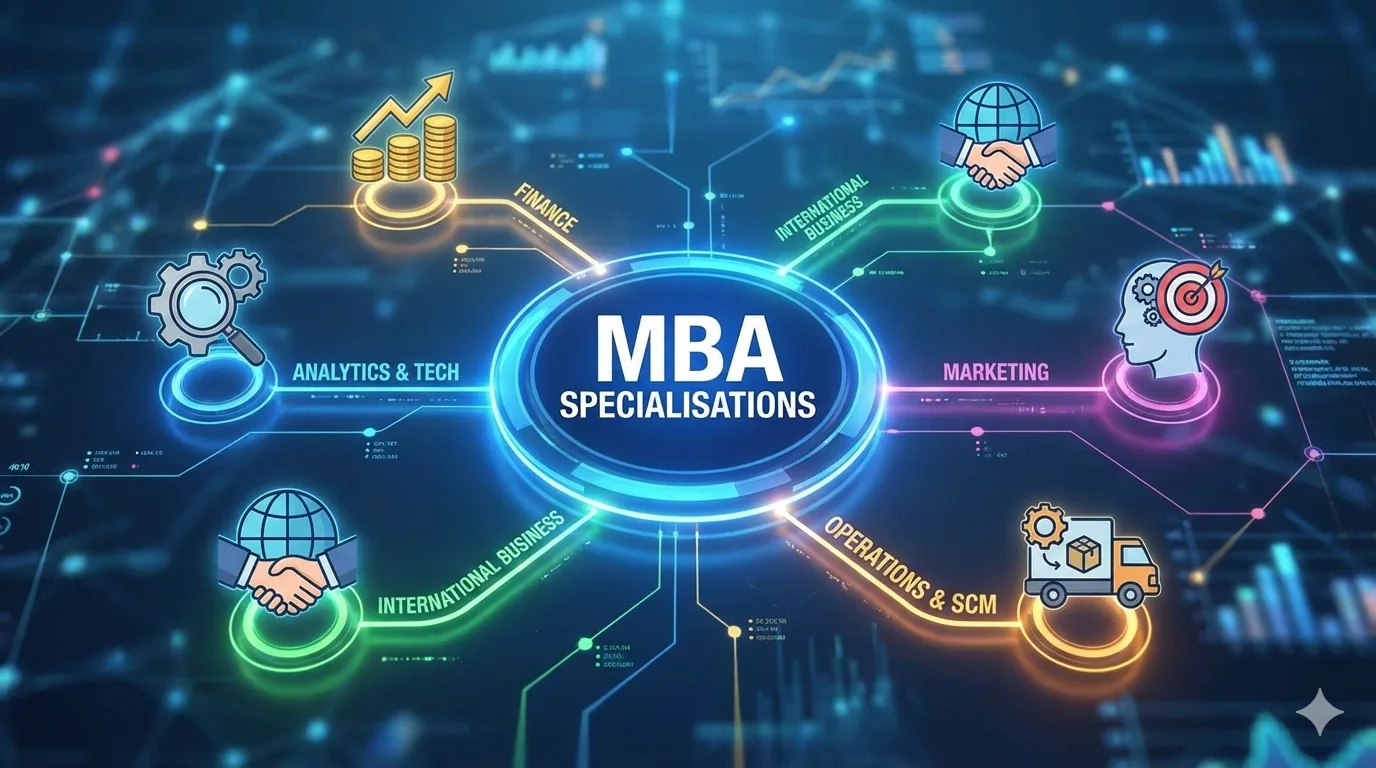
Every MBA specialisation course offers a carefully crafted list of electives, case studies, live projects, internships, and industry-focused training that helps students prepare for a specific managerial job. Some of the most sought-after specialisations from the MBA specialisation list include Finance, Marketing, Business Analytics, Human Resources, Operations, International Business, Consulting, IT Management, and Healthcare Management.
Unlike a general MBA, a specialized MBA helps the candidate acquire expertise in a particular area, which improves job prospects and the potential for higher salaries.
Why Choosing the Right MBA Specialisation Matters?
Choosing an MBA specialization is one of the most critical decisions that an students make throughout the MBA process. This decision has a direct impact on one’s career path, roles, and overall growth.
Key reasons why MBA specialisation selection matters:
Career Direction:
The specialisation you choose determines the type of roles you are eligible for. Finance experts move toward investment banking and corporate finance, while analytics specialists enter data-driven strategy roles.
Industry Demand:
Certain sectors have a constant demand because of skill shortages. Once you understand which MBA specialization is perfect for the future, it will help you in staying relevant in the dynamic market.
Salary and ROI:
Specializations that are in high demand and require high skills tend to have better entry-level salaries and a faster rate of salary progression.
Skill Alignment:
Aligning oneself with a specialization that utilizes personal strengths results in enhanced performance and job satisfaction.
Rather than following trends blindly, aspirants should balance market demand with personal aptitude while choosing an MBA specialisation in India.
MBA Specialisation List: Which is the Best MBA Specialisation?
The table below provides a snapshot of leading MBA specialisations, average salary ranges, and industry demand:
| MBA Specialisation | Average Salary Range (India) | Key Job Roles | Industry Demand |
|---|---|---|---|
| MBA in Finance | ₹10–30 LPA | Investment Banker, CFO, Analyst | High |
| MBA in Marketing | ₹8–25 LPA | Brand Manager, Digital Marketer | Very High |
| MBA in Business Analytics | ₹10–28 LPA | Data Analyst, BI Manager | Very High |
| MBA in Consulting / Strategy | ₹15–35 LPA | Strategy Consultant | High |
| MBA in International Business | ₹9–24 LPA | Global Manager | Growing |
| MBA in Operations & SCM | ₹8–22 LPA | Operations Manager | Steady |
| MBA in HR | ₹7–20 LPA | HR Manager | Consistent |
| MBA in IT / Tech Management | ₹9–26 LPA | IT Manager | High |
| MBA in Healthcare Management | ₹8–18 LPA | Healthcare Consultant | Growing |
| MBA in Entrepreneurship | Variable | Startup Founder | Variable |
People Also Read



Highest-Paying MBA Specialisations in India
For all the MBA aspirants who are aiming for long-term career growth and a good earning potential, selecting the correct specialisation is critical. There are various MBA specializations that offer consistent higher salary packages because they instil graduates with skills that are in demand and used in strategic, financial, and data-driven decision-making.
Below is a detailed overview of the highest-paying MBA specialisations in India, covering curriculum focus, career roles, fees, recruiters, and salary outlook.
1. MBA in Finance
MBA in Finance is one of the highly preferred and highest-paying MBA specialisations in India. It is best-suited for candidates with strong analytical skills and who have an interest in investments, financial systems, and corporate decision-making.
What the Programme Covers
-
Corporate Finance
-
Investment Management
-
Financial Markets & Institutions
-
Risk Management
-
Portfolio & Wealth Management
Career Opportunities
-
Investment Banker
-
Financial Analyst
-
Corporate Finance Manager
-
Credit & Risk Analyst
-
Private Equity Analyst
-
Chief Financial Officer (CFO)
Top Recruiting Sectors
Banking, financial services, insurance, investment firms, fintech companies, and corporate finance divisions of large organisations.
Other Important Details
-
Course Duration: 2 Years
-
MBA Fees: ₹1.5 lakh – ₹35 lakh
-
Average Salary: ₹18–30 LPA
-
Top Recruiters: Goldman Sachs, Deloitte, ICICI Bank, HDFC Bank
2. MBA in Marketing
If you poses creativity with strategic thinking, MBA in Marketing could be your best choice. Being one of the most versatile MBA specialisation courses, it prepares students for different roles focusing on brand building, customer engagement, and market expansion.
Core Learning Areas
-
Consumer Behaviour
-
Marketing Research
-
Brand & Product Management
-
Digital & Social Media Marketing
-
Advertising & Sales Promotion
Career Roles
-
Brand Manager
-
Product Manager
-
Digital Marketing Manager
-
Market Research Analyst
Industry Demand
High demand across FMCG, e-commerce, retail, advertising, media, and technology-driven businesses.
Other Important Details
-
Course Duration: 2 Years
-
MBA Fees: ₹6 lakh – ₹35 lakh
-
Average Salary: ₹8–15 LPA
-
Top Recruiters: Amazon, HUL, Nestlé, Flipkart
3. MBA in Business Analytics
One of the fastest growing and highest paying MBA specialisations in India is MBA in Business Analytics. It is driven by the widespread adoption of data-driven decision-making across industries.
Programme Focus
-
Big Data Analytics
-
Predictive Modelling
-
Analytics using R & Python
-
Marketing & Financial Analytics
-
Data Visualisation
Career Opportunities
-
Business Analytics Manager
-
Data Analyst
-
Analytics Consultant
-
Risk & Supply Chain Analyst
Industry Relevance
Highly востребован across IT, finance, healthcare, retail, consulting, and e-commerce sectors.
Other Important Details
-
Course Duration: 2 Years
-
MBA Fees: ₹10 lakh – ₹35 lakh
-
Average Salary: ₹13–28 LPA
-
Top Recruiters: Accenture, EY, ZS Associates, Mu Sigma
4. MBA in Operations & Supply Chain Management
This MBA specialisation focuses on managing business operations, logistics, procurement, and supply chain efficiency, critical functions in manufacturing and service-based organisations.
Key Subjects
-
Supply Chain Management
-
Operations Strategy
-
Inventory & Logistics Management
-
Decision Science
-
Enterprise Performance Management
Career Roles
-
Operations Manager
-
Supply Chain Lead
-
Procurement Manager
-
Operations Analyst
Other Important Details
-
Course Duration: 2 Years
-
MBA Fees: ₹50,000 – ₹25 lakh
-
Average Salary: ₹10–18 LPA
-
Top Recruiters: Amazon, Reliance, DHL, Blue Dart
5. MBA in Information Technology (IT / Technology Management)
MBA in IT bridges the gap between technology and business strategy, preparing graduates to lead digital transformation initiatives.
Programme Focus
-
Enterprise Resource Planning (ERP)
-
IT Strategy & Governance
-
Information Security
-
Project & Product Management
-
Business Intelligence Tools
Career Roles
-
IT Manager
-
Technology Consultant
-
Product Owner
-
Systems Analyst
Other Important Details
-
Course Duration: 2 Years
-
MBA Fees: ₹1 lakh – ₹25 lakh
-
Average Salary: ₹10–12 LPA
-
Top Recruiters: Infosys, IBM, Google, TCS
6. MBA in Human Resource Management (HR)
MBA in HR prepares professionals to manage organisational talent, culture, leadership development, and workforce strategy.
Key Learning Areas
-
Talent Acquisition & Management
-
Compensation & Performance Management
-
HR Analytics
-
Organisational Development
-
Labour Laws & Global HR Practices
Career Roles
-
HR Manager
-
Talent Acquisition Lead
-
Learning & Development Manager
Other Important Details
-
Course Duration: 2 Years
-
MBA Fees: ₹80,000 – ₹30 lakh
-
Average Salary: ₹7–20 LPA
-
Top Recruiters: Infosys, Tata Steel, Tech Mahindra
7. MBA in International Business
MBA in International Business focuses on managing cross-border operations, global trade, and multinational business strategies.
Core Areas
-
International Trade & Finance
-
Global Strategy
-
Cross-Cultural Management
-
Export–Import Regulations
Career Opportunities
-
International Business Manager
-
Export–Import Manager
-
Global Supply Chain Manager
Other Important Details
-
Course Duration: 2 Years
-
MBA Fees: Varies by institute
-
Average Salary: ₹9–24 LPA
-
Top Recruiters: Maersk, Bosch, PepsiCo
Best MBA Specialisations for the Future
With the ever-changing nature of businesses as a result of digital transformation, data-driven decision-making, sustainability, and innovation, it has become important to select an MBA specialization that is future-proof. Aspirants of an MBA degree need to move beyond current trends and identify MBA specializations that are stable and scalable in the long term.
The following MBA specializations are likely to continue being in high demand through 2026 and beyond, due to various global business requirements, changes in regulations, and new technologies.
1. MBA in Business Analytics & Data Science
MBA in Business Analytics and Data Science is widely regarded as one of the most future-proof MBA specialisation courses. It focuses on using data to drive strategic business decisions and solve complex organisational problems.
What the Programme Focuses On
-
Data visualisation and storytelling
-
Predictive and prescriptive analytics
-
Machine learning and artificial intelligence for business
-
Statistical modelling and business intelligence
Key Details
| Parameter | Information |
|---|---|
| Course Duration | 2 Years |
| Core Subjects | Data Visualisation, Predictive Analytics, Machine Learning, AI, Business Statistics |
| Top Colleges | IIM Bangalore, ISB Hyderabad, NMIMS, Amity University, Jain Online |
| MBA Fees | Varies by institute |
| Job Roles | Business Analyst, Data Scientist, Analytics Consultant, Decision Scientist |
| Industries | IT, Finance, Healthcare, Retail, E-commerce |
| Top Recruiters | Accenture, Deloitte, KPMG, Mu Sigma, TCS |
| Average Salary | ₹6–12 LPA (higher at top institutes) |
Why it’s future-ready:
Data-driven decision-making is now central to strategy across industries, making this MBA specialisation in India highly resilient to market changes.
2. MBA in Digital Marketing
MBA in Digital Marketing is among the fastest-growing MBA specialisations, aligned with the shift toward online platforms, performance marketing, and digital-first brand strategies.
What the Programme Focuses On
-
Search engine optimisation (SEO) and search engine marketing (SEM)
-
Social media and content marketing
-
Performance marketing and analytics
-
Digital brand management
Key Details
| Parameter | Information |
|---|---|
| Course Duration | 2 Years |
| Core Subjects | SEO, SEM, Social Media Marketing, Content Marketing, Email Marketing |
| Top Colleges | Symbiosis Pune, IIM Bodhgaya, LPU, Amity Online, Jain University |
| MBA Fees | ₹1 lakh – ₹35 lakh |
| Job Roles | Digital Marketing Manager, SEO Specialist, Content Strategist, PPC Expert |
| Industries | Startups, E-commerce, FMCG, Media Agencies |
| Top Recruiters | Amazon, Google, Flipkart, Zomato |
| Average Salary | ₹3–20 LPA |
Why it’s future-ready:
As consumer engagement becomes increasingly digital, companies continue to invest heavily in skilled digital marketing professionals.
3. MBA in Healthcare & Hospital Management
MBA in Healthcare and Hospital Management caters to the rapidly expanding healthcare sector in India, which requires professionals who can combine medical domain understanding with managerial expertise.
What the Programme Focuses On
-
Hospital administration and operations
-
Healthcare policy and regulation
-
Medical supply chain management
-
Patient care systems and quality management
Key Details
| Parameter | Information |
|---|---|
| Course Duration | 2 Years |
| Core Subjects | Hospital Operations, Health Policy, Medical Supply Chain, Patient Care Management |
| Top Colleges | IIHMR Jaipur, Manipal University, LPU, Amity University |
| MBA Fees | ₹1.5–19 lakh |
| Job Roles | Hospital Administrator, Healthcare Consultant, Medical Operations Head |
| Industries | Hospitals, Healthcare NGOs, Pharmaceutical Companies |
| Top Recruiters | Fortis, Apollo Hospitals, Max Healthcare, WHO |
| Average Salary | ₹4.8–12 LPA |
Why it’s future-ready:
With growing healthcare infrastructure, insurance coverage, and medical tourism, demand for healthcare management professionals is steadily rising.
4. MBA in Sustainability & Environmental Management
MBA in Sustainability and Environmental Management is an emerging MBA specialisation course focused on responsible business practices, ESG compliance, and long-term environmental impact.
What the Programme Focuses On
-
Environmental laws and compliance
-
ESG (Environmental, Social, Governance) strategy
-
Sustainable business models
-
Corporate social responsibility
Key Details
| Parameter | Information |
|---|---|
| Course Duration | 2 Years |
| Core Subjects | Environmental Laws, ESG Strategy, Green Business, Sustainable Development |
| Top Colleges | Amity University, Jain University |
| MBA Fees | ₹1.8–25 lakh |
| Job Roles | Sustainability Analyst, ESG Manager, Environmental Consultant |
| Industries | FMCG, Energy, Manufacturing, Consulting |
| Top Recruiters | Infosys, Tata Sustainability Group, Vedanta, Wipro |
| Average Salary | ₹5–15 LPA |
Why it’s future-ready:
Global regulations and corporate responsibility frameworks are driving sustained demand for sustainability-focused management professionals.
5. MBA in FinTech & Blockchain
MBA in FinTech and Blockchain is a next-generation MBA specialisation that combines finance, technology, and innovation to prepare leaders for the future of banking and financial services.
What the Programme Focuses On
-
Financial technology ecosystems
-
Blockchain applications and digital assets
-
Digital payments and neobanking
-
Risk, compliance, and regulatory technology
Key Details
| Parameter | Information |
|---|---|
| Course Duration | 2 Years |
| Core Subjects | FinTech Systems, Blockchain Technology, Digital Banking, Financial Innovation |
| Top Colleges | Amity University, Jain University, select private institutes |
| MBA Fees | ₹2–25 lakh |
| Job Roles | FinTech Consultant, Product Manager, Blockchain Analyst, Digital Finance Manager |
| Industries | Banking, Financial Services, Startups, Technology Firms |
| Top Recruiters | Paytm, Razorpay, Infosys, TCS, Global FinTech Firms |
| Average Salary | ₹6–18 LPA |
Why it’s future-ready:
As financial services rapidly digitise, professionals with combined expertise in finance and technology are becoming indispensable.
How to Decide Which MBA Specialisation Is Best for You?
There is no single “best” MBA specialisation for all candidates. The right choice depends on a combination of personal goals, market demand, and institutional strengths. MBA aspirants should carefully evaluate the following factors before finalising a specialisation:
-
Personal strengths and interests: Choose a domain that aligns with your skills, aptitude, and long-term career preferences.
-
Industry demand and future relevance: Opt for specialisations that are expected to remain in demand and offer sustainable career growth.
-
Salary potential vs job satisfaction: Balance earning prospects with role fit, work-life balance, and long-term career satisfaction.
-
Institute expertise and placement record: Review faculty strength, industry exposure, and past placement outcomes for the chosen specialisation.
A well-informed decision ensures better career alignment and a higher return on investment from your MBA programme.
Best Dual Specialisations in MBA
Choosing a dual specialisation in an MBA program enables the student to develop expertise in two different areas, thus opening up a wide range of opportunities. This becomes particularly useful when the job demands knowledge of multiple functions, including strategic, technical, and managerial skills.
The dual specializations offered by the university enable the graduates to remain flexible and adaptable in the current competitive job market, where employers are looking for multi-disciplinary skills.
Popular Dual MBA Specialisation Combinations
-
Marketing & Finance: Ideal for careers in brand finance, investment-linked marketing roles, and financial services marketing.
-
Human Resources & Organisational Psychology: Suitable for talent management, leadership development, and workplace culture roles.
-
IT & Operations: Relevant for tech operations, product management, SaaS operations, and process optimisation roles.
Many leading institutions such as Amity University, Lovely Professional University (LPU), and Jain University offer well-structured dual specialisation MBA programmes.
FAQs on MBA Specialisation
Q. Which MBA specialisation is the best in India?
There is no single “best” MBA specialisation, but Finance, Business Analytics, Marketing, and Consulting are among the most popular due to strong demand and salary potential. The best choice depends on your skills, interests, and long-term career goals.
Q. Which MBA specialisation is best for the future?
Business Analytics, Technology Management, Digital Marketing, and Sustainability-focused MBAs are considered future-ready. These fields align with digital transformation, data-driven decision-making, and evolving global business priorities.
Q. Can I choose dual MBA specialisation courses?
Yes, many Indian B-schools offer dual or flexible specialisation options, allowing students to combine two disciplines. Dual specialisations can improve role flexibility and open doors to cross-functional careers.
Q. Does MBA specialisation affect placements?
Yes, MBA specialisation plays a significant role in determining placement opportunities and salary packages. However, institute reputation, industry exposure, and individual skills are equally important.
Q. Which MBA specialisation offers the highest salary in India?
MBA in Finance, Business Analytics, Strategy, and Consulting typically offer the highest salary packages. Graduates from top institutes often receive premium compensation in these domains.
Q. Is work experience required to choose a specialisation?
Work experience is not mandatory but can help you make a more informed choice. Professionals with prior exposure often select specialisations that align with their industry background or career progression plans.
Q. Can I change my MBA specialisation after admission?
Some institutes allow students to finalise or change their specialisation after the first year. This flexibility enables students to make decisions based on academic exposure and career interests.