BSC Anaesthesia Technology: Course Details, Eligibility, Colleges, Fees, Salary & Scope (2026)
The Bachelor of Science in Anaesthesia Technology, widely known as BSc Anaesthesia Technology, represents a growing and practice-oriented undergraduate programme in the Indian healthcare education sector. The course trains students to become competent anaesthesia technologists who support anaesthesiologists by preparing and administering anaesthesia, operating and maintaining anaesthesia equipment, monitoring patients during procedures, and upholding safety standards in operating theatres.
Driven by the steady increase in surgical interventions, emergency and trauma services, intensive care units, and critical care requirements across hospitals and healthcare facilities, the need for professionally qualified anaesthesia technologists continues to grow in both public and private sectors.
This article offers full information on key aspects of the BSc Anaesthesia Technology programme, including course structure, eligibility criteria, detailed syllabus, admission procedures, leading institutions offering the degree, expected salary ranges, career scope, typical job profiles, and answers to common queries to assist prospective students in making well-informed choices.
What is BSc Anaesthesia Technology?
The Bachelor of Science in Anaesthesia Technology constitutes a three-year undergraduate degree programme, frequently incorporating an additional period of clinical internship, usually one semester. The course specialises in the principles, technology, and practices of anaesthesia administration alongside perioperative and critical patient care.
Distinct from conventional nursing programmes or shorter paramedical diplomas, BSc Anaesthesia Technology places strong emphasis on specialised areas including management of anaesthesia equipment, anaesthesia-related pharmacology, respiratory physiology and support, advanced patient monitoring methods, and provision of clinical assistance during surgical interventions.
Upon completion, graduates possess the competencies required to serve in operating rooms, intensive care units, emergency departments, and various diagnostic and procedural areas within healthcare facilities.
BSc Anaesthesia Technology Course Highlights
The BSc Anaesthesia Technology course is an undergraduate allied health science programme designed to train students in anaesthesia assistance, perioperative patient care, and operation theatre technologies. It prepares graduates to work closely with anaesthesiologists, surgeons, and critical care teams in hospital settings.
| Aspect | Details |
|---|---|
| Course Name | Bachelor of Science (BSc) in Anaesthesia Technology |
| Course Level | Undergraduate Degree |
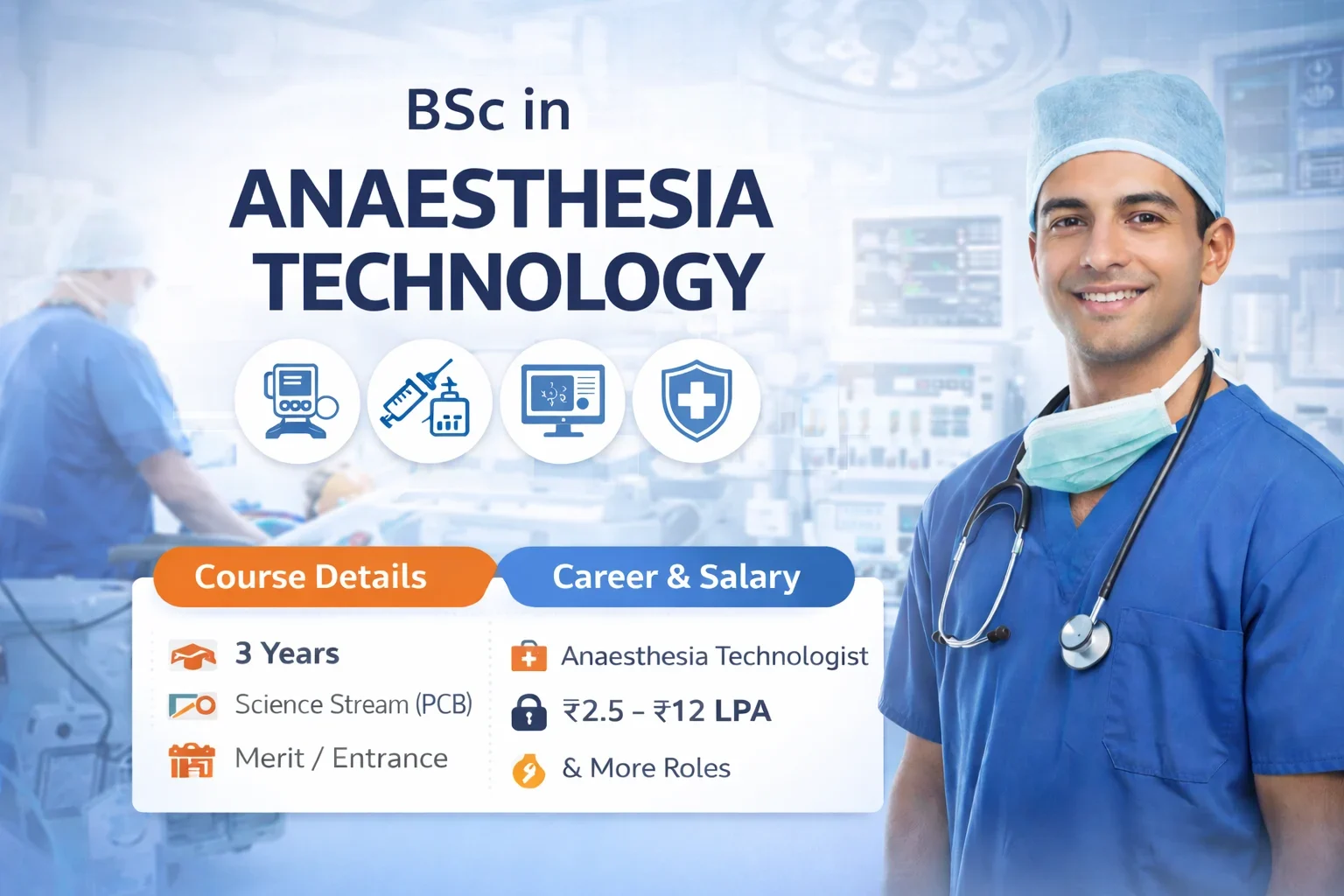
| Duration | 3 years academic study + 6 to 12 months mandatory internship (varies by university) |
| Eligibility | 10+2 with Physics, Chemistry, Biology (PCB) |
| Programme Type | Full-time, on-campus |
| Admission Mode | Merit-based / Entrance-based (institution-dependent) |
| Core Focus Areas | Anaesthesia procedures, OT assistance, patient monitoring, ICU support |
| Clinical Training | OT postings, ICU exposure, emergency care, internship |
| Career Outcomes | Anaesthesia Technologist, OT Technician, ICU Technician, Critical Care Assistant |
Eligibility Criteria for BSc Anaesthesia Technology
Eligibility norms for BSc Anaesthesia Technology are broadly standardised across India, though minor variations exist depending on the institution and university regulations.
Basic Academic Requirements
-
Candidates must have passed Class 12 (10+2) from a recognised board such as CBSE, ISC, or State Boards.
-
The science stream is mandatory, with Physics, Chemistry, and Biology (PCB) as core subjects.
-
Some institutions may accept Physics, Chemistry, and Mathematics (PCM), but PCB is preferred for clinical training eligibility.
Minimum Marks
-
Most colleges require a minimum aggregate of 45%–50% in PCB subjects.
-
Reserved category candidates (SC/ST/OBC) may receive relaxation as per government or university norms.
Age & Medical Fitness
-
Minimum age is usually 17 years at the time of admission.
-
Many institutions require a medical fitness certificate, as the course involves OT duties, long clinical hours, and patient handling.
Additional Conditions
-
Certain universities conduct institutional entrance exams or interviews.
-
Candidates must be mentally and physically fit for clinical and emergency healthcare environments.
BSc Anaesthesia Technology Admission Process
The admission process for BSc Anaesthesia Technology varies across government, private, and deemed universities, but generally follows a structured pathway.
Step-by-Step Admission Process
1. Application Submission
-
Candidates apply through:
-
University/college official websites
-
Centralised admission portals (where applicable)
-
-
Applications usually open between April and July, depending on board result timelines.
2. Eligibility Screening
-
Institutions verify:
-
10+2 subject combination (PCB)
-
Minimum percentage criteria
-
Age and medical eligibility
-
3. Entrance Test / Interview (If Applicable)
-
Some universities conduct:
-
Internal entrance tests assessing basic science knowledge
-
Personal interviews to assess aptitude for healthcare roles
-
-
Many private and autonomous colleges offer purely merit-based admission.
4. Merit List & Counselling
-
Merit lists are prepared based on:
-
Class 12 board marks
-
Entrance exam scores (if applicable)
-
-
Shortlisted candidates participate in counselling or seat allocation rounds.
5. Document Verification & Fee Payment
Candidates must submit:
-
Class 10 & 12 mark sheets
-
Transfer/Migration certificate
-
Medical fitness certificate
-
Identity proof
-
Passport-size photographs
Once verified, seat confirmation is completed after fee payment.
BSc Anaesthesia Technology Syllabus
The BSc Anaesthesia Technology syllabus is structured to progressively build knowledge from foundational biomedical sciences to advanced clinical anaesthesia practices. The curriculum blends theory, laboratory training, and hospital-based clinical exposure, ensuring students are well prepared for real-world perioperative and critical care responsibilities.
Year I: Foundational Sciences & Basics of Anaesthesia
The first year focuses on understanding the human body, basic medical sciences, and introductory anaesthesia concepts essential for safe clinical practice.
Key Subjects and Learning Focus
-
Human Anatomy and Physiology: Structure and function of organ systems with emphasis on respiratory, cardiovascular, and nervous systems relevant to anaesthesia.
-
Fundamentals of Anaesthesia Technology: Introduction to anaesthesia roles, types of anaesthesia, OT workflow, and patient safety principles.
-
Medical Terminology: Common clinical terms, abbreviations, and documentation language used in hospitals.
-
Basics of Pharmacology: General drug classification, dosage calculations, and commonly used anaesthetic medications.
-
Introduction to Operation Theatre Technology: OT layout, equipment handling, sterilisation processes, and safety protocols.
-
Microbiology & Infection Control: Principles of asepsis, disinfection, sterilisation, and prevention of hospital-acquired infections.
-
Communication Skills: Patient interaction, teamwork, professional behaviour, and healthcare communication ethics.
Year II: Clinical Anaesthesia Systems & Patient Monitoring
The second year shifts toward applied anaesthesia technology and diagnostic support, focusing on equipment, patient monitoring, and emergency preparedness.
Key Subjects and Learning Focus
-
Anaesthesia Equipment & Technology: Design, functioning, calibration, and troubleshooting of anaesthesia machines and breathing circuits.
-
Respiratory Care & Ventilation: Airway management, oxygen therapy, mechanical ventilation, and respiratory support techniques.
-
Clinical Pathology & Biochemical Investigations: Understanding lab values and investigations relevant to perioperative decision-making.
-
Principles of Anaesthesia: Local, regional, general anaesthesia concepts, premedication, induction, maintenance, and recovery.
-
Patient Monitoring Systems: ECG, blood pressure, pulse oximetry, capnography, and temperature monitoring.
-
Emergency Care Techniques: Basic life support (BLS), advanced airway management, shock management, and crisis response.
-
Ethics & Professional Practice: Legal responsibilities, patient consent, confidentiality, and ethical conduct in clinical settings.
Year III: Advanced Anaesthesia & Critical Care Training
The final academic year focuses on specialised anaesthesia care, ICU exposure, and hands-on clinical competence.
Key Subjects and Learning Focus
-
Advanced Anaesthesia Procedures: Anaesthesia for specialised surgeries, paediatrics, obstetrics, trauma, and high-risk patients.
-
Intensive Care & Critical Care Technology: ICU equipment, ventilator management, hemodynamic monitoring, and critical patient support.
-
Pain Management Techniques: Acute and chronic pain control methods, regional blocks, and postoperative analgesia.
-
Clinical Rotations in OT & ICU: Supervised hands-on experience assisting anaesthesiologists during surgeries and emergency cases.
-
Research Methodology: Basics of clinical research, data collection, and interpretation.
-
Project Work / Clinical Case Studies: Applied learning through case documentation and presentations.
-
Internship & Supervised Practice: Full-time clinical training in operation theatres and intensive care units.
Skills Developed in BSc Anaesthesia Technology
The programme equips graduates with a full skill set combining technical proficiency, clinical judgment, and professional communication.
Technical & Clinical Skills
-
Operation, calibration, and basic troubleshooting of anaesthesia machines and monitoring devices
-
Pre-operative patient preparation and assistance in anaesthesia induction
-
Continuous monitoring of vital parameters (ECG, SpO₂, BP, capnography)
-
Assistance during airway management, intubation, and ventilation
-
Maintenance of sterile and aseptic OT environments
Emergency & Critical Care Skills
-
Rapid response to intraoperative emergencies
-
Basic life support and emergency airway support
-
ICU patient monitoring and ventilator assistance
-
Post-operative recovery and pain management support
Professional & Soft Skills
-
Effective communication with surgeons, anaesthesiologists, nurses, and patients
-
Team coordination in high-pressure OT and ICU settings
-
Accurate clinical documentation and reporting
-
Adherence to ethical standards and patient safety protocols
Top BSc Anaesthesia Technology Colleges in India
BSc Anaesthesia Technology is offered mainly through medical universities, allied health science institutions, and select private universities with hospital tie-ups. Since clinical exposure is critical for this course, institutes attached to tertiary care hospitals are generally preferred.
Recognised Universities & Colleges
-
Amrita Vishwa Vidyapeetham, Kerala
Known for its strong medical ecosystem, Amrita offers structured allied health programmes with extensive exposure in multi-speciality hospitals. Students benefit from early OT and ICU exposure. -
Apollo University, Chennai
Backed by Apollo Hospitals, the programme emphasises hands-on training in operation theatres, anaesthesia monitoring, and critical care environments. -
SDM University, Dharwad
Offers a clinically oriented syllabus with focus on anaesthesia equipment, patient monitoring, and perioperative support through affiliated teaching hospitals. -
Baba Farid Group of Institutions, Punjab
Provides paramedical education with established laboratory and hospital training facilities, catering mainly to regional healthcare demand. -
Santosh University, Ghaziabad
Known for allied health science courses with access to medical college hospitals, offering exposure to surgical and diagnostic departments. -
Graphic Era University, Dehradun
Focuses on interdisciplinary learning and hospital-based training through partner healthcare facilities. -
Government Medical Colleges (Selected States)
Some state government medical colleges offer anaesthesia technology or related OT/critical care programmes with merit-based admissions and comparatively lower fees. -
Private Paramedical & Nursing Colleges
Many private institutes across India run the course under recognised universities. Quality varies, making hospital attachment and faculty expertise crucial selection factors.
BSc Anaesthesia Technology Salary in India
Salary outcomes for BSc Anaesthesia Technology graduates depend on experience, hospital type, location, and skill set, especially OT and ICU exposure.
Average Salary Range
| Experience Level | Approximate Salary (₹ per annum) |
|---|---|
| Entry-Level (0–2 years) | ₹2.5 L – ₹4.5 L |
| Mid-Level (3–6 years) | ₹4.5 L – ₹7 L |
| Senior / Experienced (>6 years) | ₹7 L – ₹12 L+ |
Factors Influencing Salary
-
Type of employer: Corporate hospitals and multi-speciality centres typically pay more than small nursing homes
-
City of employment: Metro cities and healthcare hubs offer higher compensation
-
Clinical skill depth: ICU exposure, ventilator handling, and emergency anaesthesia support improve earning potential
-
Additional certifications: Critical care, BLS/ACLS, or equipment training certifications add value
-
Role responsibility: OT coordinators, senior ICU technologists, and trainers earn more than entry-level technicians
With experience, many professionals move into supervisory, training, or equipment-specialist roles, improving long-term income prospects.
BSc Anaesthesia Technology Scope in India
The scope of BSc Anaesthesia Technology is expanding due to the rapid growth of surgical procedures, trauma care, ICUs, and critical care services across India.
Key Employment Areas
-
Operation Theatres & Surgical Units – Core role assisting anaesthesiologists during surgeries
-
Intensive Care Units (ICU) – Monitoring ventilated and critically ill patients
-
Emergency & Trauma Centres – Anaesthesia and airway support during emergency procedures
-
Diagnostic & Day-Care Centres – Sedation monitoring during imaging and minor procedures
-
Critical Care Transport Services – Patient monitoring during inter-hospital transfers
-
Medical Equipment Companies – Clinical training, demonstrations, and technical support roles
-
Academia & Training Institutes – Teaching roles after gaining sufficient clinical experience
As hospitals focus more on patient safety, standardised anaesthesia protocols, and skilled OT teams, trained anaesthesia technologists are becoming indispensable, especially in tertiary care and multi-speciality hospitals.
Job Roles After BSc Anaesthesia Technology
Graduates can work in multiple supportive yet critical roles within healthcare systems:
-
Anaesthesia Technologist / Technician
-
Operation Theatre (OT) Technician
-
ICU Anaesthesia Support Specialist
-
Emergency Care Technician (Anaesthesia Support)
-
Clinical Equipment Specialist (Anaesthesia & Ventilation Systems)
-
Trainee Anaesthesia Practitioner
-
Sales / Clinical Application Specialist (Medical device companies)
With experience, professionals may progress to OT coordinators, senior technologists, or clinical trainers.
Advantages & Limitations of BSc Anaesthesia Technology
Advantages
-
Focused undergraduate programme with strong clinical relevance
-
Extensive hands-on exposure in OT, ICU, and emergency settings
-
Consistent demand across hospitals and surgical centres
-
Opportunity to work closely with anaesthesiologists and critical care teams
-
Growing employment potential due to expansion of healthcare infrastructure
Limitations
-
Primarily a supportive role, with limited independent clinical decision-making
-
Career advancement often requires additional certifications or higher studies
-
Job roles and recognition may vary by state regulations and hospital policies
-
Academic progression options are narrower compared to MBBS-based pathways
FAQs
Q1. What is BSc Anaesthesia Technology?
It is a three-year undergraduate programme focused on allied health training to support anaesthesia and perioperative care.
Q2. What are the eligibility requirements?
Candidates must have passed 10+2 with Physics, Chemistry, and Biology from a recognised board.
Q3. How is admission done for BSc Anaesthesia Technology?
Admission is typically based on 12th board merit or institute-level entrance tests, followed by counselling.
Q4. What is the syllabus of BSc Anaesthesia Technology?
The syllabus includes human anatomy, anaesthesia equipment, clinical monitoring, respiratory care, ICU procedures, and hands-on OT training.
Q5. What is the average salary after BSc Anaesthesia Technology in India?
Average starting salary ranges from ₹2.5 L to ₹4.5 L per annum, increasing with experience and role.
Q6. Which college is best for BSc Anaesthesia Technology?
Institutes with strong hospital affiliations, high surgical volume, and strong clinical training — such as Amrita Vishwa Vidyapeetham, Apollo University, and SDM University — are considered among the best.
Q7. What is the scope of BSc Anaesthesia Technology?
The scope includes roles in OT, ICU, emergency care, trauma centres, and clinical support in multi-speciality and corporate hospitals.
Q8. Can I do higher studies after BSc Anaesthesia Technology?
Yes, graduates can pursue MSc, specialised certifications, or related allied health programmes to advance their clinical and research careers.
Q9. Which college is best for BSc Anaesthesia?
Top choices often include institutions with strong hospital affiliations, high surgical case volumes, and well-equipped labs. Fully accredited programmes with good internship support and clinical rotations are generally preferred.
Q10. What is the highest salary for BSc Anaesthesia?
Senior technologists in top corporate hospitals, specialised surgical centres, or critical care units can earn ₹10 LPA or higher, especially in metro cities or with additional training.