BSC Chemistry 2026: Overview, Subjects, Top Colleges, Fees & Career Scope in India
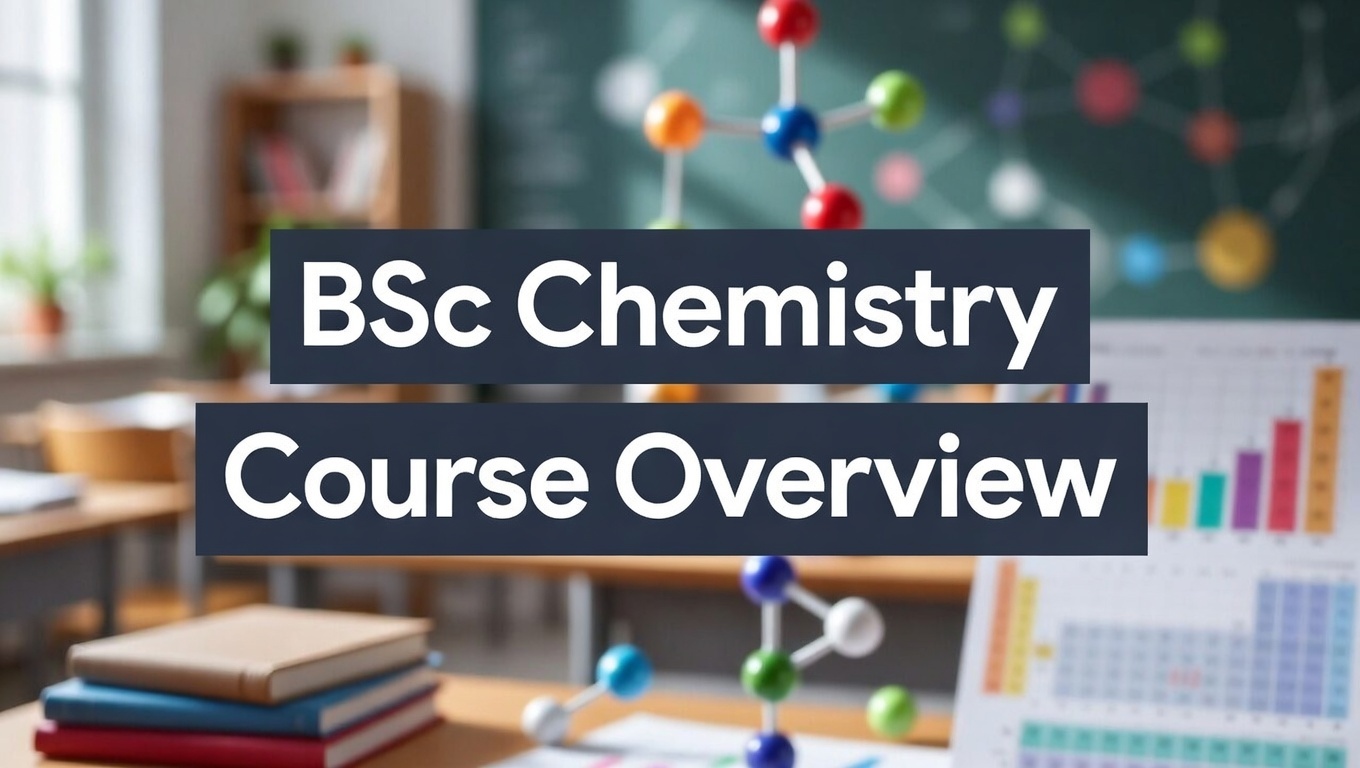
BSc Chemistry, or Bachelor of Science in Chemistry, is a popular undergraduate degree that dives deep into the fascinating world of matter, its composition, properties, structures, and transformations. Often called the “central science,” chemistry bridges physics and biology, exploring everything from atomic structures and chemical bonding to organic reactions, inorganic compounds, physical principles, thermodynamics, and laboratory techniques. This 3-year course combines rigorous theoretical learning with hands-on practical experiments. It’s ideal for students passionate about scientific discovery, lab work, and real-world applications in fields like pharmaceuticals, materials, environment, and more.
This guide offers complete details related to BSc Chemistry in India. Read on to know about eligibility, syllabus, top colleges, fees, admissions, career prospects, higher studies, salaries and more.
What is BSc Chemistry?
BSc Chemistry is a 3-year undergraduate program in India providing a foundation in chemical principles and laboratory skills. The core branches of chemistry studied include Organic, Inorganic, Physical, and Analytical Chemistry. A BSc Chemistry can include BSc (Hons) Chemistry, BSc General, and BSc Industrial Chemistry, each with a unique focus.
| Parameter | Detail |
|---|---|
| Full Course Name | Bachelor of Science (BSc) in Chemistry (commonly offered as BSc (Hons) Chemistry) |
| Course Level | Undergraduate (UG) |
| Duration | 3 Years (6 Semesters) |
| Eligibility Criteria | 10+2 (Class 12) from Science stream with Physics, Chemistry + Mathematics/Biology (PCM/PCB) |
| Admission Process | Merit-based and entrance-based |
| Core Subjects / Main Branches | Inorganic Chemistry, Organic Chemistry, Physical Chemistry Additional: Analytical Chemistry (often included) |
| Practical Components | Lab work every semester on diverse subjects |
| Average Total Fees (3 Years) | Government/Government-aided colleges: ₹15,000 – ₹1.2Lakh
Private colleges: ₹1 Lakh – ₹5 Lakh+ |
| Popular Entrance Exam | CUET UG (widely used for top universities like DU, BHU, JNU) |
| Top Popular Colleges | Hindu College, St. Stephen’s College, St. Xavier’s Mumbai, Fergusson College |
| Career Options After Course | MSc Chemistry, Pharma/Chemical industry roles, Teaching, Research and others |
| Industry Relevance | Strong linkage to India’s Chemicals & Petrochemicals sector with India ranking 6th globally in chemical production |
BSc Chemistry Eligibility
The most important step of any admission process is to know the eligibility criteria of the desired course and college. While these criteria vary from one institute to another, they typically the following parameters:
- Class 12 from Science stream with PCM or PCB (Physics and Chemistry mandatory).
- At least 50-60% aggregate marks in Class 12 required.
- Class 12 marksheet from a recognized board like CBSE, ICSE or state board.
- No upper age limit specified for BSc Chemistry admissions in most institutions.
BSc Chemistry Admission Process
Indian institutes offer both entrance and merit-based admissions into the BSc Chemistry course. Further, students have a range of government and private colleges to choose from. Admission process for the course typically includes the following steps:
- Fill and submit the application form online or offline before the deadline.
- Appear for entrance exam like CUET UG if required by the college.
- Check and wait for the release of merit list (for non-entrance based colleges) or cutoff ranks.
- Participate in counselling rounds and select preferred seats if applicable.
- Complete document verification and pay the admission fees to confirm seat.
Popular Entrance Exams for BSc Chemistry
Take a look at popular national and state entrance exams for this course below:
| Entrance Exam | Applicable Colleges / Institutes | Tentative Exam Date |
|---|---|---|
| CUET UG (Common University Entrance Test) | Delhi University (DU), Banaras Hindu University (BHU), Aligarh Muslim University (AMU), Jamia Millia Islamia (JMI), Jawaharlal Nehru University (limited seats), and many other central/state/private universities for BSc (Hons) Chemistry | 11 May – 31 May 2026 |
| NEST (National Entrance Screening Test) | NISER Bhubaneswar & UM-DAE CEBS Mumbai (5-year Integrated MSc in Chemistry) | 06 June 2026 |
| IISER Aptitude Test (IAT) | IISER Pune, Kolkata, Mohali, Bhopal, Thiruvananthapuram, Tirupati (5-year BS-MS in Chemical Sciences / Chemistry) | Third/Fourth week of May 2026 |
Top BSc Chemistry Colleges 2026
Here are some top BSc Chemistry colleges for 2026:
| College Name | Type | Approx. Fees for Total Course (3 Years) |
|---|---|---|
| Hindu College, Delhi | Government-Aided | ₹93,810 |
| St. Stephen’s College, Delhi | Government-Aided | ₹92,064 |
| Miranda House, Delhi | Government | ₹58,800 – ₹60,300 |
| Kirori Mal College, Delhi | Government-Aided | ₹68,460 |
| Loyola College, Chennai | Government-Aided | ₹91,620 |
| St. Xavier’s College, Mumbai | Government-Aided | ₹42,193 |
| Banaras Hindu University (BHU), Varanasi | Government | ₹24,000 |
| Christ University, Bangalore | Private | ₹2,49,000 – ₹2,75,000 |
| Amity University, Noida | Private | ₹3,30,000 – ₹4,14,000 |
| Chandigarh University, Mohali | Private | ₹2,70,000 – ₹3,60,000 |
| St. Joseph’s University, Bengaluru | Private (Deemed) | ₹1,80,000 – ₹2,50,000 |
Top Merit-based Colleges for BSc in Chemistry
Students looking to enroll in a BSc Chemistry course without any entrance exam have multiple options to choose from. Take a look at some of the popular choices and their typical cut-off ranges for this course:
| College Name | Approximate Cutoff |
|---|---|
| Fergusson College, Pune | 90–95% |
| Madras Christian College (MCC), Chennai | 78–89% |
| Amity University, Noida | 50–60% minimum aggregate in Science stream |
| Chandigarh University, Punjab | 50–60% minimum in 10+2 |
BSc Chemistry Syllabus
The BSc Chemistry syllabus is divided into three years and a total of six semesters. Students are offered a full understanding of chemistry principles through core and elective subjects. Take a look at the year-wise and semester-wise division of the syllabus below:
| Semester | Core Subjects |
|---|---|
| 1st Year 1st & 2nd | Inorganic Chemistry, Organic Chemistry, Physical Chemistry, Application of Computer in Chemistry |
| 2nd Year 3rd & 4th | Research Methodology for Chemistry, Industrial Chemicals and the Environment, Green Chemistry |
| 3rd Year 5th & 6th | Basic Analytical Chemistry, IT Skills of Chemists, Chemical Technology and Society |
| 3rd Year 5th & 6th | Organic Functional groups, Molecular dynamics, transition elements and nuclear elements |
Subjects in BSc Chemistry
Here is a detailed overview of the core subjects taught in this course:
| Subject Name | Subject Description |
|---|---|
| Inorganic Chemistry | Study of non-carbon compounds, elements, periodic trends, coordination chemistry, and transition metals. |
| Organic Chemistry | Exploration of carbon-based compounds, reactions, mechanisms, stereochemistry, functional groups, and synthesis. |
| Physical Chemistry | Application of physics principles to chemical systems, including thermodynamics, kinetics, quantum mechanics, and equilibria. |
| Analytical Chemistry | Techniques for identifying, separating, and quantifying chemical substances using instruments and methods. |
| Industrial Chemistry | Chemical processes in industry, manufacturing, scale-up, environmental impact, and green/sustainable practices. |
| Application of Computers in Chemistry | Use of computational tools, software, modeling, and data analysis for chemical simulations and problem-solving. |
Popular Job Roles After BSc Chemistry
BSc Chemistry graduates in India have diverse career opportunities in sectors like research, pharmaceuticals, education, and government. Potential roles include Quality Control Chemist, Research Scientist, Chemistry Teacher, and Chemical Analyst. Take a look at some popular job roles with average salary packages:
| Career Paths – Role | Salary | Skills | Top Employers |
|---|---|---|---|
| Quality Control (QC) Chemist | ₹3-5 LPA | Analytical Chemistry, Quality Assurance, Lab Testing | Sun Pharma, Cipla, BASF, Reliance |
| Research Scientist | ₹2.5-4.5 LPA (Entry-Level) | Research Methodologies, Data Analysis, Experimentation | DRDO, Research Institutes, Pharmaceutical Companies |
| Chemistry Teacher | ₹2.5-4.5 LPA (Entry-Level) | Communication, Curriculum Development, Subject Matter Expertise | Schools, Colleges, Coaching Centers |
| Chemical Analyst | ₹2.5-4.5 LPA (Entry-Level) | Analytical Chemistry, Instrumentation, Data Interpretation | Testing Laboratories, Environmental Agencies |
| Data Analyst | ₹3-6 LPA | Statistical Analysis, Data Mining, Programming (R, Python) | Wipro, Infosys, Analytics Firms |
| Quality Assurance (QA) Manager | ₹6-12 LPA (Experienced) | Quality Management Systems, Auditing, Compliance | Pharmaceutical Companies, Manufacturing Units |
| Lab Assistant | ₹2-3 LPA | Laboratory Techniques, Sample Preparation, Equipment Handling | Research Labs, Educational Institutions |
| Agricultural and Food Scientist | ₹3-6 LPA | Chemistry, Biology, Food Science | Food Industry, Agricultural Companies |
| Process Chemist | ₹4-8 LPA | Chemical Engineering, Process Optimization, Safety Protocols | Chemical Manufacturing Plants, Refineries |
| R&D Chemist | ₹5-10 LPA | Research and Development, Product Formulation, Testing | Pharmaceutical Companies, Cosmetic Manufacturers |
Courses After BSc Chemistry
BSc chemistry offers a vast scope, opening up options like MSc, PhD, MBA in Pharma and more. Some popular courses to pursue after BSc in Chemistry include:
| Course Name | Course Description (1 line) | Key Institutes (2 examples) |
|---|---|---|
| MSc Chemistry | 2-year advanced postgraduate program with specializations in Organic/Inorganic/Physical/Analytical Chemistry | IIT Bombay, IISc Bangalore |
| MSc Analytical Chemistry | Specialized program focusing on modern analytical techniques and instrumentation | ICT Mumbai, IISER Pune |
| MSc Pharmaceutical Chemistry | Industry-oriented course combining chemistry with drug design and development | NIPER Mohali, Jamia Hamdard Delhi |
| MSc Organic Chemistry | In-depth study of carbon compounds, synthesis and reaction mechanisms | University of Hyderabad, Delhi University |
| MSc Applied Chemistry | Application-oriented program linking chemistry with industry needs | BHU Varanasi, Cochin University of Science & Technology |
| MSc Industrial Chemistry | Focuses on chemical processes, scale-up and industrial applications | Alagappa University, ICT Mumbai |
| Integrated PhD Chemistry | Direct 5-6 year PhD program after BSc (with stipend) | IISc Bangalore, JNCASR Bangalore |
| MBA (Pharmaceutical Management) | Management degree specialized for pharma and chemical industries | NMIMS Mumbai, IIHMR Jaipur |
| B.Ed (for teaching career) | 2-year teacher training program to become chemistry teacher | Delhi University, Banaras Hindu University |
| MSc Environmental Chemistry | Study of chemical processes in environment and pollution control | JNU Delhi, TERI School of Advanced Studies |
Frequently Asked Questions (FAQs)
Q1. What are the types of BSc Chemistry courses available?
BSc Chemistry programs include Honours, General, Industrial, and Applied options. The Honours course emphasizes in-depth study and research. The General course provides a broad overview. The Industrial course focuses on practical applications, and the Applied course focuses on applying chemistry to specific fields.
Q2. What is the eligibility criteria for BSc Chemistry admission?
Applicants must 10+2 in Science stream with Physics, Chemistry and Maths/Biology as their main subjects. Further, they must have passed with a minimum 50-60% aggregate score
Q3. What is the fee structure for BSc Chemistry in different types of colleges?
The fee structure for BSc Chemistry in India typically ranges from ₹15,000–₹1.2 lakh in government colleges to ₹1–5 lakh or more in private colleges for the full 3-year course.
Q4. What are the core subjects in the BSc Chemistry syllabus?
First-year core subjects include Inorganic Chemistry, Organic Chemistry, Physical Chemistry, and Application of Computer in Chemistry. Second-year core subjects include Research Methodology for Chemistry, Industrial Chemicals and the Environment, and Green Chemistry.
Q5. What are the career paths and salary ranges for BSc Chemistry graduates?
BSc Chemistry graduates can pursue various career paths with salary ranges from CTC 9.5 LPA to 42 LPA. Top job roles include QC Chemist, Research Scientist, Chemical Analyst and Lab Assistant among others.