BSC Economics in India: Courses, Colleges, Fees, Eligibility, and Career Opportunities
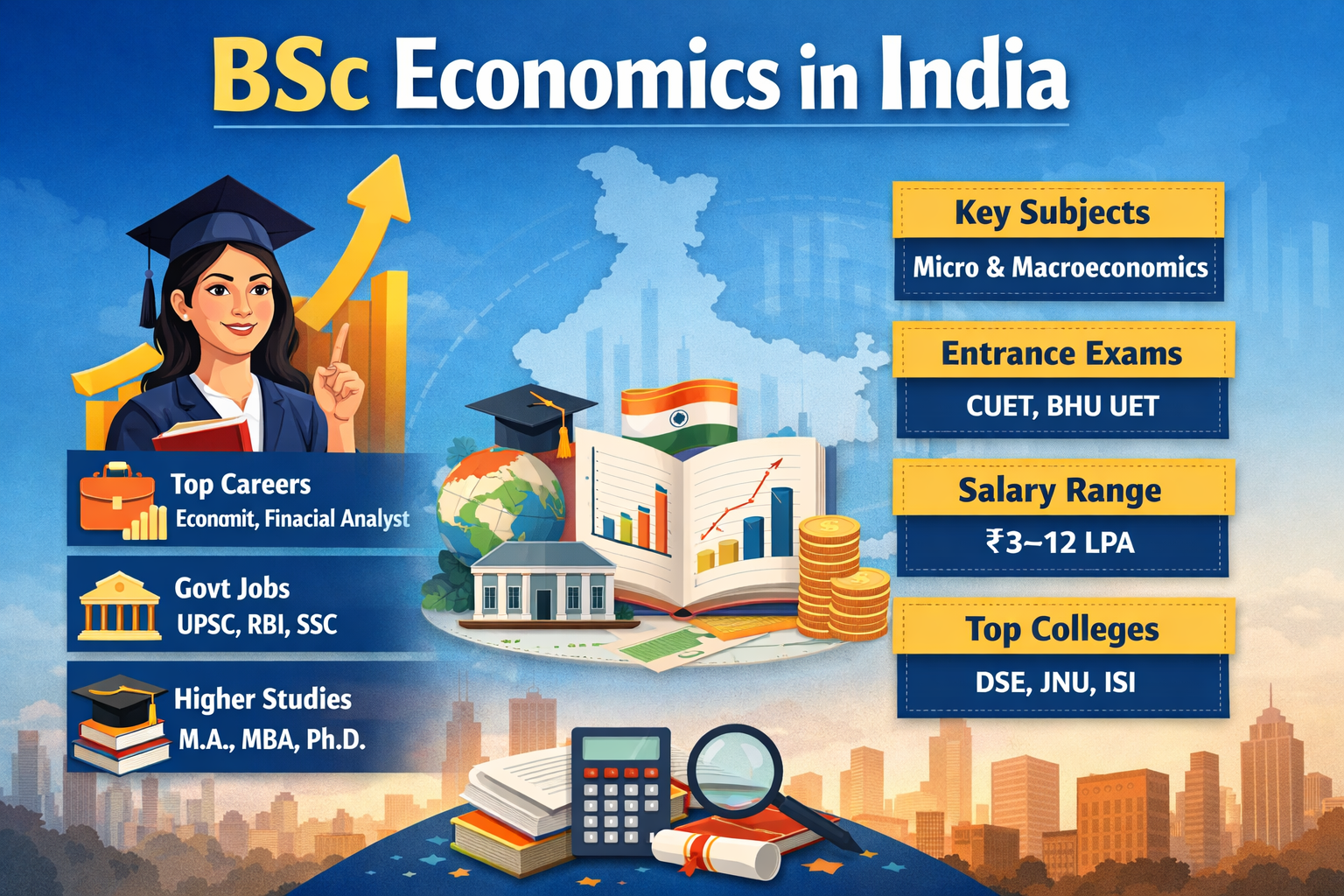
A BSc in Economics is a highly sought-after qualification in India, as the world needs skilled economists to analyse and interpret complex economic data. The BSc Economics course is a three-year undergraduate program covering microeconomics, macroeconomics, statistics, and econometrics, providing a full understanding of economic principles. Graduates can pursue careers as economists, analysts, consultants, and researchers.
🔔 BSC Economics in India Admission Alerts 2026
- Eligibility: For IIT BS Economics programs, candidates must have completed 10+2 with 75% + JEE Advanced for 2026 admissions.
- IIT Kanpur Seats: IIT Kanpur’s BS Economics program offers a limited number of 52 seats for 2026 admissions.
- IIT Bombay Fees: The total course fee for BS Economics at IIT Bombay is ₹ 8.83 Lakhs for 2026.
- IIT Kharagpur Cutoff: The overall JEE-Advanced cutoff for IIT Kharagpur’s BS Economics program ranges from 284 – 6063 across all categories for 2026.
- Scholarship Eligibility: Students with an annual income less than ₹ 5 Lakh are eligible to apply for scholarships at IITs for 2026.
To be eligible for a BSc Economics program in India, students typically need to have completed their higher secondary education with a strong foundation in mathematics and statistics. The program develops analytical, problem-solving, and data interpretation skills. The curriculum provides a deep understanding of economic theories, models, and concepts, along with practical applications and case studies, exploring microeconomics, macroeconomics, development economics, and international economics.
This article provides an overview of the BSc Economics course in India, including top colleges and universities, fees, eligibility criteria, and career opportunities. We will explore the course structure, syllabus, placement prospects, and the skills needed to succeed in this field.
B.Sc Economics Course Highlights
| Feature | Details |
|---|---|
| Degree Full Form | Bachelor of Science in Economics |
| Degree Type | Undergraduate Degree |
| Typical Duration | 4 years (for BS Economics at IITs) |
| Eligibility (India) | 10+2 with 75% + JEE Advanced (for IITs) |
| Common Entrance Exams (India) | JEE Advanced, CUET UG (for 2026 admissions) |
| Average Annual Fees (India) | ₹2,24,075 (for IIT Kharagpur, 2026) |
| Average Total Course Fees (IITs) | ₹8.83 Lakhs – ₹9.38 Lakhs (2026) |
| Career Options | Economist, Data Analyst, Financial Analyst, Policy Advisor, Investment Banker |
| Top Recruiting Sectors | Government (UPSC, SSC CGL), Banking, Defence, Railways |
| Scholarship Eligibility | Annual income less than ₹5 Lakh (based on performance) |
Why Choose B.Sc Economics?
Choosing B.Sc Economics can open doors to a wide range of career paths and academic opportunities. Economics is the study of how individuals, businesses, and governments make decisions about resources, production, and consumption. A degree in economics equips students with analytical, quantitative, and problem-solving skills that are highly valued in both private and public sectors.
-
Strong Career Prospects: Economics graduates are in demand in banking, finance, consulting, government agencies, and research organizations.
-
Analytical Skill Development: The course enhances critical thinking, data interpretation, and statistical analysis skills.
-
Versatile Career Options: Opportunities exist in economic research, policy planning, data analytics, financial analysis, and more.
-
Foundation for Higher Studies: B.Sc Economics provides a solid base for pursuing M.A./M.Sc in Economics, MBA, or courses in finance and public policy.
-
Understanding Global Trends: Students gain insights into national and international economic systems, markets, and policies.
-
Problem-Solving Abilities: The course trains students to tackle real-world economic challenges and contribute to policy-making.
Overall, B.Sc Economics is ideal for students interested in understanding how economies function, analyzing financial systems, and shaping policies that impact society. It’s a blend of theory, practical analysis, and career-ready skills that prepare students for diverse roles.
B.Sc Economics Eligibility Criteria
Eligibility criteria for BSc Economics programs in India vary, but most universities require 10+2 education with a minimum percentage of marks. The table below outlines the specific eligibility criteria for different BSc Economics programs, including BSc Economics, BSc Economics (Hons), BSc Agricultural Economics, and BSc Economics and Data Science, covering the minimum qualification, percentage, mandatory subjects, and other requirements. Students from reserved categories may be eligible for relaxation in the minimum percentage requirement as per Indian government norms.
| Degree Type | Minimum Qualification | Minimum Percentage | Mandatory Subjects | Other Requirements |
|---|---|---|---|---|
| BSc Economics | 10+2 in any stream | 50% aggregate | Mathematics, Economics | Class 12 from recognized board; age below 25 years |
| BSc Economics (Hons) | 10+2 in Commerce or Science | 60% aggregate | Mathematics, Economics, Commerce | Class 12 from recognized board; entrance exam qualification |
| BSc Agricultural Economics | 10+2 in Science or Agriculture | 55% aggregate | Agriculture, Biology, Mathematics | Class 12 from recognized board; domicile certificate required for state quota |
| BSc Economics and Data Science | 10+2 in Science or Commerce | 65% aggregate | Mathematics, Statistics, Computer Science | Class 12 from recognized board; programming skills in Python or R |
| BSc Economics with specialization in Finance | 10+2 in Commerce | 60% aggregate | Accountancy, Commerce, Mathematics | Class 12 from recognized board; entrance exam qualification |
| BSc Economics with specialization in International Trade | 10+2 in Commerce | 55% aggregate | Commerce, Economics, Geography | Class 12 from recognized board; proficiency in a foreign language |
| BSc Economics with specialization in Development Economics | 10+2 in Arts or Social Science | 50% aggregate | Economics, Sociology, Geography | Class 12 from recognized board; experience in social work or volunteerism |
| BSc Economics with specialization in Environmental Economics | 10+2 in Science | 55% aggregate | Environmental Science, Biology, Mathematics | Class 12 from recognized board; knowledge of environmental policies and regulations |
| BSc Economics with specialization in Public Policy | 10+2 in Arts or Social Science | 50% aggregate | Politics, Economics, Sociology | Class 12 from recognized board; experience in public administration or governance |
B.Sc Economics Admission Process
The admission process for BSc Economics in India involves checking eligibility criteria, applying online, and appearing for entrance exams. The process varies depending on the college or university. Government colleges often have a merit-based selection process, while private colleges may conduct their own entrance exams. The Common University Entrance Test (CUET) is accepted by some universities for BSc Economics admissions.
-
Eligibility: Minimum 50% marks in 12th standard; Economics is usually a required subject.
-
Application: Apply online via the college/university admission portal.
-
Entrance Exams: Some colleges/universities require exams such as CUET, BHU UET, or college-specific tests.
-
Merit vs Entrance: Government colleges (e.g., Delhi University) often follow merit-based selection; private colleges may have their own entrance exams.
-
Counseling/Interview: Shortlisted candidates may undergo personal interviews, group discussions, or written tests.
-
Document Submission: Mark sheets, certificates, identity proof, and other required documents must be submitted.
-
Fee Range: Tuition fees typically range from INR 20,000 to 1,00,000 per year; admission fees vary from INR 10,000 to 50,000 per semester.
-
Verification: Caste, income, or disability certificates may be required for scholarships/reservations.
-
Registration: Complete the registration form, pay registration fees, and submit documents.
-
Orientation: Attend orientation programs to get familiar with campus, faculty, and curriculum.
-
Classes Begin: Academic sessions usually start in July–August, including lectures, tutorials, and seminars.
-
Competition: Government colleges are more competitive; private colleges may have a more flexible process but higher fees.
The admission process for government colleges, such as those affiliated with Delhi University, is often more competitive, with a larger number of applicants vying for a limited number of seats. Private colleges may have a more relaxed admission process, but may also charge higher fees. Research the specific admission process and requirements for each college or university to ensure a smooth and successful admission experience.
B.Sc Economics Syllabus
The B.Sc Economics course is typically a 3-year undergraduate program divided into 6 semesters. It combines theoretical concepts with practical applications in economics, finance, statistics, and mathematics. Students learn to analyze economic problems, interpret data, and understand financial systems, policies, and global economic trends.
The syllabus is designed to give a strong foundation in both microeconomics and macroeconomics, while also introducing quantitative and analytical tools such as statistics, econometrics, and mathematical methods for economics.
Students also study applied areas like international economics, public finance, development economics, and financial markets, which prepare them for careers in banking, finance, policy-making, research, and data analysis.
Core Subjects in B.Sc Economics
The core subjects of B.Sc Economics focus on developing analytical and quantitative skills. They cover both theory and practical applications to help students understand how economies function at micro and macro levels.
Key areas include:
-
Microeconomics – Study of individual markets, demand-supply analysis, consumer behavior, and production theory.
-
Macroeconomics – Analysis of national income, inflation, unemployment, fiscal and monetary policy.
-
Econometrics – Application of statistical methods to economic data for research and forecasting.
-
Statistics & Mathematics for Economics – Quantitative tools like probability, calculus, and linear algebra for economic modeling.
-
Public Finance – Government revenue, taxation, budgeting, and fiscal policies.
-
Development Economics – Economic growth, poverty alleviation, and policy planning for developing countries.
-
International Economics – Global trade, balance of payments, exchange rates, and international finance.
-
Financial Economics – Money markets, banking systems, financial instruments, and investment analysis.
-
Research Methodology – Techniques for conducting economic research and report writing.
| Semester | Subjects / Topics |
|---|---|
| Semester 1 | Microeconomics I, Principles of Statistics, Mathematics for Economics, English / Communication Skills |
| Semester 2 | Microeconomics II, Macroeconomics I, Quantitative Methods, Computer Applications for Economics |
| Semester 3 | Macroeconomics II, Indian Economy, Econometrics I, Environmental Economics |
| Semester 4 | Development Economics, Public Finance, Econometrics II, Elective 1 (e.g., Banking or Finance) |
| Semester 5 | International Economics, Financial Economics, Elective 2 (e.g., Labor Economics), Research Methodology |
| Semester 6 | Advanced Macroeconomics, Project Work / Dissertation, Elective 3 (e.g., Policy Analysis), Seminar / Presentation |
Skills Required for B.Sc Economics Students
A B.Sc Economics degree equips students with analytical, quantitative, and problem-solving skills, but success in this field also depends on developing a set of specific abilities.
-
Analytical Thinking: Ability to evaluate economic trends, interpret data, and make evidence-based decisions.
-
Quantitative Skills: Strong foundation in mathematics, statistics, and econometrics to analyze economic problems.
-
Research Skills: Competence in collecting, analyzing, and interpreting data for reports and projects.
-
Problem-Solving: Applying economic principles to solve real-world issues in finance, policy, and business.
-
Critical Thinking: Evaluating policies, financial decisions, and market behaviors logically and objectively.
-
Communication Skills: Clearly presenting complex economic concepts through reports, presentations, or discussions.
-
Computer & Data Skills: Knowledge of Excel, SPSS, Stata, R, Python, or other data analysis tools.
-
Attention to Detail: Ensuring accuracy in statistical analysis, research reports, and financial computations.
-
Time Management: Balancing multiple assignments, projects, and deadlines effectively.
Developing these skills prepares students for diverse career paths in economics, finance, research, government, and international organizations.
Career Scope After B.Sc Economics
Salary After B.Sc Economics
The salary of B.Sc Economics graduates in India varies depending on factors such as sector, job role, location, and experience level. Economics graduates are in demand in both private and government sectors, and their analytical and quantitative skills often translate into competitive pay packages.
Entry-Level Salary:
-
Fresh graduates can expect an average salary of ₹3–6 LPA (Lakhs Per Annum) in roles like financial analyst, data analyst, research assistant, or junior economist.
-
Salaries may vary based on the type of employer—private firms often pay higher starting packages than government jobs.
Mid-Level Salary:
-
With 3–5 years of experience, professionals can earn between ₹6–12 LPA in positions such as economist, policy analyst, investment analyst, or senior data analyst.
-
Specialized skills like econometrics, financial modeling, and data analysis can significantly boost earning potential.
Senior-Level Salary:
-
Experienced professionals with 5–10 years or more can command salaries exceeding ₹12 LPA, particularly in banking, finance, consulting firms, multinational corporations, or international organizations.
-
Leadership positions such as economic consultant, senior economist, portfolio manager, or policy advisor offer higher pay and strategic responsibilities.
| Job Role | Average Salary (INR) | Description |
|---|---|---|
| Financial Analyst | 4–7 LPA | Evaluates investment opportunities, financial data, and market trends. |
| Data Analyst | 3–6 LPA | Analyzes large datasets to provide actionable insights for business decisions. |
| Economist | 6–12 LPA | Conducts research, forecasts economic trends, and advises on policy decisions. |
| Policy Analyst | 5–10 LPA | Assesses economic policies and suggests improvements for government/NGO projects. |
| Research Assistant | 3–5 LPA | Supports research projects by collecting data, analyzing trends, and preparing reports. |
| Banking & Finance Roles | 4–8 LPA | Includes investment banking, credit analysis, and financial planning roles. |
Higher Studies After B.Sc Economics
After completing B.Sc Economics, students have multiple options for higher studies to specialize, enhance their skills, and improve career prospects. These programs help graduates pursue advanced roles in research, finance, policy-making, and academia.
Popular Higher Study Options:
M.A./M.Sc Economics
- Duration: 2 years
- Focus: Advanced microeconomics, macroeconomics, econometrics, development economics, and research methodologies.
- Benefits: Prepares for careers in research, policy-making, financial analysis, and academia.
MBA (Finance / Economics / Business Analytics)
- Duration: 2 years
- Focus: Management principles, financial planning, business analytics, and strategic decision-making.
- Benefits: Opens doors to managerial positions in finance, consulting, and corporate sectors.
M.Phil / Ph.D. In Economics
- Duration: M.Phil (1–2 years), Ph.D. (3–5 years)
- Focus: In-depth research in areas like econometrics, international economics, public policy, and development economics.
- Benefits: Leads to academic and research-oriented careers, think-tank positions, and consultancy roles.
- Postgraduate Diplomas / Certifications
- Examples: Financial Economics, Data Analytics, Risk Management, Public Policy, and Actuarial Science.
- Benefits: Provides specialized skills that improve employability and salary prospects.
Professional Courses
-
-
Examples: CFA (Chartered Financial Analyst), CPA, or Certified Data Analyst courses.
-
Benefits: Globally recognized credentials enhancing opportunities in finance, banking, and investment sectors.
-
Top Government Colleges for B.Sc Economics in India
The following table provides an overview of top government colleges in India offering BSc Economics programs, including their city, NIRF ranking, annual fees in INR, and admission mode. These colleges are recognized by the University Grants Commission (UGC) and the All India Council for Technical Education (AICTE).
| College Name | City | NIRF Ranking |
|---|---|---|
| Delhi School of Economics | Delhi | 23 |
| Presidency College Kolkata | Kolkata | 11 |
| Madras School of Economics | Chennai | 28 |
| Gokhale Institute of Politics and Economics | Pune | 18 |
| Indian Statistical Institute | Kolkata | 1 |
| University of Hyderabad | Hyderabad | 14 |
| Jawaharlal Nehru University | Delhi | 2 |
| University of Delhi | Delhi | 5 |
| Calcutta University | Kolkata | 21 |
| Andhra University | Visakhapatnam | 25 |
Top Private Colleges for BSc Economics in India
The top private colleges for BSc Economics in India offer a full curriculum including microeconomics, macroeconomics, statistics, and econometrics. These colleges provide a strong foundation in economic theory and practical applications, preparing students for careers in finance, consulting, and research.
| College Name | City | Annual Fees | Courses Offered | Admission Details |
|---|---|---|---|---|
| Symbiosis School of Economics | Pune | Rs 2,50,000 per year | BSc Economics, BSc Economics and Data Science | Merit-based admission, entrance exam required |
| Christ University | Bengaluru | Rs 1,80,000 per year | BSc Economics, BSc Business and Economics | Merit-based admission, interview required |
| Ashoka University | Sonepat | Rs 4,50,000 per year | BSc Economics, BSc Economics and Finance | Merit-based admission, entrance exam required |
| Flame University | Pune | Rs 3,50,000 per year | BSc Economics, BSc Economics and Data Science | Merit-based admission, interview required |
| Indian School of Business and Finance | New Delhi | Rs 2,80,000 per year | BSc Economics, BSc Business and Economics | Merit-based admission, entrance exam required |
| Jindal School of Government and Public Policy | Sonepat | Rs 3,20,000 per year | BSc Economics, BSc Public Policy | Merit-based admission, interview required |
| Krea University | Sri City | Rs 4,20,000 per year | BSc Economics, BSc Economics and Data Science | Merit-based admission, entrance exam required |
| NIIT University | Neemrana | Rs 2,20,000 per year | BSc Economics, BSc Business and Economics | Merit-based admission, interview required |
| Shiv Nadar University | Greater Noida | Rs 3,80,000 per year | BSc Economics, BSc Economics and Finance | Merit-based admission, entrance exam required |
Advantages of Studying B.Sc Economics
Studying B.Sc Economics offers several academic, professional, and personal benefits. It provides students with a strong foundation in economic theory, quantitative analysis, and research skills that are highly valued across multiple sectors.
-
Strong Career Opportunities: Economics graduates are in demand in banking, finance, policy-making, research, and analytics.
-
Analytical & Problem-Solving Skills: The course develops critical thinking, data interpretation, and decision-making abilities.
-
Higher Studies Options: Graduates can pursue M.A./M.Sc in Economics, MBA, Ph.D., or professional courses like CFA and CPA.
-
Understanding Global Economy: Students gain insights into national and international markets, trade, and fiscal policies.
-
Flexibility in Job Roles: Career options include economist, financial analyst, data analyst, policy advisor, and researcher.
-
Foundation for Entrepreneurship: Knowledge of economic trends and financial planning can help start business ventures.
-
Policy Influence: Graduates can contribute to public policy and economic planning, impacting society positively.
Overall, B.Sc Economics equips students with versatile skills that are applicable in multiple industries and sectors, making it a highly valuable undergraduate course.
Challenges in B.Sc Economics
While B.Sc Economics offers many benefits, students may also face challenges that require dedication and perseverance.
-
High Analytical & Mathematical Demand: Strong quantitative skills in statistics, econometrics, and mathematics are essential.
-
Competition: Admission to top colleges and job placements can be highly competitive.
-
Complex Theoretical Concepts: Understanding macroeconomics, microeconomics, and policy frameworks can be challenging for some students.
-
Practical Application: Translating economic theories into real-world applications requires continuous learning and research.
-
Keeping Up with Current Affairs: Economics is dynamic, requiring students to stay updated on market trends, government policies, and global events.
-
Limited Practical Exposure in Some Colleges: Some institutions may focus more on theory than hands-on experience, limiting exposure to data analysis and research.
By addressing these challenges through practice, internships, and skill development, students can maximize the benefits of their B.Sc Economics degree.
B.Sc Economics vs B.Sc Finance
Although B.Sc Economics and B.Sc Finance are closely related, they differ in focus, subjects, and career paths.
| Feature | B.Sc Economics | B.Sc Finance |
|---|---|---|
| Focus Area | Study of economic systems, policies, markets, and resource allocation | Study of financial markets, investment, banking, and corporate finance |
| Core Subjects | Microeconomics, Macroeconomics, Econometrics, Public Finance, International Economics | Financial Management, Investment Analysis, Corporate Finance, Banking, Accounting |
| Skill Development | Analytical thinking, data interpretation, research skills, economic modeling | Financial analysis, risk management, accounting skills, investment strategies |
| Career Opportunities | Economist, Policy Analyst, Data Analyst, Researcher, Government roles | Financial Analyst, Investment Banker, Portfolio Manager, Accountant, Risk Manager |
| Higher Studies | M.A./M.Sc Economics, MBA, Ph.D., CFA | M.Sc Finance, MBA Finance, CFA, CPA, Chartered Accountant courses |
| Industry Scope | Government, research institutes, policy-making organizations, international organizations | Banking, investment firms, corporate finance departments, accounting firms |
| Job Nature | Focus on economic trends, policy-making, and research | Focus on financial planning, investments, and corporate decision-making |
-
B.Sc Economics is broader, focusing on understanding economies, markets, and policies.
-
B.Sc Finance is specialized, focusing on money management, investments, and corporate finance.
-
Students interested in research, policy, and analytics should choose Economics, while those aiming for corporate finance, banking, or investments should consider Finance.
FAQs
What is B.Sc Economics?
B.Sc Economics is a three-year undergraduate program that teaches students about economic theory, financial systems, market trends, policy-making, data analysis, and practical applications in both private and public sectors.
What are the eligibility criteria for B.Sc Economics?
Candidates must have completed 10+2 with a minimum of 50% marks, preferably with Economics, Mathematics, or Statistics as subjects. Eligibility varies by college or university.
What subjects are studied in B.Sc Economics?
Core subjects include Microeconomics, Macroeconomics, Econometrics, Statistics, Public Finance, Development Economics, International Economics, Financial Economics, and Research Methodology across six semesters.
What skills are required for B.Sc Economics students?
Analytical thinking, quantitative aptitude, research skills, problem-solving, critical thinking, communication, computer skills, and attention to detail are essential for success in B.Sc Economics programs.
What are the top career options after B.Sc Economics?
Graduates can become economists, financial analysts, data analysts, policy analysts, research officers, or pursue banking, finance, consulting, international organizations, or academic roles.
What is the average salary after B.Sc Economics?
Entry-level salaries range from ₹3–6 LPA, mid-level from ₹6–12 LPA, and experienced professionals can earn ₹12 LPA or more, depending on sector, location, and skills.
Can I pursue higher studies after B.Sc Economics?
Yes, options include M.A./M.Sc Economics, MBA, Ph.D., or professional certifications like CFA, CPA, or financial analytics courses for specialization and higher career growth.
Which government jobs are available after B.Sc Economics?
Graduates can work as economists, statistical officers, RBI analysts, civil service officers (IAS/IPS), policy analysts, or in banking, finance, taxation, and government think tanks.
How is B.Sc Economics different from B.Sc Finance?
B.Sc Economics focuses on economic theory, policy, and research, while B.Sc Finance emphasizes money management, investment, banking, accounting, and corporate financial decision-making.
Which colleges offer the best B.Sc Economics programs in India?
Top colleges include Delhi School of Economics, Presidency College Kolkata, Madras School of Economics, Gokhale Institute Pune, Indian Statistical Institute, University of Delhi, JNU, Calcutta University, University of Hyderabad, and Andhra University.
Q: What are the eligibility criteria for BSC Economics in India for 2026 admissions?
For BSC Economics, students typically need to have completed their 10+2 (or equivalent) with a minimum aggregate of 50-60% marks from a recognized board. While some universities prefer students with Mathematics in 12th grade, it’s not always mandatory. Age limits, if any, are usually around 23 years for general category students at the time of admission.
Q: What are the top entrance exams for BSC Economics in India in 2026?
Prospective students for BSC Economics often need to clear entrance exams. Key exams include CUET (for central universities), DUET (for Delhi University colleges), and specific university-level tests like the Symbiosis Entrance Test (SET) or Christ University Entrance Test. These exams typically assess analytical ability, general knowledge, and sometimes basic mathematics, with applications opening around March 2026.
Q: What is the average fee for BSC Economics in India per year in 2026?
The average fee for BSC Economics in India varies significantly. For government colleges, the annual fees can range from ₹10,000 to ₹50,000. Private institutions, however, may charge between ₹70,000 and ₹3,00,000 per year for BSC Economics. These figures are estimates for the 2026 academic year and can differ based on the college’s ranking and facilities.
Q: What is the average salary after BSC Economics in India in 2026?
The average starting salary for a BSC Economics graduate in India in 2026 can range from ₹3.5 LPA to ₹6 LPA. Graduates with BSC Economics often find roles in financial analysis, data analytics, or research. With 3-5 years of experience, this can increase significantly, with some professionals earning upwards of ₹10 LPA in specialized roles.
Q: What are the career options and job roles after BSC Economics in India?
BSC Economics opens doors to diverse career paths. Graduates can pursue roles as financial analysts, data scientists, economic consultants, market research analysts, or policy researchers. Many also opt for higher studies like an MA in Economics or an MBA. The demand for BSC Economics graduates is projected to grow by 15-20% in sectors like finance and analytics by 2026.
Q: Can I study abroad after BSC Economics in India, and what are the options?
Yes, pursuing higher education abroad after BSC Economics is a popular option. Many Indian graduates opt for Master’s programs in Economics, Finance, or Public Policy in countries like the USA, UK, Canada, and Australia. A strong academic record (typically 70% or above) and good GRE/GMAT scores are often required, with applications usually opening 12-18 months before the program start date.