BSC Electronics 2026: Courses, Career Options, Colleges & Syllabus
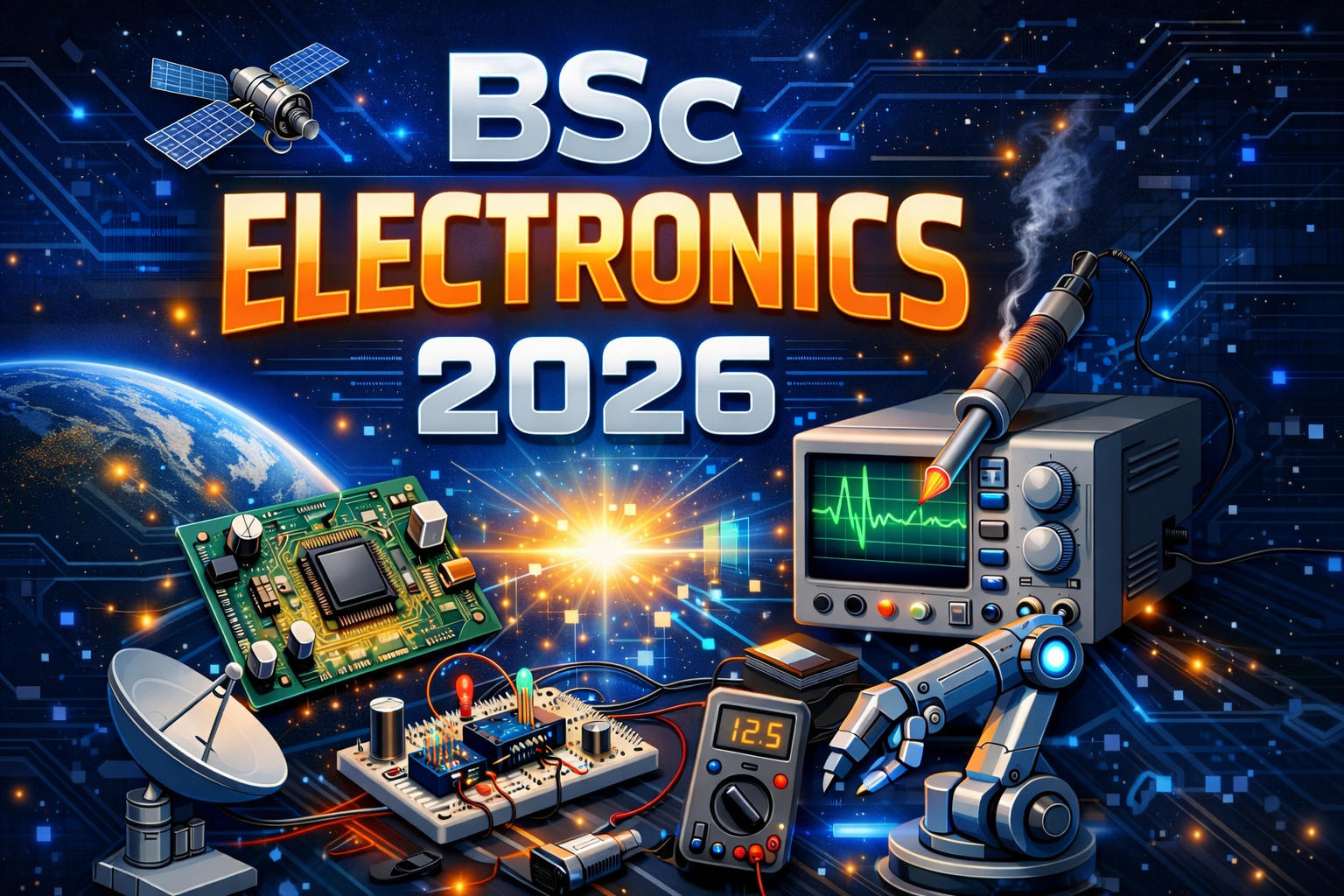
BSc Electronics 2026 is an undergraduate science programme designed for students interested in electronic systems, circuits, and modern technologies. The course focuses on the study of analog and digital electronics, microprocessors, communication systems, and embedded technology.
🔔 BSC Electronics 2026 Admission Alerts 2026
- Application Window: The 2026 application period for Bachelor of Science (BSc) degrees is currently open.
- Eligibility Criteria: Eligibility for BSc courses in 2026 varies by college/university; check specific institution requirements.
- Entrance Exams: Many top BSc colleges in India accept CUET scores for 2026 admissions.
- Course Duration: The standard duration for a Bachelor of Science (BSc) degree in 2026 is typically 3 years.
- Career Scope: A BSc degree in 2026 offers diverse career opportunities in sustainable energy, AI, and health challenges.
With the rapid growth of electronics in industries like telecommunications, automation, healthcare, and IT, this degree offers strong academic and career value. BSc Electronics is usually a three-year course, divided into six semesters, combining theory with practical lab work. It builds a strong foundation in technical knowledge and problem-solving skills.
Ths blog gives complete details about the BSc Electronics 2026 course, including eligibility, syllabus, top colleges, career options, and future scope for students planning to pursue this field.
BSc Electronics 2026: Overview
BSc Electronics 2026 is a popular undergraduate science course for students who want to build a career in electronics, communication, and modern technology-driven industries. The programme focuses on the study of electronic devices, circuits, digital systems, microprocessors, and communication technologies. It combines theoretical knowledge with practical laboratory training, helping students understand how electronic systems are designed, tested, and applied in real life.
The course is generally offered by universities and colleges across India in a three-year format, divided into six semesters. During the course, students learn core subjects like analog and digital electronics, electronic measurements, communication systems, and embedded systems. Practical sessions, projects, and internships play an important role in developing hands-on technical skills.
BSc Electronics is suitable for students who have completed 10+2 with Physics and Mathematics and have an interest in technology and innovation. After completing the degree, students can opt for higher studies such as MSc Electronics, MSc Physics, or professional courses, or they can enter the job market in sectors like electronics manufacturing, IT, telecommunications, defence, and research organisations.
| Particulars | Details |
|---|---|
| Degree Full Form | Bachelor of Science (BSc) in Electronics |
| Degree Type | Undergraduate |
| Typical Duration | 3 Years |
| Eligibility (India) | 10+2 (Higher Secondary) with Science stream |
| Common Entrance Exams (India) | CUET (for many top colleges) |
| Average Annual Fees (India) | Varies by college/university in 2026 |
| Career Options | Electronics Engineer, Research Assistant, IT Support, Technician |
| Average Starting Salary (India) | ₹2.5 LPA – ₹5 LPA (Source: Ambitionbox.com) |
| Admission Process 2026 | Merit-Based / Entrance Exam |
| Total Semesters | 6 |
| Mode of Study | Full-Time |
B.Sc Electronic 2026: Eligibilty Criteria
B.Sc Electronic 2026: Admission Process
The B.Sc Electronics admission process is designed to select students who have a strong foundation in science subjects, especially Physics and Mathematics. The process may vary slightly depending on the university or college, but the overall steps remain similar across institutions in India.
Step 1: Check Eligibility Criteria
Before applying, candidates should carefully check the eligibility conditions set by the college or university. Students must have completed 10+2 (Class 12) with Physics as a compulsory subject and Mathematics as a required or preferred subject. Meeting the minimum percentage requirement is essential for admission.
Step 2: Fill the Application Form
Eligible candidates need to fill out the application form, which is usually available on the official website of the institution. Applicants must enter personal details, educational qualifications, and contact information accurately to avoid rejection.
Step 3: Upload or Submit Required Documents
Students are required to upload or submit scanned copies of important documents such as Class 10 and 12 mark sheets, passport-size photographs, category certificates (if applicable), and valid ID proof.
Step 4: Merit List or Entrance Examination
Most colleges prepare a merit list based on marks obtained in Class 12. Some universities may conduct an entrance exam to test knowledge of Physics, Mathematics, and basic science concepts.
Step 5: Counselling and Seat Allotment
Shortlisted candidates are invited for counselling, where seats are allotted based on merit rank, reservation norms, and availability of seats in the B.Sc Electronics programme.
Step 6: Document Verification
During counselling, candidates must present original documents for verification. This step confirms the authenticity of academic records and eligibility.
Step 7: Fee Payment and Admission Confirmation
After successful verification, candidates need to pay the admission fee within the given time limit. Once the fee is paid, the admission to the B.Sc Electronics course is officially confirmed.
B.Sc Electronic 2026: Exam Pattern
BSc Electronics Course Curriculum: a Detailed Breakdown 2026
The BSc Electronics curriculum for 2026 has been carefully structured to bridge theoretical foundations with hands-on industry applications.
Spanning three years across six semesters, this programme builds competency progressively—from basic circuit analysis in the first year to advanced system design and project implementation in the final year.
The credit-based system adopted by most Indian universities ensures balanced weightage between core technical subjects, practical laboratory sessions, and elective specialisations.
You’ll develop proficiency in simulation software like MATLAB, SPICE, and Cadence while working with hardware tools including oscilloscopes, function generators, FPGA kits, and microcontroller development boards.
The curriculum’s emphasis on project-based learning prepares graduates for immediate employability in sectors ranging from semiconductor design to telecommunications and automation.
The following table presents the semester-wise subject distribution across leading Indian universities, highlighting how core and elective components are structured throughout the programme:
| Year | Semester | Core Subjects | Elective Subjects |
|---|---|---|---|
| Year 1 | Semester 1 | Circuit Theory, Basic Electronics, Mathematics-I, Physics-I | Programming in C, Technical Communication |
| Year 1 | Semester 2 | Digital Electronics, Electronic Devices, Mathematics-II, Network Analysis | Environmental Science, Introduction to Computing |
| Year 2 | Semester 3 | Analog Electronics, Microprocessors, Signals and Systems, Electronic Circuits | Data Structures, Linear Integrated Circuits |
| Year 2 | Semester 4 | Communication Systems, Control Systems, Electromagnetic Theory, Digital Communication | Object Oriented Programming, Power System Analysis |
| Year 3 | Semester 5 | VLSI Design, Power Electronics, Embedded Systems, VLSI Technology | Renewable Energy Sources, Wireless Communication |
| Year 3 | Semester 6 | Instrumentation, Digital Signal Processing, Project Work, Industrial Automation | Robotics, Advanced Microprocessors, Internet of Things |
| Year 1 | Semester 1 | Basic Electrical Engineering, Calculus, Semiconductor Physics | Engineering Graphics, Workshop Practice |
| Year 1 | Semester 2 | Differential Equations, Analog Circuits, Digital Logic Design | Indian Constitution, Ethics in Engineering |
| Year 2 | Semester 3 | Microcontroller Programming, Probability and Statistics, Electronic Measurements | Python Programming, Sensors and Transducers |
| Year 2 | Semester 4 | Feedback Control Systems, Electromagnetics, Analog Communication | Antenna Theory, Microwave Engineering |
| Year 3 | Semester 5 | Digital Signal Processing, Embedded System Design, Computer Architecture | Biomedical Instrumentation, Optical Communication |
| Year 3 | Semester 6 | Major Project, Industrial Training, Seminar Presentation | Machine Learning for Electronics, Nanoelectronics |
Each subject carries 4-6 credits with dedicated laboratory components comprising 25-30% of the total assessment.
B.Sc Electronic 2026: Exam Pattern
| Subject/Topic | Weightage | Marks | Key Areas | Resources |
|---|---|---|---|---|
| Circuit Theory | 15% | 100 | Network analysis, Thevenin’s theorem, Norton’s theorem, mesh and nodal analysis | Hayt, Kemmerly & Durbin textbook, LTspice simulations, NPTEL lectures by IIT Kharagpur |
| Digital Electronics | 12% | 100 | Logic gates, Boolean algebra, flip-flops, counters, registers, state machines | Morris Mano textbook, Logisim software, Digilent Basys FPGA kits |
| Analog Electronics | 13% | 100 | Amplifiers, oscillators, filters, operational amplifiers, power amplifiers | Sedra & Smith textbook, NI Multisim, Texas Instruments reference designs |
| Microprocessors and Microcontrollers | 10% | 100 | 8085/8086 architecture, ARM programming, interfacing techniques, memory organization | Intel datasheets, Keil uVision IDE, Arduino and Raspberry Pi development boards |
| Communication Systems | 10% | 100 | AM/FM modulation, digital modulation, transmission lines, antenna theory, satellite communication | Simon Haykin textbook, GNU Radio, MATLAB Communications Toolbox |
| Electromagnetic Theory | 8% | 100 | Maxwell’s equations, wave propagation, transmission lines, waveguides, antenna arrays | David K. Cheng textbook, Ansys HFSS software, IIT Bombay NPTEL course |
| Control Systems | 7% | 100 | Feedback control, stability analysis using Routh-Hurwitz, PID controllers, state-space analysis | Katsuhiko Ogata textbook, MATLAB Control System Toolbox, Simulink models |
| Power Electronics | 7% | 100 | Power converters, DC-DC converters, inverters, rectifiers, motor drives | Mohan, Undeland & Robbins textbook, PSIM simulation software, Texas Instruments C2000 kits |
| Instrumentation and Measurement | 6% | 100 | Strain gauges, thermocouples, RTDs, signal conditioning, data acquisition systems | A.K. Sawhney textbook, National Instruments DAQ systems, LabVIEW software |
| VLSI Design | 5% | 100 | CMOS logic design, layout design rules, fabrication process, parasitic extraction | Jan M. Rabaey textbook, Cadence Virtuoso, Synopsys Design Compiler |
| Embedded Systems | 7% | 100 | Real-time operating systems, embedded C programming, RTOS scheduling, device drivers | Jonathan Valvano textbooks, FreeRTOS kernel, STM32 Nucleo boards |
| Signal Processing | 5% | 100 | Discrete Fourier transform, digital filter design, FIR/IIR structures, spectral analysis | Proakis & Manolakis textbook, MATLAB Signal Processing Toolbox, Python SciPy library |
| Optoelectronics | 3% | 50 | LEDs, photodetectors, solar cells, optical fibers, laser fundamentals | Wilson & Hawkes textbook, OptiSystem simulation software, IIT Delhi laboratory manual |
| Electronic Materials | 3% | 50 | Semiconductor physics, crystal structures, doping, carrier transport, p-n junctions | Streetman & Banerjee textbook, AFM and XRD characterization tools, IISc research papers |
Career Scope After B.Sc Electronics
The career scope after B.Sc Electronics is good and continues to grow with the expansion of technology-based industries. Electronics graduates are needed in many sectors such as telecommunications, electronics manufacturing, IT companies, automation, healthcare equipment, defence, and research organisations. Since electronic systems are used in almost every field today, job opportunities are available in both private and government sectors.
In the private sector, B.Sc Electronics graduates can work as Electronics Technician, Service Engineer, Test Engineer, Field Engineer, Technical Support Executive, and Junior Electronics Engineer. Many companies involved in consumer electronics, mobile devices, industrial equipment, and communication systems hire electronics graduates for technical and support roles.
The government sector also offers stable career options. Graduates can apply for jobs in ISRO, DRDO, BHEL, BSNL, Indian Railways, Defence Services, and State Electricity Boards through competitive exams. Some students also choose teaching or lab assistant roles in colleges after gaining experience or higher qualifications.
Students who want better career growth can go for higher studies such as M.Sc Electronics, M.Sc Physics, M.Tech, or MBA. Short-term certification courses in Embedded Systems, VLSI, IoT, Robotics, and Automation also help in getting better job roles.
| Career Option | Job Role / Description | Sector |
|---|---|---|
| Electronics Technician | Installation, testing, and maintenance of electronic devices | Private |
| Junior Electronics Engineer | Assists in design, development, and testing of electronic systems | Private |
| Service Engineer | Repairs and services electronic equipment and machines | Private |
| Test Engineer | Tests electronic components and systems for quality and performance | Private |
| Field Engineer | Provides on-site technical support and system installation | Private |
| Technical Support Executive | Offers technical assistance and troubleshooting support | IT / Private |
| Embedded Systems Trainee | Works on microcontrollers and embedded-based projects | Private |
| Research Assistant | Supports research work in electronics and applied sciences | Research |
| Government Jobs | Roles in ISRO, DRDO, BHEL, BSNL, Railways, Defence | Government |
| Teaching / Lab Assistant | Teaching support and lab management in colleges | Education |
| Higher Studies | M.Sc Electronics, M.Tech, MBA, certification courses | Education |
Salary After B.Sc Electronics
The salary after B.Sc Electronics depends on the job role, skills, location, and experience of the candidate. Fresh graduates usually start with entry-level positions, and salaries increase with experience and technical knowledge.
For freshers, the average starting salary ranges from ₹2.5 lakh to ₹4 lakh per year. Jobs like Electronics Technician, Technical Support Engineer, and Junior Engineer usually fall in this range. Students with internships, hands-on lab skills, and certification courses may get slightly higher packages.
With 2 to 5 years of experience, professionals can earn between ₹5 lakh and ₹8 lakh per year. Roles in embedded systems, automation, telecommunications, and core electronics offer better pay at this stage.
After higher studies or specialised training, salaries can go even higher. Experienced professionals working in advanced technology fields or government organisations can earn ₹8 lakh to ₹12 lakh per year or more. Overall, B.Sc Electronics provides steady income growth and long-term career opportunities.
| Experience Level | Job Role | Average Salary (Per Year) |
|---|---|---|
| Fresher | Electronics Technician | ₹2.0 – ₹3.5 LPA |
| Fresher | Technical Support Engineer | ₹2.5 – ₹4.0 LPA |
| Fresher | Junior Electronics Engineer | ₹3.0 – ₹4.5 LPA |
| 2–3 Years Experience | Service Engineer | ₹4.0 – ₹6.0 LPA |
| 3–5 Years Experience | Test Engineer | ₹5.0 – ₹7.5 LPA |
| 3–5 Years Experience | Embedded Systems Engineer | ₹6.0 – ₹8.0 LPA |
| Experienced (5+ Years) | Senior Electronics Engineer | ₹8.0 – ₹12.0 LPA |
| Government Sector | PSU / Defence / Research Roles | ₹5.0 – ₹10.0 LPA |
| Higher Studies | After M.Sc / M.Tech | ₹7.0 – ₹15.0 LPA |
Top Colleges Offering BSc Electronics 2026
Selecting the right institution for your BSc Electronics degree can significantly shape your career trajectory in India’s rapidly expanding electronics and semiconductor sector.
With the government’s push toward domestic chip manufacturing through initiatives like the India Semiconductor Mission, colleges with strong industry partnerships and research infrastructure have become increasingly valuable.
The ideal institution should offer more than just theoretical knowledge. It must provide hands-on laboratory experience and industry collaborations with companies like Tata Electronics, Intel India, and Texas Instruments.
Look for active research opportunities in emerging domains such as VLSI design and embedded systems. A strong alumni network can open doors to mentorship and placement opportunities, while full scholarship programs ensure financial constraints don’t limit access to quality education.
Below is a detailed comparison of India’s leading institutions offering BSc Electronics programs for 2026 admissions.
| College Name | Location | Admission Criteria | Approximate Fees |
|---|---|---|---|
| St. Stephen’s College | New Delhi, Delhi | Merit-based (95%+ in 10+2 with Physics, Chemistry, Mathematics) | INR 25,000 per year |
| Hindu College | New Delhi, Delhi | Merit-based (92%+ in 10+2 with PCM combination) | INR 22,000 per year |
| Miranda House | New Delhi, Delhi | Merit-based (93%+ in 10+2 with Science stream) | INR 20,000 per year |
| Loyola College | Chennai, Tamil Nadu | Merit-based (85%+ in 10+2 with Physics and Mathematics) | INR 30,000 per year |
| Madras Christian College | Chennai, Tamil Nadu | Merit-based (80%+ in 10+2 with PCM, followed by interview) | INR 28,000 per year |
| Fergusson College | Pune, Maharashtra | Merit-based (88%+ in 10+2 with Science subjects) | INR 18,000 per year |
| Christ University | Bangalore, Karnataka | Christ University Entrance Test (CUET) followed by personal interview | INR 60,000 per year |
| Presidency College | Kolkata, West Bengal | Merit-based (75%+ in 10+2 with Physics, Chemistry, Mathematics) | INR 15,000 per year |
| Banaras Hindu University | Varanasi, Uttar Pradesh | BHU UET (University Entrance Test) with 50% weightage to 10+2 marks | INR 10,000 per year |
| Aligarh Muslim University | Aligarh, Uttar Pradesh | AMU Entrance Examination (objective type testin Physics, Chemistry, Mathematics) | INR 12,000 per year |
| Osmania University | Hyderabad, Telangana | Merit-based (70%+ in 10+2 with PCM through TS EAMCET counseling) | INR 8,000 per year |
| Ramjas College | New Delhi, Delhi | Merit-based (90%+ in 10+2 with Physics, Chemistry, Mathematics) | INR 23,000 per year |
| Hansraj College | New Delhi, Delhi | Merit-based (91%+ in 10+2 with Science stream through Delhi University cut-offs) | INR 24,000 per year |
| Sri Venkateswara College | New Delhi, Delhi | Merit-based (89%+ in 10+2 with PCM combination) | INR 21,000 per year |
| Bishop Heber College | Trichy, Tamil Nadu | Merit-based (82%+ in 10+2 with Physics and Mathematics, plus entrance assessment) | INR 35,000 per year |
When evaluating these institutions, prioritize colleges offering industry-integrated programs such as Christ University’s tie-ups with embedded systems firms and BHU’s research centers in nanoelectronics.
Career Paths After BSc Electronics 2026
A BSc Electronics degree opens diverse professional avenues across India’s rapidly expanding electronics and semiconductor ecosystem.
With the government’s push for domestic manufacturing through schemes like Production Linked Incentive (PLI) and the establishment of semiconductor fabrication plants in Gujarat and Assam, electronics graduates find themselves in high demand.
The sector spans consumer electronics, telecommunications, automotive electronics, defence, and healthcare devices.
Success in this field demands technical proficiency combined with practical exposure through internships and industry projects. Whether entering the workforce directly or pursuing higher education, graduates must prioritize continuous learning to keep pace with evolving technologies like IoT, AI hardware, and 5G infrastructure.
Below is a of career roles available to BSc Electronics graduates in 2026, including responsibilities, required competencies, and growth prospects.
| Name | Description | Key Details | Additional Info |
|---|---|---|---|
| Electronics Design Engineer | Creates circuit schematics, PCB layouts, and prototypes for electronic products ranging from smartphones to medical devices | Proficiency in Altium Designer, Cadence, SPICE simulation; starting salary ₹3.5-6 LPA | Growth to Senior Design Engineer (₹8-15 LPA) or Technical Lead roles in 5-7 years |
| Embedded Systems Engineer | Develops firmware and software for microcontrollers in automotive, industrial automation, and consumer electronics | C/C++ programming, ARM/PIC/AVR architecture, RTOS knowledge; ₹4-7 LPA entry | High demand in EV companies like Ather Energy, Ola Electric, and Tata Motors |
| VLSI Design Engineer | Works on chip design, verification, and physical layout for semiconductor companies | Verilog/VHDL, SystemVerilog, UVM methodology; requires MTech or PG diploma for advanced roles | Major employers: Intel India, Qualcomm, MediaTek, Texas Instruments Bangalore |
| Field Service Engineer | Installs, maintains, and repairs electronic equipment at client locations across telecom, medical, and industrial sectors | Hardware troubleshooting, customer communication, documentation; ₹2.5-4.5 LPA starting | Progression to Service Manager or Technical Support Head with 6-8 years experience |
| Testand Validation Engineer | Develops automated testframeworks to ensure product reliability and compliance with standards | Python/LabVIEW, JTAG/debug tools, quality standards (ISO, IPC); ₹3.5-5.5 LPA | Critical role in aerospace and defence PSUs like HAL, BEL, and ISRO suppliers |
| Technical Sales Engineer | Combines electronics knowledge with sales skills to promote components, instruments, or complete solutions | Product expertise, client relationship management, negotiation; ₹3-6 LPA with performance incentives | Represent companies like Keysight, Rohde & Schwarz, or Texas Instruments |
| Research Assistant | Supports R&D projects in academic institutions, CSIR labs, or corporate innovation centres | Literature review, experimental design, data analysis; ₹2.8-4.5 LPA at entry level | Stepping stone to PhD programs or research scientist positions at DRDO, ISRO, BARC |
| Network and Telecommunications Engineer | Designs, implements, and maintains communication networks for telecom operators and enterprises | Routing/switching, optical networks, 5G fundamentals; certifications like CCNA valuable | Employers include Jio, Airtel, BSNL, and network infrastructure vendors |
| Automation and Control Engineer | Develops PLC and SCADA systems for manufacturing process automation | PLC programming (Siemens, Allen-Bradley), HMI design, industrial protocols; ₹3.5-6 LPA | Growing demand in smart factory implementations under Industry 4.0 initiatives |
| Quality Assurance Engineer | Establishes testing protocols and ensures products meet regulatory and customer requirements | Six Sigma, statistical process control, failure analysis; ₹3-5 LPA initially | Career path to Quality Manager or compliance roles in export-oriented manufacturing |
| IoT Solutions Developer | Creates connected device ecosystems integrating sensors, cloud platforms, and mobile applications | MQTT, AWS/Azure IoT, edge computing, wireless protocols; ₹4.5-8 LPA | Emerging opportunities in smart cities, agriculture tech, and industrial monitoring startups |
| Scientific Assistant (Government) | Technical role in national laboratories, meteorological departments, and regulatory bodies | BSc with 60% marks, GATE qualification preferred; payscale ₹35,400-1,12,400 (Level 6) | Recruitment through UPSC, SSC, or direct applications to ISRO, NPL, SAMEER |
| Electronics Technician (PSU) | Operates and maintains electronic systems in railways, defence, and public sector manufacturing | Diploma or BSc with ITI certification; selection through SSC JE or departmental exams | Job security, pension benefits, and housing facilities in organizations like BHEL, ECIL, NTPC |
| Technical Writer | Produces documentation, manuals, and training materials for electronic products and systems | Technical communication, DITA/XML tools, subject matter expertise; ₹3-6 LPA | Remote work opportunities with multinational companies and specialized agencies |
| Product Management Associate | Coordinates between engineering, marketing, and sales teams to drive product development | MBA or technical background, market analysis, project coordination; ₹5-10 LPA | Fast-track career to Product Manager in technology companies with 3-4 years experience |
Further Education Options After BSc Electronics 2026
Completing a BSc Electronics degree opens multiple pathways for career advancement and specialized expertise in India’s rapidly growing technology sector.
The electronics industry is projected to reach [Amount in INR] by 2026, creating rare demand for professionals with advanced qualifications.
Whether you aspire to lead research initiatives at premier institutions, manage technology operations at multinational corporations, or develop innovative semiconductor solutions, higher education significantly enhances your market value and earning potential.
The key lies in selecting a program that aligns with your long-term career vision while leveraging India’s reliable ecosystem of technical institutions and industry partnerships.
The following detailed table outlines verified postgraduate pathways available to BSc Electronics graduates in 2026, including specialized diplomas, master’s degrees, and professional certifications with complete admission and financial details:
| Course Name | Eligibility Criteria | Admission Process | Top Colleges | Career Prospects | Approximate Fees |
|---|---|---|---|---|---|
| MSc Electronics | BSc Electronics with minimum 55% aggregate marks; Mathematics and Physics as core subjects | Entrance examination conducted by respective universities; merit-based counseling for final selection | Indian Institute of Technology Bombay, Indian Institute of Technology Delhi, University of Delhi, University of Hyderabad, Anna University Chennai | Research scientist at DRDO, ISRO, BARC; Assistant professor at universities; R&D engineer at semiconductor firms; Starting salary: ₹6-12 LPA | ₹35,000 – ₹1,80,000 per year |
| MTech Electronics and Communication Engineering | BE/BTech in Electronics/ECE or MSc Electronics with valid GATE score; minimum 60% in qualifying degree | GATE score followed by COAP counseling; personal interview for shortlisted candidates | Indian Institute of Technology Madras, Indian Institute of Technology Kharagpur, National Institute of Technology Trichy, National Institute of Technology Surathkal, Indian Institute of Technology Guwahati | Core engineer at Texas Instruments India, Qualcomm India, Intel India; VLSI design specialist; Embedded systems architect; Starting salary: ₹10-18 LPA | ₹75,000 – ₹2,50,000 per year |
| MBA in Technology Management | BSc Electronics with minimum 50% aggregate; valid CAT/XAT/GMAT score; 2+ years work experience preferred | Entrance examscore, group discussion, personal interview, and academic record evaluation | Indian Institute of Management Ahmedabad, Indian Institute of Management Bangalore, Xavier School of Management Jamshedpur, Indian School of Business Hyderabad, Management Development Institute Gurgaon | Product manager at Google India, Microsoft India; Technology consultant at Deloitte India, KPMG India; CTO roles; Starting salary: ₹15-35 LPA | ₹12,00,000 – ₹35,00,000 total program |
| MCA (Master of Computer Applications) | BSc Electronics with Mathematics as subject in 10+2 or graduation; minimum 50% aggregate marks | NIMCET for NITs; university-specific entrance exams; merit-based admission at select institutions | National Institute of Technology Tiruchirappalli, Jawaharlal Nehru University Delhi, University of Hyderabad, Anna University Chennai, Birla Institute of Technology Mesra | Software developer at TCS, Infosys, Wipro; Systems analyst; Database administrator; Cloud architect; Starting salary: ₹5-10 LPA | ₹50,000 – ₹2,00,000 per year |
| PG Diploma in VLSI Design | BSc Electronics or BE/BTech in related field with minimum 55% marks; basic knowledge of digital electronics | Entrance testconducted by CDAC or respective institute; technical interview assessing circuit design aptitude | Centre for Development of Advanced Computing Pune, Centre for Development of Advanced Computing Bangalore, National Institute of Electronics and Information Technology Delhi, Indian Institute of Technology Madras (continuing education) | VLSI design engineer at Broadcom India, MediaTek India, Cadence Design Systems; Physical design engineer; Verification engineer; Starting salary: ₹6-14 LPA | ₹1,25,000 – ₹2,50,000 total program |
| PG Diploma in Embedded Systems Design | BSc Electronics or BE/BTech with programming knowledge in C/C++; minimum 55% aggregate | Written teston C programming and basic electronics; technical interview; merit-based final selection | Centre for Development of Advanced Computing Pune, Centre for Development of Advanced Computing Hyderabad, National Institute of Electronics and Information Technology Calicut, Indian Institute of Technology Delhi (continuing education) | Embedded software engineer at Robert Bosch India, Continental Automotive India, Tata Elxsi; Firmware developer; IoT solutions architect; Starting salary: ₹5-12 LPA | ₹1,10,000 – ₹2,20,000 total program |
| MSc Data Science and Analytics | BSc Electronics with strong quantitative background; minimum 60% aggregate; programming proficiency preferred | Entrance examination testing mathematics, statistics, and logical reasoning; statement of purpose evaluation | Indian Institute of Technology Bombay, Indian Institute of Technology Madras, Indian Institute of Science Bangalore, International Institute of Information Technology Hyderabad, Chennai Mathematical Institute | Data scientist at Flipkart, Amazon India, Swiggy; Machine learning engineer; Business intelligence analyst; Starting salary: ₹8-16 LPA | ₹2,00,000 – ₹6,00,000 per year |
| MTech in Signal Processing | BE/BTech ECE or MSc Electronics with GATE qualification; strong foundation in mathematics and signals | GATE score-based selection; written testand interview at some institutions; research proposal for sponsored candidates | Indian Institute of Science Bangalore, Indian Institute of Technology Kanpur, Indian Institute of Technology Roorkee, Indian Institute of Technology Hyderabad, International Institute of Information Technology Bangalore | Algorithm engineer at Samsung R&D India, Nokia India; Audio/video processing specialist; Radar systems engineer; Starting salary: ₹9-16 LPA | ₹80,000 – ₹2,20,000 per year |
| Master of Science in Physics (Electronics specialization) | BSc Electronics with Physics as major subject; minimum 55% aggregate; JAM qualification for IITs | Joint Admission Testfor Masters for IITs and IISc; university-specific entrance exams for other institutions | Indian Institute of Science Bangalore, Indian Institute of Technology Bombay, Indian Institute of Technology Delhi, Tata Institute of Fundamental Research Mumbai, Harish-Chandra Research Institute Allahabad | Research fellow at ISRO, DRDO labs; Scientific officer at BARC; PhD leading to faculty positions; Starting salary: ₹6-10 LPA | ₹30,000 – ₹1,50,000 per year |
| Executive MBA in Operations and Supply Chain | BSc Electronics with 3+ years professional experience; minimum 50% in graduation; valid CAT/GMAT score | Profile-based shortlisting; personal interview assessing leadership potential and career trajectory | Indian Institute of Management Calcutta, Indian Institute of Management Lucknow, S.P. Jain Institute of Management and Research Mumbai, Institute of Management Technology Ghaziabad, Symbiosis Institute of Business Management Pune | Supply chain manager at Apple India, Dell India; Operations head at manufacturing units; Logistics director; Starting salary: ₹12-25 LPA | ₹8,00,000 – ₹20,00,000 total program |
| MTech in Nanoelectronics | BE/BTech ECE/EEE or MSc Electronics with GATE score; interest in semiconductor device physics | GATE score followed by department interview; research aptitude assessment for thesis-track admission | Indian Institute of Technology Bombay, Indian Institute of Science Bangalore, Indian Institute of Technology Madras, Centre for Nano Science and Engineering Bangalore, Jawaharlal Nehru Centre for Advanced Scientific Research Bangalore | Process engineer at Tata Power Solar, ReNew Power; Device modeling engineer at semiconductor fabs; Research scientist; Starting salary: ₹8-15 LPA | ₹70,000 – ₹2,00,000 per year |
| PG Certificate in Internet of Things (IoT) | BSc Electronics or equivalent with basic programming knowledge; minimum 50% aggregate | Online assessment test; video interview for non-sponsored candidates; direct admission for corporate nominees | Indian Institute of Technology Guwahati (online), Indian Institute of Technology Roorkee (continuing education), National Institute of Electronics and Information Technology multiple centers, Centre for Development of Advanced Computing Noida | IoT solutions architect at TCS IoT unit, Wipro Digital; Smart systems developer; Industrial automation specialist; Starting salary: ₹5-10 LPA | ₹75,000 – ₹1,50,000 total program |
| Master of Technology in Robotics and Automation | BE/BTech in Electronics/Mechanical/Computer Science with GATE; strong mathematics and control systems background | GATE score-based admission; practical teston robot programming at select institutions; interview | Indian Institute of Technology Kanpur, Indian Institute of Technology Bombay, Centre for Robotics and Automation Delhi Technological University, Manipal Institute of Technology, Vellore Institute of Technology | Robotics engineer at GreyOrange, Systemantics India; Automation consultant at ABB India, KUKA India; Drone systems developer; Starting salary: ₹7-14 LPA | ₹1,00,000 – ₹3,00,000 per year |
Skills Required for a Successful Career in BSc Electronics 2026
The electronics industry in India is undergoing rapid transformation, driven by initiatives like Make in India and the growing demand for semiconductor manufacturing.
Employers from Bengaluru to Hyderabad now seek graduates who combine technical expertise with adaptability and practical problem-solving abilities.
Success in this field demands more than academic knowledge. It requires a deliberate cultivation of both hard and soft skills through structured learning and real-world exposure.
Students who master circuit design fundamentals while developing strong interpersonal capabilities position themselves for roles at leading companies such as Tata Electronics, Bharat Electronics, and Texas Instruments India.
The ability to continuously upgrade one’s skill set has become non-negotiable as technologies evolve at rare speed.
Here are the essential competencies that distinguish successful BSc Electronics graduates in the 2026 job market:
- Circuit Design and Analysis: Mastery of analog and digital circuit fundamentals, including amplifier configurations, filter design, and PCB layout using tools like Eagle or KiCad, gained through dedicated lab work and simulation projects.
- Programming Proficiency: Command over C, C++, and Python for embedded applications, with hands-on experience writing firmware for microcontrollers such as Arduino, Raspberry Pi, and ARM-based platforms.
- System Troubleshooting: Methodical approach to diagnosing hardware failures using oscilloscopes, multimeters, and logic analyzers, developed through repair workshops and internship assignments at manufacturing units.
- Critical Thinking: Ability to evaluate complex electronic problems from multiple angles, identify root causes, and devise innovative solutions under resource constraints.
- Analytical Abilities: Strong foundation in mathematical modeling, signal processing, and data interpretation to optimize circuit performance and predict system behavior.
- Communication Skills: Capacity to articulate technical concepts clearly to non-technical stakeholders, prepare full documentation, and present project outcomes effectively.
- Collaborative Teamwork: Experience working in cross-functional groups during college projects, hackathons, and industry internships to deliver integrated electronic systems.
- Industry Certifications: Credentials such as NIELIT’s ‘O’ and ‘A’ Level, CDAC’s PG-Diploma certifications, or vendor-specific training from ARM and Intel that validate specialized expertise.
- Practical Experience: Substantial hands-on training through summer internships at ISRO, DRDO, or private electronics firms, building functional prototypes and participating in product development cycles.
- Continuous Learning Mindset: Commitment to staying current with emerging domains including IoT, AI hardware acceleration, and renewable energy systems through online platforms and professional workshops.
FAQs
1. What is B.Sc Electronics course?
B.Sc Electronics is a three-year undergraduate science course focusing on electronic circuits, digital systems, communication technology, and practical applications in modern industries.
2. Who is eligible for B.Sc Electronics?
Candidates who have passed 10+2 with Physics and Mathematics from a recognised board are eligible to apply for the B.Sc Electronics course.
3. What is the duration of B.Sc Electronics?
The duration of B.Sc Electronics is three years, divided into six semesters, including theory classes, practical lab work, and projects.
4. Is B.Sc Electronics a good career option?
Yes, B.Sc Electronics offers good career opportunities in electronics, IT, telecom, defence, research, and manufacturing sectors with steady growth.
5. What are the career options after B.Sc Electronics?
Graduates can work as electronics technicians, junior engineers, service engineers, test engineers, or pursue higher studies and government jobs.
6. What is the average salary after B.Sc Electronics?
The average starting salary ranges between ₹2.5 to ₹4 LPA and increases with experience, skills, higher education, and specialisation.
7. Can I get a government job after B.Sc Electronics?
Yes, graduates can apply for government jobs in ISRO, DRDO, BHEL, BSNL, Railways, and other PSUs through competitive exams.
8. What are the higher study options after B.Sc Electronics?
Students can pursue M.Sc Electronics, M.Sc Physics, M.Tech, MBA, or certification courses in VLSI, IoT, Robotics, and Embedded Systems.
9. Is Mathematics compulsory for B.Sc Electronics?
Yes, Mathematics is compulsory or highly preferred by most colleges for admission to the B.Sc Electronics programme.
10. What skills are required for B.Sc Electronics students?
Students need analytical thinking, basic programming knowledge, problem-solving skills, interest in electronics, and practical lab experience.
Q: What is the average tuition fee for BSC Electronics 2026 in India?
The average tuition fee for BSC Electronics 2026 in India can range from ₹40,000 to ₹1,50,000 per year, depending on the institution. Government colleges typically have lower fees, around ₹40,000-₹70,000 annually, while private universities might charge upwards of ₹1,00,000 per year for the BSC Electronics 2026 course.
Q: What are the eligibility criteria and entrance exams for BSC Electronics 2026 admission in India?
For BSC Electronics 2026, candidates typically need to have completed 10+2 (or equivalent) with Physics, Chemistry, and Mathematics (PCM) or Physics, Chemistry, and Computer Science (PCCs) from a recognized board, with a minimum aggregate of 50%. While many colleges offer direct admission based on 12th-grade marks, some top universities might conduct their own entrance exams or consider scores from state-level common entrance tests.
Q: Which are the top colleges for BSC Electronics 2026 in India?
Some of the top colleges for BSC Electronics 2026 in India include Delhi University (various colleges like Hansraj, Hindu), University of Mumbai, Savitribai Phule Pune University, and Christ University, Bangalore. These institutions are known for their strong curriculum, faculty, and infrastructure, often boasting a high placement rate of over 75% for their electronics graduates.
Q: What is the career scope and average salary after BSC Electronics 2026 in India in 2026?
After completing BSC Electronics 2026, graduates can find roles as Electronics Engineers, Hardware Engineers, Network Engineers, or Technical Support Specialists. The average starting salary in India for a BSC Electronics 2026 graduate in 2026 is expected to be around ₹3.5 LPA to ₹6 LPA, depending on skills, company, and location. With 2-3 years of experience, this can increase significantly.
Q: Can I pursue a master’s or work abroad after BSC Electronics 2026 from India?
Yes, a BSC Electronics 2026 degree provides a strong foundation for pursuing higher education or career opportunities abroad. Many graduates opt for an MSc in Electronics, Embedded Systems, or even an MBA. Countries like Germany, the USA, and Canada offer excellent prospects for further studies and jobs, with potential starting salaries of $40,000-$60,000 USD for relevant roles.
Q: What kind of job roles can I expect immediately after completing BSC Electronics 2026?
Immediately after completing BSC Electronics 2026, you can expect entry-level roles such as Junior Electronics Engineer, Test Engineer, Quality Control Engineer, or Field Service Engineer in manufacturing, telecommunications, or IT hardware companies. Many graduates also find opportunities in R&D departments, contributing to projects involving circuit design or embedded systems, with initial packages often starting around ₹3.5 LPA.