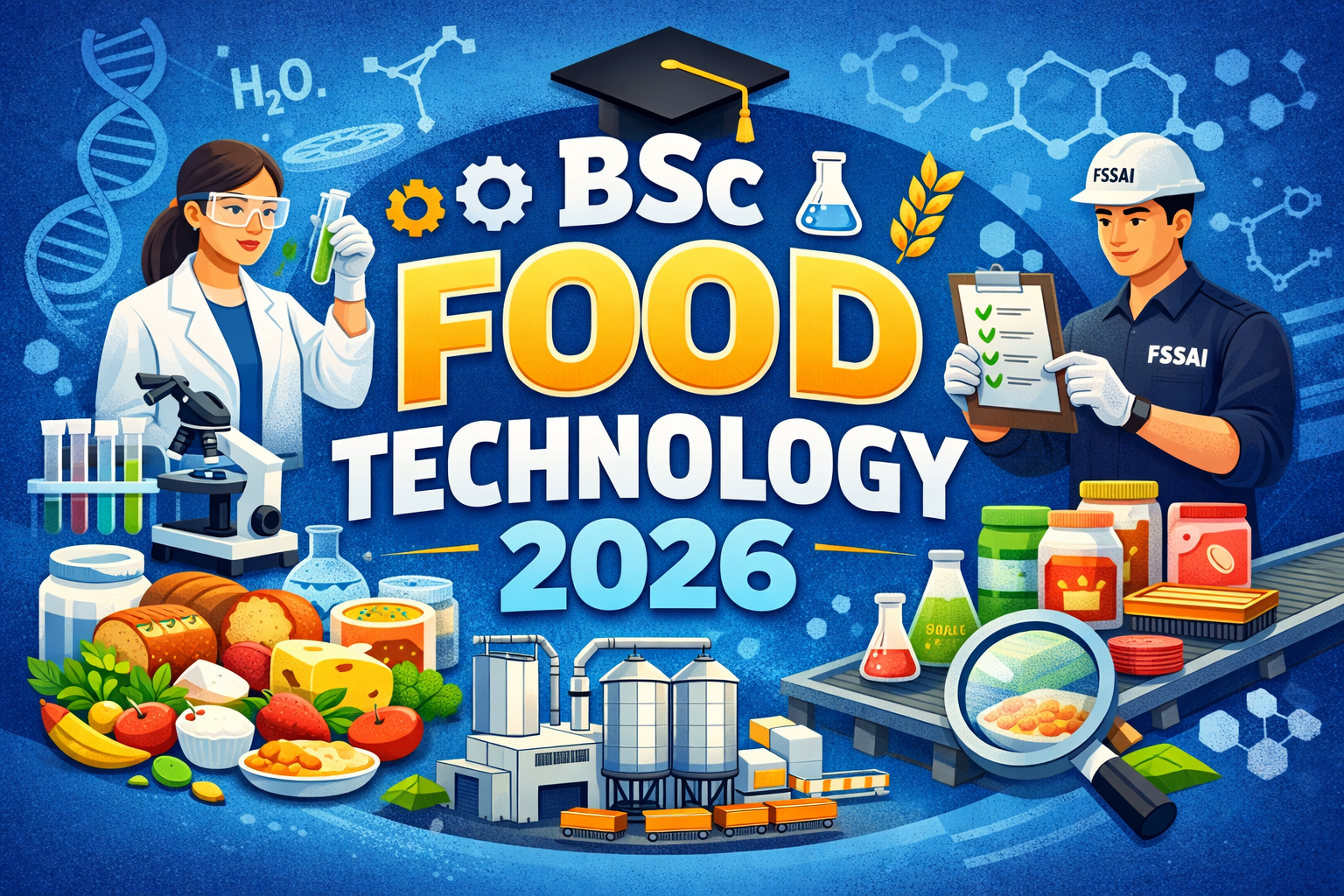
BSC Food Technology 2026: Course Details, Fees, Eligibility, Subjects, Top Colleges, Career & Salary in India
The demand for skilled professionals in food technology is increasing due to global concerns about food security, sustainability, and safety. A BSc Food Technology is a 3-year undergraduate program designed to equip students with the knowledge and skills to develop innovative solutions for the food industry.
To be eligible, students need a minimum qualification of PCM/PCB with 50% marks. The annual fees range from INR 30,000 to INR 1,50,000. Graduates of the BSc Food Technology program can pursue diverse career opportunities. Top recruiters include Nestlé, Amul, ITC, Britannia, HUL, Dabur, and PepsiCo. Admission to the program is typically based on entrance exams such as ICAR AIEEA, CUET, or state-level exams, depending on the college.
This article provides a full overview of the BSc Food Technology course, including details on fees, eligibility, subjects, top colleges, career prospects, and salary ranges in India. The curriculum provides a strong foundation in food science, technology, and management.
What Is BSc Food Technology? Overview & Highlights
BSc Food Technology is a 3-year undergraduate course that combines biology, chemistry, and engineering principles to focus on food processing, preservation, packaging, nutrition, and safety. This UGC-approved and FSSAI-regulated course offers specializations in Food Science & Technology, Dairy Technology, Food Processing, and Food Quality & Safety.
The Indian food processing industry is experiencing significant growth, supported by government initiatives like the Pradhan Mantri Kisan Sampada Yojana (PMKSY) and Mega Food Parks. Annual fees for BSc Food Technology range from INR 30,000 to INR 1,50,000. Top recruiters include Nestlé, Amul, ITC, Britannia, and Hindustan Unilever (HUL). The course provides a full understanding of food technology, enabling students to pursue careers in research, development, quality control, and management. Key aspects of the course are highlighted in the table below.
| Parameter | Details |
|---|---|
| Duration | 3 years |
| Eligibility | 10+2 with PCM/PCB/PCMB and 50% marks |
| Entrance Exams | ICAR AIEEA, CUET UG, State Agri exams |
| Top Colleges | NIFTEM, CFTRI, IIFPT, NDRI, Manav Rachna International Institute |
| Specialisations | Food Science & Technology, Dairy Technology, Food Processing, Food Quality & Safety |
| Career Options | Food Technologist, Quality Assurance Manager, Research and Development Scientist, Production Manager, Food Safety Officer |
| Salary Range | INR 3-6 LPA |
| Top Recruiters | Nestlé, Amul, ITC, Britannia, HUL, Dabur, PepsiCo |
| Government Initiatives | PMKSY, Mega Food Parks, FSSAI regulations |
BSc Food Technology Eligibility 2026
The eligibility criteria for BSc Food Technology 2026 are designed to ensure that candidates have a strong foundation in science subjects, which is essential for understanding food processing, preservation, quality control, and food safety concepts taught during the course.
Educational Qualification
-
Candidates must have successfully completed 10+2 (Class 12) or an equivalent examination from a recognized board such as CBSE, ICSE, or State Boards.
-
The qualifying examination must be passed with the Science stream, as BSc Food Technology is a technical and laboratory-oriented program.
Mandatory Subjects
-
Physics and Chemistry are compulsory subjects in Class 12.
-
Candidates must have studied Mathematics or Biology as the third core subject.
-
Students with PCB (Physics, Chemistry, Biology) or PCM (Physics, Chemistry, Mathematics) backgrounds are both eligible for admission.
Minimum Marks Requirement
-
Most colleges require candidates to secure at least 50%–60% aggregate marks in Class 12.
-
Reserved category candidates (SC/ST/OBC/EWS) are generally given relaxation of 5%–10% marks, as per government and university norms.
-
Some top institutions may have higher cut-off percentages, especially for merit-based admissions.
Age Limit
-
There is usually no upper age limit for admission to BSc Food Technology.
-
However, a few universities may specify a minimum age of 17 years at the time of admission.
Eligibility for Appearing Candidates
-
Students who are appearing for their Class 12 board exams in 2026 are also eligible to apply.
-
Final admission is granted only after submission of passing certificates and mark sheets during document verification.
Meeting the eligibility criteria is mandatory for participation in entrance exams, counselling rounds, or merit-based seat allotment.
| Eligibility Criteria | Details |
|---|---|
| Course Name | BSc Food Technology |
| Academic Qualification | Must have passed 10+2 (Class 12) or equivalent from a recognized board |
| Stream Required | Science stream |
| Mandatory Subjects | Physics and Chemistry |
| Third Subject | Mathematics or Biology |
| Minimum Marks | 50%–60% aggregate in Class 12 (varies by college) |
| Reserved Category Relaxation | 5%–10% relaxation for SC/ST/OBC/EWS candidates as per norms |
| Age Limit | Minimum 17 years (no upper age limit in most colleges) |
| Eligible Boards | CBSE, ICSE, State Boards, or any recognized board |
| Appearing Candidates | Class 12 appearing students in 2026 are eligible, subject to final results |
| Entrance Exam Requirement | Required for some universities; others offer merit-based admission |
| Nationality | Indian nationals (NRI/foreign nationals as per institute guidelines) |
BSc Food Technology Admission Process 2026
The BSc Food Technology admission process 2026 varies across institutions but generally follows either an entrance exam-based or merit-based selection system. Some universities follow a combination of both methods.
Step 1: Release of Admission Notification
Universities and colleges release official admission notifications on their websites, mentioning important dates, eligibility criteria, entrance exam details, and application procedures.
Step 2: Filling the Application Form
-
Candidates must complete the online or offline application form within the stipulated deadline.
-
Personal details, academic qualifications, subject combinations, and exam preferences must be filled accurately.
-
Application fees usually range between ₹500 to ₹2,000, depending on the institution.
Step 3: Entrance Examination or Merit-Based Selection
Entrance Exam-Based Admission
-
Many reputed institutions conduct their own entrance exams or accept scores from national/state-level exams such as CUET-UG, ICAR AIEEA, or university-specific tests.
-
Entrance exams typically test candidates on Physics, Chemistry, Mathematics/Biology, and basic aptitude.
Merit-Based Admission
-
Several colleges offer admission purely based on Class 12 marks, especially in Physics, Chemistry, and Biology/Mathematics.
-
Cut-off percentages are released after application scrutiny.
Step 4: Declaration of Results and Cut-Offs
-
Institutions publish entrance exam results, merit lists, or cut-off lists on their official websites.
-
Candidates scoring equal to or above the cut-off are shortlisted for the next round.
Step 5: Counselling Process
-
Shortlisted candidates are invited for online or offline counselling.
-
During counselling, students can select their preferred colleges and courses based on rank, seat availability, and category reservation.
-
Seat allotment is done after preference locking.
Step 6: Document Verification
Candidates must verify their documents, which usually include:
-
Class 10 and Class 12 mark sheets
-
Transfer Certificate and Migration Certificate
-
Entrance exam scorecard (if applicable)
-
Category certificate (if applicable)
-
Passport-size photographs and valid ID proof
Step 7: Fee Payment and Final Admission
-
After successful document verification, candidates must pay the admission fee to confirm their seat.
-
Once the fee is paid, the college issues a final admission confirmation letter.
Top BSc Food Technology Colleges 2026 with Fees
The top BSc Food Technology colleges in India offer a curriculum covering food processing, food safety, and quality control. These colleges provide hands-on experience and exposure to the latest technologies in the food industry. The fees range from INR 30,000 to INR 1,50,000 per year. Top colleges include NIFTEM Kundli, CFTRI Mysuru, IIFPT Thanjavur, and NDRI Karnal. These colleges are known for producing skilled professionals in high demand. The table below provides a list of top BSc Food Technology colleges in India, including their fees, location, and type.
| College | City | Type | Fees | Admission | Placement |
|---|---|---|---|---|---|
| NIFTEM Kundli | Kundli | INR 50,000 – INR 1,00,000 per year | ICAR AIEEA | 90% placement with average salary INR 4-6 LPA | |
| CFTRI Mysuru | Mysuru | INR 30,000 – INR 80,000 per year | ICAR AIEEA | 85% placement with average salary INR 3.5-5.5 LPA | |
| IIFPT Thanjavur | Thanjavur | INR 40,000 – INR 90,000 per year | ICAR AIEEA | 80% placement with average salary INR 3-5 LPA | |
| NDRI Karnal | Karnal | INR 50,000 – INR 1,20,000 per year | ICAR AIEEA | 90% placement with average salary INR 4-6 LPA | |
| PAU Ludhiana | Ludhiana | INR 30,000 – INR 80,000 per year | Punjab Agriculture University Entrance | 85% placement with average salary INR 3.5-5.5 LPA | |
| Manav Rachna | Faridabad | INR 88,000 – INR 1,64,000 per year | Manav Rachna Entrance | 85% placement with average salary INR 3.5-5.5 LPA | |
| MIT University | Pune | INR 1,00,000 – INR 2,00,000 per year | MIT Entrance | 90% placement with average salary INR 4-6 LPA |
BSc Food Technology Syllabus & Subjects
The BSc Food Technology syllabus is designed to provide students with a strong foundation in food science, food processing, nutrition, quality control, and food safety regulations. The curriculum combines theoretical knowledge, practical laboratory work, industrial training, and project-based learning, preparing graduates for careers in food manufacturing, research, and quality assurance.
The course is typically divided into 6 semesters (3 years). While the syllabus may vary slightly across universities, the core subjects remain largely similar.
Semester 1: Basic Sciences & Introduction to Food Technology
This semester focuses on building a fundamental understanding of science concepts required in food technology.
-
Fundamentals of Food Science
-
Food Chemistry – I
-
Basic Nutrition
-
Applied Mathematics / Biostatistics
-
Food Microbiology – I
-
Communication Skills
-
Food Science Laboratory – I
Semester 2: Core Scientific Principles
Students gain deeper insight into chemical, biological, and microbiological aspects of food.
-
Food Chemistry – II
-
Food Microbiology – II
-
Principles of Food Processing
-
Biochemistry
-
Food Physics
-
Environmental Studies
-
Food Microbiology & Chemistry Lab
Semester 3: Food Processing & Preservation Techniques
This semester emphasizes practical knowledge of food preservation and processing methods.
-
Food Preservation Methods
-
Cereal, Pulse, and Oilseed Technology
-
Fruits and Vegetable Processing
-
Food Engineering – I
-
Sensory Evaluation of Foods
-
Food Processing Laboratory – I
Semester 4: Advanced Food Processing Concepts
Students learn advanced techniques and industrial applications in food technology.
-
Meat, Poultry, and Fish Processing
-
Dairy Technology
-
Food Engineering – II
-
Food Packaging Technology
-
Quality Control and Food Analysis
-
Food Engineering & Packaging Lab
Semester 5: Food Safety, Quality & Management
This semester introduces food safety laws, quality management systems, and entrepreneurship.
-
Food Safety and Quality Assurance
-
Food Laws and Regulations (FSSAI)
-
Bakery and Confectionery Technology
-
Functional Foods and Nutraceuticals
-
Food Plant Management
-
Industrial Training / Internship
Semester 6: Specialization & Project Work
The final semester focuses on applied learning, research, and industry exposure.
-
Ready-to-Eat and Convenience Foods
-
Food Product Development
-
Waste Management in Food Industry
-
Research Methodology
-
Project Work / Dissertation
-
Viva Voce
Practical Training & Laboratory Work
Practical learning is a key component of the BSc Food Technology syllabus. Students perform experiments related to:
-
Microbial analysis of food
-
Chemical testing and food quality assessment
-
Food preservation techniques
-
Packaging material testing
-
Sensory evaluation of food products
Most universities also include mandatory industrial training or internships to provide real-world exposure.
Core Subjects in BSc Food Technology
The core subjects in BSc Food Technology are taught in almost every university because they form the foundation of food science and food industry knowledge. These subjects help students understand how food is processed, preserved, tested, packaged, and made safe for consumers.
Food Chemistry
Food Chemistry explains the chemical composition of food. Students learn about carbohydrates, proteins, fats, vitamins, minerals, enzymes, and additives. This subject helps in understanding how food changes during processing, cooking, and storage.
Food Microbiology
Food Microbiology deals with microorganisms present in food, such as bacteria, yeast, and molds. Students learn how microbes can spoil food or cause food poisoning and how to control them using proper processing and hygiene practices.
Food Processing and Preservation
This subject teaches different methods used to process and preserve food. Topics include drying, freezing, refrigeration, canning, fermentation, and pasteurization. It helps students understand how shelf life of food products is increased.
Food Engineering
Food Engineering focuses on machinery and equipment used in food industries. Students learn about heat transfer, mass transfer, food plant design, and processing operations used in large-scale food production.
Nutrition Science
Nutrition Science explains the nutritional value of food and its effect on human health. Students learn about balanced diets, nutrient requirements, malnutrition, and the role of food in disease prevention.
Quality Control and Food Analysis
This subject teaches methods to test food quality and safety. Students learn chemical, physical, and microbiological testing of food products to ensure they meet industry standards.
Food Packaging Technology
Food Packaging Technology covers types of packaging materials, labeling, storage, and transportation. Students learn how proper packaging protects food from contamination and spoilage.
Food Safety and Food Laws
This subject focuses on food safety standards and regulations. Students study food laws such as FSSAI, hygiene practices, HACCP, and quality management systems followed by food industries.
Elective Subjects (May Vary by University)
Elective subjects allow students to choose specialized areas based on their interests and career goals. These subjects may differ from one university to another.
Bakery and Confectionery Technology
This subject teaches the preparation and processing of bread, cakes, biscuits, chocolates, and sweets. It is useful for students interested in bakery businesses or food production units.
Dairy Technology
Dairy Technology focuses on milk processing and dairy products such as butter, cheese, yogurt, and ice cream. Students learn about dairy plant operations and quality control.
Meat, Poultry, and Fish Processing
This subject covers processing, preservation, and packaging of meat, poultry, and seafood products while maintaining hygiene and quality standards.
Food Biotechnology
Food Biotechnology explains the use of biological techniques in food production, such as fermentation, enzyme technology, and genetically improved food products.
Functional Foods and Nutraceuticals
This subject focuses on foods that provide health benefits beyond basic nutrition, such as fortified foods, probiotics, and dietary supplements.
Fermentation Technology
Fermentation Technology deals with the production of food products like curd, cheese, bread, vinegar, and alcoholic beverages using microorganisms.
Food Product Development
This subject teaches students how to develop new food products, improve taste, texture, packaging, and conduct market testing before launch.
Waste Management in Food Industry
Students learn methods to reduce, reuse, and recycle food waste, helping industries follow sustainable and eco-friendly practices.
Skills Gained Through BSc Food Technology Syllabus
The BSc Food Technology syllabus is designed to help students develop both technical skills and practical industry skills. These skills prepare graduates to work confidently in food manufacturing units, quality labs, research centers, and regulatory bodies.
Food Processing & Production Skills
Students learn how different food products are processed, preserved, and manufactured on a large scale. They understand production techniques used in industries such as dairy, bakery, beverages, and packaged foods. This skill helps graduates work in food plants and processing units.
Food Quality Testing & Analysis Skills
Through laboratory work, students gain skills in testing food quality. They learn how to check moisture, fat, protein, acidity, and microbial content. These skills are essential for jobs in quality control, food testing labs, and certification agencies.
Food Safety & Hygiene Skills
The syllabus trains students in food safety standards and hygiene practices. Students learn about FSSAI guidelines, HACCP, and sanitation procedures. This skill ensures that graduates can maintain food safety and prevent contamination in food industries.
Microbiological & Chemical Analysis Skills
Students develop skills in identifying harmful microorganisms and chemical changes in food. They learn how microbes affect food spoilage and how to control them using proper processing methods. These skills are useful in food safety labs and research facilities.
Product Development & Innovation Skills
BSc Food Technology students gain hands-on experience in developing new food products. They learn how to improve taste, texture, shelf life, and packaging. This skill is valuable for careers in research and development (R&D) and food startups.
Food Packaging & Storage Skills
Students understand the importance of proper packaging and storage methods. They learn how different packaging materials protect food from damage and spoilage. This skill helps in logistics, cold storage, and supply chain roles.
Equipment Handling & Technical Skills
The syllabus includes training on food processing machinery and lab equipment. Students learn how to operate, monitor, and maintain machines safely, which is essential for working in production units and factories.
Analytical & Problem-Solving Skills
Food Technology students learn how to analyze problems in food production and find effective solutions. This skill helps in improving product quality, reducing wastage, and maintaining industry standards.
Research & Data Interpretation Skills
Through projects and practical work, students gain experience in research methods, data collection, and result interpretation. These skills are helpful for higher studies like MSc Food Technology or research-based careers.
Communication & Teamwork Skills
Students learn how to work in teams, prepare reports, and present findings clearly. These skills are important for coordinating with production teams, quality inspectors, and management staff in food industries.
Management & Organizational Skills
The syllabus introduces basic food plant management and production planning concepts. Students learn how to manage resources, time, and workflow efficiently, which is useful for supervisory and managerial roles.
Sustainability & Waste Management Skills
Students gain awareness of environment-friendly practices and food waste management. They learn how industries reduce waste and follow sustainable food production methods.
Career Options & Salary After BSc Food Technology
A BSc in Food Technology offers diverse and lucrative career options in both government and private sectors. Graduates can work as Food Technologists, Quality Assurance Managers, Research and Development Scientists, Production Managers, and Food Safety Officers. Starting salaries range from ₹3-6 LPA, while experienced professionals can earn between ₹8-15 LPA. Top recruiters include Nestlé, Amul, ITC, Britannia, and HUL, as well as government organizations like FSSAI and FCI. The organic sector is also providing new opportunities for graduates.
| Job Role | Key Responsibilities | Starting Salary (LPA) | Experienced Salary (LPA) | Top Recruiters / Workplaces |
|---|---|---|---|---|
| Food Technologist | Develops and implements food processing techniques | ₹3–6 LPA | ₹8–12 LPA | Nestlé, ITC |
| Quality Assurance Manager | Oversees quality control and ensures food standards | ₹4–7 LPA | ₹10–15 LPA | Britannia, HUL |
| Research & Development Scientist | Develops new food products and processes | ₹3.5–6.5 LPA | ₹9–18 LPA | CFTRI, Nestlé |
| Production Manager | Manages production operations in food plants | ₹4–8 LPA | ₹10–15 LPA | Amul, Parle |
| Food Safety Officer | Ensures compliance with food safety regulations | ₹3–5 LPA | ₹6–10 LPA | FSSAI, FCI |
| Nutrition Consultant | Provides dietary advice and nutrition planning | ₹3–5 LPA | ₹6–10 LPA | Hospitals, Private Clinics |
| Food Analyst | Tests and analyzes food samples for quality | ₹3–4 LPA | ₹6–10 LPA | FARE Labs, Food Testing Labs |
| Dairy Technologist | Develops and manages dairy processing techniques | ₹3–5 LPA | ₹7–12 LPA | Amul, Mother Dairy |
| Packaging Technologist | Designs and improves food packaging solutions | ₹3–5 LPA | ₹7–12 LPA | ITC, HUL |
| FSSAI Inspector | Conducts inspections and enforces food safety laws | ₹4–6 LPA | ₹8–12 LPA | FSSAI (Government) |
Higher Education After BSc Food Technology
After completing a BSc in Food Technology, students have options for higher education in India and abroad. These include pursuing a Master’s degree in Food Technology (MSc Food Tech), a Master’s in Technology (MTech), a PhD in Food Technology, an MBA in Agribusiness, or obtaining a certification like FoSTaC from the Food Safety and Standards Authority of India (FSSAI). The table below outlines these courses, their durations, entrance exams, institutes offering them, and the expected salaries post-graduation.
| Course | Duration | Entrance | Institutes | Salary Post |
|---|---|---|---|---|
| MSc Food Technology | ICAR PG/CUET PG | NIFTEM, CFTRI | ₹5-8 LPA | |
| MTech Food Technology | GATE | IITs, NITs | ₹7-12 LPA | |
| PhD Food Technology | NET/GATE | NIFTEM, CFTRI, IITs | ₹8-15 LPA | |
| MBA Agribusiness | CAT | IIM-A, Other Top B-Schools | ₹10-18 LPA | |
| MSc Food Science Abroad | GRE/IELTS | UK/Germany Universities | $40,000-$60,000 |
BSc Food Technology vs BTech Food Technology
BSc and BTech Food Technology courses differ in duration, fees, eligibility, and career prospects. BSc Food Technology is a 3-year course with fees ranging from INR 30,000 to INR 1,50,000 per year, while BTech Food Technology is a 4-year course with fees between INR 1,00,000 to INR 3,00,000 per year. BSc Food Technology eligibility includes PCM/PCB with 50% marks, whereas BTech Food Technology requires PCM with 50% marks and a valid JEE Main or state-level exam score. The table below highlights the key differences.
| Parameter | BSc | BTech |
|---|---|---|
| Duration | 3 years | 4 years |
| Eligibility | PCM/PCB with 50% marks | PCM with 50% marks + JEE Main/State |
| Entrance Exams | ICAR AIEEA/CUET | JEE Main/State Level |
| Focus | Science + Food Processing | Engineering + Food Engineering |
| Career | QA/R&D, Food Technologist | Engineering roles, Design, Production Manager |
| Best For | Research/Quality Assurance | Engineering and Design aspects of Food Technology |
BSc Food Technology: Govt Jobs, FSSAI & Entrepreneurship
The BSc Food Technology program offers opportunities in government jobs, FSSAI, and entrepreneurship. Graduates can explore roles like FSSAI Officer, FCI Manager, State Food Inspector, and SSC, with salaries ranging from ₹25,000 to ₹1.42 lakh per month. Entrepreneurship options include starting a food processing unit via the PMFME scheme, which offers a 35% subsidy, or pursuing food consulting and blogging. The PMEGP scheme also provides support for entrepreneurship ventures. Additionally, the PLI scheme and Mega Food Parks offer opportunities for growth. With the increasing demand for organic and health foods, graduates can capitalize on this trend.
Government Job Roles After BSc Food Technology
| Job Role | Salary / Income | Key Responsibility |
|---|---|---|
| FSSAI Officer | ₹44,900 – ₹1.42 lakh per month | Ensures food safety standards and regulatory compliance across India |
| FCI Manager | ₹40,000 – ₹1.2 lakh per month | Manages food storage, procurement, and public distribution |
| State Food Inspector | ₹25,000 – ₹60,000 per month | Conducts food inspections and quality checks at state level |
| SSC (Various Posts) | ₹25,000 – ₹50,000 per month | Works in different government ministries and departments |
Entrepreneurship & Self-Employment Opportunities
| Option | Earning / Support | Highlights |
|---|---|---|
| Own Food Processing Unit | ₹5–20 lakh per year (potential) | Start a food unit with government support under PMFME scheme |
| Food Consulting Services | ₹3–10 lakh per year (potential) | Provide consultancy to food startups, hotels, and manufacturers |
| PMEGP Scheme | Subsidy support up to ₹25 lakh | Financial assistance to start and run food-related businesses |
| PLI Scheme | Incentives for food industries | Encourages large-scale investment and growth in food processing |
| Mega Food Parks | Infrastructure & facilities support | Provides common processing, storage, and logistics facilities |
| Organic & Health Foods | High market demand | Strong opportunities due to rising health and wellness awareness |
FAQs
1. What is BSc Food Technology?
BSc Food Technology is a three-year undergraduate course focusing on food processing, preservation, quality control, packaging, and food safety using scientific and technological methods.
2. Who is eligible for BSc Food Technology 2026?
Candidates must pass 10+2 with Physics and Chemistry and either Biology or Mathematics from a recognized board, securing at least 50–60% aggregate marks.
3. What is the admission process for BSc Food Technology 2026?
Admission is offered through entrance exams like CUET-UG or merit-based selection using Class 12 marks, followed by counselling, document verification, and fee payment.
4. Which entrance exams are accepted for BSc Food Technology?
Common entrance exams include CUET-UG, ICAR AIEEA, and university-specific tests conducted by state or private institutions for BSc Food Technology admission.
5. What subjects are taught in BSc Food Technology?
The syllabus includes Food Chemistry, Food Microbiology, Food Processing, Nutrition, Food Engineering, Quality Control, Packaging Technology, and Food Safety Laws.
6. What is the duration of BSc Food Technology course?
BSc Food Technology is a three-year undergraduate program divided into six semesters, including theory classes, practical laboratory sessions, internships, and final-year project work.
7. What is the average fee for BSc Food Technology in India?
The course fee ranges from ₹50,000 to ₹2.5 lakh per year, depending on the college type, location, infrastructure, and whether it is government or private.
8. What are the career options after BSc Food Technology?
Graduates can work as Food Technologists, Quality Analysts, Food Safety Officers, Production Managers, R&D Executives, or start their own food processing business.
9. What is the salary after BSc Food Technology?
Fresh graduates earn ₹3–6 LPA, while experienced professionals can earn ₹8–15 LPA, depending on job role, experience, company, and specialization.
10. Is BSc Food Technology good for government jobs?
Yes, graduates can apply for government roles like FSSAI Officer, Food Inspector, FCI Manager, and SSC posts after qualifying relevant competitive examinations.