BSc Interior Design: Admission, Colleges, Fees & Career Scope in India
A BSc in Interior Design is a 3-year UG course, offering jobs as an interior designer, set designer, exhibition designer and more. Read about its fees, top colleges, syllabus, salary and more here.
With increasing emphasis on design, a BSc Interior Design degree is a valuable qualification in India. This 3-year undergraduate program provides the knowledge and skills to create functional and aesthetically pleasing spaces. To be eligible, students need a 10+2 or equivalent with a minimum of 45-50% marks. Graduates with a BSc Interior Design degree can pursue careers as interior designers, space planners, furniture designers, and visual merchandisers, with starting salaries ranging from ₹2.5 LPA to ₹4.5 LPA. Course fees vary from INR 50,000 to INR 5,00,000, depending on the institution. This article offers a detailed look at the BSc Interior Design course, covering colleges, fees, syllabus, and career prospects.
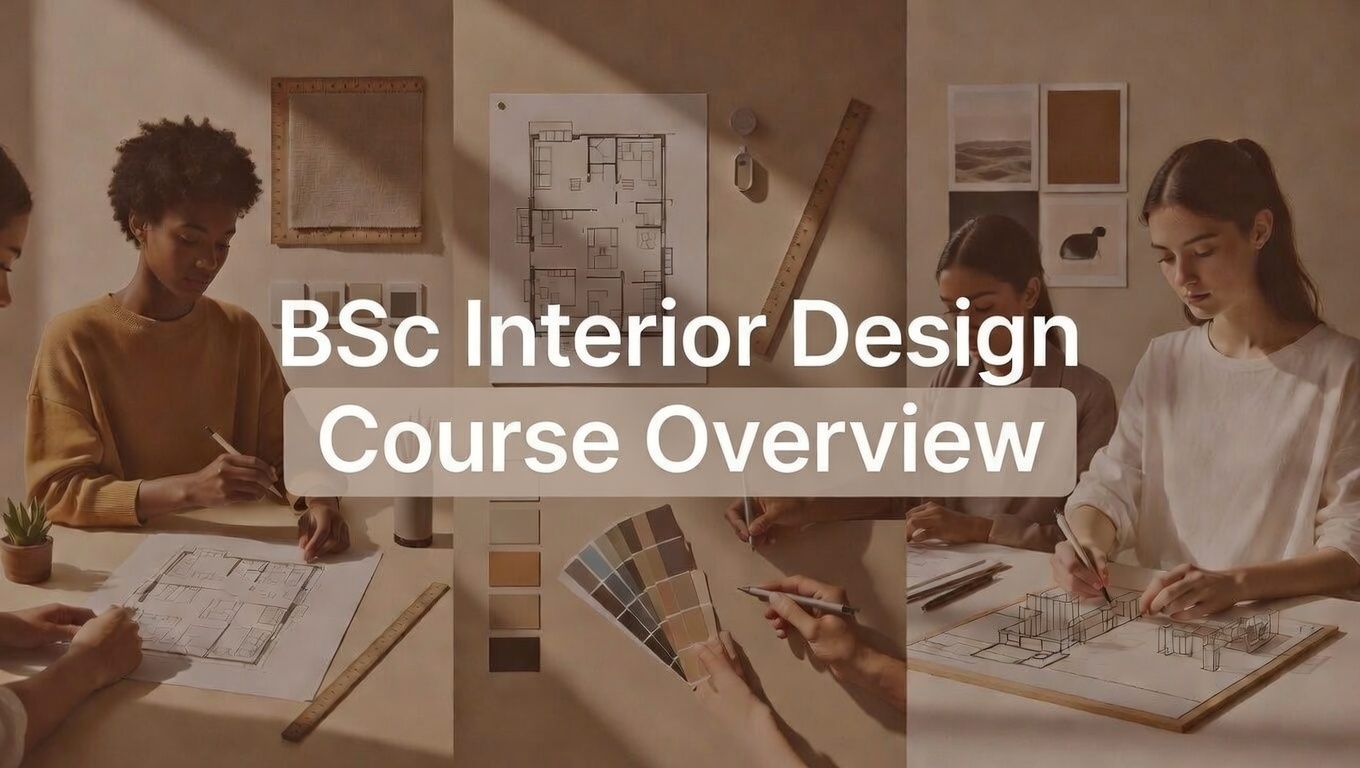
BSc Interior Design: Course Overview
🔔 Admission Alerts 2026
- Apply Now: Chitkara B.Des Interior Design applications open for 2026.
- Entrance Exam: UCEED scores are valid for B.Des Interior Design admission.
- Key Exams: CUET, UCEED, NID, NIFT Entrance exams are crucial for top colleges.
- Merit List: NID DAT Merit List 2026 release date expected soon.
The BSc Interior Design course is a three-year undergraduate program focusing on the creative and technical aspects of designing interiors. The course is divided into six semesters. Take a quick overview of this course before diving into various details:
| Aspect | Details |
|---|---|
| Full Form/ Meaning | Bachelor of Science in Interior Design |
| Duration | 3 years |
| Eligibility | 10+2 or equivalent with minimum 45-50% marks |
| Average Fees | INR 50,000 to INR 5,00,000 |
| Job Roles | Interior Designer, Space Planner, Furniture Designer, Visual Merchandiser |
| Average Starting Salary | ₹2.5 LPA – ₹4.5 LPA |
| Top Colleges | Government College of Architecture, MSU Baroda, Chandigarh College of Architecture |
| Admission Process | Merit-based or Entrance Exam |
| Course Structure | 6 semesters with a mix of theoretical and practical subjects |
| Specializations | Sustainable Design, Furniture Design, Lighting Design, Space Planning |
BSc Interior Design Eligibility Criteria: Qualification and Requirements
To be eligible for a BSc Interior Design program in India, students generally need a 10+2 or equivalent from a recognized board. The required minimum percentage typically ranges from 45% to 50%, but may vary. While eligibility criteria vary, here are some common requirements:
- Completion of 10+2 or Equivalent Qualification: Candidates must have successfully passed Class 12 (Higher Secondary) or an equivalent examination from a recognized board such as CBSE, ICSE, state boards, or equivalent, in any stream including Arts, Commerce, or Science.
- Minimum Aggregate Marks in Class 12: Applicants are generally required to secure at least 45% to 50% aggregate marks in their 10+2 examinations, though some institutions demand 50-60% for general category students, with relaxations for reserved categories.
- Stream Flexibility with No Specific Subject Mandate: The program is open to students from any academic stream (Science, Commerce, or Arts/Humanities), as most colleges do not mandate specific subjects like Physics, Mathematics, or Fine Arts at the 10+2 level.
- Age Requirement (Where Applicable): Candidates should typically be at least 16-17 years old at the time of admission.
- Entrance Exam or Merit-Based Selection: Admission may be based on merit in qualifying exams or through entrance tests like institute-specific aptitude tests, CUET, or design aptitude assessments, followed by interviews or portfolio reviews in some cases.
- Relaxation for Reserved Categories: SC/ST/OBC and other reserved category candidates often receive a 5% relaxation in minimum aggregate marks (e.g., 45% instead of 50%), as per government norms and institutional policies.
BSc Interior Design Admission Process: A Step-by-Step Guide
The admission process for a BSc Interior Design program varies by college. However, the process typically includes the below listed steps:
- Verify that you meet the BSc Interior Design program’s eligibility criteria, including having a 10+2 or equivalent with 45-50% marks.
- Complete the application form online or offline, following the college’s instructions, and pay the application fee (INR 500 to INR 2,000).
- Submit required documents, such as mark sheets, certificates, and ID proof (passport, Aadhaar card, or driving license).
- If required, appear for entrance exams like NID DAT, NIFT Entrance Exam, or college-specific exams, conducted online or offline.
- Attend counseling or interviews, in person or via video conference.
- Check the merit or admission list on the college’s website or notice board.
- Pay the admission fee (INR 50,000 to INR 5,00,000 per year) to confirm your seat.
- Confirm the college’s accreditation and recognition by NAAC or NIRF.
- Research the college’s infrastructure and facilities, including studios, labs, and libraries.
- Review the college’s placement record and alumni network.
Top Entrance Exams for BSc Interior Design in India
Take a look at some of the most common entrance exams for BSc Interior Design course in India:
| Exam Name | Eligible Colleges | Typically Conducted During |
|---|---|---|
| CUET (Common University Entrance Test) UG | Chandigarh University, Jain University, REVA University, Geeta University, Avinashilingam Institute, Sushant University, many private/deemed universities offering BSc Interior Design | May-June |
| LPUNEST (Lovely Professional University National Entrance and Scholarship Test) | Lovely Professional University (Jalandhar) – one of the top private options for BSc Interior Design | Multiple phases: January, April, June |
| Institute-Specific Aptitude Tests / Merit + Test | Army Institute of Fashion and Design (Bangalore), J.D. Birla Institute (Kolkata), Vogue Institute (Bangalore), Sandip University, many private colleges | Varies by college: Often Dec-May |
| State-Level Exams (e.g., TS EAMCET, Karnataka CET equivalents where applicable) | Malla Reddy University (Hyderabad), some state-affiliated colleges in Karnataka, Telangana | Varies: April-May |
| Other Design Exams (Limited/Accepted by Few for Related Programs) | Pearl Academy Entrance Exam (PAPT), SEED (Symbiosis) – occasionally for BSc variants or related | January-March |
Top Government BSc Interior Design Colleges in India
Take a look at some of India’s top government colleges for a BSc Interior Design, or a related course, with their location, fees and admission mode:
| College Name (City) | Total Course Fees | Admission Mode |
|---|---|---|
| Avinashilingam Institute for Home Science & Higher Education for Women (Coimbatore) | N/A (affordable government-aided/deemed) | CUET (General Test) or merit-based |
| Bengaluru Central University / Bangalore University (Bangalore) | N/A | Merit-based |
| Goa University (Goa) | N/A | Merit-based or university entrance |
| Aligarh Muslim University (Aligarh) | ₹800 – ₹8,000 (approx. Per year) | University entrance exam |
| Guru Gobind Singh Indraprastha University (Delhi) | ₹1.92 Lakh – ₹2.82 Lakh | IPU CET or CUET |
| Bharathiar University (Coimbatore – through affiliated colleges) | Varies (low in affiliated govt colleges) | Merit-based or university guidelines |
| Bengaluru North University (Kolar) | N/A | Merit-based |
Top Private BSc Interior Design Colleges in India
The following table lists top private colleges in India offering BSc Interior Design, or related course, including their location, fees and admission mode:
| College Name (City) | Total Course Fees | Admission Mode |
|---|---|---|
| Lovely Professional University (Jalandhar) | ₹5.6 Lakh – ₹8.4 Lakh | LPUNEST or CUET |
| Army Institute of Fashion and Design (Bangalore) | ₹6.12 Lakh – ₹6.74 Lakh | Entrance exam (AIFD Test) |
| J.D. Birla Institute (Kolkata) | N/A | Merit-based or institute test |
| Jain (Deemed-to-be University) (Bangalore/Kochi) | N/A | Merit-based or CUET (General Test) |
| Chandigarh University (Chandigarh) | ₹5.7 Lakh | CUCET or CUET (Home Science + General Test) |
| Malla Reddy University (Hyderabad) | N/A | TS EAMCET or merit-based |
| Sandip University (Nashik) | ₹2.25 Lakh | Merit-based or institute test |
| Indian Institute of Fashion and Design (IIFD) (Chandigarh) | ₹5.7 Lakh | Merit-based |
| AAFT University (Noida/Raipur) | ₹6 Lakh – ₹8 Lakh | Entrance exam or merit-based |
| Pillai College of Architecture (Mumbai) | ₹4.5 Lakh | Merit-based or NATA |
| Indian Institute of Fashion and Design (IIFD) (Kolkata) | ₹4.95 Lakh – ₹5 Lakh | Merit-based |
| Aditya Academy of Architecture and Design (Bangalore) | N/A | Merit-based |
| Aesthetic Institute of Design (Raipur) | N/A | Merit-based |
| Agurchand Manmull Jain College (Chennai) | ₹1.70 Lakh | Merit-based |
| Al Salama Institute of Architecture (Malappuram) | N/A | Merit-based |
| Bangalore School of Design and Technology (Bengaluru) | ₹18 Lakh | Merit-based |
| Bards Institute of Design (Guwahati) | N/A | Merit-based |
| Bharati Vidyapeeth College of Architecture (Pune) | ₹4 Lakh | NATA or merit-based |
| BK Birla College of Arts Science and Commerce (Kalyan) | N/A | Merit-based |
| Budha College of Higher Education (Karnal) | N/A | Merit-based |
| Cartier Global Academy (Mumbai) | N/A | Merit-based |
| Cindrebay School of Design (Bengaluru/Calicut/Chennai) | N/A | Institute entrance test |
| Delhi School of Architecture and Design (Delhi) | ₹3.30 Lakh | Merit-based |
| Dr. D.Y. Patil School of Design (Pune) | ₹5.80 Lakh | Entrance exam or merit-based |
| Geeta University (Panipat) | N/A | CUET (General Test) |
| Swami Vivekanand Subharti University (Meerut) | N/A | CUET (English + Fine Arts) |
| Vogue Institute of Art and Design (Bangalore) | ₹8.98 Lakh | Merit-based or institute test |
| International School of Design (INSD) (Kolkata) | ₹3.06 Lakh | Merit-based |
| Pearl Academy (Delhi/Mumbai/Jaipur/Bangalore) | ₹5.57 Lakh (approx) | Entrance exam (PAPT) |
| REVA University (Bangalore) | N/A | Merit-based or REVA CET |
BSc Interior Design Course Fees: Comparison of Government and Private Colleges
BSc Interior Design course fees vary significantly between government and private colleges. Here is a side by side comparison:
| College Type | College Name | Tuition Fees (INR) | Hostel Fees (INR) | Other Charges (INR) |
|---|---|---|---|---|
| Government | Government College of Architecture | INR 50,000 | INR 20,000 | INR 10,000 |
| Private | Amity University | INR 2,00,000 | INR 1,00,000 | INR 20,000 |
| Government | MSU Baroda – Maharaja Sayajirao University of Baroda | INR 50,000 | INR 25,000 | INR 15,000 |
| Private | Symbiosis International University | INR 3,00,000 | INR 1,20,000 | INR 30,000 |
| Government | Chandigarh College of Architecture | INR 50,000 | INR 30,000 | INR 20,000 |
| Private | Manipal University | INR 2,50,000 | INR 1,50,000 | INR 40,000 |
| Government | J J School of Arts | INR 50,000 | INR 35,000 | INR 25,000 |
| Private | VIT University | INR 3,50,000 | INR 2,00,000 | INR 50,000 |
| Government | College of Architecture | INR 50,000 | INR 40,000 | INR 30,000 |
| Private | SRM University | INR 4,00,000 | INR 2,50,000 | INR 60,000 |
BSc Interior Design Syllabus: Year-wise Breakdown
Check Bhartiyar University BSc Interior Design Official Syllabus
The BSc Interior Design program is a 3-year undergraduate course, typically divided into six semesters, focusing on both theoretical and practical aspects. Take a look at its syllabus structure below:
| Semester | Year | Core Subjects | Elective Subjects | Credit Hours |
|---|---|---|---|---|
| Semester 1 | Year 1 | Introduction to Interior Design, Basic Design Principles, Visual Communication | History of Art and Design | 20 |
| Semester 2 | Year 1 | Space Planning, Materials and Construction, Computer-Aided Design (CAD) | Ergonomics | 20 |
| Semester 3 | Year 2 | Furniture Design, Lighting Design, Sustainable Design | Landscape Design | 22 |
| Semester 4 | Year 2 | Interior Detailing, Building Services, Cost Estimation | Acoustics | 22 |
| Semester 5 | Year 3 | Professional Practice, Project Management, Advanced CAD | Universal Design | 24 |
| Semester 6 | Year 3 | Design Thesis, Portfolio Development | Interior Design Specialization | 24 |
| Semester 7 | Year 4 (Optional) | Research Methods, Design Theory | Building Information Modelling (BIM) | 20 |
| Semester 8 | Year 4 (Optional) | Dissertation, Industry Internship | Entrepreneurship in Interior Design | 20 |
Syllabus in Detail: Core Subjects in BSc Interior Design
Students looking to explore the BSc Interior Design syllabus in detail can explore core subjects and their descriptions below:
| Subject Name | Subject Description |
|---|---|
| Fundamentals of Interior Design | Introduces basic principles, elements of design, and foundational concepts for creating functional and aesthetic interiors. |
| Theory of Design / Design Principles | Explores core design theories, elements (line, shape, form, color, texture), and principles (balance, rhythm, harmony) applied to interiors. |
| History of Interior Design | Covers the evolution of interior styles, architecture, and design movements from ancient to modern periods, including Indian and global contexts. |
| Materials and Construction | Studies properties, selection, application, and construction techniques of materials like wood, metals, fabrics, and finishes used in interiors. |
| Colour Theory and Application | Examines color psychology, schemes, harmonies, and their practical use in creating mood, ambiance, and visual impact in interior spaces. |
| Space Planning and Layout Design | Focuses on efficient spatial organization, circulation, zoning, and ergonomic planning for residential and commercial interiors. |
| Furniture Design | Teaches design, ergonomics, materials, and construction of furniture, including functional and aesthetic aspects for various spaces. |
| Lighting Design | Explores types of lighting, fixtures, techniques, and their role in enhancing functionality, mood, and energy efficiency in interiors. |
| Interior Graphics and Drawing | Develops skills in freehand sketching, technical drawing, perspective, and rendering for communicating interior design ideas. |
| Computer-Aided Design (CAD) | Introduces software tools (AutoCAD, 3D modeling) for creating precise 2D/3D drawings, plans, elevations, and visualizations. |
| Building Services and Systems | Covers integration of electrical, plumbing, HVAC, acoustics, and other services essential for functional and safe interior environments. |
| Ergonomics and Human Factors | Studies human dimensions, anthropometrics, and behavioral aspects to design comfortable, accessible, and user-centered interiors. |
| Interior Design Studio / Projects | Hands-on practical studio where students apply concepts to real-world residential/commercial design projects, including presentations. |
Career Scope and Jobs & Salary after BSc Interior Design in India
BSc Interior Design graduates have diverse career options in India, including roles as Interior Designers, Space Planners, Furniture Designers, and Visual Merchandisers. Salaries vary from ₹2.5 to ₹4.5 LPA, while mid-level and senior-level salaries can reach ₹8-12 LPA and ₹15-20 LPA, respectively. Here is a detailed overview:
| Job Role | Entry-Level Salary | Mid-Level Salary | Senior-Level Salary | Skills Required |
|---|---|---|---|---|
| Interior Designer | ₹2.5 – ₹4.5 LPA | ₹6-10 LPA | ₹12-20 LPA | AutoCAD, SketchUp, space planning, color theory |
| Interior Decorator | ₹2.0 – ₹3.5 LPA | ₹4-7 LPA | ₹8-15 LPA | Color theory, textile design, lighting design, furniture selection |
| Space Planner | ₹2.4 – ₹4.0 LPA | ₹5-9 LPA | ₹10-18 LPA | AutoCAD, Revit, space planning, ergonomics |
| Furniture Designer | ₹2.2 – ₹3.8 LPA | ₹4-8 LPA | ₹8-15 LPA | AutoCAD, SolidWorks, furniture design, materials science |
| Visual Merchandiser | ₹2.0 – ₹3.5 LPA | ₹3-6 LPA | ₹6-12 LPA | Visual display, window display, store design, brand management |
| Landscape Designer | ₹2.5 – ₹4.0 LPA | ₹5-9 LPA | ₹10-18 LPA | AutoCAD, SketchUp, landscape design, horticulture |
| Lighting Designer | ₹2.2 – ₹3.8 LPA | ₹4-8 LPA | ₹8-15 LPA | Lighting design, electrical engineering, building codes |
| Set Designer | ₹2.0 – ₹3.5 LPA | ₹3-6 LPA | ₹6-12 LPA | Set design, stage design, film production, theater production |
| Exhibition Designer | ₹2.2 – ₹3.8 LPA | ₹4-8 LPA | ₹8-15 LPA | Exhibition design, display design, graphic design, event management |
| Interior Architect | ₹2.5 – ₹4.5 LPA | ₹6-10 LPA | ₹12-20 LPA | Architecture, interior design, building codes, construction management |
Top Recruiters for BSc Interior Design
BSc Interior Design graduated can target the following recruiters for various sectors:
| Industry/Sector | Top Recruiters |
|---|---|
| Modular & Tech-Enabled Home Interiors | Livspace, HomeLane, Design Café, Bonito Designs |
| Premium/Architectural Design Firms | Morphogenesis, Talati & Partners, Studio Lotus, ZZ Architects |
| Furniture & Product Design Brands | Godrej Interio, Asian Paints (Interior Solutions), Urban Ladder, Pepperfry |
| Corporate & Commercial Interiors | Space Matrix, Ace Interiors, collaboration Corporate Interiors, WeWork India |
| Residential & Renovation Services | Urban Company, De Panache, The Grid, Shobha Interiors |
| Retail & Visual Merchandising | Reliance Retail, Wizcraft, INOX Leisure, IKEA India |
| Hospitality & Exhibition Design | D’LIFE Interiors, Carafina, Dream Space India, Acme Interiors |
Scope for Higher Studies After BSc Interior Design
After completing a BSc Interior Design course, graduates can pursue the following options for higher education:
Master’s in Interior Design (MSc/MA/Master of Interior Design)
This 2-year postgraduate program deepens expertise in advanced design principles, sustainable practices, project management, and specialized areas. It prepares graduates for senior roles or consultancy. It also enhances professional credibility and opens doors to leadership positions in design firms.
Master of Design (M.Des) in Interior Design or Related Specializations
Offered by institutions like NID or private universities, this program focuses on research-oriented design innovation, user-centered approaches, and emerging trends such as biophilic or modular design. It is ideal for those aiming at creative direction, academia, or product-integrated interior solutions.
M.Arch in Interior Architecture
A postgraduate architecture degree emphasizing large-scale spatial planning, building integration, and technical aspects of interiors, suitable for graduates interested in blending architecture with design for complex projects like hospitality or institutional spaces.
MBA in Design Management or Interior Design Management
This combines creative design knowledge with business, marketing, and project leadership skills, enabling graduates to pursue entrepreneurial ventures, studio ownership, design firm management, or strategic roles in real estate and corporate sectors.
Preparation Tips for Admission into BSc Interior Design
If you’re preparing for admission into a BSc Interior Design course, here are some practical tips to strengthen your admission prospects:
- Research colleges and their specific admission requirements thoroughly: Identify target institutions, check eligibility, entrance exams (like CUET, institute tests), cut-offs, and whether a portfolio or interview is needed to tailor your preparation effectively.
- Build a strong creative portfolio showcasing your artistic skills: Compile sketches, drawings, color studies, or small design projects from observation to demonstrate creativity, perspective, and basic design sense, as many colleges value it highly.
- Practice daily sketching and observational drawing to enhance skills: Dedicate time each day to freehand sketching, still life, perspectives, and spatial arrangements to strengthen foundational abilities tested in entrance exams or interviews.
- Prepare for entrance exams or aptitude tests with consistent practice: Focus on design principles, color theory, general aptitude, reasoning, and mock tests; review previous papers and improve time management for better performance.
- Maintain good academic performance in Class 12 and develop communication skills: Secure the required minimum percentage while practicing clear expression of ideas, as interviews or discussions often assess passion, vision, and articulation during selection.
Why Pursue BSc Interior Design: Current Trends and Future Scope
In 2026, pursuing a BSc Interior Design in India stands out as a smart choice amid rapid urbanization, rising demand and a booming industry. Here are some quick reasons to choose this course:
- India’s interior design market is expanding rapidly due to ongoing urbanization and real estate boom.
- Clients increasingly demand sustainable materials and eco-friendly solutions in residential and commercial projects.
- Smart home technology, IoT devices, and AI tools are becoming standard in modern interior planning.
- Biophilic design and wellness-focused spaces with natural elements are gaining strong popularity.
- Graduates find diverse opportunities in residential, hospitality, retail, and modular furniture sectors.
- Emerging technologies like VR, AR, and sustainable innovations ensure long-term career relevance and growth.
B.Sc Interior Design vs B.Des Interior Design
A Bachelor of Design in Interior Design is a popular alternative to BSc Interior Design. Here is a side-by-side comparison of the two courses:
| Aspect | B.Sc Interior Design | B.Des Interior Design |
|---|---|---|
| Full Form | Bachelor of Science in Interior Design | Bachelor of Design in Interior Design |
| Duration | 3 years (6 semesters) | 4 years (8 semesters) |
| Primary Focus | Technical & scientific: materials, construction, ergonomics, building services, sustainability | Creative & artistic: aesthetics, conceptual innovation, user-centered design, advanced studio work |
| Approach & Strengths | Academic/theoretical with strong technical foundation (e.g., CAD, codes, science elements) | Professional/practical with emphasis on creativity, portfolio, and industry innovation |
| Eligibility | 10+2 any stream, 45-50% marks (no specific subjects usually) | 10+2 any stream, 50%+ marks; creative aptitude often preferred |
| Admission Process | Mostly merit-based (Class 12 marks) + CUET UG or institute tests | Entrance-heavy: NID DAT, UCEED, NIFT, CEED, or institute exams + portfolio/interview |
| Average Total Fees | ₹50,000 – ₹10 Lakh (lower in govt colleges) | ₹3 Lakh – ₹15 Lakh+ (higher in premium institutes like NID, Pearl Academy) |
| Core Subjects Emphasis | Materials science, building systems, technical drawing, ergonomics | Design theory, spatial aesthetics, advanced rendering, conceptual projects |
| Career Perception & Scope | Solid for technical roles, modular firms, government projects, teaching; good entry-level stability | Often seen as stronger for creative/high-profile jobs, luxury studios, freelancing, entrepreneurship |
| Starting Salary (Freshers) | ₹2.5 – ₹5 LPA | ₹3 – ₹6 LPA (higher potential in top firms due to creative edge) |
| Best For | Students wanting quicker, affordable degree with technical depth; balanced science + design | Highly creative individuals seeking artistic freedom, extensive practical training, broader industry recognition |
Frequently Asked Questions (FAQs)
Q1. What is the duration of the BSc Interior Design course?
The BSc Interior Design course is an undergraduate program lasting 3 years, divided into 6 semesters with specific core and elective subjects. The duration is the same for both government and private colleges.
Q2. What are the eligibility criteria for BSc Interior Design admission?
To be eligible for BSc Interior Design admission, you need a 10+2 or equivalent with a minimum of 45-50% marks from any stream. The minimum marks may vary by college.
Q3. What is the average starting salary for BSc Interior Design graduates in India?
BSc Interior Design graduates in India can expect an average starting salary ranging from ₹2.5 LPA to ₹4.5 LPA, depending on the job role and location. For example, an Interior Designer’s starting salary is ₹2.5 – ₹4.5 LPA, while a Space Planner can expect ₹2.4 – ₹4.0 LPA.
Q4. What are the annual fees for BSc Interior Design courses in government colleges?
Annual fees for BSc Interior Design courses in government colleges range from INR 50,000 to INR 1,00,000. This applies to colleges like Government College of Architecture, MSU Baroda, and Chandigarh College of Architecture.
Q5. What are the core subjects covered in the first year of the BSc Interior Design course?
The first year of the BSc Interior Design course covers Introduction to Interior Design, Basic Design Principles, and Visual Communication in Semester 1. Semester 2 includes Space Planning, Materials and Construction, and Computer-Aided Design (CAD). Electives such as History of Art and Design and Ergonomics are also offered.
Q6. Which are some of the top BSc Interior Design colleges in Bangalore?
Some of the top colleges offering BSc Interior Design in Bangalore include Jain (Deemed-to-be University), REVA University, Army Institute of Fashion and Design, Mount Carmel College, Bangalore School of Design & Technology, and Vogue Institute of Art and Design.
Q7. What is the scope of BSc Interior Design course?
The scope of BSc Interior Design in India remains promising with growing demand in residential, commercial, hospitality, and retail sectors due to urbanization, sustainable trends, and smart home integration. The course offers diverse roles like interior designer, space planner, and furniture designer.
Q8. What is the salary after BSc Interior Design?
Fresh graduates with a BSc Interior Design in India typically earn ₹2.5 to ₹5 LPA as entry-level salaries, with mid-level professionals (3-5 years experience) reaching ₹5-10 LPA and seniors exceeding ₹10-15 LPA depending on location, skills, and employer.
Q: What is the typical duration of a BSC Interior Design program in India?
A BSC Interior Design program in India is generally a three-year undergraduate course. It’s divided into six semesters, with each semester focusing on different aspects of design principles, software skills, and practical applications relevant to the Indian design industry.
Q: What is the estimated fee structure for a BSC Interior Design course in India for 2026?
For 2026, the estimated annual fee for a BSC Interior Design course in India can range from INR 70,000 to INR 3,00,000, depending on the institution (government vs. private) and its facilities. This typically includes tuition, lab fees, and basic material costs.
Q: Are there any common entrance exams required for admission to BSC Interior Design courses in India?
Yes, many prominent design colleges in India require entrance exams. Popular ones include NID DAT, UCEED, NIFT Entrance Exam, and CEED. Some universities might also conduct their own aptitude tests or portfolio reviews in addition to academic merit.
Q: What is the career scope after completing a BSC Interior Design degree in India?
Graduates can pursue diverse roles like Interior Designer, Exhibition Designer, Furniture Designer, Set Designer, or Visual Merchandiser. Opportunities exist with architectural firms, design studios, real estate developers, or as independent consultants, catering to residential, commercial, and hospitality sectors across India.
Q: What is the average starting salary for a BSC Interior Design graduate in India?
In India, a BSC Interior Design graduate can expect an average starting salary ranging from INR 2.5 LPA to INR 5 LPA. This figure can vary based on factors like the college’s reputation, individual skills, portfolio quality, and the city of employment (e.g., higher in metros like Mumbai or Delhi).
Q: What are the prospects for pursuing higher education or careers abroad after a BSC Interior Design from India?
A BSC Interior Design degree from India provides a solid foundation for global opportunities. Graduates can pursue Master’s degrees in Interior Architecture or Design abroad. Many Indian designers also find work in international design firms, leveraging their diverse portfolio and cultural understanding.