BSC LLB Integrated Course: Details, Colleges, Fees, and Career Opportunities in India
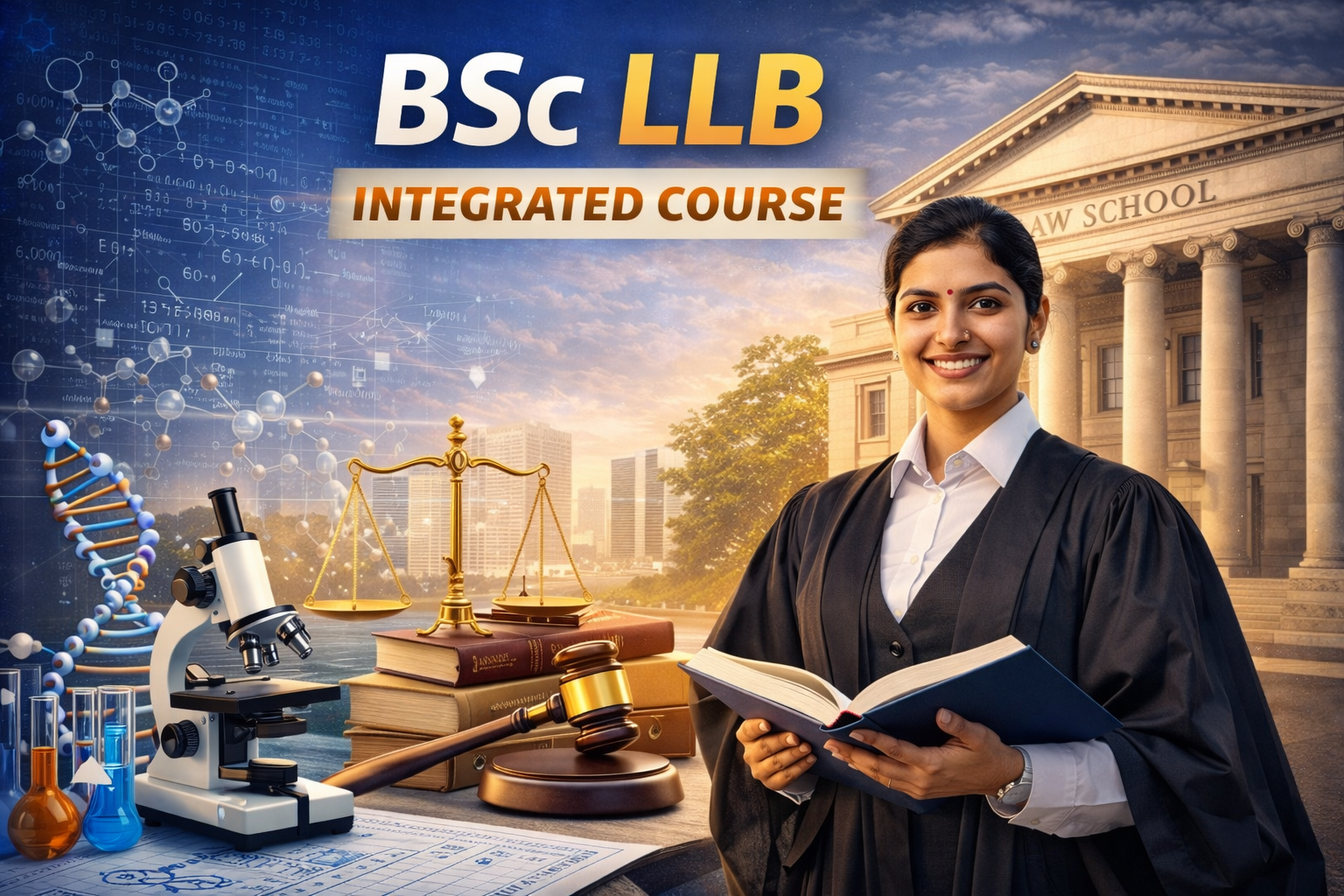
The BSc LLB Integrated Course is a unique 5-year undergraduate program in India that combines the study of science and law, offering students a multidisciplinary approach to learning. Designed for those interested in pursuing a career in law while building a strong analytical and scientific foundation, this course opens doors to diverse career opportunities in legal practice, corporate law, government services, and judiciary.
🔔 BSC LLB Integrated Course Admission Alerts 2026
- Application Deadline Extended: MH CET Law 2026 application window for 5-year LLB courses extended until March 15, 2026.
- Exam Date: MH CET Law 2026 exam is tentatively scheduled for May 8, 2026.
- Exam Date: TG LAWCET 2026 exam will be conducted on May 18, 2026.
- Registration Open: AP LAWCET 2026 registration is currently open for 5-year integrated LLB programs.
Admission is generally based on entrance exams like CLAT, LSAT India, or AILET, along with academic merit. This blog provides a full guide on BSc LLB Integrated Course details, including top colleges, fee structure, eligibility criteria, subjects, syllabus, and promising career paths, helping aspirants make informed decisions about pursuing this dynamic program in India.
Why Choose BSc LLB Integrated Course?
The BSc LLB Integrated Course is a unique 5-year program that combines science and law in a single curriculum. Choosing this course gives students an edge by blending analytical scientific thinking with legal expertise. Here are some compelling reasons to pursue this integrated program:
-
Dual Knowledge in Science and Law – Students gain expertise in both science and legal subjects, making them versatile professionals.
-
Early Career Start – Unlike pursuing separate degrees, the integrated program saves time and prepares students for law careers right after graduation.
-
Wide Career Opportunities – Graduates can work in law firms, corporate legal departments, government agencies, or pursue higher studies like LLM.
-
Enhanced Analytical and Problem-Solving Skills – The science foundation strengthens critical thinking, which is essential in law practice.
-
Eligibility for Judicial Services – Graduates can appear for judicial exams, legal advisory roles, or even competitive government exams.
-
Higher Employability – Multidisciplinary knowledge makes graduates attractive to employers in law, business, and technology-driven legal sectors.
BSc LLB Integrated Course: Key Highlights
| Feature | Details |
|---|---|
| Course Name | BSc LLB Integrated Course |
| Degree Full Form | Bachelor of Science – Bachelor of Legislative Law |
| Degree Type | Full-Time Undergraduate Integrated Program |
| Typical Duration | 5 Years |
| Eligibility (India) | 10+2 or equivalent (Science stream preferred) |
| Common Entrance Exams (India) | CLAT, MH CET Law 2026, TS LAWCET 2026, AP LAWCET 2026, CUET 2026 |
| Application Deadline 2026 | MH CET Law: March 15, 2026 (extended) |
| Exam Dates 2026 | MH CET Law: May 8, 2026 (tentative); TG LAWCET: May 18, 2026 |
| Top Colleges | National Law Universities (NLUs), Symbiosis Law School, SOA University, Saveetha Institute of Medical and Technical Sciences |
| Career Options | Lawyer, Legal Advisor, Corporate Counsel, Legal Analyst, Chartered Accountancy, Company Secretary |
BSc LLB Eligibility Criteria for Admission
Admission to the BSc LLB Integrated Course in India depends on certain academic qualifications, age limits, and entrance exam requirements. Meeting these criteria is essential for securing a seat in top law colleges and universities.
1. Educational Qualification
Candidates must have completed 10+2 or equivalent from a recognized board. Students from Science, Commerce, or Arts streams are generally eligible. A strong foundation in science subjects is preferred for integrated BSc LLB programs that combine legal and scientific studies.
2. Minimum Marks
Most universities require candidates to have secured 50–60% marks in their 12th-grade examinations. Some premier law colleges may have higher benchmarks or cut-offs based on entrance exam performance.
3. Age Criteria
Applicants should typically be between 17 to 22 years at the time of admission. Certain universities may provide age relaxations for reserved categories as per government norms.
4. Entrance Exam Requirement
Admission is primarily entrance-based, and students must qualify exams like:
-
CLAT (Common Law Admission Test)
-
LSAT India
-
AILET (All India Law Entrance Test)
-
State-level Law Entrance Exams
Some private colleges also offer merit-based admissions, considering 12th-grade marks or internal assessments, giving additional pathways for students who may not appear in entrance exams.
5. Reservation Criteria
Government and some private universities follow reservation policies for SC/ST/OBC, EWS, and differently-abled candidates as per Indian law.
| Eligibility Criteria | Details |
|---|---|
| Educational Qualification | 10+2 or equivalent from a recognized board; students from Science, Commerce, or Arts streams are eligible. |
| Minimum Marks | Generally, 50–60% in 12th-grade exams; top law colleges may have higher cut-offs or entrance-based merit requirements. |
| Age Limit | Typically 17–22 years at the time of admission; age relaxations may apply for reserved categories. |
| Entrance Exams | CLAT, LSAT India, AILET, and various state-level law entrance exams. Some private colleges also offer merit-based admission. |
| Reservation Criteria | SC/ST/OBC/EWS/differently-abled candidates are eligible for reservations as per government rules and university policies. |
| Additional Requirements | Some colleges may require aptitude tests, interviews, or group discussions for final selection. |
BSc LLB Admission Process: A Step-by-Step Guide
The BSc LLB admission process involves several steps to secure a seat in a reputable institution. Candidates must meet the eligibility criteria, typically including a minimum aggregate of 50% in the 10+2 examination from a recognized board, and decide which entrance exam to take, such as CLAT, AILET, or LSAT. The admission process varies by institution, so it’s essential to check each college’s specific criteria.
- Check eligibility criteria, including a minimum aggregate percentage of 50% in the 10+2 examination from a recognized board.
- Fill out the application form online or offline, and submit required documents, such as mark sheets and certificates.
- Appear for entrance exams, such as CLAT, AILET, or LSAT.
- Attend counseling sessions, where candidates are shortlisted based on entrance exam scores and invited for document verification.
- Pay the admission fee, which can range from ₹50,000 to ₹2,00,000 per annum, depending on the institution.
- Submit original documents, such as mark sheets, certificates, and identification proof, for verification.
- Receive confirmation of seat allotment, typically done through a merit list.
- Some institutions offer BSc LLB admission through management quota.
- Meet the age criteria, typically 22 years for general category students and 25 years for SC/ST students.
- Possess the required analytical and communication skills.
BSc LLB Subjects and Syllabus
The BSc LLB integrated course is a 5-year program providing a strong foundation in both sciences and legal studies. The curriculum is divided into 10 semesters, offering a mix of core, elective subjects, and practical training or internships. Core subjects include Legal Method, Sociology, History, Political Science, Economics, and English. Elective subjects, introduced from the second semester, allow for specialization. Practical training and internships provide hands-on experience in legal practices.
| Year | Semester | Core Subjects | Elective Subjects | Practical/Internship |
|---|---|---|---|---|
| 1st Year | Semester 1 | Legal Method, Sociology, History, Political Science, Economics, English | Introduction to Computers | Library Research, Legal Writing |
| 1st Year | Semester 2 | Law of Contract, Law of Tort, Constitutional Law, Legal Methods | Special Contracts, Family Law | Moot Courts, Client Counseling |
| 2nd Year | Semester 1 | Constitutional Amendments, Judicial Review, Legal Concepts, Principles | Company Law, Intellectual Property Law | Internship with Law Firms, Court Visits |
| 2nd Year | Semester 2 | Criminal Law, Civil Law, Property Law | Environmental Law, Human Rights Law | Participation in Legal Aid Camps, Mediation |
| 3rd Year | Semester 1 | Constitutional Law, Civil Law, Criminal Law | Labour Law, Taxation Law | Moot Courts, Internships, Legal Clinics |
| 3rd Year | Semester 2 | Company Law, Intellectual Property Law, International Law | Alternative Dispute Resolution, Media Law | Research Projects, Court Internships |
| 4th Year | Semester 1 | Administrative Law, Law of Evidence, Family Law | Cyber Law, Sports Law | Client Counseling, Negotiation |
| 4th Year | Semester 2 | Human Rights Law, Environmental Law, Labour Law | Entrepreneurship Law, Space Law | Participation in Moot Court Competitions, Research Papers |
| 5th Year | Semester 1 | International Law, Alternative Dispute Resolution, Media Law | Artificial Intelligence Law, Data Protection Law | Internship with Corporate Law Firms, Court Practice |
| 5th Year | Semester 2 | Professional Ethics, Law and Technology, Law and Medicine | Law and Economics, Law and Politics | Final Research Project, Viva Voce, Courtroom Training |
BSc LLB Entrance Exams in India: Exam Details and Eligibility
Admission to the BSc LLB integrated course requires students to pass entrance exams testing aptitude, knowledge, and skills in law, science, and general awareness. Prominent entrance exams include CLAT, LSAT-India, AILET, MH CET Law, AP LAWCET, TS LAWCET, BHU UET Law, and DU LLB Entrance Exam. Each exam has unique characteristics regarding pattern, syllabus, and eligibility. Eligibility typically includes a minimum percentage in the 10+2 examination. Exams are usually conducted between December and June.
| Exam Name | Conducting Body | Exam Type | Eligibility | Month of Exam |
|---|---|---|---|---|
| All India Law Entrance Test (AILET) | National Law University, Delhi (NLU Delhi) | University-level | 10+2 with a minimum of 50% marks | December |
| MH CET Law | State Common Entrance Test Cell, Maharashtra | law entrance exam | 10+2 with a minimum of 45% marks | |
| AP LAWCET | Andhra University, Visakhapatnam | Computer Based Test (CBT) | 10+2 with a minimum of 45% marks | May |
| TS LAWCET | Osmania University, Hyderabad | objective type | 10+2 with a minimum of 45% marks | February |
| BHU UET Law | Banaras Hindu University (BHU) | University-level | 10+2 with a minimum of 50% marks | September |
| DU LLB Entrance Exam | University of Delhi (DU) | University-level | Graduation with a minimum of 50% marks | March |
BSc LLB Duration and Program Structure
The BSc LLB Integrated Program is typically 5 years long, divided into 10 semesters. Each semester usually lasts 6 months, combining theory, practicals, and internships.
Years 1-2 (Semesters 1–4)
-
-
Focus on basic science subjects and introduction to law
-
Develops analytical, reasoning, and scientific skills
-
Years 3-4 (Semesters 5–8)
-
-
Emphasis on core law subjects like Criminal Law, Constitutional Law, and Contract Law
-
Includes practical exposure such as moot court sessions and case studies
-
Year 5 (Semesters 9–10)
-
-
Advanced law topics and specialization subjects
-
Internships with law firms, corporate legal departments, or courts
-
Project work and dissertation submission to prepare for professional practice
-
Key Features of Program Structure
-
Balanced mix of theory and practical learning
-
Early exposure to legal procedures and court environments
-
Opportunity to pursue judicial services, corporate law, or higher studies after graduation
Top Colleges and Universities Offering BSc LLB in India
The BSc LLB Integrated Course is offered by some of the most prestigious law colleges and universities across India. These institutions provide excellent academic infrastructure, experienced faculty, practical training through moot courts, and internship opportunities to prepare students for a successful legal career.
Top Colleges and Universities
National Law Universities (NLUs)
- Examples: NLSIU Bangalore, NLU Delhi, NLU Hyderabad
- These are highly competitive and offer top-tier legal education. Admission is primarily through CLAT or AILET (for NLU Delhi).
Private Universities
- Examples: Symbiosis Law School (Pune), Amity University (Noida), Christ University (Bangalore)
- These colleges offer a combination of science and law subjects and usually provide merit-based or entrance-based admissions.
State Universities
- Examples: Banaras Hindu University (BHU), University of Calcutta, Osmania University
- Many state universities conduct their own entrance exams or consider 12th-grade marks for admission.
Factors to Consider While Choosing a College
-
Accreditation: Ensure the college is recognized by the Bar Council of India (BCI).
-
Infrastructure: Look for libraries, moot court facilities, and labs for science subjects.
-
Internship Opportunities: Colleges with tie-ups with law firms, corporate companies, and courts provide better exposure.
-
Faculty: Experienced faculty with practical law and research expertise enhance learning.
Career Opportunities After BSc LLB Graduation
Graduates of the BSc LLB Integrated Course have diverse career paths due to their unique combination of scientific and legal knowledge. After completing the course, students can explore roles in law, corporate sectors, government, and higher studies.
1. Legal Practice
-
Graduates can practice as advocates in civil and criminal courts after enrolling with the Bar Council of India.
-
Specializations like criminal law, corporate law, environmental law, and intellectual property law are available.
2. Corporate Sector
-
Many multinational companies and startups hire BSc LLB graduates as legal advisors, compliance officers, or corporate counsels.
-
Graduates can also work in contract management, risk assessment, and regulatory compliance departments.
3. Government and Public Sector
-
Opportunities exist in judicial services, prosecution services, public policy, and government law departments.
-
Graduates can appear for exams like Judicial Service Exam, UPSC Legal Services, or Public Prosecutor roles.
4. Higher Studies and Research
-
Graduates can pursue LLM, MBA in Law, or PhD in specialized areas of law.
-
Research opportunities exist in areas like intellectual property rights, environmental law, or cyber law.
5. Legal Journalism and Advisory Roles
-
Graduates can become legal journalists, legal analysts, or consultants for news agencies, think tanks, and NGOs.
Tip: Practical exposure through internships and moot courts significantly improves employability in all sectors.
| Career Opportunities | Popular Job Roles | Description |
|---|---|---|
| Legal Practice | Lawyer / Advocate | Represent clients in civil or criminal courts, draft legal documents, and provide legal advice. Enrollment with Bar Council of India is mandatory. |
| Public Prosecutor | Represent the government in criminal cases, manage prosecutions, and assist in legal proceedings in courts. | |
| Corporate Sector | Legal Advisor | Provide legal guidance to businesses and organizations to ensure compliance with laws and contracts. |
| Corporate Counsel | Manage corporate contracts, compliance, risk management, and internal legal matters within companies. | |
| Compliance Officer | Ensure corporate adherence to legal and regulatory standards, often in banking, IT, or corporate sectors. | |
| Government and Public Sector | Judicial Officer | Serve as civil or criminal judges after clearing judicial services exams, handling cases in district or higher courts. |
| Higher Studies and Research | Legal Researcher | Conduct research for law firms, NGOs, government agencies, or academia, supporting policy-making or publications. |
| Intellectual Property Consultant | Advise on patents, copyrights, trademarks, and IP rights, particularly useful for BSc graduates with scientific knowledge. | |
| Legal Journalism and Advisory Roles | Legal Analyst | Analyze laws, policies, and regulations for law firms, research agencies, or media organizations. |
| Legal Journalist | Report legal developments, court verdicts, and law reforms for newspapers, TV, or digital media platforms. |
Popular Job Roles for BSc LLB Graduates
Graduates of the BSc LLB Integrated Program can pursue a variety of professional roles across sectors. Some popular job roles include:
| Job Role | Description |
|---|---|
| Lawyer/Advocate | Represent clients in courts, draft legal documents, and provide legal advice. Enrollment with the Bar Council of India is mandatory. |
| Legal Advisor | Provide legal guidance to businesses, government bodies, or individuals to ensure compliance with laws. |
| Corporate Counsel | Work in corporate legal departments to manage contracts, corporate compliance, and legal risk. |
| Legal Analyst | Analyze legal documents, policies, and regulations for firms, research agencies, or media houses. |
| Public Prosecutor | Represent the government in criminal cases and manage prosecution processes in courts. |
| Judicial Officer | After clearing judicial services exams, work as civil or criminal judges in district courts. |
| Compliance Officer | Ensure companies adhere to legal and regulatory standards, often in banking, IT, or corporate sectors. |
| Legal Researcher | Conduct research for law firms, think tanks, NGOs, or academia, often contributing to policy-making or publications. |
| Intellectual Property Consultant | Advise on patents, copyrights, trademarks, and IP rights, particularly useful for BSc graduates with scientific knowledge. |
| Legal Journalist | Report on legal developments, court verdicts, and law reforms for newspapers, TV, or digital platforms. |
Salary Packages for BSc LLB Graduates in India
Graduates of the BSc LLB Integrated Course have excellent career prospects in India due to the combination of scientific knowledge and legal expertise. Salary packages vary depending on the sector, experience, and location of employment.
1. Entry-Level Salary
-
Fresh graduates or those starting as junior associates, legal advisors, or trainee advocates can expect a salary ranging from INR 3–6 lakh per annum.
-
Entry-level positions in corporate legal departments or private law firms may start around INR 25,000–50,000 per month, depending on the city and reputation of the employer.
2. Mid-Level Salary (3–7 Years Experience)
-
Professionals with experience in corporate law, legal consultancy, or judiciary roles can earn INR 6–12 lakh per annum.
-
Roles like Corporate Counsel, Compliance Officer, or Legal Analyst tend to offer higher packages in private companies or MNCs.
3. Senior-Level Salary (7+ Years Experience)
-
Senior lawyers, partners in law firms, or experienced corporate counsels can earn INR 15–30 lakh per annum or more.
-
Those working in specialized fields such as intellectual property law, corporate mergers, or tax law often command premium salaries.
4. Government Jobs
-
Graduates joining judicial services, public prosecutor positions, or other government legal posts earn INR 7–12 lakh per annum, including allowances and perks.
-
Central government positions, such as legal advisors in ministries or regulatory bodies, may offer additional benefits like housing, pension, and medical facilities.
5. International Opportunities
-
BSc LLB graduates with strong specialization and experience may also explore careers abroad in corporate law, IP law, or compliance, with salaries ranging from USD 50,000 to 120,000 annually in countries like the USA, UK, or UAE.
Tip: Salary largely depends on experience, college reputation, specialization, and internships. Practical exposure during studies enhances employability and can significantly boost initial salary packages.
Higher Studies Options After BSc LLB
After completing a BSc LLB Integrated Program, graduates have several higher education pathways to enhance their expertise, specialize in law, or diversify their career options.
1. LLM (Master of Laws)
-
A common option for specialization in Corporate Law, Criminal Law, Intellectual Property Rights, Cyber Law, or Environmental Law.
-
Duration: 1–2 years, depending on the university.
-
Benefits: Prepares students for higher-level legal practice, academia, or research roles.
2. Judicial Services Examination
-
Graduates can appear for State Judicial Services Exams to become civil or criminal judges in district courts.
-
Eligibility: BSc LLB graduates meet the minimum law degree requirement.
-
Benefit: Stable government career with excellent salary, respect, and growth opportunities.
3. MBA with Legal Specialization
-
Pursuing an MBA in Corporate Law or Business Law equips graduates for roles in corporate compliance, legal advisory, or management positions.
-
Duration: 1–2 years.
-
Benefit: Combines legal expertise with management skills, increasing employability in the corporate sector.
4. PhD / Doctoral Programs
-
Graduates interested in research can pursue PhD in Law or PhD in interdisciplinary areas combining science and law, such as environmental law or IP rights.
-
Benefit: Opens opportunities in academia, research institutions, think tanks, or policy-making organizations.
5. Certificate and Diploma Courses
-
Short-term courses or diplomas in Cyber Law, Taxation Law, Intellectual Property Rights, Forensic Science, or Corporate Governance are popular.
-
Benefit: Provides specialized knowledge and improves job prospects in niche legal areas.
6. International Higher Studies
-
Students can pursue LLM or specialized courses abroad in countries like USA, UK, Canada, or Australia.
-
Benefit: Global exposure, better career opportunities, and eligibility for international law firms or consultancy roles.
Differences Between BSc LLB and Other Law Courses
The BSc LLB Integrated Course is a unique undergraduate program that combines the study of science and law over five years. It is designed for students who have completed their 10+2 (Higher Secondary) education and wish to pursue a career in legal practice while maintaining a strong foundation in science. Understanding the differences between BSc LLB and other law courses is crucial for aspirants planning their academic path.
1. Program Duration and Structure
-
BSc LLB: Typically spans 5 years, integrating science subjects with legal education. Students study core science subjects in the first years, followed by legal subjects and electives.
-
LLB (3-Year Program): A postgraduate program pursued after graduation in any discipline. Focuses exclusively on law and legal principles.
-
BA LLB (Integrated): Also a 5-year course, but combines arts/social sciences with law instead of science. Subjects like political science, sociology, and economics are included.
2. Eligibility Criteria
-
BSc LLB: Requires candidates to have completed 10+2 with science subjects (Physics, Chemistry, Biology, or Mathematics).
-
LLB (3-Year): Requires a graduation degree in any discipline.
-
BA LLB: Usually requires 10+2 completion in any stream; no specific science focus is needed.
3. Curriculum Focus
-
BSc LLB: Blends scientific reasoning with legal studies, ideal for areas like intellectual property, cyber law, environmental law, patent law, and medical-legal cases.
-
BA LLB: Emphasizes arts, humanities, and social sciences alongside law, suitable for careers in policy-making, corporate law, and public administration.
-
LLB (3-Year): Focuses solely on legal principles, court procedures, constitutional law, and litigation skills.
4. Career Prospects
-
BSc LLB: Graduates can work as legal consultants in biotech, pharma, IT, or environmental sectors, or pursue traditional roles like lawyers, judges, or corporate legal advisors.
-
BA LLB / LLB: Careers mainly focus on law firms, judiciary, corporate legal departments, litigation, and government legal services.
5. Competitive Advantage
BSc LLB graduates have a distinct advantage in specialized legal fields requiring scientific knowledge, like intellectual property law, technology law, environmental regulations, and forensic law, which sets them apart from BA LLB or regular LLB graduates.
Tips to Crack BSc LLB Entrance Exams
Admission to top BSc LLB programs in India usually requires candidates to clear national or university-level entrance exams such as CLAT (Common Law Admission Test), LSAT India, AILET, or university-specific tests. Here are detailed strategies to help aspirants succeed:
1. Understand the Exam Pattern and Syllabus
-
Entrance exams test English language, legal aptitude, logical reasoning, general knowledge, and basic science knowledge.
-
Review previous years’ papers to understand question formats, difficulty levels, and frequently asked topics.
-
Pay attention to time allocation for each section.
2. Strengthen Legal Aptitude
-
Focus on basic legal concepts, constitutional law, legal reasoning, and current legal developments.
-
Solve mock tests and case-based questions to develop analytical and reasoning skills.
-
Reading legal newspapers, judgments, and articles improves legal understanding and application.
3. Improve English Language Skills
-
Work on comprehension, grammar, vocabulary, and writing skills.
-
Practice para jumbles, synonyms/antonyms, and sentence correction questions regularly.
-
Reading editorials and literature enhances reading speed and comprehension.
4. Develop Logical and Analytical Reasoning
-
Focus on puzzles, series, syllogisms, and critical reasoning.
-
Solve previous years’ logical reasoning questions under timed conditions.
-
This section often differentiates top scorers from average candidates.
5. Stay Updated on Current Affairs
-
General knowledge and current affairs play a key role in CLAT, LSAT, and other exams.
-
Focus on national and international events, science and technology developments, awards, and legal updates.
-
Regularly read newspapers, magazines, and official reports.
6. Master Basic Science Concepts
-
Since BSc LLB integrates science, brush up on basic mathematics, physics, chemistry, and biology.
-
Focus on topics relevant to quantitative aptitude, reasoning, and analytical skills.
7. Practice Time Management
-
Solve mock tests and previous papers within the time limit.
-
Develop a strategy to attempt high-scoring sections first and minimize time wastage on difficult questions.
8. Take Mock Tests and Analyze Performance
-
Regular practice helps identify strengths and weaknesses.
-
Review errors and revise weak areas systematically.
-
Join online test series or coaching platforms for real-time exam simulation.
9. Maintain Consistency and Discipline
-
Create a daily study schedule balancing all sections: legal aptitude, reasoning, GK, English, and science.
-
Consistency is crucial since entrance exams demand broad knowledge and application skills.
10. Stay Calm and Confident on Exam Day
-
Avoid last-minute cramming; focus on revision and relaxation.
-
Read instructions carefully, manage your time, and maintain a positive mindset.
FAQs
1. What is a BSc LLB Integrated Course?
The BSc LLB Integrated Course is a 5-year undergraduate program combining science and law education. It provides a multidisciplinary approach, preparing students for careers in legal practice, corporate law, government services, and higher studies in law.
2. What is the eligibility criteria for BSc LLB admission in India?
Candidates must have completed 10+2 or equivalent from a recognized board, usually with 50–60% marks. Entrance exams like CLAT, LSAT India, or AILET are required by most colleges for admission.
3. How long is the BSc LLB Integrated Course?
The BSc LLB program is a 5-year undergraduate course divided into 10 semesters. It combines science subjects in early years with advanced law subjects, internships, and practical training in later years.
4. Which are the top entrance exams for BSc LLB programs in India?
The main entrance exams include CLAT (NLUs), LSAT India, AILET (NLU Delhi), state-level law exams, and some university-based tests. Clearing these exams is mandatory for admission into most reputed law colleges.
5. What subjects are taught in the BSc LLB Integrated Course?
Students study science subjects like Physics, Chemistry, Mathematics/Biology and law subjects including Constitutional Law, Criminal Law, Contract Law, Corporate Law, Intellectual Property Rights, and practical training like legal drafting and moot courts.
6. Which are the best colleges for BSc LLB in India?
Top colleges include National Law Universities (NLUs), Symbiosis Law School Pune, Christ University Bangalore, Amity University Noida, Banaras Hindu University, and Osmania University. These offer quality faculty, infrastructure, and internship opportunities.
7. What are the career opportunities after BSc LLB graduation?
Graduates can work as lawyers, corporate counsels, legal advisors, public prosecutors, compliance officers, legal analysts, or pursue judicial services, research, or higher studies like LLM in India and abroad.
8. What is the average salary for BSc LLB graduates in India?
Entry-level salaries range from INR 3–6 lakh per annum, mid-level professionals earn INR 6–12 lakh, while senior lawyers and corporate counsels can earn INR 15–30 lakh per annum, depending on experience and specialization.
9. What higher studies options are available after BSc LLB?
Graduates can pursue LLM, MBA in Law, PhD, or specialized certificate courses in areas like Corporate Law, Cyber Law, IPR, or Environmental Law to gain expertise and increase career opportunities.
10. Why should one choose a BSc LLB Integrated Course?
The course offers dual expertise in science and law, early career start, high employability, opportunities in corporate, government, and judiciary sectors, and a strong foundation for higher studies or international law careers.
Q: What are the top colleges for BSC LLB Integrated Course in India for 2026 admissions?
For the BSC LLB Integrated Course, some highly sought-after institutions include National Law School of India University (NLSIU) Bangalore, NALSAR University of Law Hyderabad, and Symbiosis Law School (SLS) Pune. These colleges consistently rank among the top 10 law schools, offering excellent faculty and infrastructure. Admission is highly competitive, with acceptance rates often below 5%.
Q: What is the average salary after BSC LLB Integrated Course in India in 2026?
Graduates of the BSC LLB Integrated Course can expect a strong starting salary. In 2026, the average entry-level salary for a BSC LLB professional in India is projected to be ₹6-9 LPA. Those joining top-tier law firms or corporate legal departments can command upwards of ₹12-15 LPA, with significant growth potential within 3-5 years of experience.
Q: What is the eligibility criteria for BSC LLB Integrated Course admissions in 2026?
To be eligible for the BSC LLB Integrated Course, applicants typically need to have completed their 10+2 (or equivalent) examination from a recognized board with a minimum aggregate score of 45-50%. Some universities may offer a 5% relaxation for SC/ST candidates. There is usually no age limit for applying to the BSC LLB Integrated Course.
Q: What are the career options after completing a BSC LLB Integrated Course in India?
The BSC LLB Integrated Course opens diverse career paths. Graduates can pursue roles as corporate lawyers, legal advisors in scientific research firms, patent attorneys, or environmental law specialists. Other options include litigation, judicial services, or working with NGOs. The unique blend of science and law makes BSC LLB graduates highly valuable in niche sectors, with over 80% placement rates in good institutions.
Q: What are the typical fees for BSC LLB Integrated Course in India per year in 2026?
The annual fees for the BSC LLB Integrated Course vary significantly across institutions. For government universities, the fees can range from ₹50,000 to ₹1.5 Lakh per year. Private universities and national law universities typically charge between ₹2 Lakh and ₹4.5 Lakh annually for the BSC LLB Integrated Course, excluding hostel and other miscellaneous expenses.
Q: Can I pursue higher studies or work abroad after a BSC LLB Integrated Course from India?
Yes, the BSC LLB Integrated Course provides a strong foundation for international opportunities. Graduates can pursue LLM (Master of Laws) programs abroad in countries like the UK, USA, or Canada, often specializing in areas like intellectual property or environmental law. Many international law firms and organizations also recognize the BSC LLB degree, offering opportunities for global careers, especially in patent law, with starting salaries potentially exceeding $60,000 USD annually.