BSC Zoology Syllabus: Complete Year-Wise Curriculum, Subjects, and Detailed Explanation
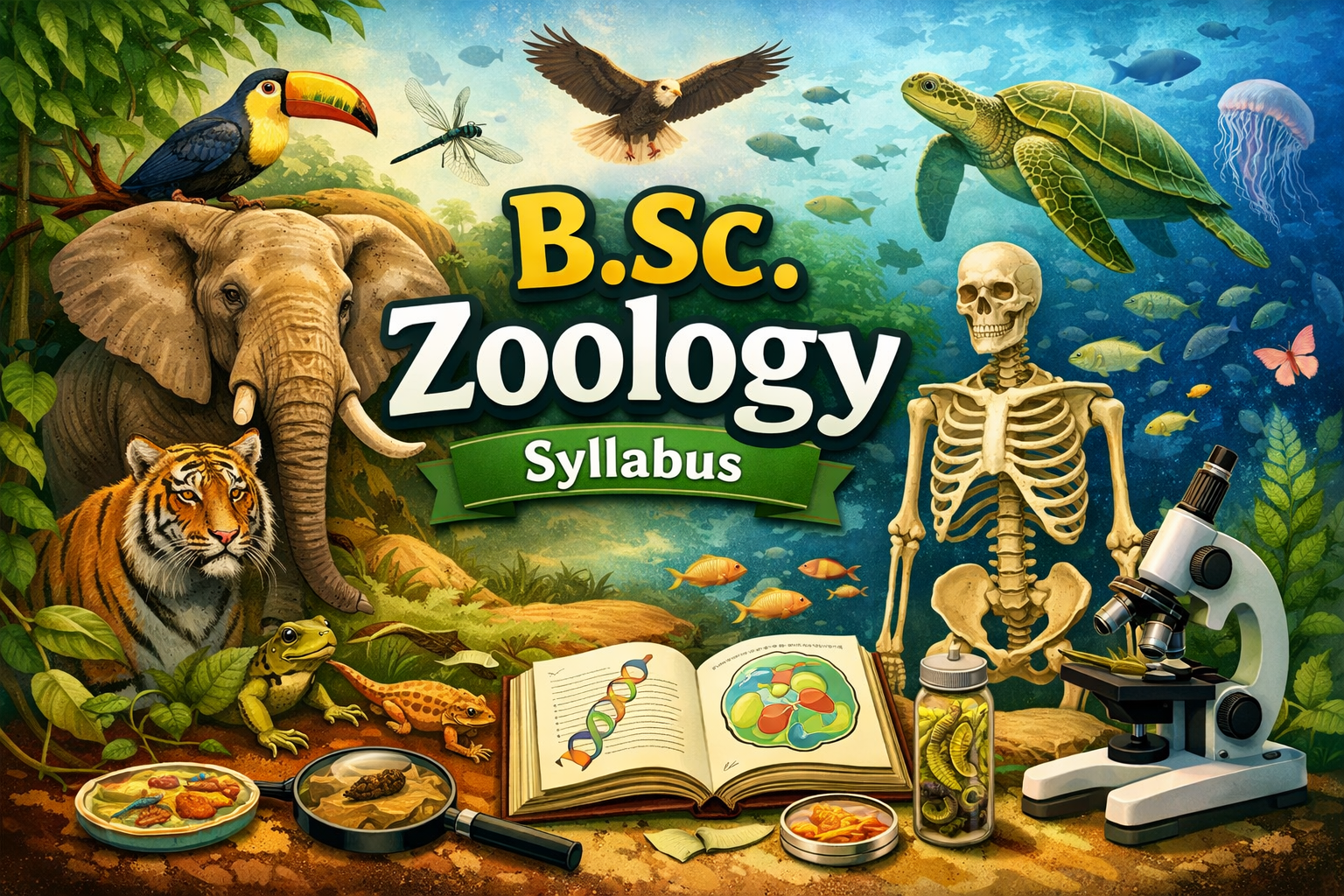
BSc Zoology is a three-year undergraduate degree program that offers an in-depth understanding of the animal kingdom through scientific study and systematic exploration. The course is designed to introduce students to the structure, functioning, classification, behavior, and evolution of animals, from microscopic organisms to complex vertebrates.
It also emphasizes the ecological relationships between animals and their environment, helping learners understand biodiversity and conservation. The syllabus blends strong theoretical foundations with hands-on laboratory practicals, dissections, fieldwork, and research-based activities.
This balanced approach helps students develop analytical, observational, and experimental skills. Overall, BSc Zoology prepares students for higher studies, research roles, and diverse career opportunities in life sciences, wildlife, environmental studies, and allied fields.
BSc Zoology Course Overview
The BSc Zoology syllabus is divided into six semesters spread across three academic years. Each year introduces new concepts while strengthening previously learned topics. The course gradually moves from basic animal classification to advanced subjects like genetics, ecology, and biotechnology.
Duration and Semester Pattern
The course follows a semester system where students appear for exams twice a year. Each semester includes theory papers, practical exams, internal assessments, and sometimes project work.
| Course Level | Undergraduate |
| Duration | 3 Years |
| Semesters | 6 |
| Stream | Science |
| Practical Work | Included |
| Field Study | Included |
Teaching and Learning Approach
Teaching methods include lectures, lab experiments, group discussions, presentations, assignments, and field visits. This approach ensures conceptual clarity and hands-on experience.
Objectives of the BSc Zoology Syllabus
The BSc Zoology syllabus is designed with clear academic and professional goals. It aims to provide students with a strong foundation in animal sciences while developing scientific skills, environmental awareness, and research ability. Below is a detailed explanation of the main objectives of the BSc Zoology syllabus.
| Objective Area | Description of the Objective | Learning Outcome for Students |
| Understanding Animal Diversity | To introduce students to the vast diversity of animal life, including non-chordates and chordates, their classification, structure, and habitats. | Students gain the ability to identify animal groups, understand biodiversity, and recognize evolutionary relationships among species. |
| Knowledge of Animal Structure and Function | To provide in-depth knowledge of animal anatomy, physiology, and organ systems such as digestion, respiration, circulation, and nervous coordination. | Students understand how different body systems function and interact, supporting further studies in biology and medical sciences. |
| Foundation in Cell Biology and Biomolecules | To explain the cellular basis of life and the role of biomolecules like proteins, lipids, carbohydrates, and nucleic acids. | Students develop clarity on cellular processes and biochemical reactions essential for life functions. |
| Understanding Genetics and Heredity | To introduce basic genetic principles including DNA structure, gene expression, inheritance patterns, and mutations. | Students understand heredity, genetic variation, and the molecular basis of traits and disorders. |
| Understanding Evolutionary Processes | To explain evolutionary theories, natural selection, adaptation, and speciation. | Students develop an evolutionary perspective to understand biological diversity and species development. |
| Development of Practical and Laboratory Skills | To train students in laboratory techniques such as microscopy, dissection, specimen identification, and experimental procedures. | Students gain hands-on experience and laboratory competence required for research and technical jobs. |
| Promotion of Scientific Thinking | To encourage logical reasoning, observation, experimentation, and data interpretation through practicals and projects. | Students develop analytical thinking and problem-solving skills needed for research and competitive exams. |
| Awareness of Ecology and Environment | To educate students about ecosystems, biodiversity conservation, environmental pollution, and sustainability. | Students become environmentally responsible and capable of contributing to conservation and environmental management. |
| Exposure to Applied Zoology | To introduce applied fields such as aquaculture, sericulture, apiculture, and animal behavior. | Students acquire job-oriented knowledge and practical skills for employment in applied biological sectors. |
| Introduction to Biotechnology and Bioinformatics | To familiarize students with modern biological tools like genetic engineering, PCR, and biological data analysis. | Students gain basic understanding of advanced technologies used in research, healthcare, and biotechnology industries. |
| Preparation for Higher Education | To build a strong academic foundation for postgraduate studies and research programs. | Students are well-prepared for MSc, PhD, and interdisciplinary science courses. |
| Career and Employability Enhancement | To develop skills relevant to teaching, research, healthcare, wildlife management, and government services. | Students become career-ready with diverse employment and professional growth opportunities. |
BSc Zoology Syllabus: Year-Wise Detailed Syllabus
The BSc Zoology syllabus is structured over three academic years, with each year divided into two semesters. The syllabus progresses from basic concepts of animal diversity and cell biology to advanced topics like physiology, genetics, ecology, and biotechnology. Below is a clear, year-wise detailed explanation of the BSc Zoology syllabus, written in simple English and supported with tables for better understanding.
BSc Zoology 1st Year Syllabus (Semester 1 & Semester 2)
The first year of BSc Zoology focuses on fundamental concepts. It helps students build a strong base in zoology by introducing animal diversity, cell structure, and basic biological principles.
Core Focus of 1st Year
- Understanding the diversity of animals
- Learning basic cell biology and biomolecules
- Developing initial laboratory skills
BSc Zoology 1st Year Subjects
| Subject Name | Key Topics Covered |
| Animal Diversity – Non-Chordates | Classification and characteristics of Protozoa, Porifera, Cnidaria, Platyhelminthes, Nematoda, Annelida, Arthropoda, Mollusca, Echinodermata |
| Cell Biology | Cell structure, cell membrane, nucleus, mitochondria, endoplasmic reticulum, ribosomes |
| Biomolecules | Carbohydrates, proteins, lipids, enzymes, nucleic acids |
| Animal Physiology (Basics) | Digestion, respiration, circulation (introductory level) |
| Environmental Studies / AECC | Ecosystems, biodiversity, environmental issues |
Practical Work (1st Year)
- Microscope handling
- Temporary and permanent slide preparation
- Identification of non-chordate specimens
- Basic dissection techniques
Outcome:
By the end of the first year, students develop a clear understanding of basic zoological concepts and laboratory fundamentals.
BSc Zoology 2nd Year Syllabus (Semester 3 & Semester 4)
The second year syllabus is more analytical and comparative. It focuses on vertebrate animals, genetics, evolution, and developmental biology.
Core Focus of 2nd Year
- Studying chordate animals in detail
- Understanding heredity and evolution
- Learning comparative anatomy
BSc Zoology 2nd Year Subjects
| Subject Name | Key Topics Covered |
| Animal Diversity – Chordates | Pisces, Amphibia, Reptilia, Aves, Mammalia; adaptations and classification |
| Comparative Anatomy | Skeletal, muscular, digestive, respiratory, circulatory systems |
| Genetics | Mendel’s laws, chromosomes, DNA, gene interaction, mutations |
| Evolutionary Biology | Theories of evolution, natural selection, speciation |
| Developmental Biology | Gametogenesis, fertilization, embryonic development |
Practical Work (2nd Year)
- Identification of chordate specimens
- Comparative anatomy slides and charts
- Genetic problem-solving
- Embryological stages study
Outcome:
Students gain deeper biological understanding and develop analytical thinking required for higher studies and research.
BSc Zoology 3rd Year Syllabus (Semester 5 & Semester 6)
The final year of BSc Zoology deals with advanced and applied zoology. It prepares students for careers, research, and postgraduate education.
Core Focus of 3rd Year
- Understanding complex physiological processes
- Learning ecology and environmental conservation
- Introduction to biotechnology and applied sciences
BSc Zoology 3rd Year Subjects
| Subject Name | Key Topics Covered |
| Animal Physiology | Digestive, respiratory, circulatory, excretory, nervous systems |
| Endocrinology & Reproductive Biology | Hormones, endocrine glands, reproduction, fertility control |
| Ecology | Ecosystems, food chains, energy flow, population ecology |
| Environmental Biology | Pollution, biodiversity conservation, climate change |
| Biotechnology | Genetic engineering, PCR, cloning, recombinant DNA technology |
| Bioinformatics | Biological databases, sequence analysis, applications |
Practical & Project Work (3rd Year)
- Advanced physiology and biochemical experiments
- Field visits (wildlife parks, fisheries, ecological sites)
- Project work or dissertation
- Viva-voce examination
Outcome:
By the end of the third year, students are well-prepared for MSc courses, research programs, teaching, laboratory jobs, and competitive exams.
Skill Enhancement and Elective Papers (Across All Years)
Many universities include Skill Enhancement Courses (SEC) and Discipline-Specific Electives (DSE) as per NEP guidelines.
| Skill/Elective Course | Practical Application |
| Aquaculture | Fish farming and management |
| Apiculture | Beekeeping |
| Sericulture | Silk production |
| Animal Behavior | Behavioral studies |
| Wildlife Biology | Conservation and management |
Download BSc Zoology Syallbus PDF
Download PDF: B.Sc. Hons. Zoology
BSc Zoology 1st Year Exam Pattern
The BSc Zoology 1st Year exam pattern is designed to evaluate students on both theoretical understanding and practical knowledge. Most universities in India follow a semester-based system with internal assessments and end-of-semester examinations.
| Exam Component | Description | Marks | Duration | Remarks |
| Theory Exam | Written examination covering all 1st-year subjects (Animal Diversity, Cell Biology, Biomolecules) | 70–80 | 3 Hours | Includes short answer, long answer, and diagram-based questions |
| Practical Exam | Laboratory-based exam including specimen identification, dissection, microscope work, and experiments | 20–25 | 3–4 Hours | Students must maintain a practical record/logbook |
| Viva-Voce | Oral examination assessing understanding of practical and theoretical knowledge | 5–10 | 15–20 Minutes | Conducted during practical exam |
| Internal Assessment | Assignments, quizzes, tests, attendance, and seminar participation | 10–20 | – | Weightage varies by university |
| Total Marks | Combined total of theory, practical, viva, and internal assessment | 100 | – | Minimum passing marks usually 40–45% in each component |
Preparation Tips for B.Sc 1st Year Students
BSc 1st Year is a crucial stage because it lays the foundation for advanced zoology subjects. Proper planning and consistent study are key to success.
Understand the Syllabus Thoroughly
Before starting preparation, students should carefully go through the official syllabus. Knowing important units, weightage, and practical topics helps in planning study time effectively.
Create a Realistic Study Schedule
Make a daily timetable that includes:
- Theory reading
- Diagram practice
- Practical revision
- Short revision sessions
Avoid last-minute cramming. Regular study builds confidence.
Focus on Conceptual Clarity
Instead of memorizing, focus on understanding concepts such as animal classification, cell structure, and biomolecules. Use flowcharts, tables, and diagrams for better retention.
Practice Diagrams and Scientific Terms
Zoology exams often include diagram-based questions. Practice neat and well-labeled diagrams of:
- Cell structure
- Animal classification charts
- Body systems
Use proper scientific terminology to score better.
Give Importance to Practical Work
Attend practical classes regularly. Practice specimen identification, microscope handling, and basic dissection. Practical exams can significantly improve overall marks.
Revise Regularly and Solve Previous Papers
Revision is essential. Solve previous years’ question papers to understand:
- Question pattern
- Frequently asked topics
- Time management during exams
FAQs
What is the syllabus of BSc Zoology 1st Year?
BSc Zoology 1st Year syllabus includes Animal Diversity (Non-Chordates), Cell Biology, Biomolecules, Environmental Studies, and basic practicals to build foundational zoology knowledge.
How many semesters are there in BSc Zoology 1st Year?
BSc Zoology 1st Year is divided into two semesters, with theory, practical exams, internal assessments, and viva-voce conducted separately for evaluation.
Which books are best for BSc Zoology 1st Year?
Recommended books include Rastogi Zoology, Verma and Agarwal, and NCERT Biology, covering theory, practical guidance, diagrams, and numerical problems for better preparation.
Is practical exam necessary in BSc Zoology 1st Year?
Yes, practical exams are mandatory. They include specimen identification, dissections, lab experiments, and viva-voce, forming an essential part of the final grade.
What is the exam pattern for BSc Zoology 1st Year?
Exams include theory (70–80 marks), practical (25–30 marks), viva, and internal assessments. Question types are short answers, diagrams, long answers, and multiple-choice questions.
How can I prepare for BSc Zoology 1st Year exams?
Understand the syllabus, make a study timetable, practice diagrams, revise regularly, solve previous papers, and focus equally on theory and practical skills.
Are diagrams important in BSc Zoology 1st Year exams?
Yes, diagrams are crucial. Well-labeled diagrams for cell structures, animal phyla, and organ systems can secure extra marks and improve answer clarity significantly.
What is the duration of BSc Zoology 1st Year practical exams?
Practical exams typically last 3–4 hours, covering specimen identification, lab experiments, and viva-voce, depending on university guidelines and course structure.
Can I pass BSc Zoology 1st Year without coaching?
Yes, consistent self-study, understanding concepts, practicing diagrams, and revising previous years’ question papers are enough to excel without coaching or extra classes.
Does BSc Zoology 1st Year help in future careers?
Yes, it provides a foundation for MSc Zoology, research, teaching, wildlife biology, biotechnology, and competitive exams like CSIR-NET and UPSC, preparing students for multiple career paths.