BSEB 10th Exam Pattern 2026: Know Marking Scheme, Question Types & Exam Duration
Understanding the BSEB 10th Exam Pattern 2026 gives you a clear roadmap for your board exam preparation. The Bihar School Examination Board has designed a structured format that tests both your objective knowledge and subjective understanding. If you’re appearing for the Matric examination this year, knowing this pattern inside out will help you allocate study time wisely across different question types.
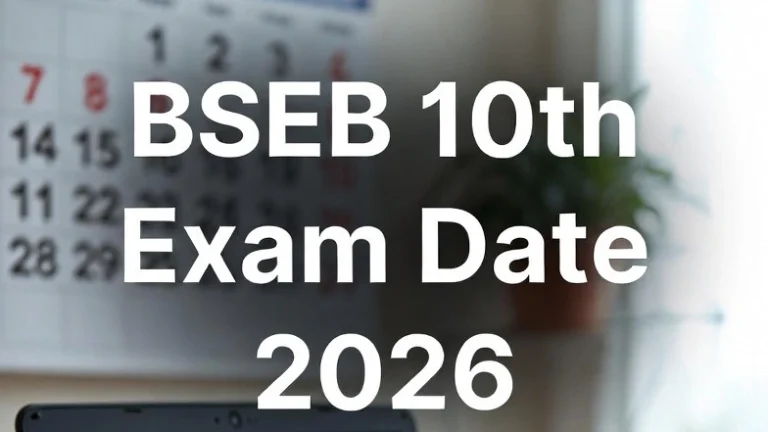
We have put together this complete guide covering the marking scheme, section-wise distribution, time duration, and passing criteria. The Bihar Board Matric exam 2026 is scheduled from February 17 to February 25, 2026. Each paper follows the same structure with an OMR-based objective section followed by descriptive questions. Let us walk you through every detail you need to score well.
BSEB 10th Exam Pattern 2026 Overview
Before diving into subject-specific details, here is a quick snapshot of what the Bihar Board Class 10 examination looks like. This overview table gives you the essential numbers at a glance. Keep these figures in mind as you plan your revision schedule.
| Aspect | Details |
|---|---|
| Conducting Body | Bihar School Examination Board (BSEB), Patna |
| Examination Name | Bihar Board Matric (Class 10) Annual Examination 2026 |
| Total Subjects | 5 Compulsory + 1 Optional |
| Maximum Marks | 500 (100 marks per subject) |
| Exam Duration | 3 hours 15 minutes per paper |
| Extra Reading Time | 15 minutes |
| Question Paper Sections | Section A (Objective) + Section B (Subjective) |
| Passing Percentage | 33% in aggregate |
| Negative Marking | Not applicable |
| Mode of Examination | Offline (Pen and Paper) |
Bihar Board Matric Exam 2026 Section-wise Distribution
The question paper is divided into two main sections. Section A contains objective-type multiple choice questions that you mark on an OMR sheet. Section B has descriptive questions where you write answers in the answer booklet. Both sections carry equal weightage of 50 marks each for subjects with 100 marks theory.
Managing your time between these sections is crucial. Many students spend too long on objective questions and then rush through the subjective portion. We suggest completing Section A within 60-70 minutes so you have adequate time for writing detailed answers in Section B.
Section A – Objective Type Questions
- Total questions in paper: 100
- Questions to be attempted: 50
- Marks per question: 1
- Maximum marks: 50
- Answer format: OMR sheet (bubble the correct option)
- Important note: If you attempt more than 50 questions, only the first 50 will be evaluated
Section B – Subjective Type Questions
- Short answer questions: 30 (attempt any 15)
- Marks per short answer: 2
- Long answer questions: 8 (attempt any 4)
- Marks per long answer: 5
- Total marks from Section B: 50 (30 + 20)
BSEB 10th Marking Scheme 2026 Subject-wise
Different subjects have slightly different marking structures. Mathematics, Hindi, English, and Sanskrit carry 100 marks each for the theory paper. Science and Social Science have an 80-20 split between theory and internal assessment (practical/project work). Understanding this helps you focus on both written exams and school-based assessments.
| Subject | Theory Marks | Internal Assessment | Total Marks | Passing Marks |
|---|---|---|---|---|
| Hindi (Mother Tongue) | 100 | – | 100 | 33 |
| English | 100 | – | 100 | 33 |
| Mathematics | 100 | – | 100 | 33 |
| Science | 80 | 20 | 100 | 33 (Theory: 27, Practical: 6) |
| Social Science | 80 | 20 | 100 | 33 (Theory: 27, Practical: 6) |
| Sanskrit/Urdu (Second Language) | 100 | – | 100 | 33 |
Bihar Board Matric Exam Pattern for Mathematics
Mathematics is often considered the most scoring subject if you have practiced well. The paper tests your understanding of Algebra, Geometry, Trigonometry, Statistics, and Coordinate Geometry. Questions range from straightforward formula applications to multi-step problem solving.
The objective section includes direct questions based on formulas, theorems, and basic calculations. Short answer questions typically ask you to solve equations or prove simple results. Long answer questions involve detailed proofs, constructions, or word problems requiring multiple steps.
| Question Type | Total Questions | To Attempt | Marks Each | Total Marks |
|---|---|---|---|---|
| Objective (MCQ) | 100 | 50 | 1 | 50 |
| Short Answer | 30 | 15 | 2 | 30 |
| Long Answer | 8 | 4 | 5 | 20 |
High-Weightage Topics in Mathematics
- Quadratic Equations and Linear Equations
- Trigonometry and its Applications
- Coordinate Geometry
- Circles and Constructions
- Surface Areas and Volumes
- Statistics and Probability
BSEB Class 10 Science Exam Pattern 2026
Science paper covers Physics, Chemistry, and Biology in a single examination. The theory portion carries 80 marks while the remaining 20 marks come from practical work and internal assessment conducted at the school level. You need to prepare all three sections equally as questions come from each.
Diagrams play an important role in Science answers. Whether it is the human digestive system, electric circuit, or reflection of light, well-labeled diagrams can fetch you extra marks. We recommend practicing diagram-based questions separately as part of your preparation.
| Component | Marks | Details |
|---|---|---|
| Theory Paper | 80 | Objective + Subjective questions |
| Practical/Internal Assessment | 20 | Lab work, Project, Viva |
| Total | 100 | – |
Chapter-wise Weightage in Science
- Physics: Light (Reflection & Refraction), Electricity, Magnetic Effects
- Chemistry: Acids Bases & Salts, Chemical Reactions, Carbon Compounds
- Biology: Life Processes, Control & Coordination, Heredity & Evolution
Bihar Board 10th Social Science Exam Pattern
Social Science combines History, Geography, Political Science, Economics, and Disaster Management. Like Science, this subject also has 80 marks for theory and 20 marks for internal assessment. Map work is an essential component that students often overlook during preparation.
The History section covers the Indian National Movement, World Wars, and major revolutions. Geography focuses on resources, agriculture, and industries of India. Political Science deals with democracy and federalism while Economics covers development and sectors of the Indian economy.
| Section | Topics Covered | Approximate Weightage |
|---|---|---|
| History | Indian & World History since 1850 | 20-25 marks |
| Geography | India: Resources, Agriculture, Industries | 20-25 marks |
| Political Science | Democracy, Federalism, Political Parties | 15-20 marks |
| Economics | Development, Sectors, Money & Credit | 10-15 marks |
| Disaster Management | Natural & Man-made Disasters | 5-10 marks |
BSEB 10th English Exam Pattern 2026
English is a compulsory subject but its marks are not added to the aggregate for Bihar Board students. However, you still need to pass this subject with minimum 33 marks to be declared successful in the examination. The paper tests reading comprehension, grammar, and writing skills.
The question paper has sections covering prose, poetry, grammar, and composition. Prose questions ask about chapters from your textbook while poetry section includes appreciation and explanation of verses. Grammar questions test your knowledge of tenses, voice, narration, and sentence correction. Composition includes letter writing, paragraph writing, and essay.
English Paper Structure
- Section A: Reading Comprehension (Unseen Passage)
- Section B: Prose (Questions from Textbook chapters)
- Section C: Poetry (Explanation and Appreciation)
- Section D: Grammar (Tenses, Voice, Narration, Transformation)
- Section E: Composition (Letter, Essay, Paragraph)
Bihar Board Class 10 Grading System 2026
BSEB follows a 9-point grading system to evaluate student performance. Your marks are converted into grades that appear on the marksheet along with actual marks obtained. This system helps compare performance across subjects and provides a standardized assessment scale.
Students scoring below 33% are given an “E” grade which indicates failure. Such students need to appear for the compartmental examination to clear the subject. The grading is done separately for each subject based on marks obtained.
| Grade | Marks Range | Grade Point | Description |
|---|---|---|---|
| A1 | 91-100 | 10 | Outstanding |
| A2 | 81-90 | 9 | Excellent |
| B1 | 71-80 | 8 | Very Good |
| B2 | 61-70 | 7 | Good |
| C1 | 51-60 | 6 | Above Average |
| C2 | 41-50 | 5 | Average |
| D | 33-40 | 4 | Below Average |
| E1 | 21-32 | – | Failed (Needs Improvement) |
| E2 | 0-20 | – | Failed |
BSEB Matric Exam 2026 Important Instructions
Bihar Board issues specific guidelines that every student must follow during the examination. Breaking these rules can lead to disqualification or cancellation of your paper. Read these instructions carefully and follow them strictly on exam day.
The board has been strict about unfair means in recent years. CCTV cameras are installed at exam centers and flying squads conduct surprise checks. We strongly advise you to rely on your preparation rather than taking any risks.
Items Not Allowed in Exam Hall
- Mobile phones and smartphones
- Smartwatches or any electronic gadgets
- Bluetooth devices and earphones
- Calculators (even for Mathematics)
- Whitener or correction fluid
- Textbooks, notes, or any study material
Items You Must Carry
- Original admit card
- Blue or black ball pen
- School identity card (if required by center)
How to Download BSEB 10th Exam Pattern 2026 PDF
The official exam pattern along with model papers is available on the Bihar Board website. You can download subject-wise PDFs to understand the exact format of questions. These documents are released by the board and reflect the actual examination structure.
- Visit the official BSEB website at biharboardonline.com
- Navigate to the “Students” section on the homepage
- Click on “School” and then select “Model Question Paper”
- Choose “Matric” from the available options
- Select your subject to view and download the model paper PDF
- The model paper demonstrates the exact exam pattern for that subject
Frequently Asked Questions on BSEB 10th Exam Pattern 2026
What is the total duration of BSEB 10th exam?
The total duration is 3 hours and 15 minutes for each paper. Additionally, students get 15 minutes of reading time before the exam begins to go through the question paper.
Is there negative marking in Bihar Board Matric exam?
No, there is no negative marking in BSEB 10th exams. You do not lose marks for wrong answers in the objective section. So attempt all 50 questions even if you are unsure about some.
What happens if I attempt more than 50 objective questions?
If you mark more than 50 answers in the OMR sheet, only your first 50 responses will be evaluated. The remaining answers will be ignored. Be careful while bubbling your responses.
What are the passing marks for Bihar Board 10th exam?
You need to score at least 33% in aggregate (150 out of 500 marks) and also pass individually in each subject. For theory-only subjects, passing marks are 33. For subjects with practical, you need 27 in theory and 6 in practical.
Will competency-based questions be asked in BSEB 10th 2026?
Yes, the board has introduced competency-based questions to test deeper understanding rather than rote learning. These questions assess your ability to apply concepts in real-life situations.
What is the exam timing for Bihar Board Matric 2026?
Exams are conducted in two shifts. Morning shift runs from 9:30 AM to 12:45 PM. Afternoon shift is from 2:00 PM to 5:15 PM. Check your admit card for your specific shift timings.
Where can I get BSEB 10th model papers?
You can download official model papers from biharboardonline.com under the Model Question Paper section. These papers follow the exact exam pattern and help you understand the question format.
The BSEB 10th Exam Pattern 2026 provides a clear framework for your board exam preparation. Focus on both objective and subjective sections equally. Practice previous year papers to get comfortable with the question format and time management. With consistent preparation and understanding of the marking scheme, you can score well in your Bihar Board Matric examination. For any updates regarding changes in exam pattern, keep checking the official BSEB website regularly.