BTech Civil Engineering 2026: Scope, Psus, Salary & Top Recruiters
Civil Engineering is the backbone of every nation’s growth, the art and science behind bridges, highways, skyscrapers, and the very foundations of modern life. In 2026, as India experiences a massive infrastructure boom powered by projects like Smart Cities, Gati Shakti, high-speed rail, and renewable energy corridors, the demand for skilled civil engineers is reaching new heights.
A BTech in Civil Engineering continues to be one of the most stable and respected career paths in the engineering world. It blends creativity with technical precision — designing not just buildings, but the future itself. With government PSUs, private EPC firms, and global construction giants hiring aggressively, civil engineers in 2026 are looking at some of the best job markets in a decade.
From PSU careers through GATE 2026 to project management roles in L&T, Adani Infra, and Tata Projects, civil engineering offers both job security and long-term growth. Whether you aim to work on smart infrastructure, sustainable design, or international projects, this branch remains a cornerstone of engineering excellence.
What is BTech in Civil Engineering?
BTech Civil Engineering is a 4-year undergraduate engineering program that focuses on the planning, design, construction, and maintenance of infrastructure that shapes the modern world — from roads, bridges, and tunnels to dams, airports, and skyscrapers. It’s one of the oldest and most essential branches of engineering, combining technical knowledge, environmental understanding, and practical execution.
Civil engineers ensure that the structures we live in and depend on are safe, sustainable, and efficient. The course trains students to balance aesthetic design with structural integrity — making it both a creative and analytical discipline.
Course Duration & Structure
The BTech Civil Engineering course is divided into 8 semesters over 4 years, combining:
- Theory (engineering science and design principles)
- Laboratory work (material testing, surveying, CAD labs)
- Industrial training and final-year project
Some universities also offer specialisations or elective tracks in areas like:
- Structural & Earthquake Engineering
- Smart Infrastructure Systems
- Environmental Sustainability
- Urban & Regional Planning
Why Choose Civil Engineering in 2026?
Civil engineering continues to evolve in 2026 with new-age technologies like:
- Building Information Modelling (BIM) for digital construction.
- Green and sustainable materials for eco-friendly infrastructure.
- AI and IoT in smart city planning.
- Drones and GIS for surveying and monitoring.
As India’s infrastructure spending is projected to cross ₹10 trillion by 2027, civil engineers are at the forefront of this national transformation. It’s not just about constructing buildings — it’s about engineering the future of society.
People Also Read


Scope of Civil Engineering in 2026 & Beyond
The scope of Civil Engineering in 2026 is broader and more dynamic than ever before. With India entering a new phase of infrastructure expansion and sustainable urbanisation, civil engineers are playing a central role in designing the nation’s future. From smart cities and expressways to green buildings and renewable energy projects, the opportunities for civil engineers are vast, stable, and steadily growing.
1. India’s Infrastructure Boom
India’s infrastructure sector is projected to be worth over USD 290 billion by 2026, driven by flagship programs like:
- PM Gati Shakti Mission – integrating road, rail, port, and airport connectivity.
- Smart Cities Mission – developing sustainable, tech-integrated urban spaces.
- National Infrastructure Pipeline (NIP) – ₹111 lakh crore investment plan covering energy, housing, and water sectors.
- Bharatmala & Sagarmala Projects – expanding highways and port infrastructure.
These initiatives are generating massive hiring demand for civil engineers in design, planning, project execution, and quality management.
2. Global Demand for Indian Civil Engineers
Indian civil engineers are increasingly sought after in the Middle East, Singapore, Canada, and Europe due to their technical proficiency and project management skills. Countries with ongoing mega-projects—such as NEOM in Saudi Arabia, UAE’s sustainable cities, and Singapore’s urban redevelopment plans—offer high-paying roles (₹12–25 LPA) to experienced engineers from India.
3. Shift Toward Sustainable & Smart Infrastructure
The future of civil engineering lies in sustainability and smart technology integration. By 2026, the focus is shifting from traditional concrete structures to:
- Green buildings and net-zero design
- Use of AI, IoT, and data analytics in construction monitoring
- Recycling and carbon-neutral materials
- Water management and urban resilience projects
Civil engineers trained in BIM (Building Information Modelling), GIS (Geographic Information Systems), and Environmental Impact Assessment will have a strong edge in both Indian and global markets.
4. Research & Innovation Opportunities
Beyond fieldwork, the sector offers research-based careers in:
- Earthquake-resistant design
- Smart materials and 3D-printed structures
- Renewable energy infrastructure (solar, wind foundations)
- Disaster management & climate-resilient engineering
With the rise of National Research Centres and IIT collaborations, R&D in civil engineering is becoming a lucrative and respected career path.
5. Long-Term Career Stability
Unlike software and AI sectors that fluctuate with market trends, civil engineering offers steady, long-term career stability. Every economic cycle demands construction, maintenance, and renovation — making civil engineers indispensable.
Whether you’re joining a government PSU, working with global EPC firms, or managing urban development projects, civil engineers will remain key players in India’s 2030 development roadmap.
BTech Civil Engineering Syllabus
The BTech Civil Engineering program is a 4-year, 8-semester course. It combines theoretical fundamentals, practical lab work, and project-based learning. The syllabus is designed to build a strong foundation in engineering science, structural design, and environmental sustainability and infrastructure development.
| Year | Semester | BTech Civil Engineering Subjects |
| 1st Year | Sem I – II | Engineering Mathematics, Physics & Chemistry, Engineering Graphics, Basic Civil & Mechanical Engineering, Computer Programming, Workshop Practice |
| 2nd Year | Sem III – IV | Strength of Materials, Engineering Mechanics, Surveying, Fluid Mechanics, Structural Analysis, Building Materials & Construction, Environmental Studies |
| 3rd Year | Sem V – VI | Geotechnical Engineering, Design of Concrete Structures, Transportation Engineering, Hydrology & Water Resources, Estimation & Costing, CAD Lab, Field Work / Mini Project |
| 4th Year | Sem VII – VIII | Design of Steel Structures, Construction Management, Environmental Engineering II, Electives (Smart Infrastructure, BIM, Green Building), Major Project, Industrial Internship |
Note: The exact subject list may vary slightly across universities, but the core structure remains focused on structural design, environmental systems, and project execution skills—ensuring civil engineers are industry-ready by graduation.
Top BTech Civil Engineering Colleges in India (2026)
Choosing the right college for your BTech in Civil Engineering is just as important as choosing the branch itself. The right institute can give you access to better labs, strong industry tie-ups, higher placements, and better preparation for roles in PSUs, infrastructure firms and research. Here are some of the top institutions for civil engineering in India for 2026.
| College | Location | Why It’s a Top Choice for Civil Engineering |
| Indian Institute of Technology Madras (IIT Madras) | Chennai, Tamil Nadu | Ranked #1 in engineering in India; excellent civil engineering department with strong research & infra exposure. |
| Indian Institute of Technology Delhi (IIT Delhi) | New Delhi | Among the top institutes nationally; great for structural, geotech and urban-infrastructure specialisations. |
| Indian Institute of Technology Bombay (IIT Bombay) | Mumbai, Maharashtra | Strong civil engineering program, ideal for students looking at infrastructure & industrial projects. |
| Indian Institute of Technology Kharagpur (IIT Kharagpur) | Kharagpur, West Bengal | One of the oldest and big in civil engineering; significant alumni network and industry links. |
| National Institute of Technology Tiruchirappalli (NIT Trichy) | Tiruchirappalli, Tamil Nadu | Best among NITs for civil engineering; strong placement record for infra-sector roles. |
| Birla Institute of Technology and Science Pilani (BITS Pilani) | Pilani, Rajasthan | Private-sector leader; good for those looking at both design & software roles within civil engineering. |
| Vellore Institute of Technology (VIT) | Vellore, Tamil Nadu | Strong for private-university options; good facilities for civil, construction and smart infrastructure specialisations. |
Top B Tech Civil Engineering Colleges in Delhi
Delhi, being India’s education and infrastructure hub, is home to some of the best BTech Civil Engineering colleges in the country. From premier government institutes like IIT Delhi to renowned private universities with strong placement networks, the capital offers excellent academic and career opportunities for aspiring civil engineers.
Whether you want to work in core construction, structural design, or project management, studying in Delhi ensures access to top faculty, modern labs, and exposure to real-world infrastructure projects happening in and around the NCR region.
Top Government Civil Engineering Colleges in Delhi
| College Name | Affiliation / Admission Mode | Key Highlights |
|---|---|---|
| Indian Institute of Technology (IIT) Delhi | Admission via JEE Advanced | Among India’s top-ranked institutes; advanced research in structural & environmental engineering; high PSU and global placements. |
| Delhi Technological University (DTU) | Admission via JEE Main (JoSAA Counselling) | Strong focus on infrastructure design, hydrology, and environmental systems; excellent placement record. |
| Netaji Subhas University of Technology (NSUT) | Admission via JEE Main | Offers advanced courses in construction management and geotechnical engineering; industry-linked internships. |
| Jamia Millia Islamia (JMI) | Admission via CUET / JEE Main | NAAC A+ accredited; strong focus on civil design, transportation, and surveying labs. |
| Indira Gandhi Delhi Technical University for Women (IGDTUW) | Admission via JEE Main (for female candidates) | Exclusive for women; focuses on sustainable and smart infrastructure development. |
Top Private Civil Engineering Colleges in Delhi NCR
| College Name | Affiliation / Admission Mode | Key Highlights |
|---|---|---|
| Amity University, Noida | Admission via Amity JEE / Direct Counselling | Smart infrastructure labs, strong placement tie-ups with L&T, DLF, and Gammon India. |
| Manav Rachna International Institute of Research & Studies (MRIIRS) | Admission via MRNAT / JEE Main | Special focus on green construction and smart city projects; modern simulation labs. |
| Galgotias University, Greater Noida | Admission via CUET / Direct | Updated syllabus including BIM, AutoCAD, and project management; good placements in EPC companies. |
| Sharda University | Admission via SUAT / JEE Main | Offers global internships and research collaborations; exposure to real estate and smart infrastructure firms. |
| KIET Group of Institutions (Ghaziabad) | Affiliated to AKTU, Lucknow | Emphasis on civil materials, structural design, and sustainable technology; good core job placements. |
BTech Civil Engineering Govt Jobs
Civil Engineering is one of the few branches in India that continues to have strong demand in the public sector, especially through GATE (Graduate Aptitude Test in Engineering) and state-level engineering services. For graduates who prefer job security, structured growth, PSUs and government departments offer some of the most rewarding careers.
Civil Engineering is one of the few branches in India that continues to have strong demand in the public sector, especially through GATE (Graduate Aptitude Test in Engineering) and state-level engineering services. For graduates who prefer job security, structured growth, and involvement in large-scale infrastructure projects, PSUs and government departments offer some of the most rewarding careers.
Top PSUs Hiring Civil Engineers via GATE 2026 (BTech Civil Government Jobs)
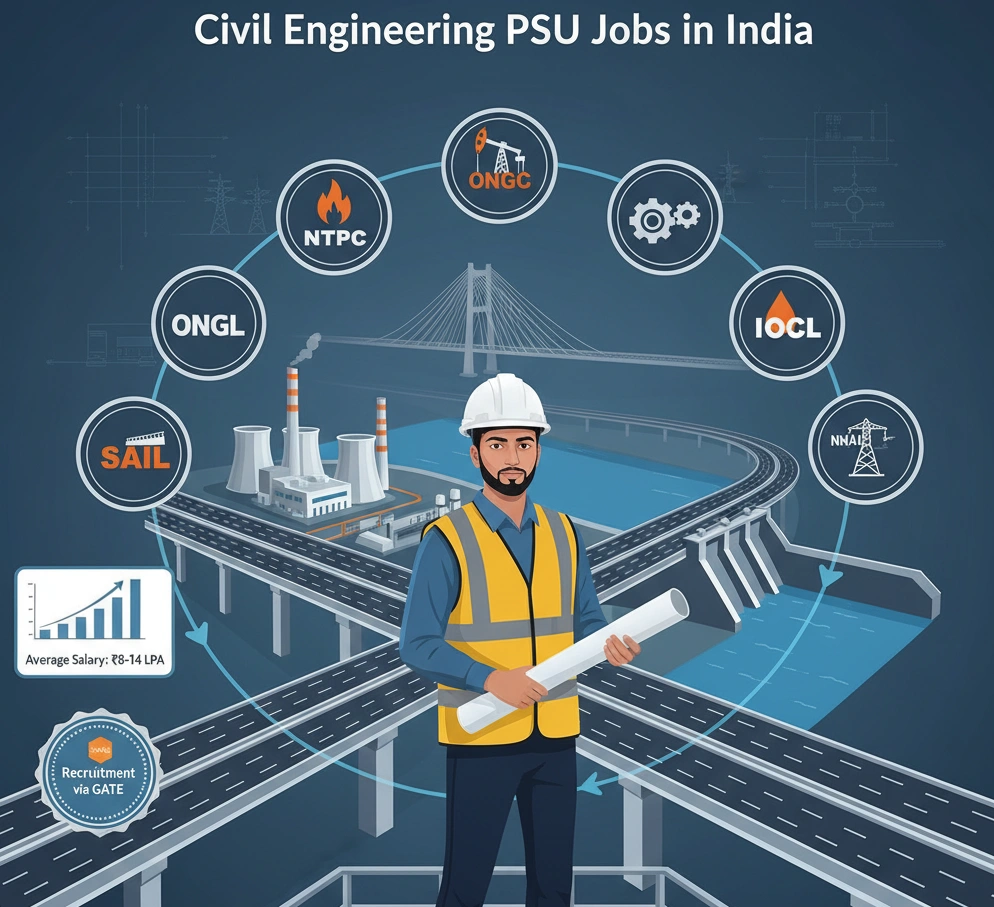
Many leading Public Sector Undertakings (PSUs) recruit civil engineers based on their GATE Civil Engineering (CE) score. These roles typically offer competitive packages, stability, and the chance to work on nation-building projects.
| PSU / Organisation | Recruitment Mode | Approx. Salary (₹ per annum) | Work Area |
| National Thermal Power Corporation (NTPC) | Through GATE-CE | ₹12–14 LPA | Power plant infrastructure, water systems, and structural works |
| Oil and Natural Gas Corporation (ONGC) | Through GATE-CE | ₹11–13 LPA | Offshore/onshore infrastructure, construction, and pipeline projects |
| Bharat Heavy Electricals Limited (BHEL) | Through GATE-CE | ₹10–12 LPA | Project design, hydroelectric and thermal power civil works |
| Steel Authority of India Limited (SAIL) | Through GATE-CE | ₹9–10 LPA | Plant infrastructure, building & maintenance projects |
| Indian Oil Corporation Limited (IOCL) | Through GATE-CE | ₹10–11 LPA | Refinery structures, civil maintenance, and plant design |
| National Highways Authority of India (NHAI) | Direct recruitment / GATE | ₹8–10 LPA | Highway design, bridges, and road project supervision |
| Power Grid Corporation of India (PGCIL) | Through GATE-CE | ₹11–13 LPA | Transmission tower foundations, substations, civil layout planning |
| NBCC (India) Limited | Through GATE-CE / Interview | ₹9–10 LPA | Real estate, smart cities, and government building projects |
Government Engineering Services (ESE & State AE/JE Exams)
Apart from PSUs, several central and state government departments conduct their own exams for civil engineers.
| Exam / Department | Conducting Body | Role / Position | Starting Pay Scale |
| Engineering Services Examination (ESE) | UPSC | Class-I Officer in Central Engineering Services | ₹10–12 LPA (Level 10 Pay Matrix) |
| State Public Service Commissions (AE/JE) | State PSCs (like UPPSC, TNPSC, MPPSC, etc.) | Assistant Engineer / Junior Engineer | ₹6–8 LPA |
| Central Public Works Department (CPWD) | SSC / UPSC | Civil Engineer / Executive Engineer | ₹8–10 LPA |
| Indian Railways (IRSE) | UPSC / RRB | Railway Civil Engineer (Construction, Maintenance) | ₹9–11 LPA |
| Defence Services (MES, BRO) | Ministry of Defence | Civil Engineer (Infrastructure & Construction) | ₹8–9 LPA |
Perks of Working in PSUs & Government Departments
- Job Security: Long-term stability with pension and other retirement benefits.
- Work-Life Balance: Fixed working hours and structured promotions.
- Prestige & Scale: Opportunity to contribute to major infrastructure projects like highways, metros, and dams.
- Growth Path: Options for promotions into managerial and administrative roles.
Top BTech Civil Engineering Jobs: Private Sector
While government and PSU jobs remain a dream for many, the private sector continues to be the biggest employer of civil engineers in India. With the rapid expansion of smart cities, real estate, infrastructure, and green energy projects, 2026 offers record demand for civil engineers in both core construction and tech-enabled design roles.
Private companies today don’t just hire civil engineers for traditional construction sites — they’re also looking for professionals skilled in 3D modelling, BIM (Building Information Modelling), AI-driven design, and project analytics.
| Company / Organisation | Industry Segment | Popular BTech Civil Engineering Jobs | Average Salary (₹ per annum) |
| Larsen & Toubro (L&T) | Infrastructure & EPC | Site Engineer, Project Coordinator, Planning Engineer | ₹6–9 LPA |
| Tata Projects Ltd. | Industrial & Urban Infra | Structural Engineer, Project Executive | ₹5–8 LPA |
| Adani Infra / Ports | Ports, Logistics, Infra | Project Engineer, Quality Control Engineer | ₹5–8 LPA |
| Shapoorji Pallonji | Construction & Real Estate | Civil Design Engineer, Estimation Engineer | ₹5–7 LPA |
| GMR Group / IRB Infra | Highways & Airports | Project Site Engineer, QA/QC Engineer | ₹4–7 LPA |
| Gammon India / Afcons Infrastructure | Heavy Civil Construction | Construction Engineer, Planning Executive | ₹4–6 LPA |
| DLF / Godrej Properties / Prestige Group | Real Estate | Structural Design, Quantity Surveyor | ₹5–8 LPA |
| AECOM / Atkins / Jacobs Engineering | Global Design & Consultancy | Structural Analyst, BIM Modeler, Project Engineer | ₹7–12 LPA |
| UltraTech Cement / Ambuja Cements | Materials & Construction Tech | Site Application Engineer, Technical Executive | ₹5–7 LPA |
BTech Civil Engineering Salary Trends in India (2026 Update)
The private sector offers competitive salaries depending on skills, experience, and project size.
| Experience Level | Typical Role | Average Salary (₹ per annum) |
| 0–2 years (Freshers) | Site Engineer, Junior Designer | ₹3.5 – ₹5.5 LPA |
| 3–5 years | Structural Engineer, Project Executive | ₹6 – ₹9 LPA |
| 5–10 years | Project Manager, BIM Lead | ₹10 – ₹15 LPA |
| 10+ years | Senior Consultant, Construction Head | ₹18 – ₹25 LPA |
Global Opportunities: Civil engineers with experience in structural design, project management, and BIM are increasingly sought after in countries like the UAE, Singapore, and Canada, where infrastructure projects are booming.
BTech Civil Engineering Salary Per Month
The monthly salary of a BTech Civil Engineer in India varies depending on experience, job profile, company type, and project scale. In 2025, civil engineers will continue to earn steady and growing packages, especially in infrastructure, construction, and public sector organisations.
On average, fresh graduates can expect to earn ₹25,000 – ₹45,000 per month, while experienced professionals in core industries or managerial positions can make ₹1 lakh or more month.
BTech Civil Engineering Salary Per Month
| Experience Level | Job Role / Designation | Average Monthly Salary (₹) |
|---|---|---|
| Entry Level (0–2 years) | Site Engineer, Junior Civil Engineer | ₹25,000 – ₹45,000 |
| Mid-Level (3–7 years) | Structural Engineer, Project Executive, Quality Engineer | ₹50,000 – ₹85,000 |
| Senior Level (8–15 years) | Project Manager, Construction Head, Planning Engineer | ₹90,000 – ₹1,50,000 |
| Top-Level / Consultancy Roles | Chief Engineer, Design Consultant | ₹1,50,000 – ₹3,00,000+ |
BTech Civil Engineering Salary Per Month: Govt Vs Private
| Sector | Average Monthly Salary (₹) | Highlights |
|---|---|---|
| Private Construction Firms | ₹30,000 – ₹1,20,000 | Salary varies with company size and project scale; big EPCs like L&T and Shapoorji offer higher packages |
| Government Jobs / PSUs | ₹45,000 – ₹1,25,000 | Includes benefits, stable increments, and long-term job security |
| Overseas / Gulf Projects | ₹1,50,000 – ₹3,00,000+ | High demand for Indian civil engineers in UAE, Saudi Arabia, and Singapore |
Is Civil Engineering in High Demand: Career Path & Higher Studies Options
For BTech Civil students aspiring to deepen their expertise or pivot into management or research, pursuing higher studies can be a game-changer.
| Program | Focus / Specialisations | Top Colleges (India / Abroad) | Entrance Exam / Eligibility | Career Outcomes |
| M.Tech / MS in Civil Engineering | Structural, Geotechnical, Environmental, Transportation, Construction Management | IITs, NITs, BITS Pilani, IISc Bangalore / US & EU universities | GATE (India) / GRE (Abroad) | Structural Engineer, Project Planner, Researcher |
| MBA / PGDM | Project Management, Operations, and Infrastructure Finance | IIMs, XLRI, SPJIMR, NICMAR Pune | CAT / XAT / CMAT | Project Manager, Consultant, Business Analyst |
| MS Abroad (Civil / Construction Mgmt.) | Smart Infrastructure, Urban Design, Green Building | USA, Canada, Germany, Australia | GRE + IELTS/TOEFL | Design Engineer, Global Project Consultant |
| PhD / Research | Structural Materials, Urban Sustainability, Smart Cities | IITs, IISc, Foreign Universities | M.Tech + Research Proposal | Professor, Scientist, Innovator |
FAQs
What is the future scope of Civil Engineering in India in 2026?
The scope of Civil Engineering in 2026 is expanding rapidly due to India’s infrastructure boom — including smart cities, metro networks, highways, and green energy projects. Both government PSUs and private EPC companies are expected to increase hiring by 15–20% compared to 2025.
What is the average salary of a BTech Civil Engineer in India?
Freshers in Civil Engineering typically earn between ₹3.5 – ₹5.5 LPA, depending on their college, skills, and employer. Experienced professionals or those working in PSUs and large private firms can earn ₹10–20 LPA or higher.
Which companies offer the best placements for Civil Engineering graduates?
Top recruiters include Larsen & Toubro (L&T), Tata Projects, Adani Infra, Shapoorji Pallonji, GMR Group, and AECOM. Many civil engineers are also recruited by global design consultancies and real estate firms like DLF and Godrej Properties.
Can Civil Engineers get government jobs through GATE?
Yes. Many PSUs such as NTPC, ONGC, BHEL, IOCL, and NBCC hire Civil Engineers through GATE 2026 (Civil Engineering paper). In addition, exams like UPSC ESE and State PSC AE/JE recruit directly for government departments like CPWD, NHAI, and Indian Railways.
Which is better after Civil Engineering – M.Tech or MBA?
It depends on your career goal. Choose M.Tech if you want to specialise in technical areas like structural or environmental engineering. Opt for an MBA or PGDM if you’re more interested in project management, operations, or leadership roles in the infrastructure or real estate sectors.
Is Civil Engineering a good branch for the future?
Yes, Civil Engineering remains a core evergreen branch with consistent demand in both India and abroad. With the government’s focus on infrastructure modernisation, sustainability, and smart urban planning, civil engineers will continue to play a critical role for decades.