
Last Updated on December 3, 2025 by amay mathur
B Tech Electrical And Computer Engineering (ECE) is one of the most sought-after hybrid branches in 2026, blending the hardware precision of electrical systems with the computing intelligence of software. From designing AI-powered circuits and embedded chips to building intelligent energy systems and connected devices, ECE engineers are driving the next industrial revolution — Industry 4.0.
This branch is ideal for students who enjoy both coding and circuitry, offering a curriculum that spans digital electronics, machine learning, IoT architecture, microcontrollers, and automation systems. It’s no longer just about wires and processors — it’s about creating smart systems that think, adapt, and communicate.
In this blog, we’ll explore what makes Electrical & Computer Engineering a defining branch for the future — including its 2026 syllabus, industry demand, career scope, top colleges, and how it powers breakthrough technologies in AI, IoT, and EV innovation.
What is B.Tech Electrical And Computer Engineering?
BTech in Electrical & Computer Engineering (ECE) is a 4-year interdisciplinary engineering program that combines the core principles of electrical engineering, computer science, and electronics. It’s designed for the new era of smart systems, where machines aren’t just powered — they’re intelligent, connected, and autonomous.
This program bridges the gap between hardware design and software intelligence, training students to build and manage systems that form the backbone of modern technology — from IoT devices and AI-driven sensors to smart grids, robotics, and electric vehicles (EVs).
Key Features of the Program
- Hybrid Curriculum: A blend of electrical systems, embedded programming, signal processing, and AI fundamentals.
- Hands-on Learning: Focus on lab work, simulations, and real-time embedded systems using microcontrollers and IoT platforms.
- Industry-Oriented Approach: Prepares students for emerging fields like AIoT (Artificial Intelligence of Things), autonomous robotics, 5G communications, and EV electronics.
- Tool Exposure: Students work with modern software and hardware tools such as MATLAB, Arduino, Raspberry Pi, Python, VLSI design kits, and simulation environments.
Core Learning Domains
The ECE program builds foundational expertise across four main technical pillars:
- Electrical Systems & Control: Power electronics, signal control, and sustainable energy systems.
- Computing & Embedded Systems: Microprocessors, IoT architecture, and embedded C programming.
- Artificial Intelligence & Data Systems: Machine learning, neural networks, and real-time data processing.
- Communication & Networking: Wireless networks, 5G/6G systems, and sensor-based communication.
Why ECE (Electrical & Computer) Is an Emerging Branch in 2026
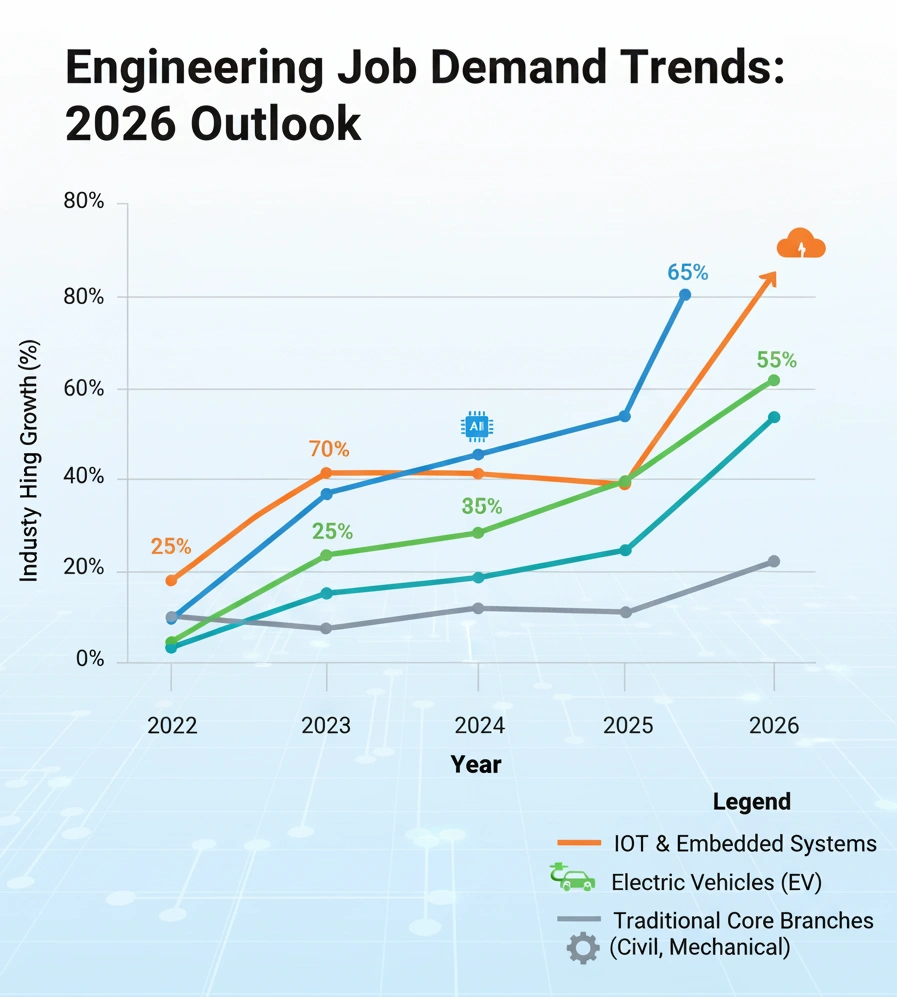
The rise of Electrical & Computer Engineering (ECE) as a top-choice branch in 2026 is no coincidence — it’s a direct result of the global shift toward intelligent, connected, and sustainable technologies. As industries move beyond traditional boundaries, engineers who understand both hardware (electrical systems) and software (AI, IoT, computing) have become the new backbone of innovation. This branch is redefining what it means to be an engineer in the digital era — not just someone who builds machines, but someone who teaches machines to think.
1. Industry Convergence: Hardware Meets Intelligence
Modern industries are powered by the integration of electronics, data, and automation. Electrical & Computer engineers sit at the intersection of these worlds — designing systems that sense, process, and act. For instance:
- IoT devices rely on embedded electronics to communicate with AI algorithms.
- Electric vehicles (EVs) need engineers who understand both power electronics and smart control software.
- Robotics and automation depend on real-time computing with precision sensors and actuators.
As a result, industries from automotive to healthcare to aerospace are now seeking ECE graduates to bridge this hardware-software divide.
2. The 2026 Tech Shift: AI, IoT & EVs
The year 2026 marks a turning point for AI-driven automation and smart electronics. Key global trends driving ECE’s rise include:
- Internet of Things (IoT): Over 75 billion connected devices expected globally by 2026.
- Electric Vehicle (EV) Expansion: India’s EV market projected to grow at 40% CAGR — fueling demand for control system engineers.
- Semiconductor and Chip Design Boom: “Make in India” semiconductor push creating opportunities in VLSI and embedded systems.
- AI-Integrated Energy Systems: Smart grids, renewable energy management, and intelligent control systems are becoming mainstream.
ECE graduates are uniquely positioned to work in all these areas — from designing chips to programming neural networks that optimise hardware.
3. Global Employability & Future-Proof Careers
Because of its interdisciplinary foundation, Electrical & Computer Engineering is among the most globally employable branches. Tech giants like Intel, NVIDIA, Qualcomm, Tesla, Siemens, Bosch, and Google hire ECE graduates for roles in:
- Embedded AI & IoT Engineering
- Hardware-Software Co-Design
- Energy Systems & Automation
- EV Powertrain Control & Sensor Integration
The versatility of this degree ensures graduates can switch seamlessly between core engineering, software, and AI fields. Thus making it one of the most future-proof careers of the decade.
4. Government & Industry Push in India
In India, 2026 brings major opportunities due to initiatives like:
- Digital India & Smart Cities Mission – requiring IoT and automation engineers.
- National Semiconductor Mission – boosting chip design and fabrication.
- EV Manufacturing & Renewable Energy Policies – generating massive demand for power electronics experts.
These initiatives are accelerating ECE program expansions across IITs, NITs, and leading private universities, highlighting their strategic importance for India’s tech future.
5. Why Students Prefer ECE (Electrical & Computer) Over Traditional Branches
Modern aspirants are drawn to ECE because it offers:
- Broader career flexibility – both core and IT job opportunities.
- Exposure to cutting-edge domains – AI, IoT, robotics, embedded intelligence.
- Higher ROI in placements – average salaries ranging from ₹8–14 LPA in top institutions.
- Innovation-driven learning – labs focused on automation, simulation, and data systems.
B Tech Electrical And Computer Engineering Syllabus
The BTech Electrical & Computer Engineering (ECE) syllabus is designed to create engineers fluent in both electrical systems and computing intelligence. This 4-year, 8-semester program blends the fundamentals of electrical circuits with advanced computer technologies like AI, IoT, embedded systems, and robotics — preparing students to design the smart, connected technologies of tomorrow.
The course structure typically follows a progressive learning model — starting with the basics of engineering and gradually integrating machine learning, automation, and embedded AI.
B Tech Electrical and Computer Engineering Subjects
| Year | B Tech Electrical and Computer Engineering Subjects | Major Labs / Projects |
| 1st Year | Engineering Physics, Mathematics, Basics of Electrical & Programming Fundamentals | Electrical Workshop, Programming Lab |
| 2nd Year | Circuit Analysis, Digital Logic Design, Microprocessors, Signal Processing | Electronics Lab, Control Systems Lab |
| 3rd Year | IoT Architecture, Power Electronics, Embedded Systems, Data Communication | Embedded Systems Project, IoT Lab |
| 4th Year | Artificial Intelligence, Robotics, Edge Computing, VLSI Design | Major Project, Industry Internship |
B Tech Electrical And Computer Engineering Colleges in India
As Electrical & Computer Engineering (ECE) becomes one of the fastest-growing hybrid branches in 2025–26, several top universities in India and abroad have introduced specialised programs that merge electrical systems, computing, AI, and embedded technologies.
Choosing the right college can make a huge difference — from access to cutting-edge labs and internships to better placements in IoT, semiconductor, and AI-driven industries.
Top BTech Electrical and Computer Colleges in India (2026 Admissions)
| College / University | Program Offered | Key Highlights |
| IIT Delhi | BTech in Electrical Engineering with Computer Technology Specialisation | AI-integrated curriculum, top research in smart grids and embedded systems |
| IIT Hyderabad | BTech in Electrical and Computer Engineering | Focus on IoT, chip design, and machine learning applications |
| BITS Pilani | BE (Hons) Electrical & Electronics with Computer Systems electives | Excellent placement in semiconductor and embedded software firms |
| VIT Vellore | BTech in Electrical and Computer Engineering | Hands-on projects in EV systems, IoT labs, and robotics |
| SRM Institute of Science and Technology | BTech in Electrical and Computer Engineering | Industry-integrated syllabus with electives in AI, Data Science, and Power Systems |
| Amrita Vishwa Vidyapeetham | BTech in Electrical and Computer Engineering | Focus on smart energy, automation, and sustainable systems |
| Manipal Institute of Technology (MIT) | BTech in Electrical and Electronics Engineering with Computer Applications | Global tie-ups, AI & embedded systems research labs |
| Lovely Professional University (LPU) | BTech in Electrical & Computer Engineering | Updated curriculum aligned with Industry 4.0 skills and IoT hardware projects |
Top BTech ECE International Universities
For students aspiring to study abroad, leading global universities offer BS / BEng programs in Electrical and Computer Engineering, emphasising AI hardware, robotics, and automation.
| University | Location | Global Edge |
| Massachusetts Institute of Technology (MIT) | USA | Global #1 in AI and chip design; advanced labs in embedded AI systems |
| Stanford University | USA | Leading research in machine learning hardware and computer architecture |
| Carnegie Mellon University (CMU) | USA | Renowned for robotics, embedded AI, and control systems |
| University of Toronto | Canada | Excellent ECE research in smart grids and computer hardware |
| National University of Singapore (NUS) | Singapore | Focus on electronics, computer integration, and IoT networks |
| TU Munich | Germany | Strong industry links in automotive electronics and EV systems |
B Tech Electrical and Computer Engineering Scope
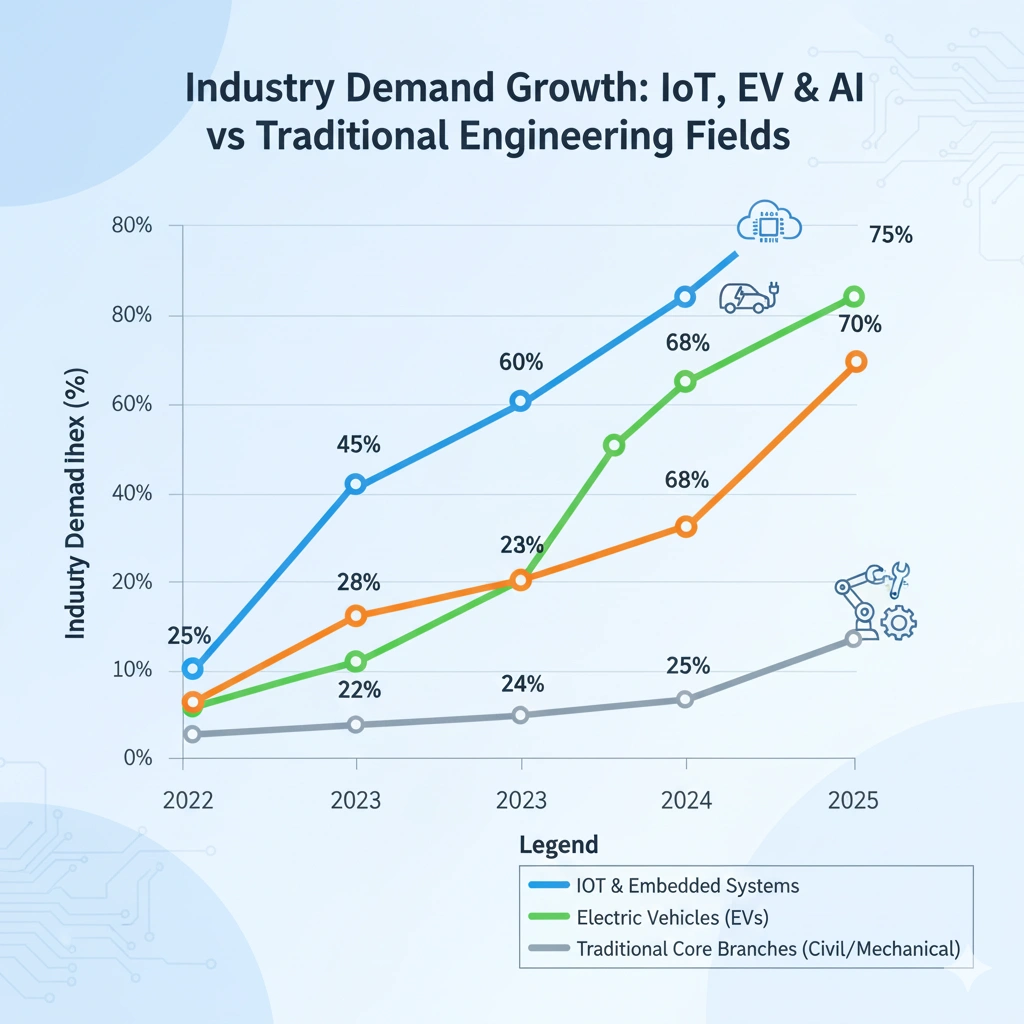
The demand for Electrical & Computer Engineers (ECE) is at an all-time high in 2025, driven by the digital transformation of industries, the rise of smart electronics, and the electrification of global mobility. As companies adopt AI-powered automation, 5G connectivity, IoT ecosystems, and EV infrastructure, ECE graduates are emerging as the most adaptable and in-demand professionals of the decade.
This branch’s hybrid skill set — the ability to design hardware and program intelligent systems — positions its graduates at the heart of innovation across multiple industries.
Core Industries Hiring ECE Engineers
| Industry | Hiring Focus (2025) | Key Job Roles |
| IoT & Smart Devices | Rapid growth due to smart homes, wearables, and sensors | IoT Engineer, Firmware Developer, Embedded Software Engineer |
| Electric Vehicles (EVs) & Renewable Energy | EV powertrain control, battery management, and charging networks | EV System Engineer, Power Electronics Engineer, Control Systems Analyst |
| AI, Automation & Robotics | Integration of machine learning in hardware systems | Robotics Engineer, Automation Developer, Embedded AI Engineer |
| Semiconductors & VLSI Design | High demand due to India’s semiconductor mission | VLSI Design Engineer, Chip Verification Engineer, FPGA Developer |
| Telecom & 5G Networks | 5G rollout and communication hardware development | Network Engineer, RF Engineer, Signal Processing Specialist |
| Smart Infrastructure & Energy | Smart grids, automation, and industrial IoT adoption | Energy Systems Engineer, Industrial Automation Engineer |
Hiring Trends & Growth Statistics (2025 Projections)
- IoT job demand in India has grown by 45% YoY, with over 2 lakh new roles in embedded and connected systems.
- The EV industry is expected to create 5 million engineering jobs globally by 2026.
- AI hardware and robotics sectors show a 38% increase in specialised ECE hiring.
- The Indian semiconductor and electronics market is projected to reach USD 400 billion by 2026, led by chip design and embedded system manufacturing.
- 5G and telecom expansion will employ over 50,000 ECE engineers in network optimisation and infrastructure design roles.
These numbers clearly show that ECE engineers are no longer limited to traditional electrical work; they’re driving innovation across every frontier of smart technology.
Top Companies Hiring ECE Graduates (2026)
| Category | Top Recruiters |
| Tech & AI Giants | Google, Intel, NVIDIA, Apple, Microsoft, Amazon |
| Semiconductor & Electronics | Qualcomm, Texas Instruments, Samsung, MediaTek, Micron |
| EV & Automotive | Tesla, Tata Motors, Ola Electric, Bosch, Continental |
| Telecom & Networking | Ericsson, Nokia, Cisco, Reliance Jio |
| IoT & Automation Firms | Siemens, ABB, Honeywell, Schneider Electric |
| Indian Core & Startup Ecosystem | Tata Elxsi, KPIT, Livguard, IoTronix, Mindtree, Infosys |
Most of these companies are looking for engineers who can design embedded systems, optimise hardware, and integrate software intelligence — exactly what the Electrical & Computer Engineering curriculum prepares students for.
B Tech Electrical and Computer Engineering Salary
A BTech in Electrical & Computer Engineering (ECE) opens doors to some of the most versatile and future-proof careers in the engineering world. In 2025, companies are hunting for engineers who can design intelligent systems, manage embedded computing. And build the electrical backbone of AI-driven technologies — and that’s exactly what ECE graduates are trained to do. From IoT and EVs to telecom, chip design, and automation, ECE engineers today are the architects of the connected future.
| Career Domain | Key Job Roles | Top Recruiters (2025) | Average Salary (₹ per annum) |
| IoT & Embedded Systems | IoT Developer, Embedded Software Engineer, Hardware Programmer | Intel, Bosch, Honeywell, Mindtree, Infosys | ₹6–10 LPA |
| Artificial Intelligence & Robotics | AI Hardware Engineer, Robotics Programmer, Control System Engineer | NVIDIA, ABB, Siemens, Tata Elxsi | ₹8–14 LPA |
| Electric Vehicles (EVs) & Smart Energy | Power Electronics Engineer, BMS Engineer, EV Design Engineer | Tesla, Ola Electric, Tata Motors, Hero MotoCorp | ₹7–12 LPA |
| Semiconductors & VLSI | Chip Design Engineer, FPGA Developer, Verification Engineer | Qualcomm, Texas Instruments, Samsung, Micron | ₹8–15 LPA |
| Telecom & Networking (5G/6G) | Network Engineer, RF Engineer, Signal Processing Expert | Ericsson, Nokia, Cisco, Reliance Jio | ₹6–10 LPA |
| Software & IT Integration | Systems Analyst, Hardware-Software Integration Engineer | TCS, Wipro, Capgemini, Accenture | ₹5–9 LPA |
B Tech Electrical and Computer Engineering Salary Trends in India (2026)
ECE graduates enjoy competitive pay packages, especially when skilled in AI integration, embedded design, or VLSI systems.
| Experience Level | Typical Role | Average Salary Range (₹ per annum) |
| Freshers (0–2 years) | Embedded Engineer, Network Engineer | ₹4.5 – ₹7 LPA |
| Mid-Level (3–6 years) | System Design Engineer, IoT Specialist | ₹8 – ₹12 LPA |
| Experienced (7–10 years) | Project Lead, AI Hardware Architect | ₹15 – ₹25 LPA |
| Abroad / MNC Roles | Chip Design / R&D Engineer | ₹30 – ₹60 LPA (₹ equivalent) |
Globally, ECE engineers are in high demand in the US, Germany, Singapore, and Canada, particularly in chip design, EVs, and automation fields.
FAQs
Is Electrical & Computer Engineering better than traditional ECE or CSE?
Yes, it’s more interdisciplinary. While traditional ECE focuses on circuits and communication, and CSE emphasizes software, Electrical & Computer Engineering merges both. This gives graduates wider career options in hardware, software, AI, and robotics.
What are the top job opportunities after BTech ECE?
Graduates can work as IoT Engineers, Embedded System Developers, AI Hardware Engineers, Robotics Specialists, and Power Electronics Engineers. Top recruiters include Intel, Bosch, NVIDIA, Qualcomm, Tata Motors, and Siemens.
What is the average salary of ECE graduates in 2025?
Freshers typically earn between ₹5–8 LPA, while experienced professionals in core or R&D roles earn ₹12–25 LPA. In global firms or semiconductor industries, packages can go up to ₹40–60 LPA depending on specialization.
Which colleges offer BTech in Electrical & Computer Engineering in India?
Leading institutes include IIT Delhi, IIT Hyderabad, BITS Pilani, VIT Vellore, SRM University, and Amrita University. These colleges offer industry-oriented curricula integrating AI, IoT, and embedded systems.
What is the future scope of ECE in 2026 and beyond?
The scope is massive — especially with the rise of AIoT, EVs, smart grids, and semiconductor design. By 2030, Electrical & Computer Engineers will be key contributors to Industry 4.0, powering automation, sustainable energy, and intelligent systems worldwide.