Bvsc Course Duration — 2026
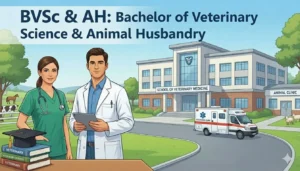
The Bachelor of Veterinary Science (BVSc) course in India typically spans 5.5 years, including a mandatory one-year internship, as per the Veterinary Council of India (VCI) guidelines for the 2026-2027 academic session. This full undergraduate program focuses on animal healthcare, disease prevention, and livestock management, providing in-depth theoretical knowledge and practical training.
| Parameter | Details |
|---|---|
| Course Full Form | Bachelor of Veterinary Science (BVSc) / Bachelor of Veterinary Science and Animal Husbandry (BVSc & AH) |
| Standard Duration (VCI Guidelines) | 5.5 years (10 semesters + 1 year compulsory internship training program) |
| General Duration (Some Universities) | 5 years (including academic study and internship) |
| Course Type | Undergraduate Professional Degree (Medical and Healthcare discipline) |
| Eligibility (Academic) | Class 12 in Science stream with Physics, Chemistry, Biology (PCB) and English as compulsory subjects from a recognized board. |
| Minimum Aggregate Marks | 50% for General category; 40% for reserved categories; 47.5% for SC/ST candidates in PCB. |
| Age Limit | 17-25 years at the time of admission (as of December 31, 2026) |
| Admission Mode | NEET UG (primary), merit-based selection (in some universities), college-specific entrance exams. |
| Curriculum Body | Veterinary Council of India (VCI) |
| Pass Criteria | Minimum 50% marks in theory as well as in practicals separately for each examination. |
| Attendance Requirement | Minimum 75% attendance in scheduled theory and practical sessions separately for each subject. |
| Average Annual Fees (2026) | ₹20,000 – ₹4 lakh per annum (average range across India). |
| Government College Fee Range (2026) | ₹10,000 – ₹1 lakh per annum. |
| Total Course Fees (2025-26) | ₹4,000 to ₹30.25 lakh (depending on institution type). |
| BHU BVSc & A.H. First Year Fee (2026) | ₹56,089 (total first-year cost). |
| BHU BVSc & A.H. Subsequent Years Fee | ₹50,314 per annum (from second year onward). |
| Odisha University of Agriculture and Technology BVSc & AH Total Fee | ₹85,000 (total 5-year program fee, excluding hostel). |
| Veterinary College and Research Institute, Theni BVSc & AH Total Fee | ₹44,000 (total tuition fee for 66 months course). |
| Birsa Agricultural University BVSc & A.H. Total Fee (2026) | ₹128,460 (for the complete 5-year full-time course). |
| CSKHPKV B.V.SC Animal Husbandry Total Fee (2025) | ₹2.13 lakh (for the complete course duration, excluding hostel fees). |
| Maharashtra Animal & Fishery Sciences University B.V.SC. & A.H. Admission Fee (Unreserved, 2025-26) | ₹62,635 (per year admission fee). |
| Key Specializations | Veterinary Medicine, Animal Husbandry, Animal Anatomy, Disease Prevention, Livestock Management, Surgery, Animal Nutrition, Genetics, Microbiology, Radiology. |
| Colloquial Title | Veterinary graduates are often referred to as ‘Doctor’ in India, reflecting their expertise in animal health. |
The BVSc & AH program is designed to provide extensive theoretical and practical training, preparing students for diverse roles in animal care and veterinary science across India.
BVSc Course Duration: Types, Categories & Key Components Explained
The standard BVSc (Bachelor of Veterinary Science) and Animal Husbandry (AH) course in India spans 5.5 years for the 2026-2027 academic session. This duration includes a mandatory one-year internship, as per Veterinary Council of India (VCI) guidelines. Students considering professional courses often compare durations; for instance, an M Tech course duration is typically 2 years, while ITI Mechanic courses can range from 6 months to 2 years.
| Type/Category | Details | Key Feature |
|---|---|---|
| Bachelor of Veterinary Science and Animal Husbandry (BVSc & AH) | 5.5 years (10 semesters + 1 year compulsory internship). Eligibility: 10+2 Science (PCB, English) with 50% marks. | VCI-mandated professional degree. Focuses on animal health, treatment, and welfare. |
| Veterinary College and Research Institute, Theni | 66 months (5.5 years) for B.V.SC. And AH. | Includes 1 year of mandatory internship. Located in Tamil Nadu. |
| College of Veterinary Science, Proddatur | 66 months (5.5 years) for BVSc. | Full-time mode. Affiliated with Sri Venkateswara Veterinary University. |
| Krantisinh Nana Patil College of Veterinary Science, Satara | 66 months (5.5 years) for Bachelor of Veterinary Science (BVSc). | Full-time mode. Located in Maharashtra. |
| Bhumika Institute of Veterinary Sciences, Mohali | 5.5 years (full-time undergraduate degree). Eligibility: Higher Secondary/Intermediate (10+2) or equivalent. | Affiliated with Lala Lajpat Rai University of Veterinary and Animal Sciences, Hisar. |
| College of Veterinary Sciences and Animal Husbandry, Imphal | 5.5 years (full-time undergraduate degree). | Affiliated with Central Agricultural University, Imphal. |
| Bachelor of Veterinary Science (General) | 5 years (10 semesters). Eligibility: 10+2 Science (PCB, English). | Mixes classroom learning with practical training in laboratories, farms, and hospitals. |
| Odisha University of Agriculture and Technology, Bhubaneswar | 5 years for Bachelor of Veterinary Science (BVSc) and Animal Husbandry (AH). | Located in Bhubaneswar. |
| Birsa Agricultural University (BAU), Ranchi | 5 Years (Full Time) for BVSc & A.H. | Total fee ₹1,28,460 (2026). |
| Govind Ballabh Pant University of Agriculture and Technology, Pantnagar | 5 years (full-time) for BVSc. Eligibility: 10+2 with 50% in PCMBE. | Qualified faculty with PhDs. |
| Chaudhary Sarwan Kumar Himachal Pradesh Krishi Vishvavidyalaya (CSKHPKV), Palampur | 5 Years (Full Time) for B.V.SC Animal Husbandry. | 60 seats available. Total fee ₹2.13 Lakhs (2025). |
| Sardarkrushinagar Dantiwada Agricultural University | 5 years (full-time) for B.V.SC. & AH. | Located in Sardarkrushinagar. |
| Sher-e-Kashmir University of Agricultural Sciences and Technology of Kashmir (SKUAST Kashmir) | 5 Years (Full time) for B.V.SC and Animal Health. | Located in Srinagar, Jammu and Kashmir. |
| Bihar Veterinary College, Patna | 4 Years (Full Time) for BVSc & A.H. | Offers degrees in B.V.SC, Ph.D, M.V.SC. |
| College of Veterinary & Animal Sciences, Latur | 4 Years for BVSc. | Government Institute established in 1987. |
| BVSc in Veterinary Surgery and Radiology | 3 years. | Bachelor’s degree focused on animal surgery and imaging. |
| BVSc in Veterinary Microbiology | 3 years (undergraduate-level). | Focuses on bacterial and viral diseases of domestic vertebrate animals. |
| BVSc in Animal Nutrition | 3 years. | Program focused on animal nutrition, reproduction, and health. |
| Diploma in Veterinary Pharmacy | Minimum 2 years. Eligibility: Biology background. | Focuses on manufacturing drugs for animal illnesses and injuries. |
| General Diploma and Certificate courses | 6 months to 2 years. | Offers practical skills in various veterinary fields. |
| BVSc (Distance Learning) | Few months to over a year (varies). Eligibility: Qualified and practicing veterinarians. | Primarily for skill updates. Colleges conduct examinations. |
| BVSc (Online Courses) | Varies depending on platform and specialization. | Available on individual online platforms with unique offerings. |
These varied durations reflect diverse academic and professional pathways in veterinary science. Options range from full professional degrees to specialized undergraduate programs and skill-ment courses.
BVSc Course Duration: Key Statistics & Data Points for 2026
The Bachelor of Veterinary Science (BVSc) and Animal Husbandry (A.H.) program typically spans 5.5 years, including a mandatory one-year internship as per Veterinary Council of India (VCI) guidelines for the 2026 academic session. This full duration ensures students gain extensive theoretical knowledge across 10 semesters and practical clinical experience in animal healthcare.
| Parameter | Value/Details (2026 Academic Session) | Applicability/Context | Source |
|---|---|---|---|
| Standard BVSc & A.H. Duration | 5.5 years | Includes 10 academic semesters and 1 year of compulsory internship | VCI Guidelines, Collegedunia |
| Academic Semesters | 10 semesters | Covers theoretical and practical coursework | BVSc Course Structure |
| Compulsory Internship Duration | 1 year | Mandatory practical training in veterinary hospitals/clinics | VCI Guidelines, Shiksha |
| Eligibility: Class 12 Subjects | Physics, Chemistry, Biology (PCB) and English | Mandatory subjects from a recognized board | NEET UG Information Bulletin |
| Eligibility: Minimum Marks (General) | 50% aggregate in PCB | For unreserved category candidates | Shiksha, Getmyuni |
| Eligibility: Minimum Marks (Reserved Categories) | 40% (general reserved), 47.5% (SC/ST) | Relaxation for specific categories | BVSc Course Data |
| Eligibility: Age Limit | 17-25 years | Candidate must be 17 by December 31, 2026; maximum 25 years | Shiksha, BVSc Course Data |
| Primary Admission Exam | NEET UG | National Eligibility cum Entrance Test (Undergraduate) | Collegedunia, Shiksha |
| NEET UG Score for Govt. Colleges (General) | 500+ | Required for admission to top government BVSc colleges | Shiksha |
| NEET UG Score for Govt. Colleges (OBC) | 450+ | Required for admission to top government BVSc colleges | Shiksha |
| NEET UG Score for Govt. Colleges (SC) | 380+ | Required for admission to top government BVSc colleges | Shiksha |
| NEET UG Score for Govt. Colleges (ST) | 320+ | Required for admission to top government BVSc colleges | Shiksha |
| Average Annual Fees (India) | ₹20,000 – ₹4 lakh | Average range across government and private institutions | BVSc Course Data |
| Total BVSc Colleges in India | 47+ | Number of recognized institutions offering BVSc programs | Collegedunia |
| BHU BVSc & A.H. Seats | 60 seats | Offered at Rajiv Gandhi South Campus, Mirzapur | Banaras Hindu University Official Website |
| BHU BVSc First Year Fee (2026) | ₹56,089 | Includes admission and tuition charges | Banaras Hindu University Official Website |
| Bihar Veterinary College Patna BVSc & A.H. Duration | 4 Years (Full Time) | Specific program duration at this institution | Bihar Veterinary College Official Website |
| College of Veterinary & Animal Sciences, Latur BVSc Duration | 4 Years | Specific program duration at this institution | College Official Website |
| Odisha University of Agriculture and Technology BVSc & AH Duration | 5 years | Specific program duration at this institution | Odisha University Official Website |
| Diploma in Veterinary Pharmacy Duration | Minimum 2 years | Undergraduate Diploma course | BVSc Course Data |
| PG Level Veterinary Courses Duration | 2 years | Master’s degree programs (e.g., MVSc) | BVSc Course Data |
The BVSc program’s 5.5-year structure, including a mandatory internship, is a critical factor for students planning their academic and career timelines in veterinary science.
How BVSc Course Duration Works: Process, Steps & Key Details
The BVSc course duration is 5.5 years in India for the 2026-2027 academic session. This includes 10 academic semesters and a mandatory one-year internship program, as per Veterinary Council of India (VCI) guidelines. Understanding this structured process is vital for prospective students.
- Overall Program Length: The Bachelor of Veterinary Science (BVSc) and Animal Husbandry (AH) is a 5.5-year undergraduate degree. This full duration is uniformly mandated by the Veterinary Council of India (VCI) across all recognized institutions in India.
- Academic Semesters: The academic portion of the BVSc program spans 10 semesters, covering 4.5 years of intensive classroom and laboratory learning. Students explore core subjects like Animal Anatomy, Physiology, Pathology, and Veterinary Medicine during this period.
- Compulsory Internship: Following the academic semesters, students undertake a mandatory one-year (12-month) internship. This practical training phase is for gaining hands-on experience in real-world veterinary settings, including hospitals and clinics.
- Internship Activities: During the internship, students actively participate in medical procedures, develop treatment plans, and engage in an educational tour. This tour exposes them to diverse facilities such as research farms, zoological parks, and vaccine institutes.
- Admission Age Criteria: For admission to the BVSc course in 2026, candidates must be between 17 and 25 years old. Age relaxations are provided for reserved categories, adhering to government regulations.
- Attendance Requirements: A strict minimum of 75% attendance is compulsory for both theory and practical sessions in every subject. This requirement ensures consistent student engagement with the rigorous curriculum throughout the program.
- Examination Structure: Professional examinations within the BVSc program feature both external theory and internal practical components. The Veterinary Council of India (VCI) conducts the final examination, which is a critical step for degree completion.
- Passing Marks: To successfully pass each subject, students must secure a minimum of 50% marks in both the theory and practical examinations separately. This rigorous standard ensures a full understanding of veterinary science.
- Attendance Relaxation Policies: Specific relaxations of up to 20 working days are granted for participation in NCC/NSS activities, other co-curricular engagements, or on valid medical grounds. A 7-day relaxation is also applicable for 0+1 credit courses.
- Admission Pathways: Admission to BVSc programs for the 2026-2027 academic year is primarily based on NEET UG scores. Some universities also offer admission through a merit-based selection process or conduct their own specific entrance examinations.
Understanding these detailed steps and requirements is for students to effectively plan their academic and professional trajectory in veterinary science.
BVSc Course Duration: Benefits, Advantages & Why Students Choose IT
The 5.5-year BVSc course duration in India provides full training, including a mandatory one-year internship, preparing graduates for diverse animal healthcare roles. This extended period ensures in-depth theoretical knowledge and extensive practical skills, aligning with Veterinary Council of India (VCI) guidelines for professional competency.
- full Curriculum: The 5.5-year BVSc program, including 10 semesters, covers extensive subjects like animal physiology, anatomy, nutrition, genetics, and surgery. This ensures a deep understanding of animal health and welfare across various species.
- Mandatory Clinical Internship: A full one-year compulsory internship is integrated into the 5.5-year duration, providing hands-on experience in diagnosing and treating animal illnesses. Students gain practical skills in veterinary hospitals and clinics.
- VCI-Approved Standardisation: The Veterinary Council of India (VCI) mandates the 5.5-year duration, ensuring a nationally recognized and standardized professional degree. This prepares graduates for licensure and practice across India.
- In-depth Practical Training: The extended duration allows for significant practical training in laboratories, farms, and teaching animal health facilities. Students develop proficiency in medical procedures and treatment plans for animals.
- Diverse Specialization Exposure: Students explore multiple specializations like Veterinary Medicine, Animal Husbandry, and Veterinary Microbiology during the program. This broad exposure helps in choosing future postgraduate studies or career paths.
- Skill Development for Animal Care: The curriculum builds skills in animal care, disease prevention, livestock management, and surgical techniques. Graduates are equipped to handle both exotic and regular breeds.
- d Career Readiness: The rigorous 5.5-year training ensures graduates are highly competent and ready for roles in government veterinary services, private clinics, and research institutions. This leads to strong career prospects in the animal healthcare sector.
- Research Opportunities: The full nature of the program, particularly in specializations like Veterinary Microbiology, allows for participation in small and large-scale clinical and laboratory-based research. This builds scientific inquiry and innovation.
- Professional Identity: Completing the VCI-approved 5.5-year BVSc program bestows the professional title of “Doctor of Veterinary Medicine” (colloquially “Doctor” in India). This establishes a respected identity within the healthcare community.
The full 5.5-year BVSc curriculum, with its integrated internship and VCI guidelines, provides a strong foundation for a successful career in veterinary science.
BVSc Course Duration vs Alternatives: Which Option is Best?
The BVSc & AH course spans 5.5 years, including a mandatory one-year internship, as per Veterinary Council of India (VCI) guidelines for 2026 admissions. Students often compare this duration with other science-stream programs like agricultural degrees or veterinary diplomas to make informed career choices. For those exploring various technical fields, understanding the ITI Mechanic course duration can also provide a different perspective on vocational training.
| Feature | BVSc & AH (5.5 Years) | B.SC (Hons.) Agriculture (4 Years) | Diploma in Veterinary Pharmacy (2 Years) |
|---|---|---|---|
| Course Full Name | Bachelor of Veterinary Science and Animal Husbandry | Bachelor of Science (Honours) Agriculture | Diploma in Veterinary Pharmacy |
| Total Course Duration | 5.5 years (10 semesters + 1 year compulsory internship) | 4 Years (Full Time) | Minimum 2 years |
| Minimum Eligibility (10+2) | Class 12 PCB + English, min 50% aggregate (40% reserved); age 17-25 years | 10+2 (Science stream usually implied) | Biology background |
| Primary Admission Mode | NEET UG, merit-based, college-specific exams | University-specific entrance exams, merit | Merit-based |
| Core Focus | Animal healthcare, disease diagnosis, treatment, welfare, breeding, livestock management | Crop production, soil science, agricultural engineering, farm management | Manufacturing and dispensing animal drugs, pharmacology, animal illness/injury medication |
| Internship/Practical Component | 1 year compulsory internship (hands-on training in hospitals/farms) | Field work, practical sessions, project-based learning | Practical training in labs, clinical attachments |
| Typical Annual Fees (2026) | ₹20,000 – ₹4 LPA | Approx. ₹15,000/year (e.g., Birsa Agricultural University) | Varies by institution; generally lower than degree courses |
| Career Path Level | Professional Undergraduate Degree | Undergraduate Degree | Diploma |
Choosing between these options depends on a student’s long-term career aspirations and commitment to a specific duration and academic rigor. For those considering other science-related degrees, understanding the BSc course salary can provide further comparison points.
Common Misconceptions About BVSc Course Duration: Myths vs Reality
The Bachelor of Veterinary Science and Animal Husbandry (BVSc & AH) is a 5.5-year undergraduate program in India. Many students hold misconceptions about this duration, often confusing IT with other medical or vocational courses.
- Myth 1: BVSc is a 5-year program. The Bachelor of Veterinary Science and Animal Husbandry (BVSc & AH) is a 5.5-year undergraduate program. This duration, including a compulsory internship, is mandated by the Veterinary Council of India (VCI) guidelines for all recognized institutions.
- Myth 2: The internship is an optional or separate addition. The 1-year internship is a mandatory and integrated component of the 5.5-year BVSc & AH curriculum. IT provides practical training in veterinary hospitals and farms, for hands-on experience.
- Myth 3: All BVSc-related courses have a 5.5-year duration. While the core BVSc & AH is 5.5 years, specialized BVSc programs like “BVSc in Veterinary Microbiology” or “BVSc in Veterinary Surgery and Radiology” can be 3 years. Diploma courses in the veterinary field typically range from 6 months to 2 years, similar to other allied medical courses.
- Myth 4: BVSc course duration varies significantly between colleges. For the Bachelor of Veterinary Science and Animal Husbandry (BVSc & AH) degree, the duration is standardized at 5.5 years across most Indian universities. This ensures uniformity in veterinary education as per VCI regulations.
- Myth 5: Online or distance learning BVSc offers a full degree. Online and distance BVSc courses are generally shorter, lasting a few months to over a year. These programs are primarily designed for qualified and practicing veterinarians to update their skills, not to confer a full undergraduate degree.
- Myth 6: BVSc and MBBS have identical course durations. Both BVSc & AH and MBBS are 5.5-year programs. However, MBBS typically includes an *additional* one-year compulsory rotating internship, extending the total duration to 6.5 years, whereas the BVSc internship is *included* within its 5.5 years.
Understanding these distinctions helps students make informed decisions about their veterinary education path in 2026.
What to Do Next: Actionable Steps for Students Interested in BVSc Course Duration
The BVSc course duration is 5.5 years, including a mandatory one-year internship, as per Veterinary Council of India (VCI) guidelines for 2026 admissions. Most admissions for the 2026-27 academic session rely on NEET UG scores.
- Verify Eligibility Criteria: Ensure you meet the 10+2 Science stream requirements with Physics, Chemistry, Biology, and English, securing at least 50% aggregate marks (40% for reserved categories). The age limit for BVSc admission is typically 17-25 years as of December 31, 2026.
- Prepare for NEET UG 2026: NEET UG is the primary entrance examination for BVSc admissions across India. General category candidates often need 500+ marks for government college seats, while OBC requires 450+ and SC/ST 320+ marks. For other undergraduate courses, students might explore options like BSc courses or GNM programs.
- Research BVSc Colleges: Identify colleges offering the 5.5-year BVSc & AH program, such as Banaras Hindu University (BHU), Kerala Veterinary and Animal Sciences University, and Maharashtra Animal & Fishery Sciences University (MAFSU). Check their specific admission processes and fee structures for 2026-27.
- Understand the Internship Component: The 1-year compulsory internship is an integral part of the 5.5-year BVSc duration, providing hands-on training in veterinary hospitals, farms, and research facilities. This practical exposure is for professional development.
- Gather Required Documents: Prepare necessary documents including academic transcripts, NEET UG scorecard, caste certificates (if applicable), and a physical fitness Certificate. Kerala Veterinary and Animal Sciences University, for instance, requires a physical fitness Certificate for admission.
- Explore Merit-Based Admissions: While NEET UG is dominant, a few universities in India offer BVSc admissions based on Class 12 merit without an entrance exam. Research these specific institutions and their application timelines for 2026.
Taking these actionable steps will help prospective students the BVSc admission process for the 2026 academic year effectively.
Key Takeaways
- The standard BVSc course duration is 5.5 years, which includes 4.5 years of academic study and a mandatory 1-year internship.
- NEET UG 2026 is the primary entrance exam, with general category candidates needing 500+ marks for government BVSc college admissions.
- Eligibility requires 10+2 Science (PCB + English) with a minimum 50% aggregate, and candidates must be 17-25 years old by December 31, 2026.
Monitor the official NEET UG 2026 website and individual university portals for application deadlines and counselling schedules.
Frequently Asked Questions (FAQs)
What is the BVSc course duration in India?
The BVSc course duration is 5.5 years, including a 1-year compulsory internship. This structure is mandated by the Veterinary Council of India and divided into 10 semesters.
Does BVSc require NEET for admission?
Yes, NEET UG scores are mandatory for 85% of BVSc seats in India. General category candidates need 500+ marks, OBC 450+, SC 380+, and ST 320+ (as per 2025 cutoffs).
What are the BVSc fees in Indian colleges?
BVSc fees range from ₹10,000/year (government colleges like IVRI) to ₹1.2 lakh/year (private institutions). Rajasthan Agricultural University charges ₹18,000/year for domicile students.
Can I get BVSc admission without entrance exams?
Yes, 15% of BVSc seats in state universities like Rajasthan and Karnataka admit through merit-based selection without entrance exams, using 10+2 PCB scores.
What career options exist after BVSc?
Graduates work as veterinary officers (₹3-6 LPA), animal breeders, or research scientists. Top recruiters include NDDB, Cattle Feed India, and private pet care chains like Petco.
Is internship mandatory in BVSc?
Yes, the 1-year internship includes rotations in veterinary hospitals, dairy farms, and vaccine production units. Students also undertake educational tours to zoological parks and research institutes.
What are the BVSc eligibility criteria?
Candidates must complete 10+2 with Physics, Chemistry, Biology, and English (50% aggregate). Age limit is 17-25 years as per Veterinary Council of India regulations (2025 data).
Disclaimer: The information provided in this article is sourced from official websites, NIRF rankings, and publicly available data. Fees, placement figures, and other details may vary. Please verify with the official institution website for the most current information.