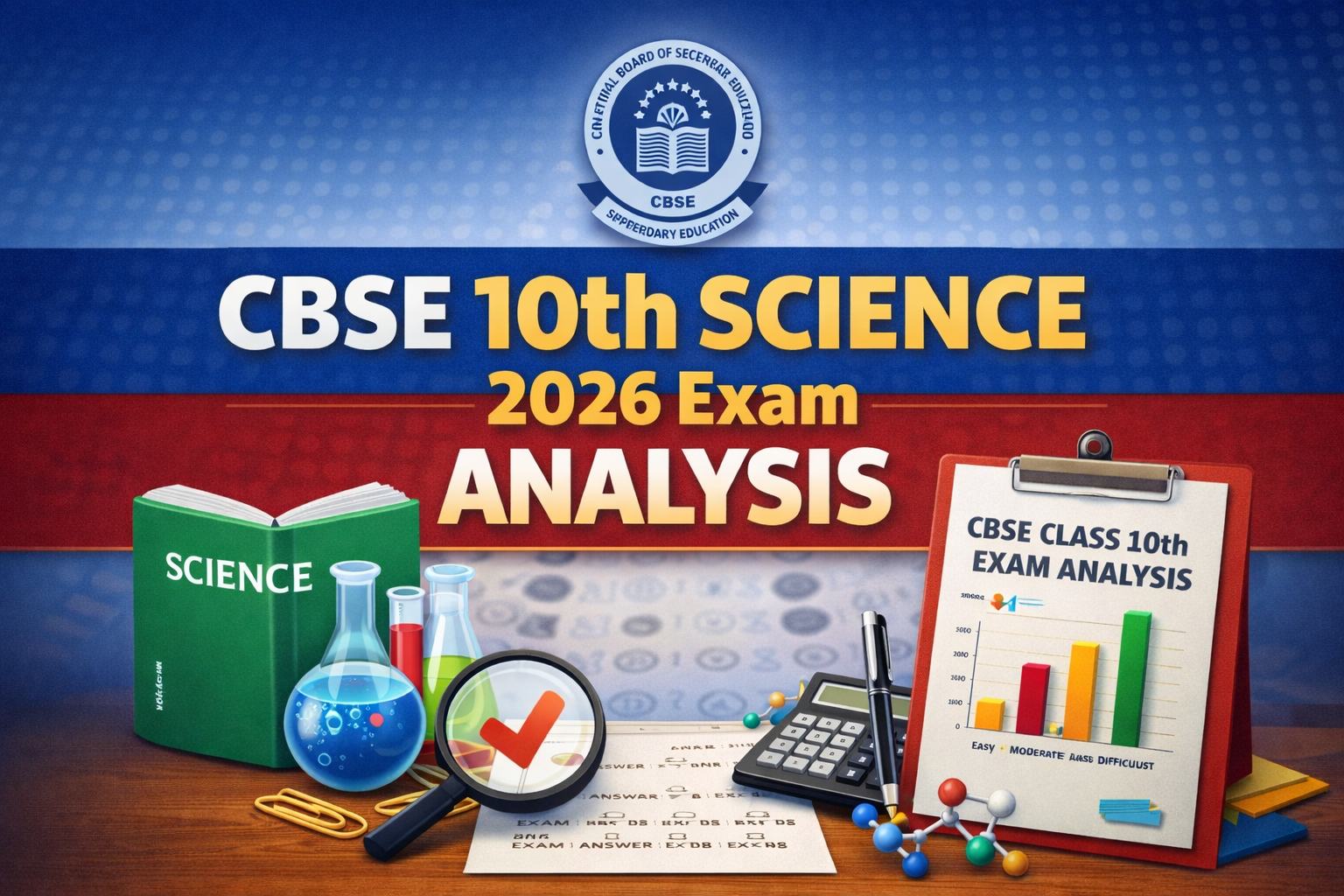
CBSE 10th Science 2026 Exam Analysis: Difficulty Level & Students’ Reactions
The Class 10 Science board examination conducted by the Central Board of Secondary Education has concluded successfully across the country. Students who appeared for the exam shared mixed yet largely positive reactions, describing the paper as balanced and aligned with the prescribed syllabus. The examination was held at multiple centres in New Delhi and other regions under standard board guidelines.
Early feedback from students and teachers suggests that the question paper followed the competency-based pattern introduced in recent years and emphasized conceptual understanding over rote learning.
Overall Difficulty Level: Easy to Moderate
Based on initial reactions and expert reviews, the CBSE Class 10 Science 2026 paper was rated easy to moderate in overall difficulty. Most questions were directly based on the syllabus prescribed by the National Council of Educational Research and Training, making the paper manageable for students who had thoroughly studied NCERT textbooks and solved sample papers.
The paper included a balanced combination of multiple-choice questions, short-answer questions, assertion–reason items, and case-study-based questions. Teachers noted that the structure allowed students to attempt the exam comfortably within the three-hour duration.
Many students reported that the questions were familiar and similar to those seen in previous years’ board papers and practice tests.
Section-Wise Exam Analysis: Physics, Chemistry, Biology
Physics Section Slightly Lengthy
The Physics portion was considered moderately difficult compared to the rest of the paper. While the questions were concept-based and derived from the syllabus, some numerical problems required careful calculations and proper formula application.
Topics such as electricity, magnetic effects of current, and light were prominently featured. Students mentioned that this section was slightly time-consuming, especially for those who spent more time solving numerical questions.
However, teachers stated that the difficulty level remained within the expected board standard and did not include unexpected or out-of-syllabus questions.
People Also Read


Chemistry Section Balanced and Scoring
The Chemistry section was widely regarded as balanced and scoring. Questions from chemical reactions, acids and bases, metals and non-metals, and carbon compounds were asked in a straightforward format.
Students reported that many questions were directly linked to textbook examples and exercises, making the section easier for those who had revised NCERT thoroughly. Assertion-reason questions and short conceptual questions were also manageable.
Experts noted that Chemistry required clarity of concepts rather than lengthy calculations, which helped students complete this portion quickly.
Biology Section Easiest for Most Students
Biology emerged as the easiest section of the paper according to most students. Questions were largely theory-based and included diagrams and direct conceptual prompts.
Important chapters such as life processes, reproduction, heredity, and environment were covered. Students found diagram-based questions simple and scoring.
Teachers observed that the Biology section rewarded students who focused on textbook definitions, diagrams, and key processes.
Students’ Reactions After the Exam
Students across different exam centres expressed relief after reviewing the question paper. Many said the paper was less stressful compared to some other major subjects and that most questions were predictable.
Several students shared that Biology and Chemistry helped boost their confidence, while Physics required more attention and time management. Overall, students felt that the paper provided a fair opportunity to score well.
Teachers also noted that students who practiced sample papers and previous year questions found the exam easier to attempt.
Exam Pattern and Competency-Based Questions
The CBSE continued its competency-focused assessment pattern in 2026, aiming to test conceptual clarity and application skills. Case-study questions and assertion–reason formats were included to evaluate analytical understanding.
Internal choices were provided in most sections, allowing students to select questions based on their preparation strengths. This approach reduced exam pressure and helped students manage time effectively.
Experts believe that the board’s gradual shift toward conceptual assessment is encouraging deeper learning rather than memorization.
Time Management Played a Key Role
Time management remained an important factor in the exam. Students who attempted easier sections first, particularly Biology and Chemistry, were able to allocate more time to Physics numericals.
Teachers advised future aspirants to practice solving full-length sample papers within the time limit to improve speed and accuracy.
Proper reading of case-study questions and step-wise solving of numerical problems were also highlighted as effective strategies.
Expected Impact on Results
Given the moderate difficulty level and strong alignment with the NCERT syllabus, teachers expect overall performance to remain stable or improve this year. Students who maintained consistent preparation and conceptual clarity are likely to score high marks.
With the Science examination completed, students are now focusing on their remaining subjects while awaiting evaluation updates and result announcements in the coming months.
News Important Links
Final Verdict
The CBSE Class 10 Science 2026 examination was balanced, student-friendly, and largely predictable. While the Physics section added a moderate level of challenge, Chemistry and Biology were straightforward and scoring. Overall, the paper reflected the board’s focus on conceptual learning and fair assessment standards.

Simran is currently working as a Senior Content Writer at Findmycollege , where she creates engaging and research-driven learning resources for students. She has completed her Graduation in Journalism from Delhi University. With 4 years of experience in the EdTech industry, she has previously contributed to leading platforms like Leverage Edu and Aakash. Her expertise lies in simplifying Engineering and Medical entrance exam content to guide aspirants in their preparation journey. Beyond writing, Simran enjoys sketching, watching movies, and finding creative inspiration in everyday life.
View all posts →Related Articles
JEE Main 2026 Jan 22 Exam Analysis: How Difficult Was Each Section?
Jan 23, 2026
JEE Main 2026 January 28 Shift-Wise Exam Analysis: Difficulty Level and Section Review
Jan 28, 2026
CBSE Class 12 Physics Exam 2026 Analysis; Mixed Reactions on Difficulty; Download Question Paper Here
Feb 20, 2026
ISC Class 12 History Exam 2026 Held; Paper Rated Moderate by Students
Feb 26, 2026
HBSE Class 10 Mathematics Exam 2026 Held; Students Describe Paper as Easy to Moderate but Lengthy
Feb 27, 2026