CBSE Board Exams 2026: Major Changes in Exam Pattern and Evaluation
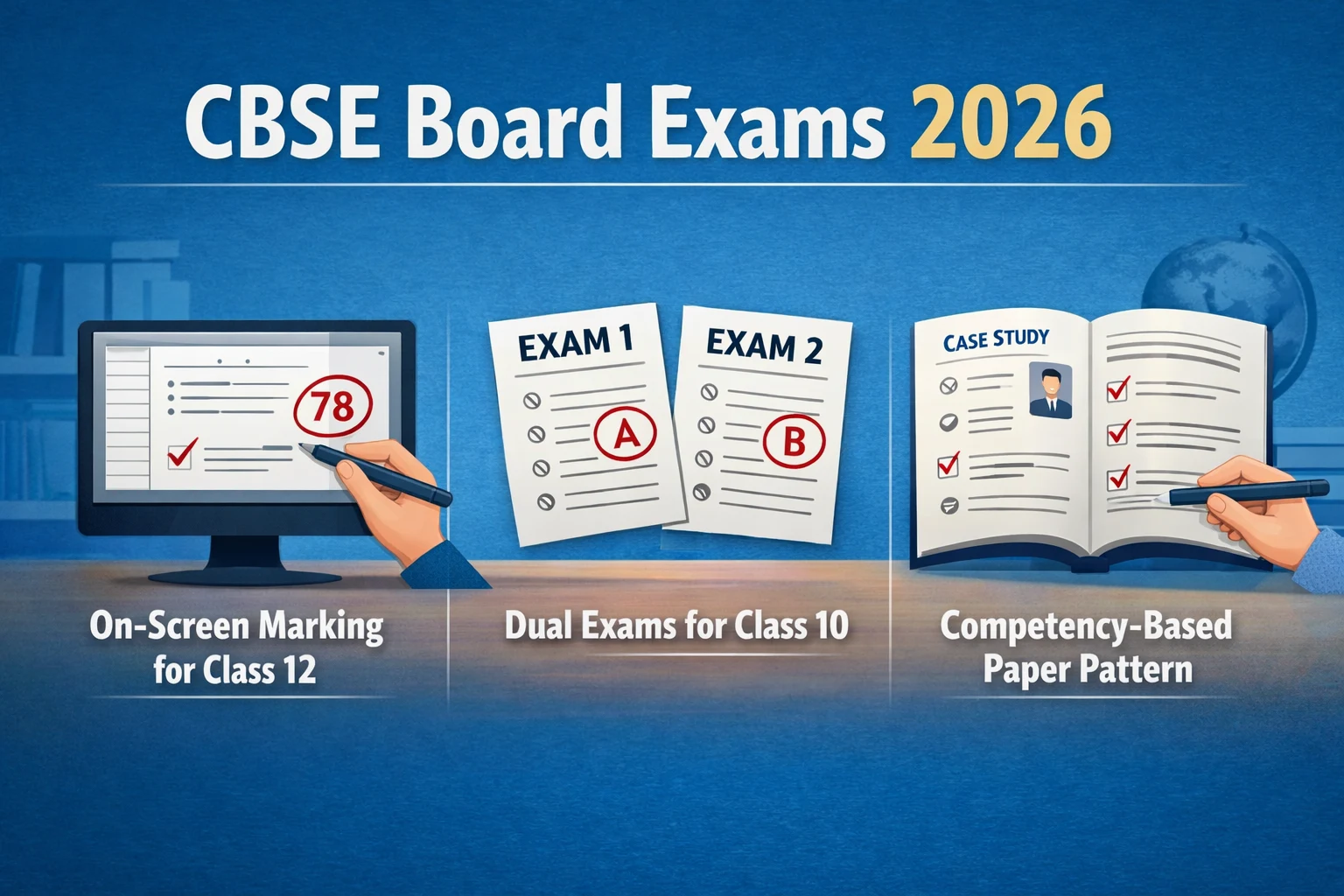
The Central Board of Secondary Education (CBSE) has introduced several structural reforms for the 2026 Class 10 and Class 12 board examinations. Key changes include the implementation of On-Screen Marking (OSM) for Class 12 answer sheets, the introduction of two board exam opportunities for Class 10 students, and the continued shift toward competency-based question paper design aligned with the National Education Policy (NEP) 2020.
These reforms aim to improve evaluation efficiency, reduce exam stress, and encourage application-oriented learning among students across CBSE-affiliated schools in India and abroad.
On-Screen Marking (OSM) for Class 12 Evaluation
As per the CBSE circular dated February 9, 2026, the board will introduce On-Screen Marking for evaluating Class 12 answer scripts starting with the 2026 examinations. Under this system, answer sheets will be digitised and assessed online by trained examiners.
Key confirmed benefits include:
- Elimination of totalling errors
- Automated coordination and reduced manual intervention
- Faster evaluation process with wider teacher participation
- Teachers can evaluate from their schools without travelling
- Reduced transportation time and costs
- Less manpower required for verification
- Opportunity for teachers from affiliated schools worldwide
- Environmentally sustainable digital evaluation
CBSE has clarified that Class 10 answer books will continue to be evaluated physically in 2026.
Dual Board Examination System for Class 10
CBSE has confirmed that Class 10 students will have the option to appear in two board examinations beginning in 2026, as notified earlier in June 2025.
The reform is designed to:
- Reduce high-stakes exam pressure
- Provide flexibility within the same academic cycle
- Offer improvement opportunities for students
Revised Question Paper Structure for Classes 10 & 12
CBSE has aligned the exam format with NEP 2020 through Circular No. Acad-30/2024. While implemented from the 2024-25 session, the 2026 exams will be among the first full cycles based entirely on this competency-driven design.
Updated paper composition:
- 50% competency-focused questions: Case-based, source-based, and application-driven formats
- 20% select response questions: Objective-type MCQs testing conceptual clarity
- 30% constructed response questions: Short- and long-answer types with reduced weightage
This restructuring aims to move away from rote learning and emphasise analytical and real-world understanding.
Scope & Implementation
The reforms apply to CBSE-affiliated schools for the 2025-26 academic year leading to the 2026 board examinations. Further operational details and exam-specific instructions are expected through official CBSE circulars and updates on the board’s website.

📰 More Education News
- Delhi DoE Result 2026 for Class 9, Class 11 Released at edudel.nic.in; Direct Link HereMar 30, 2026 • Simran
- UPPSC PCS Final Result 2024 Declared: Download Roll Number Wise PDF, Check Merit List & Cut OffMar 30, 2026 • Simran
- BSEB Bihar Board 10th Result 2026 Out: Check Time, Direct Link, Scorecard Download & Toppers ListMar 30, 2026 • Simran
- IIT Joint Admission Test 2026 Toppers List Out, Check Subject-wise Top RankersMar 27, 2026 • Prabhu Raul