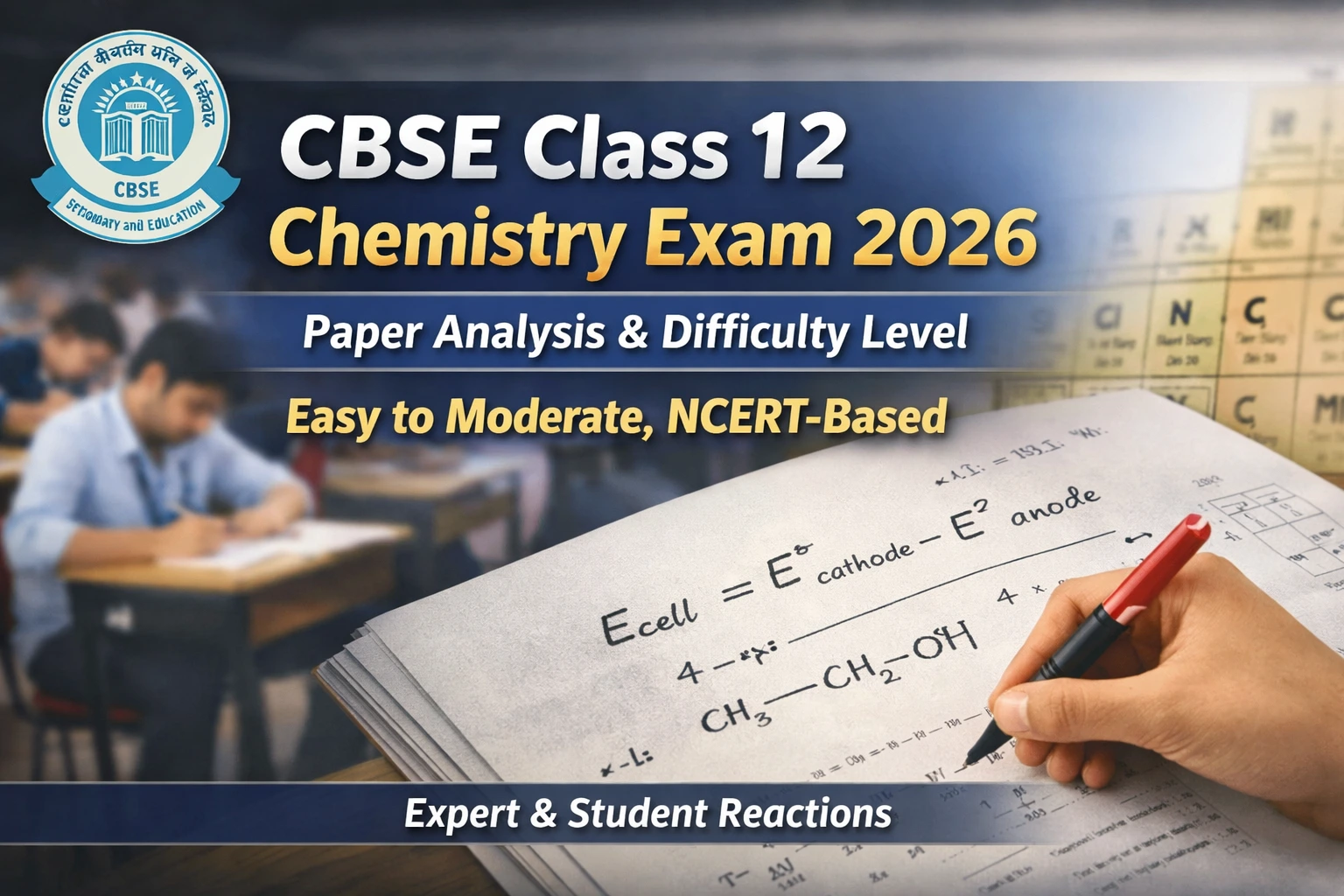
CBSE Class 12 Chemistry Exam Analysis 2026: Paper Rated Easy to Moderate, NCERT-Based Questions Dominate
The Class 12 Chemistry board examination conducted by the Central Board of Secondary Education for the academic session 2025–26 was successfully held on February 28, 2026, across various examination centres in the country. The exam took place from 10:30 AM to 1:30 PM under strict board guidelines. As per initial reactions from students and teachers, the Chemistry paper followed the latest CBSE exam pattern and was largely based on conceptual understanding and textbook-focused preparation.
According to feedback collected from multiple schools in New Delhi and other regions, the overall difficulty level of the paper was rated easy to moderate, with a balanced mix of theoretical and numerical questions. Students who prepared thoroughly from the National Council of Educational Research and Training (NCERT) textbooks found the paper manageable and scoring.
Overall Difficulty Level of CBSE Class 12 Chemistry Paper 2026
The CBSE Class 12 Chemistry question paper 2026 was structured to test conceptual clarity along with application-based learning. Most students reported that the paper was neither too lengthy nor excessively difficult. The majority of questions were directly aligned with the prescribed syllabus, and no out-of-syllabus questions were reported.
Teachers observed that the paper maintained the board’s recent trend of competency-based assessment, encouraging analytical thinking rather than rote memorization. While some sections required deeper conceptual understanding, overall the paper allowed well-prepared students to attempt all questions within the given time frame.
Experts believe that the balanced structure of the question paper may result in stable scoring patterns in the Chemistry subject this year.
Section-Wise Analysis of the Chemistry Question Paper
Physical Chemistry
Physical Chemistry was considered slightly time-consuming due to numerical-based questions. Although the calculations were not overly complex, students needed careful time management to solve them accurately. Chapters such as Electrochemistry and Chemical Kinetics had direct formula-based questions.
Students who practiced sample papers and previous-year numerical problems found this section manageable.
People Also Read

Organic Chemistry
Organic Chemistry was largely straightforward and textbook-oriented. Named reactions, reaction mechanisms, and conversions were asked in a direct format. Assertion-reason and short-answer questions from Biomolecules and Haloalkanes contributed to scoring opportunities.
Teachers noted that the questions tested conceptual clarity but did not include unexpected twists.
Inorganic Chemistry
Inorganic Chemistry questions were mostly fact-based and derived directly from NCERT content. Topics such as Coordination Compounds and d- and f-Block Elements were prominently featured. Students reported that this section was scoring and less time-consuming compared to Physical Chemistry.
Question Paper Pattern and Structure
The paper followed the updated CBSE format with a mix of:
-
Multiple Choice Questions (MCQs)
-
Assertion and Reasoning questions
-
Case-study based questions
-
Short and long answer questions
The competency-based questions required interpretation and application of concepts, reflecting CBSE’s continued focus on conceptual learning.
Teachers highlighted that the case-study questions were moderate in difficulty and could be answered easily by students with strong textbook preparation.
Students’ Reactions After the Examination
Most students described the paper as balanced and fair. Many reported that direct questions from NCERT examples and exercises helped them complete the paper confidently. Some students mentioned that Physical Chemistry numericals required more time, but overall the paper was not lengthy.
Students who focused on revision and mock tests expressed satisfaction with the question pattern.
Expert Opinion on Expected Performance Trends
Education experts suggest that the moderate difficulty level of the Chemistry paper may lead to improved average scores compared to previous years. Since the exam was concept-driven and aligned closely with the syllabus, students with consistent preparation are expected to perform well.
Teachers also emphasized that the paper rewarded clarity of concepts rather than memorization, which aligns with CBSE’s assessment reforms introduced in recent academic sessions.
CBSE Class 12 Chemistry Exam 2026: Key Highlights
-
Overall difficulty level rated easy to moderate
-
Strong emphasis on NCERT-based questions
-
Physical Chemistry numericals slightly time-consuming
-
Organic and Inorganic sections largely scoring
-
Balanced mix of competency-based and direct questions
The CBSE Class 12 board examinations will continue through March 2026, and subject-wise exam analyses are being released after each paper. Students are now awaiting the evaluation process, while experts predict stable performance trends in Chemistry due to the balanced nature of the question paper.


📰 More Education News
- IIT Hyderabad invites applications for SURE internship: Know eligibility, duration & fellowshipMar 4, 2026 • Abhijeet Chatterjee
- BEd : इलाहाबाद विश्वविद्यालय से करें 4 वर्षीय बीएड ITEP कोर्स, 10 मार्च तक आवेदन का मौका, क्या है वेल्यूMar 4, 2026 • Aayush Kukreja
- UPSC Final Result 2026 Soon, Civil Services Result & Merit List PDFMar 4, 2026 • Simran
- ITEP BEd Course : इलाहाबाद यूनिवर्सिटी से करें 4 साल का बीएड कोर्स, 12वीं पास के पास मौका, जानें क्या है वै…Mar 4, 2026 • Abhijeet Chatterjee