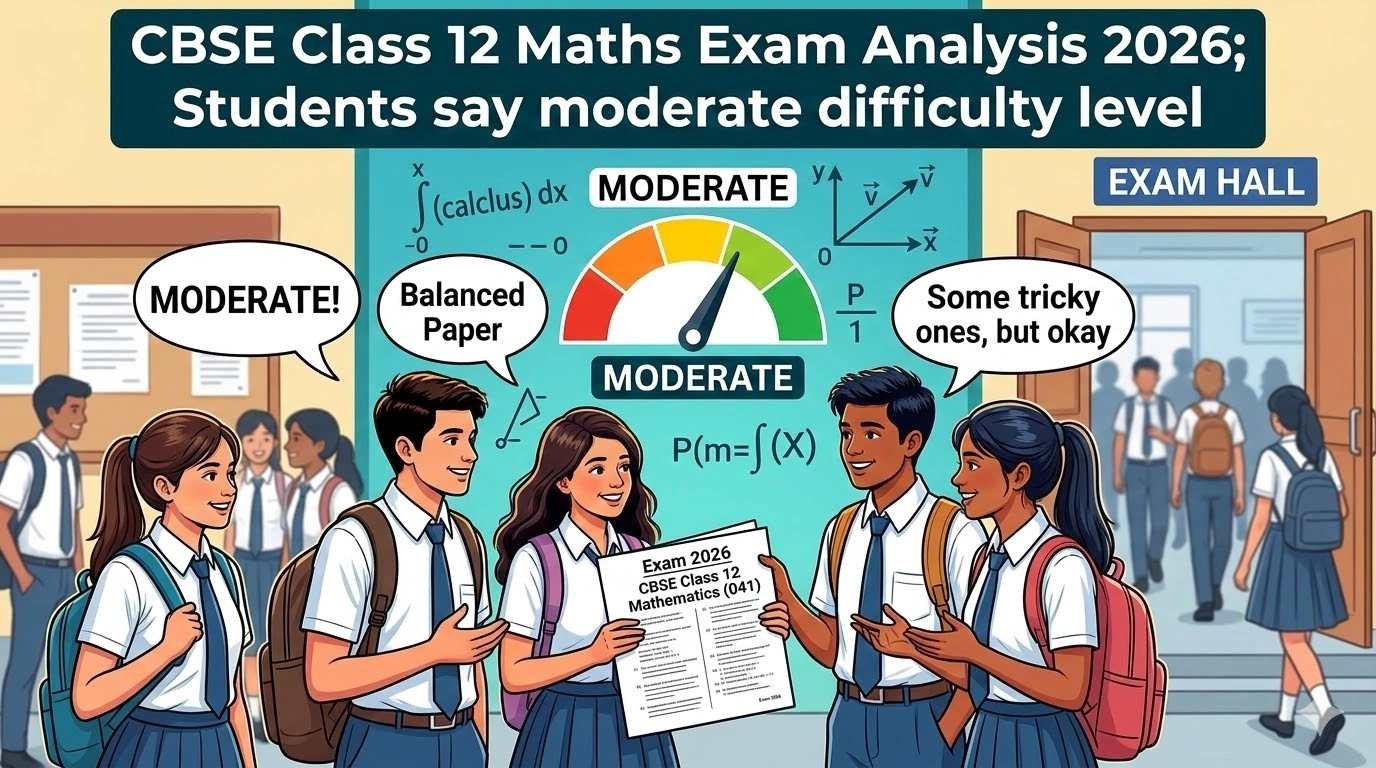
CBSE Class 12 Maths Exam Analysis 2026; Students say moderate difficulty level; Reviews here
Students exiting exam centers called the paper manageable for those practicing previous years' questions, though some ran out of time on tricky problems.
The Central Board of Secondary Education, on March 9 from 10:30 AM to 1:30 PM, drew mixed reactions from students across India. Students and teachers both described the overall paper as moderate. Students also described the paper as lengthy, emphasising strong time management needs.
Student Reactions to Class 12 CBSE Mathematics Paper
Students exiting exam centres called the paper manageable for those practising previous years’ questions, though some ran out of time on tricky problems. Feedback highlighted syllabus-aligned questions, with a few requiring careful thinking. Time management also remained a key factor in successfully completion of the paper.
Also Read: CBSE Class 12th Maths Paper QR Code Opens to Rick Astley’s Song
CBSE Class 12 Maths Exam Analysis 2026
Reviews from students and teachers unanimously found the paper to be moderately difficult but lengthy. Section D proved most challenging due to lengthy calculations, especially in calculus and integration.
According to Shyam Singh, PGT-Maths, DAV School, Delhi, “the CBSE Class 12 Maths exam paper was well balanced and aligned wth the syllabus. The paper focused on critical thinking, comprehension and application-based.”
| Section | Questions | Marks | Key Topics Covered | Difficulty Level | Student Feedback |
| A (MCQs) | 20 | 20 (1 each) | Matrices, Determinants, Continuity/Differentiability, Probability, Relations/Functions | Easy-Moderate | Straightforward; some tricky options in probability; quick to solve newsx |
| B (Very Short) | 5 | 10 (2 each) | Vector Algebra, 3D Geometry, Inverse Trig Functions | Moderate | Concise steps needed; vectors easy for most newsx |
| C (Short Answer) | 6 | 18 (3 each) | Calculus (Applications of Derivatives/Integrals), Linear Programming | Moderate | Application-based; time-friendly but error-prone |
| D (Long Answer) | 4 | 20 (5 each) | Definite Integrals, Differential Equations, Vectors/3D Applications | Moderate-Difficult | Lengthy calculations; integration toughest; many rushed newsx |
| E (Case Study) | 3 (4 sub-q each) | 12 (4 each) | Real-life calculus/algebra scenarios (e.g., optimization, probability models) | Easy-Moderate | Conceptual; relatable; score booster newsx |
The MCQs were from matrix, determinants, differentiations, derivates application, integration, vectors, etc., touching almost all the major topics.
Section B had 2 mark questions, it featured questions from trigonometry, relations and functions, vector 3D, differentiation, involving parametric form. Sections C & D carried questions from probability, integrationa and, differentiation, properties of definite integration, and linear programming.
The 3 case-based questions were from application of integration, maxima and minima, and the probability question was based on Bayes ‘ theorem.

📰 More Education News
- RRB NTPC Admit Card Update: City Intimation Slip Released, Hall Ticket to Follow SoonMar 10, 2026 • Shreoshree Chakrabarty
- SBI Clerk Mains 2025 Scorecard Released – Find Direct Links to Check Your ScoreMar 10, 2026 • Aayush Kukreja
- UP Scholarship Status 2026: Check Application Status, Eligibility and Application Process; Direct Link HereMar 10, 2026 • Abhijeet Chatterjee
- UPSC Rank 301 Dispute Ends: Ghazipur’s Akanksha Singh Confirmed as CSE 2025 QualifierMar 10, 2026 • Shreoshree Chakrabarty