Bachelor of Arts (BA) 2026 Complete Guide: Eligibility, Specializations, Syllabus, Cutoffs, Top Colleges & Placements
Bachelor of Arts, commonly known as BA, is a three-year undergraduate degree program that offers a broad foundation in humanities, social sciences, and liberal arts. This course is designed for students interested in exploring subjects like history, literature, sociology, and political science, building critical thinking and analytical skills. Recognized by universities across India, BA prepares individuals for diverse careers in education, media, civil services, and more.
The program emphasizes interdisciplinary learning, with options for specializations and electives. With the evolving job market, BA graduates find opportunities in content creation, research, and public administration, making it a versatile choice for those seeking intellectual growth and societal impact.
Bachelor of Arts Highlights
BA stands out as a flexible undergraduate program in arts and humanities, ideal for developing communication and research skills. It combines core subjects with electives, spanning three years in six semesters. Fees are affordable in government institutions, with strong emphasis on holistic education.
Highlights include merit-based admissions, diverse specializations, and pathways to higher studies like MA or competitive exams. This course suits those aiming for careers in teaching, journalism, or public service.
| Particulars | Details |
| Course Full Form | Bachelor of Arts |
| Course Level | Undergraduate Degree |
| Duration | 3 Years (6 Semesters) |
| Eligibility | 10+2 with 40-50% aggregate in any stream |
| Entrance Exams | CUET, Merit-based |
| Average Fees | INR 5,000 to 50,000 per year |
| Top Colleges | St. Stephen’s Delhi, LSR Delhi, Loyola Chennai |
| Average Salary | INR 2-5 LPA starting |
| Job Profiles | Teacher, Journalist, Content Writer |
| Top Recruiters | Times Group, TCS, Government Departments |
Bachelor of Arts Eligibility
The eligibility criteria for Bachelor of Arts (BA) are set by the UGC, ensuring candidates have the necessary background for humanities studies. These standards prepare individuals for analytical and creative challenges in arts subjects. Primarily, applicants must have completed 10+2, demonstrating basic education for advanced learning.
Academic qualifications are key, requiring 10+2 from a recognized board with 40-50% aggregate. Any stream is acceptable, but arts background is preferred. This ensures a grasp of foundational subjects, built upon in BA.
English proficiency is crucial for communication in diverse subjects. No strict age limit, but some universities cap at 23 years. Relaxations for reserved categories promote inclusivity.
Medical fitness not required, but overall readiness for studies is expected. Additional prerequisites include documents like mark sheets. Meeting criteria prepares for exams like CUET.
Universities may offer bridge courses for non-arts students. Preparation involves reviewing school subjects. Aspiring candidates should maintain records to avoid hurdles.
| Criteria | Requirements | Details/Notes |
| Academic Qualification | 10+2 or equivalent | From recognized board; any stream, arts preferred |
| Minimum Marks | 40-50% aggregate | Relaxation 5% for SC/ST/OBC |
| Age Limit | No upper limit generally | Some universities up to 23 years |
| English Proficiency | Pass in English | Essential for humanities subjects |
| Other Requirements | Documents like mark sheets | Category certificates for reservations |
| Relaxations | For reserved categories | SC/ST: 5% marks; PWD: additional |
| Entrance | CUET for central unis | Merit for others |
Bachelor of Arts Courses
Bachelor of Arts (BA) courses serve as a important entry point for students into humanities and social sciences, transforming high school knowledge into specialized expertise. These programs are carefully structured to develop critical thinking and cultural awareness. Approved by the UGC, BA courses emphasize a blend of core subjects and electives, ensuring broad exposure. The core curriculum adapts basic education to advanced topics like literature and sociology.
The standard BA is a three-year program, divided into six semesters. Variations cater to interests, like honors for in-depth study. Specialized BA options include English or History, with additional modules in languages or psychology. Some institutes offer modular courses for flexibility, such as part-time or integrated with journalism.
The course design prioritizes seminars, projects, and field work, building skills in research and communication. Institutes like St. Stephen’s tailor offerings to include electives in contemporary issues like gender studies. This ensures graduates are versatile for diverse careers.
Choosing BA type depends on goals; standard for general knowledge, specialized for focused careers like teaching or media.
| Course Type | Key Features | Eligibility | Training Components | Placement Scope | Duration |
| Standard BA | Core arts program with foundational subjects in humanities. | 10+2 with 40-50% | Lectures, assignments, basic research. | Teaching, admin roles | 3 Years |
| BA Honors | Advanced with thesis in chosen subject. | 10+2 with 50% | Seminars, projects, internships. | Research, higher studies | 3 Years |
| Specialized BA (English) | Focus on literature, language. | 10+2 with English | Literary analysis, writing workshops. | Writing, media | 3 Years |
| Integrated BA (with BEd) | Arts with education for teaching. | 10+2 with 45% | Pedagogy, subject teaching. | School teaching | 4 Years |
| Modular BA (Sociology/Psychology) | Flexible electives in social sciences. | 10+2 any stream | Field work, surveys. | Social work, research | 3-4 Years |
People Also Read

Bachelor of Arts Syllabus
The BA syllabus is carefully designed to align with the National Education Policy (NEP) 2020, encompassing approximately 3600 teaching hours over three years, balancing theoretical knowledge with practical applications.
In Year 1, the focus is on core subjects like literature and history, providing insights into cultural and social foundations. Practical components, totaling around 180 hours, include seminars and group discussions to reinforce learning. These sessions teach skills in essay writing and debate, preparing students for deeper exploration.
Year 2 shifts towards advanced theories, including sociology and political science, with practicals in field studies and case analyses. This year emphasizes global perspectives and regulatory frameworks.
Year 3 covers strategic areas like philosophy and electives, with capstone projects simulating real-world applications. The curriculum integrates themes such as gender studies and environmental humanities, ensuring holistic preparation.
Updates per NEP incorporate enhanced competencies in digital humanities, cultural studies, and sustainable development. Institutes must adhere to UGC guidelines, including provisions for flexible electives. This detailed syllabus not only equips students for careers in education and media but also promotes lifelong learning in evolving social sciences, making BA graduates adaptable and insightful.
BA Ist Year Syllabus – Fundamentals & Workshops
| Subject Area | Detailed Topics Covered | Practical Components |
| English Literature | Introduction to poetry, prose, drama; literary terms, genres, British literature overview. | Reading sessions, literary analysis essays. |
| History | Ancient civilizations, Indian history up to medieval period, world history basics. | Timeline creation, historical map exercises. |
| Political Science | Political theories, state and government, Indian Constitution fundamentals. | Debates on political issues. |
| Sociology | Social institutions, culture, socialization, stratification basics. | Group discussions on social norms. |
| Environmental Studies | Ecosystems, conservation, sustainable development, environmental policies. | Field visits, awareness campaigns. |
| Language Elective | Hindi/Sanskrit/Foreign language grammar, literature introduction. | Language labs, conversation practice. |
| Foundation Course | Ethics, human rights, gender studies basics. | Workshops on social issues. |
BA IInd Year Syllabus – Operations, Regulations & Advanced Systems
| Subject Area | Detailed Topics Covered | Practical Components |
| English Literature II | Romanticism, Victorian era, modern literature, Indian English writers. | Literary criticism exercises. |
| Modern History | Colonialism, independence movements, world wars, post-colonial India. | Document analysis, archival research. |
| Political Science II | International relations, comparative politics, public administration. | Model UN simulations. |
| Sociology II | Social change, deviance, family dynamics, urbanization. | Sociological surveys, case studies. |
| Economics Elective | Micro/macro economics basics, Indian economy, development issues. | Economic data interpretation. |
| Psychology Elective | Cognitive processes, personality, abnormal psychology. | Psychological tests, experiments. |
| Skill Course | Digital literacy, research methods, creative writing. | Software training, writing workshops. |
BA IIIrd Year Syllabus – Strategy, Specializations & Projects
| Subject Area | Detailed Topics Covered | Practical Components |
| English Literature III | Postmodernism, world literature, literary theory, criticism. | Thesis on literary works. |
| Contemporary History | Globalization, post-cold war, Indian foreign policy, current events. | Research papers on events. |
| Political Science III | Political economy, human rights, environmental politics. | Policy analysis projects. |
| Sociology III | Gender studies, globalization impact, research methodology. | Field research, dissertations. |
| Philosophy Elective | Ethics, metaphysics, Indian philosophy, western thinkers. | Philosophical debates. |
| Geography Elective | Human geography, regional planning, GIS basics. | Map reading, GIS software. |
| Project Work | Independent research, interdisciplinary topics, presentation. | Field surveys, viva voce. |
Bachelor of Arts Syllabus Download PDF
Download the latest BA Syllabus in multiple subjects in the PDF format for your reference.
BA vs Other Programmes
BA differs from other undergraduate programs in its emphasis on humanities and social sciences. Unlike the science-focused B.Sc, which deals with empirical methods and labs, BA promotes critical thinking through literature and history. It provides a broad base for diverse careers in arts.
Compared to B.Com, centered on commerce and finance, BA is more theoretical and exploratory, less on quantitative skills. B.A. B.Ed integrated combines arts with teaching, while BA prioritizes subject depth over pedagogy. This makes BA suitable for roles in media or research.
In career progression, BA graduates advance to roles like journalists or analysts faster, with opportunities in NGOs and academia. Other programs lead to technical or business fields, but BA ensures interdisciplinary skills from the start.
| Parameters | BA | B.Sc | B.Com |
| Duration | 3 Years | 3 Years | 3 Years |
| Eligibility | 10+2 with 40-50% | 10+2 Science with 50% | 10+2 with 45% |
| Focus | Humanities & Social Sciences | Natural Sciences | Commerce & Finance |
| Average Fees | INR 5K-50K | INR 10K-1L | INR 10K-1L |
| Average Salary | INR 2-5 LPA | INR 3-6 LPA | INR 3-6 LPA |
BA Admission
Admission to BA involves a structured process starting with online application on university portals. Candidates register, upload documents, and pay fees. Entrance exams like CUET are common for central universities, while state institutions may use merit from Class 12 marks. Personal statements or interviews may be required for honors programs.
Reservation policies for SC/ST/OBC/EWS ensure inclusivity, with quotas and relaxations. Key documents include 10+2 certificates, ID proofs, and category proofs. Admission cycles align with academic calendars, typically June-July post-board results.
Preparation tips include reviewing school subjects, practicing aptitude for exams, and gathering documents early. Successful candidates receive provisional admission, leading to fee deposit and orientation.
- Check university website for notifications.
- Register and submit application form.
- Appear for CUET or institute test.
- Document verification during counseling.
- Seat allotment and fee payment.
Bachelor of Arts Cut Off 2026 (Expected)
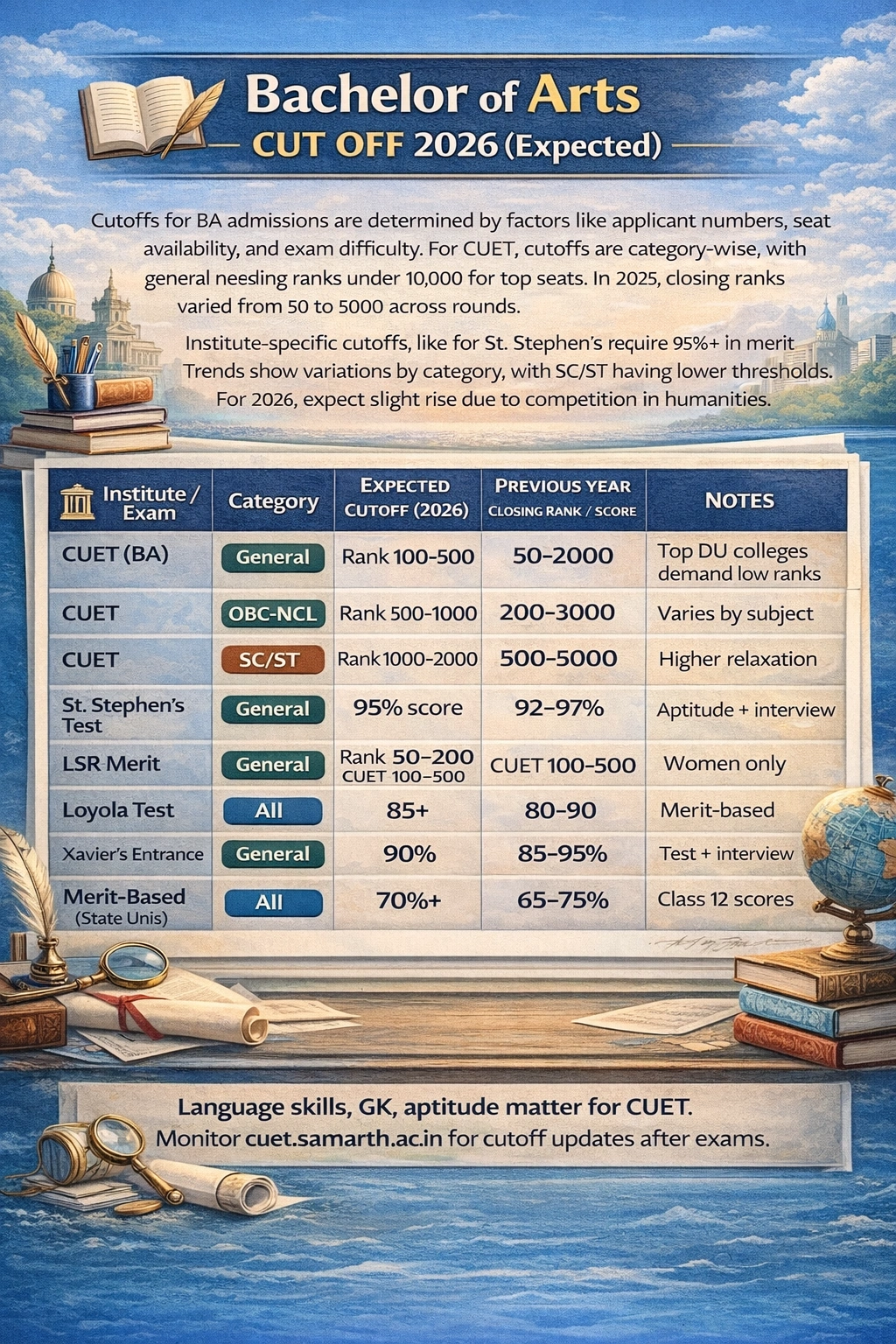
Cutoffs for BA admissions are determined by factors like applicant numbers, seat availability, and exam difficulty. For CUET, cutoffs are category-wise, with general needing ranks under 10,000 for top seats. In 2025, closing ranks varied from 50 to 5000 across rounds.
Institute-specific cutoffs, like for St. Stephen’s, require 95%+ in merit. Trends show variations by category, with SC/ST having lower thresholds. For 2026, expect slight rise due to competition in humanities.
Preparation involves focusing on languages and general knowledge for CUET. Candidates monitor sites like cuet.samarth.ac.in for updates. Meeting cutoffs leads to counseling.
Top Bachelor of Arts Colleges in India
Bachelor of Arts (BA) programs in India provide a versatile foundation in humanities, social sciences, languages, and related fields, building critical thinking, communication skills, and cultural awareness. These degrees open doors to diverse careers in journalism, civil services, education, and more.
Selecting a top college ensures access to quality faculty, research opportunities, and a active campus life that enhances overall development. The lists below categorize leading institutions into government and private sectors, highlighting key aspects like fees, admissions, and placements to help prospective students make informed choices.
Top Government BA Colleges in India
Government BA colleges in India stand out for their affordability, making higher education accessible to a wide range of students. These institutions are often affiliated with renowned universities and emphasize rigorous academic standards, extracurricular activities, and societal contributions.
With a focus on merit-based admissions through national exams, they attract talented individuals and offer a nurturing environment for intellectual growth. Many of these colleges have a rich legacy, producing influential alumni in various fields.
| College Name | 1st Year Fees (INR) | Application Deadline (2026 Cycle) | Entrance Exam | Why Apply | Brochure Link | Average Placement Salary (LPA) | NIRF Ranking |
| Hindu College, Delhi | 22,000 | March 15, 2026 (CUET Registration) | CUET UG | Prestigious institution with excellent faculty, active campus life, and strong alumni network offering diverse BA specializations. | Download Here | 10 | 1 |
| Miranda House, Delhi | 19,800 | March 15, 2026 (CUET Registration) | CUET UG | Leading women’s college known for academic excellence, research opportunities, and overall development in liberal arts. | Download Here | 8 | 2 |
| Hans Raj College, Delhi | 24,515 | March 15, 2026 (CUET Registration) | CUET UG | Renowned for its academic rigor, extracurricular activities, and good placement records in humanities. | Download Here | 8.4 | 3 |
| Kirori Mal College, Delhi | 12,345 | March 15, 2026 (CUET Registration) | CUET UG | Offers a dynamic learning environment with focus on interdisciplinary studies and cultural societies. | Download Here | 6 | 4 |
| Atma Ram Sanatan Dharma College, Delhi | 12,000 | March 15, 2026 (CUET Registration) | CUET UG | Affordable education with strong emphasis on social sciences and community engagement. | Download Here | 5 | 7 |
| Sri Venkateswara College, Delhi | 13,500 | March 15, 2026 (CUET Registration) | CUET UG | Known for its inclusive atmosphere, modern facilities, and opportunities in arts and languages. | Download Here | 7 | 11 |
| Loyola College, Chennai | 48,000 | TBA | Merit-Based | Government-aided college with a legacy of excellence in humanities, ethics, and service-oriented education. | Download Here | 5.5 | 14 |
| Presidency College, Chennai | 1,250 | TBA | Merit-Based | Historic institution offering quality arts education at low cost with focus on research and innovation. | Download Here | 3 | 15 |
| Lady Shri Ram College for Women, Delhi | 21,000 | March 15, 2026 (CUET Registration) | CUET UG | Empowers women through liberal arts education, leadership programs, and global exposure. | Download Here | 9.5 | 17 |
| Ramjas College, Delhi | 15,000 | March 15, 2026 (CUET Registration) | CUET UG | Diverse BA programs with emphasis on critical thinking, debates, and cultural activities. | Download Here | 7 | 28 |
| Daulat Ram College, Delhi | 19,000 | March 15, 2026 (CUET Registration) | CUET UG | Women’s college with strong academics, sports facilities, and career guidance in arts. | Download Here | 6 | 26 |
| Deen Dayal Upadhyaya College, Delhi | 19,345 | March 15, 2026 (CUET Registration) | CUET UG | Focuses on skill development, interdisciplinary courses, and industry linkages for BA students. | Download Here | 6.5 | 27 |
Top Private BA Colleges in India
Private BA colleges in India are distinguished by their innovative teaching methods, modern facilities, and industry-oriented approaches. These institutions often provide personalized attention, international exchange programs, and strong placement support
Thus catering to students who value flexibility and modern amenities. While fees may be higher, the investment yields benefits through enhanced employability and networking opportunities in a competitive job market.
| College Name | 1st Year Fees (INR) | Application Deadline (2026 Cycle) | Entrance Exam | Why Apply | Brochure Link | Average Placement Salary (LPA) | NIRF Ranking |
| St. Stephen’s College, Delhi | 24,670 | March 15, 2026 (CUET Registration) | CUET UG + Interview | Elite minority institution with rigorous academics, ethical values, and distinguished alumni. | Download Here | 10 | 5 |
| St. Xavier’s College, Kolkata | 60,500 | TBA | Merit-Based | Autonomous college offering innovative BA programs with emphasis on research and global perspectives. | Download Here | 5.5 | 8 |
| PSGR Krishnammal College for Women, Coimbatore | 2,000 | TBA | Merit-Based | Women’s college with affordable fees, strong focus on arts, and empowerment through education. | Download Here | 3.5 | 9 |
| PSG College of Arts and Science, Coimbatore | 70,000 | TBA | Merit-Based | Autonomous institution known for full arts curriculum and industry collaborations. | Download Here | 4 | 10 |
| Madras Christian College, Chennai | 19,000 | TBA | Merit-Based | Historic college with eco-friendly campus, diverse BA options, and strong value-based education. | Download Here | 4.5 | 16 |
| Thiagarajar College, Madurai | 40,000 | TBA | Merit-Based | Autonomous college emphasizing research, skill development, and community service in arts. | Download Here | 3 | 20 |
| St. Joseph’s College, Tiruchirappalli | 20,000 | TBA | Merit-Based | Focuses on overall development, ethics, and employability skills in liberal arts. | Download Here | 4 | 25 |
| Sri Guru Tegh Bahadur Khalsa College, Delhi | 21,000 | March 15, 2026 (CUET Registration) | CUET UG | Minority college with strong academic tradition in humanities and Sikh studies. | Download Here | 7 | 29 |
| Christ University, Bangalore | 65,000 | April 2026 (Tentative) | CUET / Christ Entrance Test | Deemed university with modern curriculum, international exposure, and excellent placements. | Download Here | 7 | Not Ranked in Top 30 |
| St. Xavier’s College, Mumbai | 7,000 | TBA | Merit-Based | Autonomous college with active urban campus, focus on social justice and arts innovation. | Download Here | 6.5 | Not Ranked in Top 30 |
| Mithibai College, Mumbai | 18,000 | TBA | Merit-Based | Known for cultural festivals, interdisciplinary BA programs, and strong alumni network. | Download Here | 5 | Not Ranked in Top 30 |
| Mount Carmel College, Bangalore | 44,000 | TBA | Merit-Based | Women’s autonomous college with emphasis on leadership, entrepreneurship, and liberal arts. | Download Here | 4.5 | Not Ranked in Top 30 |
Bachelor of Arts Placements
Bachelor of Arts (BA) placements in India reflect the versatility of the degree, with graduates finding opportunities across diverse sectors due to their strong foundational skills in communication, critical thinking, and analysis. As the job market evolves, BA holders are increasingly valued for their adaptability in roles that require interpersonal abilities and creativity.
Placement trends show a growing demand in digital and service-oriented industries, with many colleges facilitating internships and recruitment drives to bridge the gap between education and employment. This section explores key aspects of placements, including job roles, growth prospects, statistics, sectoral opportunities, and global avenues.
BA Job Roles and Salaries
BA graduates in India can pursue a wide array of job roles that use their liberal arts education, ranging from creative fields to administrative positions. Entry-level salaries typically start modest but can increase significantly with experience, specializations, or additional certifications.
Factors like location, industry, and individual skills influence earnings, with metropolitan areas offering higher pay scales. Popular roles include those in education, media, marketing, and public services, providing a balance of job satisfaction and financial growth.
| Job Role | Average Salary (INR LPA) | Key Responsibilities |
| Content Writer | 3 – 5 | Creating engaging articles, blogs, and web content for media or marketing firms. |
| Digital Marketing Executive | 4 – 6 | Managing social media campaigns, SEO, and online advertising strategies. |
| Teacher/Educator | 2.5 – 4.5 | Imparting knowledge in schools or coaching centers, curriculum development. |
| HR Executive | 3 – 5 | Handling recruitment, employee relations, and training programs. |
| Sales Executive | 2.5 – 4 | Promoting products/services, client management, and achieving sales targets. |
| Journalist | 3 – 5.5 | Reporting news, conducting interviews, and writing stories for media outlets. |
| Public Relations Officer | 4 – 6 | Managing brand image, media relations, and crisis communication. |
| Administrative Assistant | 2.5 – 4 | Supporting office operations, scheduling, and document management. |
| Event Manager | 3.5 – 5.5 | Planning and executing events, vendor coordination, and budgeting. |
| Social Media Manager | 4 – 6 | Curating content, engaging audiences, and analyzing social metrics. |
BA Career Growth Projections
Career growth for BA graduates in India is promising, driven by the expanding digital economy, sustainability initiatives, and the need for soft skills in emerging sectors. Projections for 2026 and beyond indicate steady demand in areas like content creation, digital marketing, and public policy, with opportunities amplified by upskilling in AI, data analysis, or management.
The overall employability for arts graduates is improving, with roles in green infrastructure and quick commerce expected to see significant expansion, offering pathways to mid-senior positions within 5-10 years.
| Field | Projected Growth (2026-2030) | Key Drivers |
| Digital Marketing | 15-20% annual growth | Rise in e-commerce and social media adoption. |
| Content Creation & Journalism | 10-15% | Demand for digital content and media expansion. |
| Human Resources | 12-18% | Focus on talent management in growing industries. |
| Public Administration/Civil Services | 8-12% | Government initiatives and policy reforms. |
| Education & Training | 10-14% | Edtech boom and skill development programs. |
| Green & Sustainable Roles | 20-25% | Emphasis on eco-friendly infrastructure. |
| Data Analysis (with upskilling) | 18-22% | Integration of analytics in humanities fields. |
Bachelor of Arts Placement Statistics and Top Recruiters
Placement statistics for BA programs in India highlight a competitive landscape, with top colleges achieving high placement rates and attractive packages. Average salaries range from 3-7 LPA, with highest offers reaching 20+ LPA in premium institutions.
Recruiters value BA graduates for their versatility, often hiring for entry-level roles that lead to rapid promotions. Data from 2025 indicates an employability rate around 50-60% for arts graduates, with strong ties to consulting, media, and tech firms.
| Statistic | Value (2025) | Top Recruiters |
| Average Placement Rate | 70-80% in top colleges | Deloitte, EY, KPMG |
| Average Salary (LPA) | 4-7 | Google, Accenture, TCS |
| Highest Salary (LPA) | 20-23 | PwC, HDFC Bank, Amazon |
| Median Salary (LPA) | 5 | Wipro, Infosys, Capgemini |
| Top Sectors for Placements | Media, Consulting, Education | Times Group, McKinsey, Teach For India |
Opportunities in Different Sectors
BA graduates enjoy opportunities across various sectors in India, where their broad knowledge base allows them to adapt to roles requiring analytical and communicative skills. Government sectors offer stability and public service, while private industries provide dynamic growth.
Emerging areas like NGOs and startups value social awareness and innovation, making BA a gateway to impactful careers.
| Sector | Key Opportunities | Average Starting Salary (LPA) |
| Government | Civil Services, Teaching, Administrative Roles | 4-6 |
| Private Corporate | HR, Marketing, Sales | 3-5 |
| Media & Journalism | Reporter, Editor, Content Creator | 3-5.5 |
| Education | Lecturer, Counselor, Edtech Specialist | 2.5-4.5 |
| NGOs & Social Work | Program Coordinator, Community Organizer | 3-4.5 |
| Hospitality & Tourism | Event Planner, Hotel Management | 3-5 |
| Tech & Digital | UX Researcher, Data Entry Analyst | 4-6 |
Global Opportunities after BA
A BA degree opens doors to global opportunities, allowing graduates to pursue careers or further studies abroad. With skills in languages, culture, and analysis, BA holders are sought in international organizations, multinational corporations, and educational institutions.
Migration trends show increasing demand in regions like Europe, North America, and Asia-Pacific for roles in diplomacy, media, and business, often requiring additional qualifications like master’s degrees or certifications.
| Region/Country | Key Opportunities | Requirements/Notes |
| USA/Canada | Marketing, PR, Teaching English | Work visas, language proficiency. |
| Europe (UK, Germany) | Journalism, NGOs, Policy Analysis | EU mobility, master’s preferred. |
| Australia/New Zealand | Education, Hospitality, Digital Media | Skilled migration programs. |
| Middle East (UAE, Qatar) | HR, Event Management, Sales | Experience in multicultural settings. |
| Asia (Singapore, Japan) | Business Development, Content Strategy | Language skills, international exposure. |
Bachelor of Arts Scholarships
Pursuing a Bachelor of Arts (BA) degree in India can be financially supported through various scholarships aimed at meritorious, underprivileged, or talented students in humanities, social sciences, and related fields. These awards are provided by government entities, private foundations, and cultural organizations, often covering tuition fees, maintenance allowances, or full educational costs.
Eligibility typically includes academic performance, family income limits, or specific criteria like category or artistic talent. Students are encouraged to verify details on official portals, prepare necessary documents, and adhere to deadlines to maximize their opportunities for funding.
| Scholarship Name | Eligibility | Amount (INR) | Application Deadline (2026 Cycle) | Apply Here |
| Central Sector Scheme of Scholarship for College and University Students | Above 80th percentile in Class 12, family income ≤ 4.5 lakh per annum, not availing other scholarships. | 12,000 per year for UG. | TBA (typically December) | Apply Here |
| Post Matric Scholarship Scheme for Minorities | Minority community students, 50% marks in previous exam, family income ≤ 2 lakh per annum. | Up to 30,000 for course fee + maintenance allowance. | TBA | Apply Here |
| Post Matric Scholarship for SC Students | SC category, family income ≤ 2.5 lakh per annum, pursuing post-matric courses. | Full tuition + maintenance allowance. | TBA | Apply Here |
| Post Matric Scholarship for ST Students | ST category, family income ≤ 2.5 lakh per annum, pursuing post-matric courses. | Full tuition + maintenance allowance. | TBA | Apply Here |
| Post Matric Scholarship for OBC Students | OBC category, family income ≤ 1.5 lakh per annum, 50% marks. | Tuition fee reimbursement + maintenance. | TBA | Apply Here |
| Reliance Foundation Undergraduate Scholarships | First-year UG students, 60% in Class 12, family income ≤ 15 lakh, merit-cum-means. | Up to 2,00,000. | TBA | Apply Here |
| Bharti Airtel Foundation Scholarship | Underprivileged students admitted to top NIRF-ranked colleges for UG programs. | 100% annual fees including meals. | TBA | Apply Here |
| Tata Trusts Individual Education Grants | Indian citizens pursuing BA, good academic record, financial need. | 20,000 to 1,00,000 (varies). | Ongoing | Apply Here |
| Scheme for Scholarships to Young Artistes in Different Cultural Fields | Age 18-25, undergoing training in cultural fields, enrolled in recognized institutions. | 5,000 per month for 2 years. | TBA | Apply Here |
| Saryu Doshi Graduate Fellowships in Liberal Arts & Sciences | Merit-based for post-UG in liberal arts abroad, from underprivileged backgrounds. | Up to 3,00,000. | TBA | Apply Here |
FAQs
1. What are the top government BA colleges in India and their key features?
Top government BA colleges include Hindu College, Miranda House, and Hans Raj College in Delhi, known for affordable fees ranging from 1,250 to 24,515 INR per year, CUET UG entrance exams, and high NIRF rankings. They offer active campus life, excellent faculty, and strong placements averaging 5-10 LPA, emphasizing academic rigor and extracurricular activities for overall development.
2. How do private BA colleges differ from government ones in terms of benefits?
Private BA colleges like St. Stephen’s and Christ University provide innovative curricula, international exposure, and personalized attention with fees from 2,000 to 70,000 INR. They excel in placements with averages of 3.5-10 LPA, modern facilities, and industry ties, offering flexibility and networking that government colleges match in affordability but often surpass in legacy and accessibility.
3. What entrance exams are needed for admission to top BA programs?
Most top BA colleges require CUET UG for Delhi University affiliates, focusing on general knowledge and subject aptitude. Others like Christ University use their own tests or merit-based selection. Preparation involves Class 12 syllabus review, mock tests, and deadlines around March-April 2026, ensuring eligibility for diverse specializations in humanities and social sciences.
4. What job roles and salaries can BA graduates expect in India?
BA graduates can pursue roles like content writer (3-5 LPA), digital marketing executive (4-6 LPA), or journalist (3-5.5 LPA), leveraging skills in communication and analysis. Salaries start modest but grow with experience, influenced by location and upskilling, offering entry into media, education, and corporate sectors with balanced job satisfaction and financial prospects.
5. What are the career growth projections for BA degree holders?
Projections show 10-25% growth in fields like digital marketing and sustainable roles by 2030, driven by e-commerce and edtech booms. Upskilling in AI or data analysis leads to mid-senior positions within 5-10 years, enhancing employability from 50-60% to higher, with pathways in policy, HR, and green infrastructure for long-term advancement.
6. Who are the top recruiters and placement statistics for BA programs?
Top recruiters include Deloitte, Google, and Times Group, with average placements at 70-80% in premier colleges, salaries of 4-7 LPA, and highs up to 23 LPA. Statistics highlight versatility in consulting, media, and education sectors, where internships and recruitment drives bridge education to employment, valuing soft skills for rapid promotions.
7. What opportunities exist in different sectors for BA graduates?
Sectors like government offer civil services (4-6 LPA), media provides journalism roles (3-5.5 LPA), and tech includes UX research (4-6 LPA). BA’s broad base enables adaptation in NGOs, hospitality, and private corporates, emphasizing analytical skills for stability in public service or dynamic growth in innovative startups and emerging industries.
8. What scholarships are available for BA students and how to apply?
Scholarships like Central Sector Scheme (12,000 INR/year) for meritorious students or Reliance Foundation (up to 2,00,000 INR) target financial need and academics. Eligibility includes income limits and marks; apply via portals like scholarships.gov.in by December deadlines, preparing documents for tuition coverage, maintenance, and cultural grants to make BA education accessible.