Bachelor of Commerce (B.Com) 2026 Complete Guide: Eligibility, Specializations, Syllabus, Cutoffs, Top Colleges & Placements
Bachelor of Commerce, commonly abbreviated as B.Com, is a three-year undergraduate degree program that provides a strong foundation in commerce, finance, accounting, and business management. This course is ideal for students interested in pursuing careers in banking, finance, taxation, or corporate sectors. Recognized by universities across India, B.Com equips learners with analytical skills, economic understanding, and practical knowledge essential for the business world.
The curriculum covers core subjects like accounting, economics, and business laws, with options for specializations in areas such as finance or marketing. With the evolving business landscape, B.Com graduates find opportunities in diverse fields, including digital commerce and entrepreneurship, making it a versatile choice for aspiring professionals.
Bachelor of Commerce Highlights
B.Com is a popular undergraduate program that focuses on commerce and business principles, preparing students for roles in finance, accounting, and management. The course duration is three years, divided into six semesters, with affordable fees in government colleges. It emphasizes theoretical knowledge combined with practical applications through projects and internships.
Key highlights include eligibility based on 10+2 marks, entrance exams like CUET, and strong placement prospects in banking and corporate sectors. This program is suitable for those aiming for professional qualifications like CA or MBA.
| Particulars | Details |
| Course Full Form | Bachelor of Commerce |
| Course Level | Undergraduate Degree |
| Duration | 3 Years (6 Semesters) |
| Eligibility | 10+2 with 45-50% aggregate, preferably Commerce stream |
| Entrance Exams | CUET, IPU CET, Merit-based |
| Average Fees | INR 10,000 to 1,00,000 per year |
| Top Colleges | SRCC Delhi, Hindu College Delhi, Christ University Bangalore |
| Average Salary | INR 3-6 LPA starting |
| Job Profiles | Accountant, Financial Analyst, Tax Consultant |
| Top Recruiters | Deloitte, KPMG, ICICI Bank |
Bachelor of Commerce Eligibility
Eligibility for B.Com requires completion of 10+2 or equivalent from a recognized board. Candidates should have studied commerce subjects like accountancy and business studies, though students from other streams may apply with additional requirements. Minimum aggregate marks are typically 45% to 50%, varying by institution and category.
There is no upper age limit in most cases, but some universities may have restrictions. Proficiency in English is essential, and mathematics is preferred for certain specializations. Reserved categories receive relaxations in marks, promoting inclusivity in higher education.
Documents needed include mark sheets, identity proofs, and category certificates. Meeting these criteria ensures admission to reputed colleges through merit or entrance exams.
| Criteria | Requirements | Details/Notes |
| Academic Qualification | 10+2 or equivalent | From recognized board; Commerce stream preferred |
| Minimum Marks | 45-50% aggregate | Relaxation for SC/ST/OBC up to 5% |
| Subjects | Accountancy, Business Studies, Maths/Economics | Essential for core understanding |
| Age Limit | No upper limit generally | Varies by university |
| Other Requirements | English proficiency | Documents: Mark sheets, ID proof |
Bachelor of Commerce Courses
Bachelor of Commerce (B.Com) courses serve as a foundational entry point for students into the world of business, finance, and economics. These programs are structured to transform high school graduates into knowledgeable professionals capable of navigating commercial landscapes. Approved by the University Grants Commission (UGC), B.Com courses emphasize a blend of theoretical concepts and practical applications, ensuring compliance with national education standards. The core curriculum focuses on adapting school-level knowledge to advanced commerce topics, covering accounting principles, economic theories, and business management.
The standard B.Com course is typically a three-year program, spanning six semesters. However, variations exist to cater to different needs and career aspirations. Honors B.Com courses, often preferred by top universities, integrate deeper analytical modules for research-oriented students. Specialized B.Com options extend to niche areas such as accounting and finance or banking and insurance, which could include additional certifications in taxation or risk management. Some institutes offer modular courses that allow flexibility, such as part-time or integrated programs with law or management.
| Course Type | Key Features | Eligibility | Training Components | Placement Scope | Duration |
| Standard B.Com | Core commerce program providing foundational knowledge in accounting, economics, and business laws. | 10+2 with minimum 45-50% aggregate; any stream acceptable but commerce preferred. | Classroom lectures, assignments, basic computer applications, group discussions. | Entry-level roles in accounting, banking, retail management. | 3 Years |
| B.Com Honors | Advanced curriculum with research projects and deeper analytical subjects; often includes honors thesis. | 10+2 with 50-60% aggregate; entrance exam like CUET required for top colleges. | Seminars, case studies, internships, advanced software tools like Tally. | Higher positions in finance, consulting, or preparation for MBA/CA. | 3 Years |
| Specialized B.Com (Accounting & Finance) | Focus on financial reporting, auditing, and investment analysis; includes certifications like ACCA modules. | 10+2 commerce stream with maths; minimum 50% aggregate. | Practical labs, guest lectures from industry experts, financial modeling workshops. | Roles in auditing firms, stock markets, financial planning. | 3 Years |
| Integrated B.Com (with LLB or CA) | Combines commerce with law or professional accounting; dual degree for full expertise. | 10+2 with 45-55%; entrance tests like CLAT for LLB integration. | Interdisciplinary classes, moot courts for LLB, CA foundation coaching. | Corporate law, tax consultancy, chartered accountancy firms. | 5 Years |
| Modular B.Com (Fintech/Marketing) | Flexible modules in emerging areas like digital finance or consumer behavior; customizable electives. | 10+2 any stream; institute-specific criteria for modules. | Online tools, digital marketing simulations, fintech software training. | Digital banking, e-commerce, marketing agencies. | 3-4 Years (Variable) |
People Also Read


Bachelor of Commerce Syllabus
The B.Com syllabus is fullly designed to align with the National Education Policy (NEP) 2020, encompassing around 3600 learning hours over three years, balancing theoretical instruction with practical projects. Year 1 introduces foundational concepts, Year 2 builds intermediate skills, and Year 3 focuses on advanced applications and specializations. This progression covers core areas like accounting, economics, and management, with electives allowing customization. Assessments include exams, assignments, and viva voce, building analytical thinking.
The B.Com syllabus is fullly designed to align with the National Education Policy (NEP) 2020, encompassing around 3600 hours of learning over three years, balancing theoretical instruction with practical projects. Updates per NEP incorporate enhanced competencies in digital literacy, research, and global business. Universities must adhere to UGC guidelines, ensuring alignment with industry needs. This detailed syllabus not only equips students for entry-level roles but also promotes lifelong learning in evolving fields like fintech and sustainable economics, making B.Com graduates highly employable.
BCom Year 1 Syllabus – Fundamentals & Workshops
| Subject Area | Detailed Topics Covered | Practical Components |
| Financial Accounting | Accounting principles, journal entries, ledger posting, trial balance, final accounts, depreciation, bank reconciliation, rectification of errors. | Tally ERP practice, voucher entry simulations, balance sheet preparation. |
| Business Organisation & Management | Forms of business, sole proprietorship, partnership, companies, management functions, planning, organizing, directing, controlling. | Case studies on business models, group discussions on management theories. |
| Micro Economics | Demand and supply, elasticity, consumer behavior, production costs, market structures, perfect competition, monopoly. | Graph drawing, market simulation exercises. |
| Business Mathematics & Statistics | Ratios, proportions, sets, matrices, calculus, measures of central tendency, dispersion, correlation, regression. | Excel computations, statistical software labs. |
| Environmental Studies | Ecosystems, biodiversity, pollution, sustainable development, environmental laws, green initiatives. | Field trips, project reports on sustainability. |
| Business Communication | Verbal and non-verbal communication, business letters, reports, presentations, emails, interpersonal skills. | Role plays, presentation sessions, email drafting. |
| Business Laws | Indian Contract Act, Sale of Goods Act, Negotiable Instruments, consumer protection, IPR basics. | Contract analysis, legal case discussions. |
BCom Year 2 Syllabus– Operations, Regulations & Advanced Systems
| Subject Area | Detailed Topics Covered | Practical Components |
| Corporate Accounting | Company accounts, share capital, debentures, redemption, final accounts, amalgamation, valuation of shares and goodwill. | Company balance sheet preparation, merger simulations. |
| Cost Accounting | Cost concepts, classification, material control, labor costing, overheads, methods like job, process, contract costing. | Cost sheet exercises, variance analysis. |
| Income Tax Laws | Heads of income, deductions, computation of total income, tax slabs, filing returns, TDS, advance tax. | Tax return filing software, computation sheets. |
| Company Law | Incorporation, memorandum, articles, directors, meetings, winding up, CSR provisions. | Drafting MOA/AOA, mock board meetings. |
| Human Resource Management | Recruitment, selection, training, performance appraisal, compensation, labor laws. | HR case studies, recruitment simulations. |
| Indian Economy | Growth, planning, agriculture, industry, services, poverty, unemployment, reforms. | Economic data analysis, policy debates. |
| E-Commerce | Models, online payment, security, legal issues, digital marketing, supply chain. | Website development basics, online transaction demos. |
BCom Year 3 Syllabus – Strategy, Specializations & Projects
| Subject Area | Detailed Topics Covered | Practical Components |
| Management Accounting | Budgeting, variance analysis, ratio analysis, cash flow, fund flow, decision making. | Budget preparation, ratio computations. |
| Financial Management | Capital structure, dividend policy, working capital, investment decisions, risk-return. | NPV/IRR calculations, portfolio simulations. |
| Auditing | Types, vouching, verification, internal control, audit reports, standards. | Audit checklists, report drafting. |
| Indirect Tax Laws (GST) | GST framework, registration, input tax credit, returns, e-way bills, customs. | GST portal navigation, return filing practice. |
| Principles of Marketing | 4Ps, market segmentation, consumer behavior, advertising, sales promotion. | Marketing plans, ad campaigns. |
| International Business | Trade theories, FDI, WTO, export-import procedures, forex markets. | Trade policy analysis, export documentation. |
| Project Work/Electives | Research methodology, data collection, analysis, report writing; electives like fintech, entrepreneurship. | Field surveys, dissertation presentations. |
Bachelor of Commerce Syllabus Download PDF
Download the latest B.Com Syllabus in PDF format for your reference.
B.Com vs Other Programmes
B.Com differs from other business-related programs in its focus and scope. Unlike the management-oriented BBA, which emphasizes leadership and operations, B.Com is centered on commerce fundamentals like accounting and finance. It provides a theoretical base suitable for entry-level roles or further professional studies.
Compared to B.Com LLB, an integrated program combining commerce with law, B.Com is shorter and more focused on business aspects without legal depth. B.A. Economics leans towards theoretical analysis, while B.Com prioritizes practical applications in trade and finance. This makes B.Com ideal for those seeking quick entry into accounting or banking.
In terms of career progression, B.Com graduates can pursue CA or MBA faster, with opportunities in diverse sectors. Other programs might lead to specialized fields like management consulting or legal advisory, but B.Com ensures broad foundational skills from the start.
| Parameters | B.Com | BBA | B.Com LLB |
| Duration | 3 Years | 3 Years | 5 Years |
| Eligibility | 10+2 with 45-50% | 10+2 with 50% | 10+2 with 45% |
| Focus | Accounting & Finance | Business Management | Commerce + Law |
| Average Fees | INR 10K-1L | INR 50K-3L | INR 1L-5L |
| Average Salary | INR 3-6 LPA | INR 4-7 LPA | INR 5-8 LPA |
B.Com Admission Process
Admission to B.Com involves registering on university portals, submitting applications, and meeting eligibility criteria. Candidates must provide 10+2 mark sheets and other documents. Many universities conduct entrance exams like CUET for selection.
Merit-based admissions consider Class 12 scores, while others require qualifying exams. Reservation policies apply for categories like SC/ST. Application timelines vary, often starting post-board results.
Preparation includes reviewing commerce basics and practicing aptitude tests. Successful applicants receive allotment letters, leading to fee payment and enrollment.
- Check university websites for notifications.
- Register and fill application form.
- Appear for entrance exam if required.
- Submit documents for verification.
- Participate in counseling and pay fees.
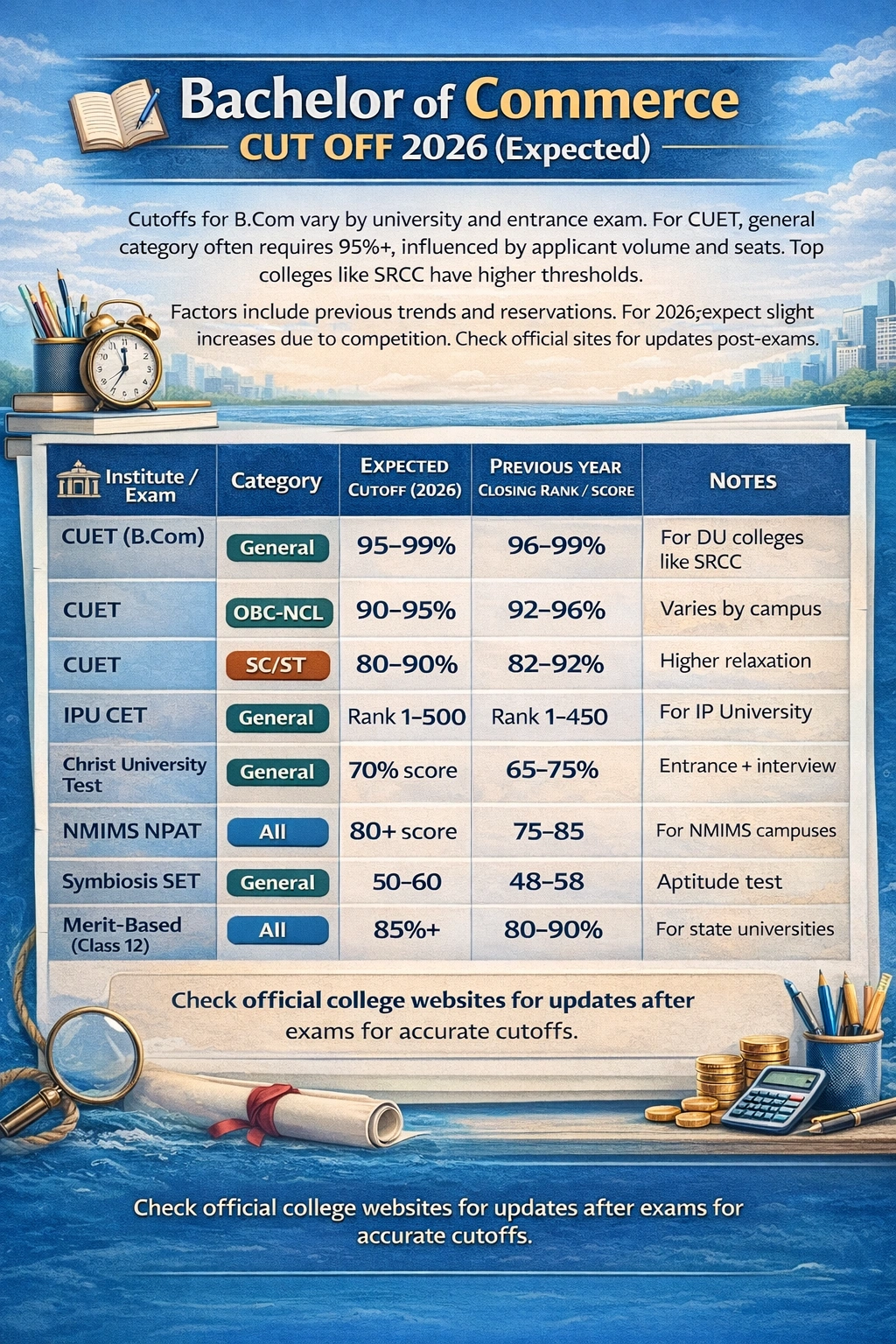
BCom Cut Off 2026 (Expected)
Cutoffs for B.Com vary by university and entrance exam. For CUET, general category often requires 95%+, influenced by applicant volume and seats. Top colleges like SRCC have higher thresholds.
Factors include previous trends and reservations. For 2026, expect slight increases due to competition. Check official sites for updates post-exams.
Top BCom Colleges in India
Top colleges for Bachelor of Commerce (B.Com) in India are approved by the UGC and offer rigorous training with modern facilities like libraries and labs. These institutions focus on practical skills, industry ties, and overall development, ensuring high employability. Government colleges offer subsidized fees and credibility, while private ones emphasize specialized programs and global placements. Selection criteria include entrance exams, merit, and interviews. Fees range from INR 5,000 to 1 lakh, with additional costs for hostels. Placements are strong, with starting salaries in commerce ranging from INR 3-8 LPA, escalating with experience.
Prospective students should consider factors like location, accreditation, placement records, and alumni networks. Many colleges offer scholarships and relaxations for reserved categories. For the 2026 cycle, applications typically open 3-6 months before commencement, often post-Class 12 results.
Top BCom Government Colleges in India
Government colleges for B.Com, such as those under Delhi University or state PSUs, offer affordable education with government-backed credibility. They provide full training aligned with national standards, with emphasis on research and operational excellence. These institutions often have direct ties to public sectors, facilitating better career advancement.
| College Name | 1st Year Fees (INR) | Application Deadline (2026 Cycle) | Entrance Exam | Why Apply | Brochure Link | Average Placement Salary (LPA) | NIRF Ranking |
| Shri Ram College of Commerce (SRCC), Delhi | 29,000 | May 31, 2026 | CUET | Premier institution with top faculty, global ties, and exceptional placements in finance. | Download Here | 8.00 | 1 |
| Hindu College, Delhi | 18,000 | May 31, 2026 | CUET | Historic college with strong academics, active campus, and good industry connections. | Download Here | 6.50 | 2 |
| Lady Shri Ram College for Women (LSR), Delhi | 20,000 | May 31, 2026 | CUET | Empowering education for women with excellent faculty and high placement rates. | Download Here | 7.00 | 3 |
| Hansraj College, Delhi | 21,000 | May 31, 2026 | CUET | Balanced academics and extracurriculars with solid placement support. | Download Here | 5.50 | 14 |
| Sri Venkateswara College, Delhi | 12,000 | May 31, 2026 | CUET | Diverse student body with strong commerce faculty and career guidance. | Download Here | 5.00 | 13 |
| Jesus and Mary College, Delhi | 16,000 | May 31, 2026 | CUET | Women-focused with emphasis on ethics and practical skills in commerce. | Download Here | 4.80 | N/A |
| Gargi College, Delhi | 15,000 | May 31, 2026 | CUET | active campus for women with good academic and placement records. | Download Here | 4.50 | N/A |
| Kirori Mal College, Delhi | 12,000 | May 31, 2026 | CUET | Strong in arts and commerce with active societies and placements. | Download Here | 5.20 | 9 |
| Ramjas College, Delhi | 14,000 | May 31, 2026 | CUET | Diverse courses with good infrastructure and career support. | Download Here | 4.70 | N/A |
| St. Stephen’s College, Delhi | 25,000 | May 31, 2026 | CUET + Interview | Elite education with rigorous selection and excellent alumni network. | Download Here | 7.50 | 4 |
| Delhi College of Arts and Commerce | 10,000 | May 31, 2026 | CUET | Focus on arts-integrated commerce with affordable fees. | Download Here | 4.00 | 29 |
| Shaheed Bhagat Singh College, Delhi | 11,000 | May 31, 2026 | CUET | Strong in commerce with active placement cell. | Download Here | 4.20 | 21 |
Top BCom Private Colleges in India
Private B.Com colleges excel in sponsored programs, modern amenities, and international collaborations. They often provide 100% placement assistance through ties with global firms, making them attractive for quick career launches.
| College Name | 1st Year Fees (INR) | Application Deadline (2026 Cycle) | Entrance Exam | Why Apply | Brochure Link | Average Placement Salary (LPA) | NIRF Ranking |
| Christ University, Bangalore | 85,000 | April 30, 2026 | CUET/Institute Test | Innovative curriculum with focus on research and industry-ready skills. | Download Here | 5.50 | 13 |
| Narsee Monjee College of Commerce and Economics, Mumbai | 50,000 | June 30, 2026 | Merit | Strong emphasis on practical learning and corporate placements. | Download Here | 4.80 | N/A |
| Symbiosis College of Arts and Commerce, Pune | 28,000 | May 15, 2026 | SET | Liberal arts integration with commerce for creative thinkers. | Download Here | 5.00 | N/A |
| St. Xavier’s College, Mumbai | 6,000 | June 15, 2026 | Merit | Prestigious with balanced academics and extracurriculars. | Download Here | 4.50 | 20 |
| Loyola College, Chennai | 13,000 | June 30, 2026 | Merit | Value-based learning with strong community focus. | Download Here | 4.20 | 6 |
| Mount Carmel College, Bangalore | 45,000 | May 31, 2026 | Merit | Women empowerment through quality commerce education. | Download Here | 4.00 | N/A |
| Madras Christian College, Chennai | 19,000 | June 15, 2026 | Merit | Liberal education with research in commerce. | Download Here | 4.50 | 17 |
| St. Joseph’s College, Bangalore | 28,000 | May 31, 2026 | Merit | Jesuit education with emphasis on ethics and placements. | Download Here | 5.20 | 10 |
| Mithibai College, Mumbai | 5,000 | June 30, 2026 | Merit | Affordable with good academic and co-curricular balance. | Download Here | 4.00 | N/A |
| HR College of Commerce and Economics, Mumbai | 18,000 | June 15, 2026 | Merit | Specialized in commerce with strong placement track. | Download Here | 4.50 | N/A |
| Jai Hind College, Mumbai | 6,000 | June 30, 2026 | Merit | Dynamic learning environment with industry focus. | Download Here | 4.20 | N/A |
| K J Somaiya College of Arts and Commerce, Mumbai | 10,000 | June 15, 2026 | Merit | overall development with good infrastructure. | Download Here | 4.00 | N/A |
Bachelor of Commerce Placements
Placements for Bachelor of Commerce (B.Com) graduates are highly promising, driven by the expanding financial services and corporate sectors. Most reputable institutes report placement rates exceeding 80%, with many students securing positions through campus drives. Programs often include internships, providing a seamless transition to professional roles. Average starting salaries range from INR 3 to 6 LPA, but in top colleges, earnings can escalate with skills in accounting or finance.
The placement process involves company presentations, aptitude tests, group discussions, and interviews. Institutes like SRCC and Christ University help interactions with recruiters, emphasizing analytical skills, communication, and ethical practices.
With the rise of fintech and e-commerce, placements favor candidates with digital proficiency. Overall, B.Com offers strong career entry points, with opportunities for further studies like CA or MBA.
B.Com Job Roles and Salaries
Upon completing B.Com, graduates typically start in entry-level roles like accountant or analyst in corporate firms. Key positions involve financial reporting, data analysis, and compliance. As experience grows, they advance to supervisory roles, handling budgets and strategies. Salaries vary by sector, with banking offering higher packages including incentives.
Freshers earn INR 3-5 LPA, rising to 8-12 LPA mid-career. Factors like certifications (e.g., Tally) influence pay. These roles require analytical skills, rewarding with growth in dynamic industries.
| Job Role | Description | Average Salary (INR per month) |
| Junior Accountant | Manages daily transactions, prepares reports under supervision. | 20,000 – 30,000 |
| Financial Analyst | Analyzes data, forecasts trends, supports decision-making. | 25,000 – 40,000 |
| Tax Consultant | Prepares returns, advises on compliance, handles audits. | 30,000 – 50,000 |
| Banking Officer | Manages accounts, processes loans, customer service. | 25,000 – 45,000 |
| Auditor | Verifies records, ensures regulatory adherence. | 35,000 – 60,000 |
| Marketing Executive | Promotes products, market research, campaigns. | 20,000 – 35,000 |
| HR Assistant | Recruitment, employee records, payroll support. | 22,000 – 40,000 |
B.Com Career Growth Projections
Career progression in B.Com is based on experience, certifications, and performance. Starting as juniors, graduates advance to mid-level roles in 3-5 years, then senior positions. The commerce sector offers a hierarchy, reaching manager levels in 8-10 years with salaries over INR 10 LPA. Trends like digitization create specializations, projecting 12-15% demand growth by 2030.
Further growth includes managerial roles or entrepreneurship after 10 years. Pursuing MBA or CA leads to executive positions. With economic expansion, stability is high, supported by continuous learning. Projections show 15-25% salary hikes per promotion.
| Rank/Stage | Required Experience (Years) | Projected Salary Growth (INR LPA) | Key Skills for Advancement |
| Entry to Junior | 0-2 | 3-5 to 5-7 | Basic accounting, software proficiency |
| Junior to Mid-Level | 2-5 | 5-7 to 8-12 | Analysis, team management |
| Mid to Senior | 5-8 | 8-12 to 15-20 | Strategic planning, compliance |
| Senior to Executive | 8-12 | 15-20 to 25-40 | Leadership, decision-making |
| Executive Roles | 12+ | 40+ | Visionary strategy, networking |
Bachelor of Commerce Placement Statistics and Top Recruiters
Placement statistics for B.Com highlight strong demand, with top institutes achieving 85-95% rates. SRCC reports over 90% placements, with regular recruiter visits. Average packages range from INR 3.5 to 8 LPA. Data from 2025 shows growth in fintech hiring. Recruiters value analytical skills, offering roles in diverse fields.
Key metrics include percentages, packages, and company variety. Trends indicate higher offers, driven by economic recovery. Colleges like LSR excel, supported by training programs.
| College Name | Placement Rate (%) | Average Package (INR LPA) | Highest Package (INR LPA) | Top Recruiters |
| SRCC Delhi | 95 | 8.00 | 35 | Deloitte, KPMG, Bain & Co |
| Hindu College Delhi | 85 | 6.50 | 20 | EY, PwC, ICICI Bank |
| LSR Delhi | 90 | 7.00 | 25 | McKinsey, Boston Consulting |
| Christ University | 85 | 5.50 | 15 | Accenture, Goldman Sachs |
| St. Xavier’s Mumbai | 80 | 4.50 | 12 | JPMorgan, HDFC Bank |
| Loyola Chennai | 75 | 4.20 | 10 | Cognizant, Wipro |
Opportunities in Different Sectors
B.Com opens doors to diverse sectors like banking, finance, and IT. In banking, roles focus on operations, while finance involves analysis. Manufacturing requires cost management, and e-commerce needs marketing experts. Emerging areas like fintech offer digital roles. Each sector provides challenges, from compliance in finance to innovation in startups.
Opportunities abound with India’s economic growth, government initiatives boosting MSMEs. Sectors like consulting emphasize strategy, while education allows teaching. Diversification enables mobility after experience.
| Sector | Key Roles | Opportunities | Average Salary (INR LPA) |
| Banking | Officer, Analyst | Loans, customer service, growth in PSU banks | 3-6 |
| Finance & Insurance | Advisor, Underwriter | Risk assessment, policy sales | 4-8 |
| Accounting & Auditing | Auditor, Tax Consultant | Firms like Big 4, compliance services | 4-7 |
| IT & Consulting | Business Analyst | Process optimization, advisory | 5-10 |
| E-Commerce & Retail | Manager, Marketer | Supply chain, digital sales | 3-6 |
| Manufacturing | Cost Accountant | Inventory control, efficiency | 4-7 |
Global Opportunities after B.Com
B.Com graduates access global roles in multinational firms like Deloitte and KPMG. Opportunities include working in finance hubs, pursuing MBA abroad. Certifications like ACCA enable jobs in Europe or Middle East.
Demand rises with globalization, projecting shortages in skilled accountants. Roles in Dubai or Singapore offer USD 2000-4000 monthly. Events like career fairs aid networking. Countries like USA host programs for further studies, leading to residencies.
| Region/Country | Key Opportunities | Top Companies/Institutes | Average Starting Salary (USD per month) |
| Europe (e.g., UK, Germany) | Accounting, consulting | PwC, EY | 2500-4000 |
| Middle East (e.g., UAE, Saudi) | Finance, auditing | KPMG, Deloitte | 2000-3500 |
| Asia (e.g., Singapore, Japan) | Banking, trade | HSBC, Standard Chartered | 1800-3000 |
| North America (e.g., USA, Canada) | Analyst, consultant | McKinsey, Bain | 3000-5000 |
| Australia/Oceania | Finance, accounting | ANZ Bank, PwC Australia | 2500-4000 |
Bachelor of Commerce Scholarships
Scholarships for B.Com help reduce financial burdens for meritorious and needy students. Many universities offer merit-based awards, while private foundations provide need-based support. Female students often receive incentives to promote gender equality in education.
Government schemes like Post-Matric Scholarships are available for SC/ST/OBC categories. Applications require academic records, income certificates, and essays. Checking university websites like du.ac.in for updates is recommended.
These opportunities make B.Com accessible, encouraging diversity in commerce fields. Sponsored programs by corporates ensure skill development with financial aid.
| Scholarship Name | Eligibility | Amount (INR) | Provider |
| Merit Cum Means Scholarship | High scores, family income <2.5L | Up to 25,000 | Various Universities |
| Inspire Scholarship | Top 1% in Class 12 | 80,000 per year | DST, Government |
| Post-Matric Scholarship | SC/ST/OBC students | Full tuition | State Governments |
| Girl Child Scholarship | Female students | 10,000 discount | CBSE, Private Trusts |
| Minority Scholarship | Minority communities | Variable | Ministry of Minority Affairs |
| Corporate Sponsorship | Merit-based | Up to 50,000 | Tata, Reliance |
FAQs
What is B.Com?
Bachelor of Commerce (B.Com) is a three-year undergraduate degree focusing on commerce, accounting, finance, and business management. It prepares students for careers in banking, taxation, and corporate sectors, with a curriculum including economics, laws, and practical skills. Graduates can pursue CA, MBA, or entry-level jobs.
What are the eligibility criteria for B.Com?
Eligibility requires 10+2 from a recognized board with 45-50% aggregate, preferably in commerce stream. Subjects like accountancy and maths are advantageous. No age limit generally, but English proficiency is needed. Relaxations for SC/ST/OBC up to 5%. Documents include mark sheets and ID proofs.
What is the average salary after completing B.Com?
B.Com graduates start with INR 3-6 LPA in roles like accountant or analyst. With experience or certifications like CA, salaries rise to 8-15 LPA. Top colleges offer higher starts, up to 8 LPA, plus benefits. Sectors like finance and consulting provide better pay scales.
Which are the top colleges for B.Com in India?
Top B.Com colleges include SRCC Delhi, Hindu College Delhi, LSR Delhi, Christ University Bangalore, and St. Xavier’s Mumbai. These offer UGC-approved programs with modern facilities, strong placements, and fees from INR 10K-1L. High NIRF rankings ensure quality education and industry ties.
Is B.Com a good career option?
Yes, B.Com provides versatile careers in finance, banking, and business with steady growth and earning potential. It suits analytical minds seeking stability, as demand grows with economic expansion. However, it requires continuous upskilling for advancement, balanced by opportunities in diverse sectors.
What is the duration of the B.Com course?
The standard B.Com course is three years, divided into six semesters of classroom learning and projects. Integrated programs like B.Com LLB extend to five years. This structure builds foundational to advanced skills, preparing for professional exams or jobs in commerce fields.
How can I get admission to B.Com?
Admission involves applying via university portals, clearing exams like CUET, and merit-based selection. Submit 10+2 marks and documents. Reserved seats for categories. Applications open post-Class 12 results, with counseling for allotments. Preparation includes reviewing basics and aptitude practice.
What is covered in the B.Com syllabus?
B.Com syllabus covers financial accounting, economics, business laws, taxation, management, and electives like marketing. Year 1 focuses on basics, Year 2 on regulations, Year 3 on strategy. Practicals include software labs and projects for real-world application in business scenarios.
What is the difference between B.Com and BBA?
B.Com emphasizes commerce fundamentals like accounting and finance for analytical roles. BBA focuses on management and leadership for operational positions. B.Com suits finance careers with lower fees, while BBA offers broader business skills for managerial paths.
Are there scholarships available for B.Com students?
Yes, scholarships include merit-based up to INR 25,000, need-based for low-income, and category-specific like Post-Matric for SC/ST. Women and minorities get incentives. Providers are governments and trusts. Applications need academics and income proofs, detailed on university sites.