
Bachelor of Computer Applications (BCA): Complete Guide 2025
The Bachelor of Computer Applications (BCA) is a three-year undergraduate program specifically designed for students who are passionate about technology, software development, and computer applications. Unlike a B.Tech in Computer Science, which is often theory-intensive and lasts four years, BCA offers a shorter, practical-oriented approach, making it an ideal choice for students eager to enter the IT industry quickly. The program equips students with a solid foundation in programming languages, database management, networking, and emerging technologies such as Artificial Intelligence (AI), Machine Learning (ML), and cloud computing.
With India’s IT sector booming and projected to reach new heights by 2025, the demand for skilled BCA graduates is increasing rapidly. Companies are actively looking for professionals adept in software development, web applications, data analysis, and cybersecurity. BCA acts as a stepping stone not only for immediate employment but also for advanced education like MCA (Master of Computer Applications) or even MBA for those aiming for managerial roles in technology-driven companies.
BCA also emphasizes practical learning through projects, internships, and exposure to real-time software development environments, ensuring that students are industry-ready upon graduation. Universities like Alpine College, COER University, and Noble University are among the institutions in India offering BCA programs with modern curricula, updated labs, and experienced faculty. With affordable fees compared to engineering and the flexibility to pursue various specializations, BCA remains one of the most sought-after undergraduate degrees in India.
Why Choose BCA?
Choosing BCA offers numerous advantages, especially for students from diverse academic streams who aspire to enter the IT sector. The course is particularly suitable for Science, Commerce, or Arts students looking to develop technical expertise without the four-year commitment required for engineering programs. Here’s a detailed look at why BCA is an excellent choice:
-
Practical Focus on Programming, Databases, and Web Technologies:
BCA emphasizes hands-on experience in programming languages such as C, C++, Java, and Python. Students gain exposure to database management, web development frameworks, and software tools widely used in industry. This practical approach ensures graduates can handle real-world projects immediately after completing their degree. -
Affordable Compared to B.Tech:
Tuition fees for BCA programs are significantly lower than engineering programs. Government colleges offer the course for ₹10,000–₹50,000 per year, while private institutions range from ₹50,000–₹2,00,000 annually. This cost-effectiveness allows students from varied financial backgrounds to pursue technical education without heavy loans. -
Direct Pathway to Jobs in Top IT Companies:
BCA graduates are actively recruited by leading IT companies such as TCS, Infosys, Wipro, HCL, Accenture, and Cognizant. Roles include software developer, web developer, system analyst, data analyst, and cybersecurity specialist. -
Flexibility for Higher Studies:
BCA is a strong foundation for pursuing MCA for advanced technical knowledge or MBA for managerial roles. Specializations such as AI, cloud computing, and data science make BCA students competitive in emerging technologies. -
Industry-Relevant Skills:
With a curriculum updated according to industry trends, BCA ensures students acquire skills required for a digital-first world, including programming, networking, database handling, and software project management.
Eligibility Criteria for BCA
To pursue BCA in India, students must meet certain academic requirements and follow standard admission procedures. The eligibility criteria are designed to ensure students have the foundational knowledge required for computing studies:
-
Completion of Class 12 (10+2):
Students must have completed their higher secondary education from a recognized board such as CBSE, ICSE, or state boards. All streams—Science, Commerce, or Arts—are accepted in most colleges. -
Minimum Marks Requirement:
Most institutions require a minimum aggregate of 45–50% in Class 12. Reserved category candidates often receive relaxation in marks criteria. -
English as a Compulsory Subject:
Proficiency in English is mandatory, as it forms the medium of instruction and is essential for understanding programming languages and technical documentation. -
Preferred Subjects:
Mathematics or Computer Science is preferred but not mandatory in many colleges. Having a background in mathematics helps in programming, logical reasoning, and data structures. -
Age Limit:
Most colleges do not impose an upper age limit, making BCA accessible to students of various age groups. -
Admission Mode:
Admissions are generally merit-based (Class 12 scores) or entrance exam-based. Entrance exams assess aptitude, reasoning, and basic computer knowledge, ensuring selection of capable students.
This broad eligibility criterion makes BCA accessible to a wide range of students who are keen to develop a career in IT without committing to a longer engineering course.
Admission Process 2025
The BCA admission process is typically conducted between May and July every year. Students can secure admission either based on their Class 12 marks or through competitive entrance exams conducted by universities and colleges. Here’s a step-by-step explanation:
-
Merit-Based Admission:
Many private and government colleges accept students purely based on Class 12 marks. The merit list is published on the college website, and selected candidates are invited for counseling and seat allotment. -
Entrance Exam-Based Admission:
National, university, and college-level entrance exams play a vital role in securing admission. Students need to register online, appear for the exam, and secure qualifying marks. -
Application Submission:
Applications are submitted through college portals or centralized admission systems. Students must attach Class 12 marksheets, identity proof, and passport-sized photographs. -
Counseling and Seat Allotment:
Based on merit or entrance scores, students participate in counseling sessions where they select colleges and specializations. Seats are allotted according to merit rank and availability.
Popular Entrance Exams for 2025:
| Exam | Conducting Body | Level | Key Focus Areas |
|---|---|---|---|
| CUET UG | NTA | National | English, Maths, General Aptitude |
| IPU CET | GGSIPU | University | Computer Awareness, Reasoning |
| SET | Symbiosis | University | Analytical Skills, Quantitative Ability |
| AIMA UGAT | All India Management Assoc. | National | English, Numerical Ability |
Preparing for these exams requires a strong grasp of logical reasoning, mathematics, and basic computer knowledge. Early preparation improves chances of securing admission in top BCA colleges.
People Also Read




BCA Course Fees in India
The cost of pursuing a BCA degree in India varies depending on the type of institution, infrastructure, and location. Here’s a detailed overview:
| Type of College | Fees per Year (₹) | Total Fees (₹) | Notes |
|---|---|---|---|
| Government Colleges | 10,000 – 50,000 | 30,000 – 1,50,000 | Highly affordable, limited seats |
| Private Colleges | 50,000 – 2,00,000 | 1,50,000 – 6,00,000 | Modern infrastructure, industry exposure |
| Average Total Fees | 50,000 – 1,00,000 | 1,50,000 – 5,00,000 | Varies based on college, city, and facilities |
Scholarships and Financial Aid:
Many colleges offer merit-based scholarships for top-performing students in Class 12 or entrance exams. Reserved category students may get full or partial fee waivers. Some universities provide education loans with affordable interest rates, making BCA accessible to financially constrained students.
BCA Syllabus: Semester-Wise Breakdown
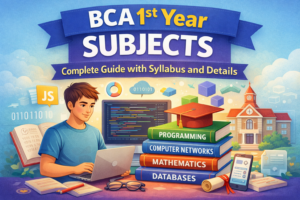
BCA is a six-semester program blending theory, practicals, and projects. Each semester builds upon foundational knowledge while integrating core concepts and advanced topics.
Semester 1-2 (Foundation Courses):
-
Fundamentals of Computers
-
Programming in C
-
Mathematics for Computing
-
Digital Electronics
-
Communication Skills
These courses develop a strong foundation in computing, logic building, and problem-solving, along with soft skills essential for the workplace.
Semester 3-4 (Core Concepts):
-
Data Structures
-
Database Management Systems
-
Object-Oriented Programming (C++/Java)
-
Operating Systems
-
Web Technology
At this stage, students develop programming efficiency, database handling skills, and understand system-level software management.
Semester 5-6 (Advanced & Specialization):
-
Software Engineering
-
Computer Networks
-
Cloud Computing / AI (Electives)
-
Project Work / Internship
-
Specializations: Data Science, Cybersecurity, AI & ML
Final semesters emphasize hands-on experience, internships, and project work, preparing students for real-world IT challenges.
Top BCA Colleges in India
Choosing the right college is critical for skill development, placements, and exposure. Here are some of the top BCA colleges:
| College | Location | Approx. Fees (Total) | Notable Features |
|---|---|---|---|
| Christ University | Bangalore | ₹4-6 Lakh | Excellent placements, modern labs |
| Symbiosis (SICSR) | Pune | ₹5-7 Lakh | Industry-focused curriculum |
| Amity University | Noida | ₹4-6 Lakh | Modern infrastructure, global tie-ups |
| Loyola College | Chennai | ₹2-3 Lakh | Affordable, reputed faculty |
| Kristu Jayanti College | Bangalore | ₹3-4 Lakh | Strong faculty, practical focus |
Other notable options include VIT Vellore, Presidency College, and Galgotias University, each offering specialized courses and strong placement support.
Career Scope and Job Opportunities After BCA
BCA opens doors to multiple career opportunities in IT, finance, e-commerce, cybersecurity, and emerging technologies. Average starting salary ranges between ₹3–6 LPA for freshers, with experienced professionals earning ₹10+ LPA.
Top Job Profiles:
| Job Role | Average Salary (Freshers) | Top Recruiters |
|---|---|---|
| Software Developer | ₹4-8 LPA | TCS, Infosys, Wipro |
| Web Developer | ₹3-6 LPA | Accenture, Cognizant |
| Data Analyst | ₹4-7 LPA | IBM, Capgemini |
| System Analyst | ₹5-9 LPA | HCL, Tech Mahindra |
| Cybersecurity Specialist | ₹6-10 LPA | Deloitte, KPMG |
Emerging Fields:
AI/ML Engineer, Cloud Architect, and Data Scientist are in high demand. Professionals with certifications in these areas can earn ₹8–15 LPA or more.
Higher Studies:
Graduates may pursue MCA for deeper technical expertise or MBA for managerial roles in IT, finance, or operations. Specialization courses and certifications add value and enhance employability.
Conclusion
The BCA degree is a future-proof choice, providing a perfect blend of technical knowledge, practical skills, and career opportunities. With India’s IT sector expanding rapidly, BCA graduates are well-positioned to secure high-paying jobs or pursue advanced studies. By choosing the right college, focusing on skill development, and gaining industry exposure through internships and projects, students can achieve success in a digital-first world.
BCA not only provides immediate employability but also acts as a stepping stone to emerging fields like AI, cloud computing, and cybersecurity. Students are encouraged to start early, select colleges strategically, and build a strong portfolio to maximize career prospects in 2025 and beyond.
FAQs
What is BCA full form?
BCA stands for Bachelor of Computer Applications, a three-year undergraduate program focused on computer science, programming, and IT skills.
What are the eligibility criteria for BCA?
Students must complete Class 12 with minimum 45–50% marks; Mathematics or Computer Science is preferred but not always mandatory.
What is the duration of BCA course in India?
BCA is a three-year undergraduate program divided into six semesters, blending theory, practicals, and project work for industry readiness.
Which entrance exams are required for BCA admission?
Popular entrance exams include CUET UG, IPU CET, SET, and AIMA UGAT, assessing reasoning, mathematics, and basic computer knowledge.
What is the average BCA course fee in India?
Government colleges: ₹10,000–50,000/year; private colleges: ₹50,000–2,00,000/year; scholarships and loans are available for eligible students.
What subjects are taught in BCA syllabus?
Subjects include programming (C, C++, Java), databases, data structures, web development, operating systems, networking, AI, cloud computing, and software engineering.
Which colleges are best for BCA in India?
Top colleges: Christ University, Symbiosis, Amity University, Loyola College, Kristu Jayanti College, VIT Vellore, and Presidency College, offering placements and infrastructure.
What career opportunities are available after BCA?
Jobs include Software Developer, Web Developer, Data Analyst, System Analyst, Cybersecurity Specialist, AI/ML Engineer, Cloud Architect, and IT consultant roles.
Can BCA graduates pursue higher studies?
Yes, graduates can pursue MCA for technical depth or MBA for managerial roles, plus certifications in AI, cloud computing, or cybersecurity.
What is the average salary after BCA in India?
Freshers earn ₹3–6 LPA; experienced professionals earn ₹10+ LPA; specialized roles in AI, cybersecurity, and cloud computing offer higher pay.







what is the best colleges for BCA