Bachelor of Science (B.Sc) Computer Science Course Details 2026: Eligibility, Admission Process, Fees, Syllabus & Career Scope
Bachelor of Science (B.Sc) in Computer Science is a three-year undergraduate program that provides foundational knowledge in computing, programming, algorithms, and data structures. It prepares students for roles in software development, data analysis, and IT services. The course combines theoretical concepts with practical applications through labs and projects.
Offered by universities and colleges across the country, it emphasizes problem-solving and logical thinking. Graduates can pursue higher studies or enter the workforce directly. With the growing tech industry, this degree offers strong career prospects in various sectors.
Bachelor of Science Computer Science Course Highlights
Parameter
Details
Duration
3 years (6 semesters)
Eligibility
10+2 with Physics, Chemistry, Mathematics (minimum 50% aggregate)
Entrance Exams
CUET UG, BITSAT, state-level exams
Average Fees
INR 50,000 – 2 lakhs per year
Average Starting Salary
INR 3-6 LPA
Top Specializations
Artificial Intelligence, Data Science, Cybersecurity
Top Recruiters
TCS, Infosys, Wipro, Google, Microsoft
The program is recognized by UGC and focuses on building technical skills for the digital economy. Many institutions offer electives in emerging technologies.
To pursue B.Sc Computer Science, candidates must meet specific academic requirements set by universities. The primary criterion is completing 10+2 or equivalent from a recognized board in the Science stream, with Physics, Chemistry, and Mathematics (PCM) as core subjects. This ensures a solid foundation for technical topics like programming and algorithms.
A minimum aggregate of 50% in 10+2 is required for general candidates, with relaxations for reserved categories. Mathematics must have at least 50% marks. Age limits typically range from 17-25 years, and lateral entry options exist for diploma holders. Variations occur across institutes, so checking official websites is essential.
Category
Minimum Aggregate (10+2)
Relaxation
Other Requirements
General
50%
None
PCM compulsory, 50% in Maths
SC/ST
45%
5%
Category certificate needed
OBC-NCL
45-50%
Varies
Non-creamy layer proof
EWS
50%
None
EWS certificate
PwD
45%
5%
Disability certificate, accommodations
Entrance Exams for B.Sc Computer Science
Entrance exams are key for admission to top B.Sc Computer Science programs, evaluating science aptitude and reasoning. CUET UG is central for many universities, with others having specific tests.
Exams like BITSAT and state-level tests follow. Preparation involves NCERT syllabus and mocks. Dates are tentative; confirm on official sites.
Exam
Conducting Body
Tentative Date 2026
Pattern
CUET UG
NTA
May-June
MCQ, Domain + General
BITSAT
BITS Pilani
Apr 15-17 & May 24-26
MCQ, PCM + English + Logic
GCSET
GCSET Org
TBA
Online, CS-focused
MHT CET
Maharashtra CET Cell
Apr 11-19 (PCM), Apr 21-26 (PCB)
MCQ, PCM
AP EAMCET
APSCHE
May
MCQ, Science
NPAT
NMIMS
Jan-May
MCQ, Aptitude
CMI Entrance
CMI
May 2
Subject-based
Bachelor of Science Computer Science Admission Process
The admission process for B.Sc Computer Science includes application, selection via merit or entrance, and counseling. It ensures fair allocation based on performance.
Key steps involve online forms, exams, and document verification. Timelines start from December 2025; reservations apply as per norms.
Step
Description
Tentative Timeline 2026
Application
Online form submission
Dec 2025 – Mar
Entrance Exam
Appear for CUET/BITSAT
Apr-Jun
Result Declaration
Scores and ranks
Jun
Counseling
Seat allocation
Jun-Jul
Verification & Admission
Documents, fees
Jul-Aug
B.Sc Computer Science Syllabus
The B.Sc Computer Science syllabus is structured over six semesters in a three-year program, blending theoretical concepts with practical applications. It covers foundational topics in programming, data structures, and hardware in early semesters, progressing to advanced areas like software engineering, databases, and emerging technologies. The curriculum, often following UGC guidelines or university-specific adaptations, includes core courses, electives, labs, and projects to build problem-solving skills.
Detailed coverage varies by institution, but a standard structure emphasizes languages like C, Java, and Python, alongside mathematics and electronics. Practicals reinforce theory through coding, simulations, and mini-projects. Electives allow specialization in areas like AI or cybersecurity. Assessments combine exams, assignments, and viva.
Semester
Subjects
Detailed Topics
1
Introduction to Digital Electronics, Basics of Computer Science, Environmental Sciences, Foundation Course in Mathematics, Computer Fundamentals and Programming in C, Digital Electronics Lab, C Programming Lab
Digital Electronics: Number systems, logic gates, Boolean algebra, flip-flops, adders. Basics of Computer Science: Components, characteristics, memory types, storage devices. Programming in C: Data types, operators, control structures, arrays, functions, pointers, strings, file handling. Labs: Experiments on logic gates, rectifiers, C syntax, arrays, structures, file operations.
2
Discrete Mathematics, Computer Organization, Fundamentals of Open Source Software-Linux, Front Office Management, Environmental Studies, Data Structures, Computer Architecture and Microprocessors, Data Structures Lab, Assembly Language Programming Lab
Value and Ethics, Database Management Systems, System Analysis and Design, Analytical Skill Development-II, System Software, Computer Networks, Web Technologies, Elective-I, Web Technologies Lab, Networks Lab
System Software: Assemblers, loaders, compilers. Computer Networks: OSI model, LAN/WAN, protocols, TCP/IP. Web Technologies: HTML, CSS, JavaScript, PHP. System Analysis: Feasibility, DFD, structured design. Labs: HTML forms, JavaScript validation, network simulations, socket programming.
5
Operating Systems Concepts, Python Programming, Introduction to Data Structures, Introduction to Software Engineering, Mobile Application Development, Elective-II, Python Lab, Mobile App Lab
Operating Systems: Deadlocks, virtual memory, disk scheduling. Python: Variables, loops, functions, lists, dictionaries, OOP, file handling. Data Structures: Trees, graphs, hashing. Software Engineering: Testing, maintenance. Mobile Development: Android basics, UI, intents. Labs: Python scripts, data analysis, Android apps.
6
Introduction to Computer Networks, System Programming, Numerical Analysis, Introduction to Web Technology, Cloud Computing, Project Work, Internship
Networks: Security, wireless, routing. System Programming: Macros, linkers. Numerical Analysis: Interpolation, integration. Web Technology: Server-side scripting, databases. Cloud: Virtualization, AWS/Azure. Project: Major software development. Internship: Industry exposure.
Download B.Sc Computer Science Syllabus PDF
Below is the latest BSc Computer Science syllabus with detailed subject coverage in downloadable PDF format:
Bachelor of Science Computer Science Specialisations Details
B.Sc Computer Science offers specializations in niche areas, typically starting from the third semester. These allow students to gain in-depth knowledge in emerging fields, enhancing career prospects in the IT industry.
Popular options include AI, Data Science, and Cybersecurity, focusing on advanced technologies. Institutions vary in offerings, with some allowing dual specializations. Choices should align with interests and market demands for better employability.
Specialization
Key Courses
Career Prospects
Duration/Level
Artificial Intelligence
Machine Learning, Deep Learning, Robotics
AI Engineer, ML Specialist
Advanced, Sem 4-6
Data Science
Big Data, Statistics, Data Mining
Data Analyst, Scientist
Intermediate-Advanced
Cybersecurity
Ethical Hacking, Forensics, Security Protocols
Security Analyst, Ethical Hacker
Advanced
Software Engineering
Agile, Software Testing, Design Patterns
Software Developer, Engineer
Core-Advanced
Web Development
React, Django, Database Integration
Web Developer, Full-Stack Engineer
Intermediate
Cloud Computing
AWS, Microservices, DevOps
Cloud Architect, Engineer
Advanced
Internet of Things
Sensor Tech, Embedded C, IoT Protocols
IoT Developer, System Integrator
Advanced
Top B.Sc Computer Science Colleges with Cut Off for 2026
Top colleges for B.Sc Computer Science in India are renowned for their robust curriculum, experienced faculty, modern infrastructure, and strong industry connections. Institutions like those affiliated with Delhi University, Loyola College, and Christ University stand out in rankings such as NIRF and India Today. Admissions are competitive, often through CUET UG or merit, with cut offs reflecting high demand.
For 2026, cut offs are expected to remain high based on 2025 trends, typically 90+ percentile in CUET for premier colleges. Factors like reservations apply, and fees vary from government-subsidized to private institutions. Candidates should check official sites for updates.
College
Location
Expected Cut Off (CUET Percentile/General)
Average Fees (INR per year)
St. Stephen’s College
Delhi
95+
50,000
Miranda House
Delhi
96+
20,000
Loyola College
Chennai
90+
40,000
Christ University
Bengaluru
85-90
80,000
Madras Christian College
Chennai
88+
35,000
Fergusson College
Pune
85-90
20,000
St. Xavier’s College
Mumbai
92+
40,000
Hansraj College
Delhi
94+
25,000
Presidency College
Chennai
90+
25,000
Banaras Hindu University
Varanasi
85-90
10,000
Aligarh Muslim University
Aligarh
80-85
15,000
Placement & Opportunities After Bachelor of Science Computer Science
Graduates of B.Sc Computer Science enter a thriving job market in India’s digital economy, where the IT sector drives significant employment growth. With skills in programming, data structures, and emerging technologies, they secure roles across various industries. Placements through campus drives in top colleges often achieve 80-90% rates, with average starting salaries of INR 3-6 LPA as of 2025 trends. Higher education like M.Sc or MCA, or certifications in AI and cloud computing, can accelerate career progression. The sector’s expansion, projected to double the workforce to 10 million by 2030, promises robust opportunities.
B.Sc Computer Science Job Roles and Salaries
Common job roles for B.Sc Computer Science graduates include software development, data analysis, and web design, leveraging core skills in coding and problem-solving. Salaries vary by role, experience, and location, with freshers starting lower and advancing quickly through upskilling.
Job Role
Average Salary (INR LPA)
Key Responsibilities
Software Developer
4-8.5
Designing, coding, and maintaining applications
Data Analyst
3-6
Analyzing data sets for insights and reports
Web Developer
3-5
Building and optimizing websites
Cybersecurity Analyst
5-8
Protecting systems from threats
IT Support Specialist
3-4
Troubleshooting hardware and software issues
Machine Learning Engineer
7-10
Developing AI models and algorithms
Programmer
4-6
Writing and testing code for software
Data Scientist
8-12
Using statistics for data-driven decisions
Mobile App Developer
4-7
Creating apps for Android/iOS
Cloud Engineer
6-9
Managing cloud infrastructure
Network Administrator
4-6
Maintaining network systems
B.Sc Computer Science Career Growth Projections
Career growth for B.Sc Computer Science graduates is promising, with the IT sector expected to add 2-3 million jobs by 2030, particularly in AI and data science. Freshers can progress to mid-level roles within 3-5 years, earning INR 10-20 LPA or more with experience and specializations. Projections indicate a shift towards high-tech roles, with demand for skills in cybersecurity and machine learning growing at 20-30% annually. Continuous learning through certifications enhances promotion prospects.
B.Sc Computer Science Placement Statistics and Top Recruiters
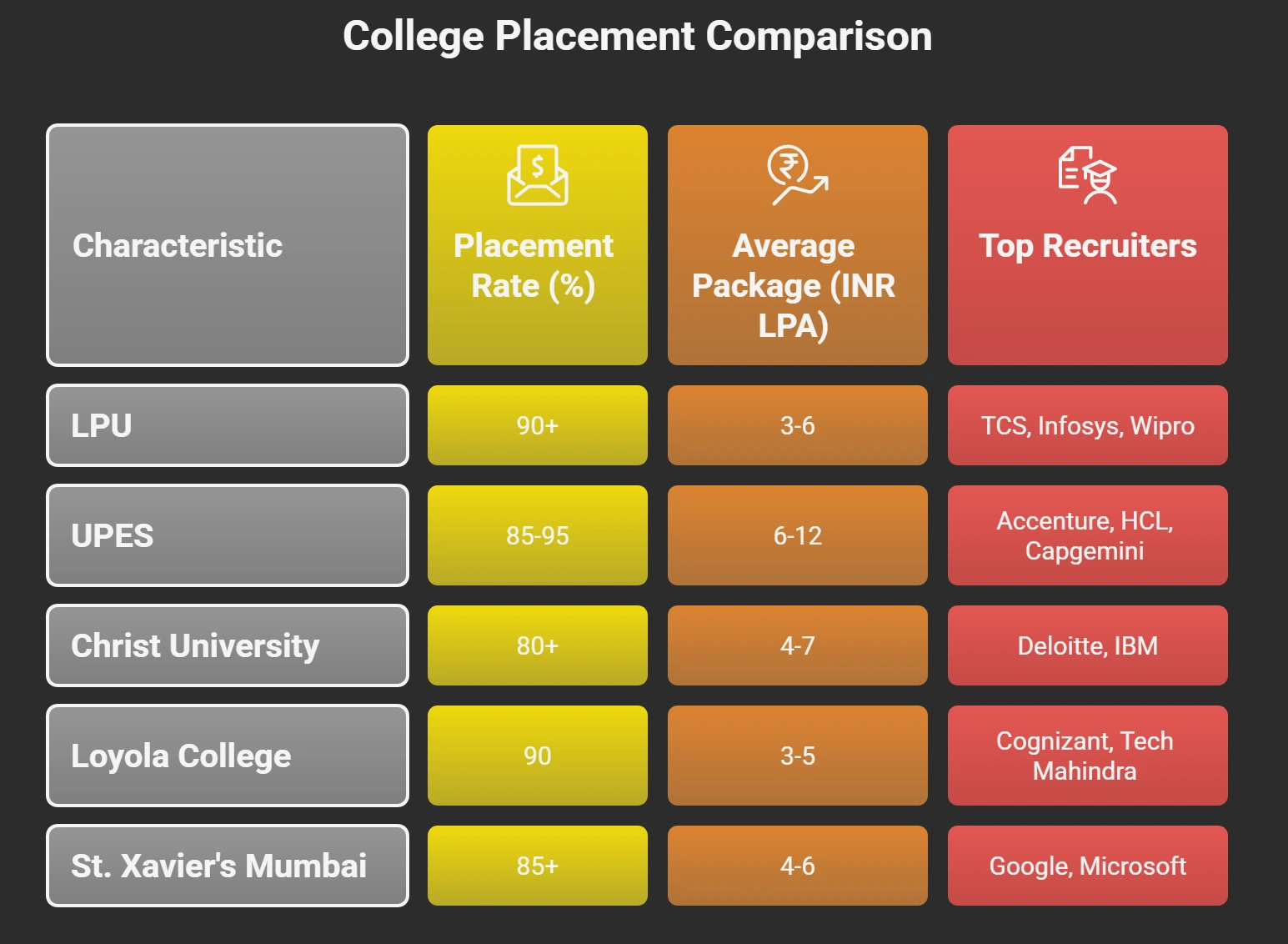
Placement statistics from top colleges show strong outcomes, with rates of 80-95% and median packages around INR 4-6 LPA. Institutions like LPU and UPES report high placements, while Delhi University affiliates achieve even higher figures. Top recruiters value practical skills, offering roles during campus drives.
Opportunities in Different Sectors
B.Sc Computer Science graduates find opportunities across sectors beyond IT, applying skills in digital solutions. Banking uses them for fintech, e-commerce for data analytics, and healthcare for tech integration. Logistics and manufacturing leverage software for efficiency, while education and entertainment need developers for apps and content management.
Sector
Key Opportunities
Examples
IT Services
Software development, support
TCS, Infosys
E-commerce
Data analysis, web development
Amazon, Flipkart
Finance/Banking
Fintech, risk analysis
HDFC, ICICI
Healthcare
Health tech, data management
Apollo, Pfizer
Manufacturing
Automation, IoT
Tata Steel, Reliance
Education
Edtech platforms
Byju’s, Unacademy
Entertainment
Game development, digital media
Netflix, Zee
Global Opportunities
Indian B.Sc Computer Science graduates have expanding global opportunities, particularly in Canada, Germany, and the US, where demand for IT talent is high. Roles like software engineer abroad offer salaries of $60,000+ annually. Programs like Canada’s PGWP and Germany’s Job Seeker Visa facilitate transitions. Skills in AI and cybersecurity are sought, with companies like Google and Microsoft hiring internationally. Pursuing MS abroad enhances prospects.
B.Sc Computer Science Scholarships
Scholarships for B.Sc Computer Science students in India play a crucial role in making higher education accessible, especially given the rising costs of tuition and living expenses. These financial aids are offered by government bodies, private corporations, foundations, and universities, targeting merit, financial need, academic excellence, or specific demographics like women, minorities, or students from low-income backgrounds. As of December 2025, several scholarships are available for the 2026 intake, with applications often opening in early 2026. They can cover tuition fees, books, laptops, or even full program costs, reducing the burden on students pursuing tech-oriented degrees amid India’s growing digital sector.
Eligibility typically includes academic performance (e.g., 80%+ in 10+2), family income thresholds (often below INR 8-15 lakhs), and sometimes entrance exam scores like CUET. Many scholarships require essays, interviews, or recommendations. Popular ones like Reliance Foundation and Amazon Future Engineer emphasize STEM fields, including computer science. Students should apply early via official portals, as deadlines vary from January to September 2026. Combining multiple scholarships is possible if rules allow, and education loans can supplement.
Types of Scholarships
Scholarships are categorized into merit-based (for high achievers), need-based (for economically weaker sections), category-based (for SC/ST/OBC/EWS/PwD), and special scholarships (for women, minorities, or specific fields like AI in CS). Government schemes focus on inclusivity, while corporate ones often include mentorship and internships.
Top BSc Computer Science Scholarships for 2026
Scholarship
Provider
Eligibility
Amount (INR)
Application Deadline
Reliance Foundation Undergraduate
Reliance Foundation
Merit-based, family incomeUp to 2 lakhsExpected Feb 2026
Amazon Future Engineer
Amazon
CS undergrads, merit, aptitude test
50,000 per year (up to 2 lakhs total)
Expected Mar 2026
Bharti Airtel Scholarship
Bharti Airtel Foundation
Tech undergrads, merit-cum-means
Full tuition + support
Expected Jan 2026
INSPIRE Scholarship for Higher Education
DST, Govt of India
Top 1% in 10+2, science stream
80,000 per year
Expected Aug 2026
National Scholarship for Post Graduate Studies (applicable for integrated programs)
B.Sc Computer Science, BCA (Bachelor of Computer Applications), and B.Tech in Computer Science (CS) are popular undergraduate programs in India for students interested in technology and computing. While all three lead to careers in IT and software, they differ in focus, duration, curriculum depth, and career outcomes. B.Sc CS emphasizes theoretical foundations and is ideal for research-oriented paths, BCA focuses on practical applications for quick entry into software roles, and B.Tech CS provides an engineering perspective with intensive technical training. Choosing among them depends on academic interests, career goals, and eligibility for entrance exams.
In India, these programs are offered by universities and colleges under UGC and AICTE regulations. B.Sc CS is typically a science degree, BCA a vocational course, and B.Tech an engineering degree requiring JEE or state entrances. Fees range from INR 20,000-1 lakh per year for B.Sc/BCA in government colleges to INR 1-4 lakhs for B.Tech in private institutions. Job prospects are strong across all, but B.Tech often commands higher starting salaries due to its rigor.
Parameter
B.Sc Computer Science
BCA
B.Tech Computer Science
Duration
3 years (6 semesters)
3 years (6 semesters)
4 years (8 semesters)
Eligibility
10+2 Science with PCM, 50% aggregate; entrances like CUET
10+2 any stream with Maths/Computer Science, 50% aggregate; merit or institute tests
10+2 Science with PCM, 50-60% aggregate; entrances like JEE Main, state CETs
While BCA is for application-focused students seeking faster workforce entry. B.Tech CS, being longer and more rigorous, prepares for advanced technical roles but requires stronger entrance preparation.
In terms of job market perception in India, B.Tech CS is often favoured by top recruiters like TCS and Infosys for its comprehensive training, leading to better initial placements. However, with skills like coding and certifications, B.Sc and BCA graduates can compete effectively.
FAQs
What is the duration and structure of B.Sc Computer Science?
The program spans three years, divided into six semesters under a choice-based credit system. It includes core subjects like programming, data structures, and algorithms, along with electives, practical labs, and projects. This structure ensures a balance between theoretical knowledge and hands-on skills, preparing students for industry roles or further studies in computer science fields.
Is Mathematics compulsory for eligibility in B.Sc Computer Science?
Yes, Mathematics is mandatory in the 10+2 Science stream with Physics and Chemistry. Candidates need at least 50% aggregate marks, with relaxations for reserved categories. This requirement stems from the program’s emphasis on logical reasoning and quantitative analysis, essential for topics like algorithms and data processing in computing.
What specializations are available in B.Sc Computer Science?
Specializations include Artificial Intelligence, Data Science, Cybersecurity, Software Engineering, Web Development, Cloud Computing, and Internet of Things. These are typically chosen in later semesters and focus on advanced technologies, allowing students to tailor their education to career interests and emerging industry demands for specialized skills.
Which entrance exams are required for B.Sc Computer Science admission?
Key exams include CUET UG for central universities, BITSAT for BITS Pilani, and state-level tests like MHT CET or AP EAMCET. These assess knowledge in Physics, Chemistry, Mathematics, and aptitude. Preparation involves NCERT syllabus and practice tests to secure high percentiles for top colleges.
What is the admission process for B.Sc Computer Science in 2026?
The process starts with online applications in December 2025, followed by entrance exams in April-June 2026. Shortlisting is based on scores or merit, then counseling for seat allocation. Document verification and fee payment finalize admission, with reservations applied. Check university websites for specific timelines and requirements.
What does the syllabus of B.Sc Computer Science cover?
The syllabus is semester-wise, beginning with basics like C programming and digital electronics, advancing to data structures, algorithms, databases, operating systems, and web technologies. Final semesters include electives, projects, and internships, emphasizing practical skills alongside theory for comprehensive preparation in computing concepts.
What are the expected cut offs for top B.Sc Computer Science colleges in 2026?
Cut offs vary but are projected at 95+ percentile in CUET for St. Stephen’s Delhi, 90+ for Loyola Chennai, and 85-90 for Christ University. These are based on 2025 trends, influenced by category reservations. High scores in entrances and academics are crucial for securing seats.
What career opportunities follow B.Sc Computer Science?
Graduates can pursue roles like software developer, data analyst, web developer, or cybersecurity specialist, with starting salaries of INR 3-6 LPA. Opportunities span IT, e-commerce, finance, and more. Further studies or certifications enhance prospects, while entrepreneurship in tech startups is also viable with gained skills.
What scholarships are available for B.Sc Computer Science students?
Options include Reliance Foundation for merit and need, Amazon Future Engineer for CS students, INSPIRE for top performers, and post-matric schemes for reserved categories. These cover tuition and expenses, requiring applications with academic proofs and income certificates via portals like NSP, aiding financial accessibility for deserving candidates.
Abhijeet Chatterjee is a professional Content and Copy specialist with over five years of experience in crafting compelling content around the Edtech domain. His portfolio includes notable work for companies such as PhysicsWallah, Roar Media, Jagran Josh, etc. Academically, Abhijeet holds a Master's in Mass Communication, where he was awarded a gold medal for his outstanding performance. He has also qualified for the UGC NET in Mass Communication, demonstrating his expertise and a deep understanding of the field. His academic foundation is built on a Bachelor's degree in English Literature. Beyond his professional work, Abhijeet is an avid writer and a cinephile. His personal interests include scriptwriting, film criticism, and reading novels.