Graduate Marine Engineering, commonly known as GME, is a specialized one-year pre-sea training program designed for engineering graduates aspiring to build a career in the merchant navy as marine engineers. This course equips candidates with essential skills in marine machinery operation, maintenance, and safety protocols, enabling them to handle the technical demands of seafaring vessels. Approved by the Directorate General of Shipping, GME bridges the gap between mechanical engineering knowledge and maritime applications, preparing individuals for roles on ships, oil rigs, and offshore platforms.
The program emphasizes practical training alongside theoretical learning, covering areas like engine systems, electrical engineering, and naval architecture. With the growing maritime industry, GME offers promising opportunities for those seeking adventure and high-earning potential in global shipping operations.
GME stands out as a fast-track route into marine engineering for mechanical or naval architecture graduates. It combines intensive classroom sessions, workshops, and simulations to ensure readiness for onboard duties. Key aspects include a focus on safety standards, environmental regulations, and efficient machinery management. The course duration is typically one year, divided into two semesters, with fees varying based on the institute. Graduates often secure placements with leading shipping companies, starting as junior engineers.
Highlights also encompass eligibility requirements, entrance exams, and post-course certifications like the Marine Engineer Officer Class IV exam. This program is ideal for those with a technical background looking to transition into the dynamic field of maritime engineering.
Particulars
Details
Course Full Form
Graduate Marine Engineering
Course Level
Postgraduate Diploma
Duration
1 Year (2 Semesters)
Eligibility
BE/B.Tech in Mechanical Engineering or Naval Architecture with 50-60% aggregate
To pursue GME, candidates must meet specific academic and physical criteria set by the Directorate General of Shipping. Primarily, applicants should hold a bachelor’s degree in mechanical engineering or naval architecture from a recognised university. The minimum aggregate marks required are usually 50% to 60%, depending on the institute. Proficiency in English is mandatory, with at least 50% marks in the subject at the 10+2 or degree level.
Age limits are strict, typically not exceeding 28 years at the course commencement. Medical fitness is crucial, including perfect eyesight (6/6 without aids), no color blindness, and overall physical health certified by a DG Shipping-approved doctor. These standards ensure candidates can withstand the rigors of sea life and perform duties effectively. Further details are added in the table below:
Criteria
Requirements
Details/Notes
Academic Qualification
BE/B.Tech in Mechanical Engineering, Naval Architecture, or Mechanical & Automation
From AICTE/UGC approved institution; minimum 50-60% aggregate or in final year; equivalent degrees may be considered
English Proficiency
Minimum 50% marks in English
At 10th, 12th, or degree level; essential for communication in maritime settings
Age Limit
Maximum 28 years
As of course start date; relaxations: 5 years for SC/ST, 5% marks for island residents
Medical Fitness
Certified fit by DGS-approved doctor
Eyesight: 6/6 better eye, 6/9 other (unaided) or corrected; no color/night blindness; overall health including hearing, BMI
Other Requirements
Valid Indian Passport; Unmarried (in some institutes)
Essential for international voyages; gender no bar; documents: mark sheets, birth certificate, character certificate
Relaxations
For reserved categories and specific regions
SC/ST: age +5 years; Lakshadweep/Andaman: 5% marks relaxation in eligibility
Sponsorship
Company-specific criteria
May include additional tests; assured placement post-course
Graduate Marine Engineering Courses
Graduate Marine Engineering (GME) programs offer a fast-track route for engineering graduates—mainly mechanical and naval architecture—to join the merchant navy as marine engineers. These courses are approved by DG Shipping and aligned with STCW standards, blending theory with hands-on workshops, simulators, and ship-specific training. The course type varies based on career goals, sponsorships, and specialization needs.
Choosing the right GME pathway depends on whether a candidate wants standard training, assured placement through sponsorship, or advanced specialization for roles on tankers, LNG carriers, or offshore vessels.
Course Type
Key Features
Eligibility
Training Components
Placement Scope
Duration
Standard GME
DG Shipping–approved core training; gateway to MEO Class IV
B.E./B.Tech Mechanical/Naval Architecture with 50–60%
Classroom theory, labs, workshops, simulators
Merchant Navy (all vessel types)
1 Year (Shore-based)
Sponsored GME
Training funded/guaranteed by companies like Anglo-Eastern, Maersk
Company test + interview + medical clearance
Standard syllabus + company-specific modules
Assured placement with sponsoring company
1 Year (May include onboard extension)
Advanced GME
Specialization for tankers, LNGs, offshore, automation
Standard GME eligibility + specialization module selection
Flexible, customizable modules; suitable for professionals upgrading skills
Engineering degree + institute criteria
Electives in green propulsion, offshore tech, PLC/automation
Upgradation roles, technical shore jobs
1–2 Years (Variable)
Graduate Marine Engineering Syllabus
The GME syllabus follows DG Shipping and STCW guidelines, combining around 1798 hours of learning across two semesters. Semester I focuses on marine engineering fundamentals, while Semester II targets operational management, watchkeeping, electrical engineering, safety regulations, and ERM. Extensive workshops and simulator sessions ensure competency for engine room duties and MEO Class IV exams.
Upgrades per the Manila Amendments incorporate a stronger emphasis on communication, leadership, pollution prevention, and risk management, keeping graduates aligned with global standards.
Admission to GME involves a multi-step process starting with application submission on institute portals. Candidates must register, pay fees, and appear for entrance exams or merit-based selection. Institutes like HIMT conduct online written tests followed by interviews. Medical examinations are mandatory to confirm fitness.
Some programs require sponsorship from shipping companies, which can cover fees in exchange for post-course employment. Key documents include academic transcripts, identity proofs, and medical certificates. Admission timelines align with academic calendars, often starting in January or August.
Preparation tips include reviewing mechanical engineering concepts and maritime basics. Successful candidates receive provisional letters, leading to fee payment and course commencement.
Online registration on institute website.
Entrance exam (e.g., IMU CET or institute-specific).
Personal interview.
Medical fitness test by DG-approved doctor.
Document verification and fee payment.
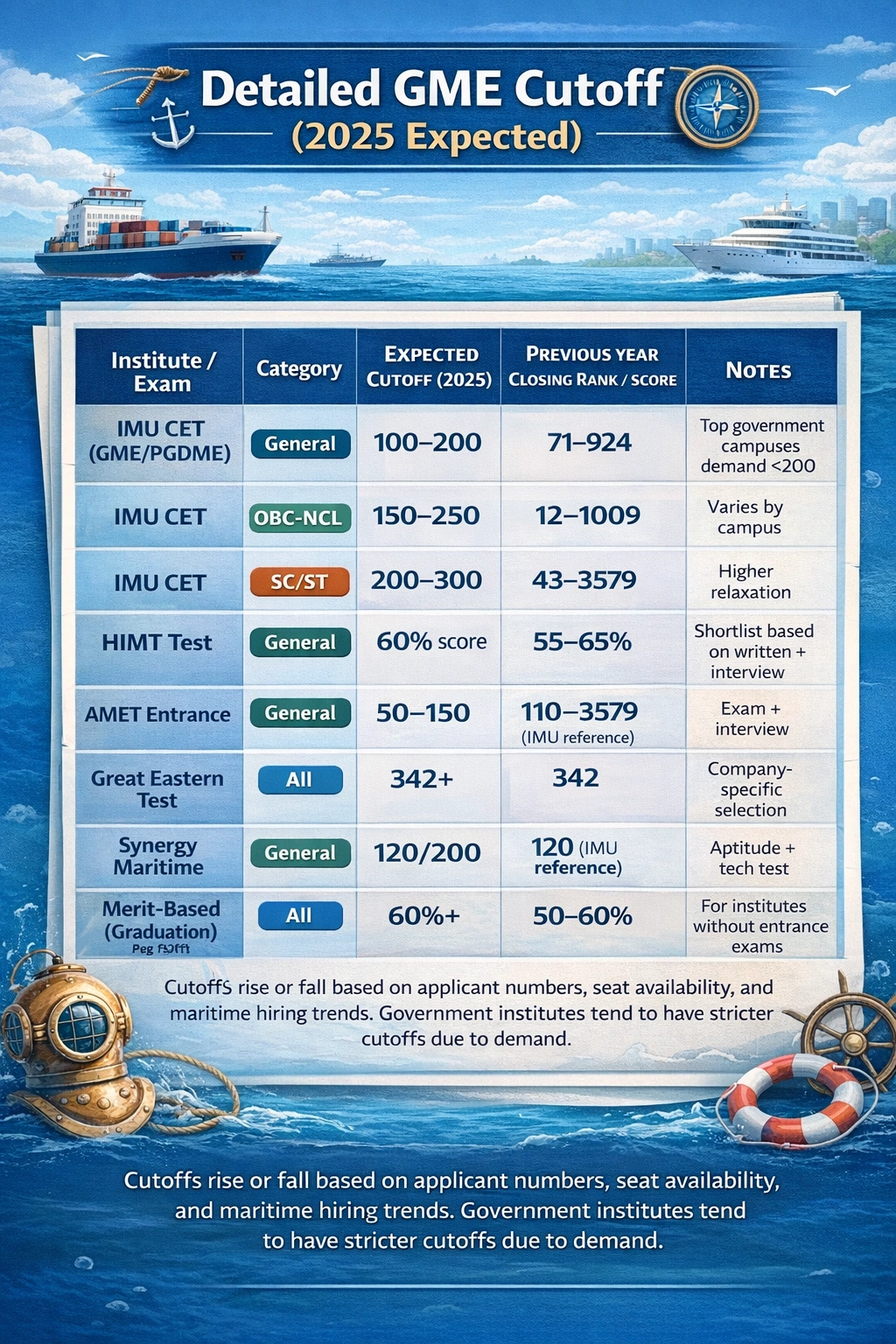
Graduate Marine Engineering Cut Off 2026 (Expected)
Cutoffs for GME programs vary by institute, exams (IMU CET or internal tests), and category. Top institutes generally require ranks under 150 for general category in IMU CET. Private institutes and sponsored programs may have more flexible criteria, though strong academic scores and medical fitness remain essential.
Cutoffs rise or fall based on applicant numbers, seat availability, and maritime hiring trends, with 2025 showing tighter competition due to renewed interest in shipping careers.
Top Graduate Marine Engineering Colleges
Top colleges for Graduate Marine Engineering (GME) in India are approved by the Directorate General of Shipping and offer rigorous training with modern facilities like simulators and workshops. These institutions focus on practical skills, safety standards, and industry collaborations, ensuring high employability. Government colleges provide affordable education with strong infrastructure, while private ones often emphasize sponsored programs and global placements. Selection criteria include entrance exams, medical fitness, and interviews. Fees vary, with additional costs for hostels and uniforms. Placements are robust, with starting salaries in the merchant navy ranging from INR 3-12 LPA, escalating with experience.
Prospective students should consider factors like location, accreditation, placement records, and alumni networks. Many colleges offer scholarships and relaxations for reserved categories. For the 2026 cycle, applications typically open 3-6 months before commencement, often in January or August intakes.
Top Graduate Marine Engineering Government Colleges
Government colleges for GME, such as those under IMU or PSUs, offer subsidized fees and government-backed credibility. They provide comprehensive training aligned with international standards, with emphasis on research and operational excellence. These institutions often have direct ties to naval and shipping sectors, facilitating better career advancement.
College Name
1st Year Fees (INR)
Application Deadline (2026 Cycle)
Entrance Exam
Why Apply
Brochure Link
Average Placement Salary (LPA)
NIRF Ranking
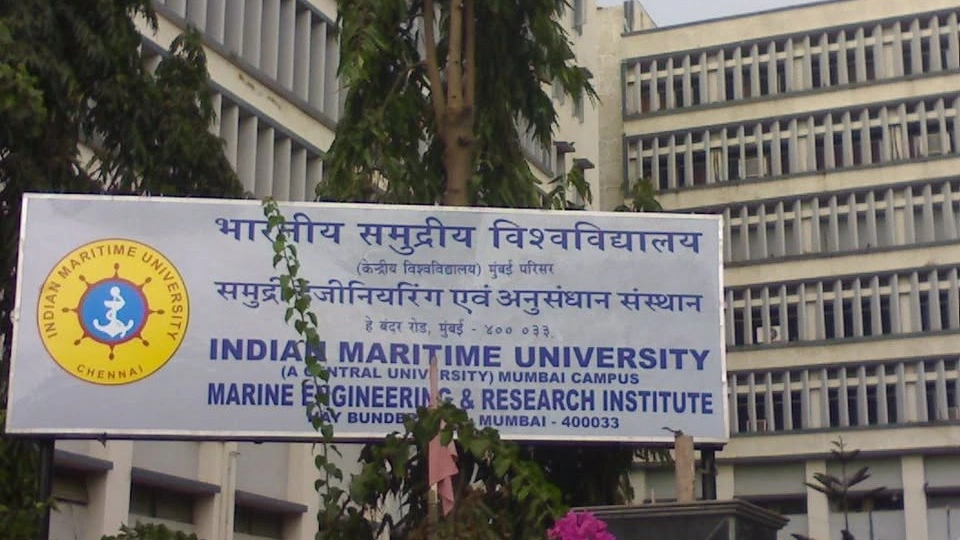
Indian Maritime University Mumbai Port Campus (MERI)
3,50,000
May 31, 2026
IMU CET
Government institution with excellent infrastructure, strong industry ties, and high certification success rates for global maritime careers.
Private GME colleges excel in sponsored programs, modern amenities, and international collaborations. They often provide 100% placement assistance through ties with global shipping firms, making them attractive for quick career launches.
College Name
1st Year Fees (INR)
Application Deadline (2026 Cycle)
Entrance Exam
Why Apply
Brochure Link
Average Placement Salary (LPA)
NIRF Ranking
Hindustan Institute of Maritime Training (HIMT), Chennai
4,21,000
August 15, 2026
HIMT Online Test
Renowned for advanced simulators, expert faculty, and strong placement records with leading companies.
Placements for Graduate Marine Engineering (GME) graduates are highly promising, driven by the expanding global maritime industry and demand for skilled engineers in shipping and offshore sectors. Most reputable institutes report placement rates exceeding 80%, with many students securing positions even before course completion through campus recruitment drives.
Sponsored programs, common in GME, often guarantee employment with partnering shipping companies, providing a seamless transition from training to professional roles. Average starting salaries range from INR 3 to 12 LPA, but in the merchant navy, earnings are typically quoted monthly and can escalate rapidly with promotions and sea time.
The placement process involves company presentations, written tests, technical interviews, and medical evaluations. Institutes like HIMT and AMET facilitate interactions with international recruiters, emphasizing skills in machinery maintenance, safety compliance, and teamwork.
With the industry’s shift towards sustainable technologies, placements increasingly favor candidates proficient in green propulsion and automation. Overall, GME offers robust career entry points, with opportunities for tax benefits like NRE status after six months of international sailing.
GME Job Roles and Salaries
Upon completing GME and passing the Marine Engineer Officer (MEO) Class IV examination, graduates typically start as junior or fourth engineers on merchant vessels. Key roles involve operating and maintaining ship machinery, ensuring compliance with international regulations, and troubleshooting technical issues. As experience grows, engineers advance to supervisory positions, handling complex systems like propulsion and electrical networks. Salaries vary by rank, vessel type (dry cargo vs. wet tankers), and company, with entry-level positions offering competitive pay that includes allowances for food, accommodation, and overseas travel.
Freshers often earn between INR 3.6 to 6 LPA annually during initial training, but monthly stipends can range from INR 30,000 to 84,000. With promotions, salaries can reach INR 12 to 24 LPA for mid-level roles and up to INR 2 crore annually for chief engineers. Factors influencing pay include sea time, certifications, and fleet specialization, such as LNG carriers offering higher premiums. These roles demand physical resilience and technical expertise, rewarding with high earnings and global exposure.
Job Role
Description
Average Salary (INR per month)
Trainee Marine Engineer (TME)
Entry-level training role involving basic machinery operations and maintenance under supervision.
27,000 – 84,000
4th Engineer
Handles routine inspections, troubleshooting, and auxiliary systems on vessels.
1,80,000 – 4,50,000
3rd Engineer
Supervises engine room operations, fuel management, and compliance with safety standards.
2,50,000 – 6,00,000
2nd Engineer
Manages advanced maintenance, team leadership, and emergency responses.
5,00,000 – 10,00,000
Chief Engineer
Oversees all engineering departments, ensures regulatory adherence, and optimizes performance.
7,00,000 – 20,00,000
Marine Surveyor
Inspects vessels for compliance, evaluates damage, and certifies seaworthiness.
5,00,000 – 8,00,000
Coastal Marine Engineer
Maintains offshore structures and equipment for oil and gas operations.
3,00,000 – 5,00,000
GME Career Growth Projections
Career progression in GME is structured around accumulating sea time, passing competency exams, and gaining practical experience. Starting as a trainee, graduates can advance to fourth engineer within 6-12 months, followed by promotions every 1-2 years based on performance. The merchant navy offers a clear hierarchy, with opportunities to reach chief engineer in 8-10 years, commanding salaries over INR 15 lakhs per month. Emerging trends like zero-carbon propulsion, AI diagnostics, and cybersecurity are creating new specializations, projecting a 10-15% growth in demand for skilled marine engineers by 2030.
Further growth includes shore-based roles in management, consulting, or academia after 10-15 years at sea. Pursuing an MBA or PhD can lead to executive positions in shipping firms or research. With global shipping volumes expected to rise, career stability is high, supported by international certifications like STCW. Projections indicate average salary increases of 20-30% per promotion, with NRE tax benefits enhancing net earnings for those sailing internationally.
Rank/Stage
Required Experience (Years)
Projected Salary Growth (INR LPA)
Key Skills for Advancement
Trainee to 4th Engineer
0.5-1
3-6 to 12-18
Basic maintenance, safety protocols
4th to 3rd Engineer
1-2
12-18 to 18-24
Troubleshooting, team supervision
3rd to 2nd Engineer
2-4
18-24 to 30-48
Advanced systems, ERM
2nd to Chief Engineer
4-8
30-48 to 60-120
Leadership, regulatory compliance
Shore-based Roles
10+
50-100+
Management, consulting skills
Graduate Marine Engineering Placement Statistics and Top Recruiters
Placement statistics for GME programs highlight strong industry demand, with top institutes achieving 85-100% placement rates. For instance, HIMT reports over 90% placements, with monthly campus visits from recruiters. Average packages vary by college, ranging from INR 2.32 to 5.66 LPA, though actual earnings in the navy are higher due to contractual nature. Statistics from 2025 show increased recruitment in sustainable shipping, with 400+ companies participating across institutes. Top recruiters prioritize candidates with strong academics and medical fitness, offering sponsorships for assured jobs.
Key metrics include placement percentages, average and highest packages, and recruiter diversity. Data from recent years indicates a trend towards higher packages, driven by global fleet expansions. Institutes like MERI and AMET excel in placements, with success rates bolstered by alumni networks and training simulations.
College Name
Placement Rate (%)
Average Package (INR LPA)
Highest Package (INR LPA)
Top Recruiters
HIMT Chennai
90+
5.66
12
VR Maritime, Synergy Marine, MOL
AMET Chennai
85
3.60
10
Bernhard Schulte, Fleet Management
MERI Mumbai
90
4.80
15
Maersk, Mitsui OSK
Samundra Institute
100
6.00
18
Samundra Shipping, D’Amico
Great Eastern Institute
95
5.50
20
Great Eastern, BW Maritime
Coimbatore Marine College
80
4.20
20
Anglo-Eastern, Larsen & Toubro
Opportunities in Different Sectors
GME opens doors to diverse sectors beyond traditional shipping, including offshore energy, naval defense, and manufacturing. In the merchant navy, roles focus on vessel operations, while offshore oil rigs demand expertise in harsh environments. Shipbuilding involves design and construction, and port authorities require maintenance specialists. Emerging sectors like renewable energy (e.g., floating wind farms) offer roles in sustainable technologies. Each sector provides unique challenges, from regulatory compliance in defense to innovation in hydrodynamics for oceanography.
Opportunities are abundant due to India’s growing maritime infrastructure, with government initiatives boosting port development and shipbuilding. Sectors like marine equipment manufacturing emphasize materials science, while sales roles leverage technical knowledge for business growth. Diversification allows career flexibility, with cross-sector mobility after initial experience.
Sector
Key Roles
Opportunities
Average Salary (INR LPA)
Merchant Navy
Marine Engineer, 4th Engineer
Vessel operations, global travel, high earnings
3-12
Offshore Oil & Gas
Coastal Engineer, Rig Maintenance
Platform management, hazardous cargo handling
4-15
Shipbuilding & Repair
Structural Engineer, Surveyor
Design, construction, yards like Cochin Shipyard
5-10
Naval Defense
Engineer Officer
Military vessels, national security roles
6-12
Port & Harbor
Maintenance Engineer
Infrastructure management, logistics
4-8
Renewable Energy
Hydrodynamics Specialist
Wave energy, floating farms innovation
5-12
Global Opportunities after GME
GME graduates enjoy extensive global opportunities, working on international fleets with companies like Maersk and Anglo-Eastern. Roles involve sailing on cargo ships, tankers, and cruise liners across oceans, exposing professionals to diverse cultures and regulations. Certifications like STCW enable employment in foreign navies or offshore projects in the Middle East, Europe, and Southeast Asia. Many pursue advanced training abroad, enhancing resumes for multinational roles.
Global demand is rising with trade growth, projecting 1.5 million seafarer shortages by 2025. Opportunities include technical superintendency in Singapore or surveying in Dubai, with salaries in USD (500-2000 monthly starting). NRE status offers tax advantages, and events like INMARCO facilitate networking. Countries like Canada and Finland host top programs for further studies, leading to permanent residencies in maritime hubs.
Region/Country
Key Opportunities
Top Companies/Institutes
Average Starting Salary (USD per month)
Europe (e.g., Belgium, Finland)
Vessel management, surveying
Antwerp Maritime Academy, Novia University
800-1500
Middle East (e.g., UAE, Qatar)
Offshore rigs, tankers
Maersk, Bernhard Schulte
1000-2000
Asia (e.g., Singapore, Japan)
Ship operations, superintendency
Mitsui OSK, K Line
700-1200
North America (e.g., Canada)
Coast guard, research
Canadian Coast Guard College, Marine Institute
900-1600
Australia/Oceania
Mining vessels, renewable energy
Anglo-Eastern, V Ships
800-1400
Graduate Marine Engineering Scholarships
Scholarships for GME help alleviate financial burdens for deserving candidates. Many institutes offer merit-based awards, while shipping companies provide sponsorships covering full fees in return for committed service. Women candidates often receive discounts, such as INR 25,000 off at HIMT.
Government schemes and fisheries scholarships are available for eligible students from specific backgrounds. Applications typically require academic records, income proofs, and essays. Checking institute websites like himtcollege.com for updates is recommended.
These opportunities make GME accessible, encouraging diversity in the maritime sector. Sponsored programs ensure job security, blending education with career assurance.
Scholarship Name
Eligibility
Amount (INR)
Provider
Merit-Based Scholarship
High academic scores
Up to 50,000
Various Institutes
Women in Maritime
Female candidates
25,000 discount
HIMT, AMET
Company Sponsorship
Entrance clearance
Full fees
Anglo-Eastern, Maersk
Fisheries Scholarship
From fishing communities
Variable
Government
Island Residents Relaxation
Lakshadweep/Andaman natives
5% marks relaxation
DG Shipping
SC/ST Scholarships
Reserved categories
Fee waivers
State Governments
GME vs Other Programmes
GME differs from other marine-related programs in its focus and duration. Unlike the four-year B.Tech in Marine Engineering, which is an undergraduate degree starting from basics, GME is a postgraduate diploma for those already holding a mechanical engineering degree. It provides accelerated training tailored for quick entry into the merchant navy.
Compared to M.Tech in Marine Engineering, GME is more practical and shorter, emphasizing operational skills over advanced research. MSc programs often lean towards theoretical oceanography, while GME prioritizes engineering applications on vessels. This makes GME suitable for career-oriented individuals seeking immediate seafaring roles.
In terms of career progression, GME graduates can advance to senior engineer positions faster, with opportunities in global shipping. Other programs might lead to design or academic roles, but GME ensures hands-on experience from the start.
Parameters
GME
B.Tech Marine Engineering
M.Tech Marine Engineering
Duration
1 Year
4 Years
2 Years
Eligibility
BE/B.Tech in Mechanical/Naval Arch
10+2 with PCM
BE/B.Tech in Relevant Field
Focus
Practical Marine Training
Undergraduate Engineering Basics
Advanced Design and Research
Average Fees
INR 2.5-5 Lakh
INR 8-12 Lakh
INR 1-3 Lakh
Average Salary
INR 3-12 LPA
INR 4-10 LPA
INR 5-15 LPA
FAQs
What is the GME course?
The Graduate Marine Engineering (GME) is a one-year postgraduate diploma program for mechanical or naval architecture graduates aiming for a career in the merchant navy. It provides specialized training in marine machinery, safety, and operations, approved by the Directorate General of Shipping. Graduates become eligible for roles as marine engineers on ships, with practical skills honed through simulations and workshops.
What are the eligibility criteria for GME?
To qualify for GME, candidates need a BE/B.Tech in Mechanical Engineering or Naval Architecture with at least 50-60% aggregate marks from an AICTE/UGC-approved institution. They must be under 28 years old, medically fit per DG Shipping standards (including 6/6 eyesight without color blindness), and have 50% in English. Relaxations apply for reserved categories and island residents.
What is the average salary after completing GME?
GME graduates typically start as junior marine engineers with salaries ranging from INR 3-12 LPA, or monthly earnings of INR 50,000-2 lakhs during initial sea contracts. With promotions and sea experience, pay can rise to INR 15-20 lakhs per month for senior roles like chief engineer, plus benefits like NRE tax exemptions for international sailing.
Which are the top colleges for GME in India?
Leading GME colleges include HIMT Chennai, AMET Chennai, MERI Mumbai, Samundra Institute Mumbai, and Anglo Eastern Maritime Academy Karjat. These institutions offer DG Shipping-approved programs with modern simulators, strong placements, and sponsored options. Fees range from INR 3-7 lakhs, with high success rates in MEO certifications and global recruiter ties.
Is GME a good career option?
Yes, GME offers an excellent career in the maritime industry with high earning potential, global travel, and rapid promotions. It suits those with engineering backgrounds seeking adventure and stability, as the sector grows with increasing trade. However, it demands physical fitness and long absences from home, balanced by tax perks and job security in shipping firms.
What is the duration of the GME course?
The standard GME course lasts one year, divided into two semesters of intensive training. Some integrated or sponsored programs extend to 18 months, combining shore-based learning with onboard experience. This structure prepares graduates for MEO Class IV exams, ensuring quick entry into merchant navy roles with a focus on practical and theoretical maritime engineering.
How can I get admission to GME?
Admission to GME involves applying via institute websites, clearing entrance exams like IMU CET or institute-specific tests, followed by interviews and medical checks. Eligibility verification and document submission are key steps. Sponsored seats from companies like Maersk offer direct placements. Applications typically open 3-6 months before January or August intakes.
What is covered in the GME syllabus?
The GME syllabus includes internal combustion engines, naval architecture, marine auxiliaries, electrical engineering, watchkeeping, and safety regulations like MARPOL and ISM. Semester 1 focuses on basics and workshops, while Semester 2 covers advanced operations, leadership, and labs. Practical training in simulators emphasizes maintenance, troubleshooting, and compliance for real-world shipboard duties.
What is the difference between GME and B.Tech Marine Engineering?
GME is a one-year postgraduate diploma for mechanical graduates, emphasizing practical marine training for quick navy entry. B.Tech Marine Engineering is a four-year undergraduate degree starting from 10+2, covering broader engineering fundamentals. GME suits faster career transitions with higher initial pay, while B.Tech provides deeper academic foundations for diverse roles.
Are there scholarships available for GME students?
Yes, scholarships for GME include merit-based awards up to INR 50,000, women-specific discounts like INR 25,000 at HIMT, and full-fee sponsorships from companies like Anglo-Eastern in exchange for service bonds. Government schemes for SC/ST, fisheries communities, and island residents offer waivers. Applications require academic proofs and are detailed on institute websites.
Abhijeet Chatterjee is a professional Content and Copy specialist with over five years of experience in crafting compelling content around the Edtech domain. His portfolio includes notable work for companies such as PhysicsWallah, Roar Media, Jagran Josh, etc. Academically, Abhijeet holds a Master's in Mass Communication, where he was awarded a gold medal for his outstanding performance. He has also qualified for the UGC NET in Mass Communication, demonstrating his expertise and a deep understanding of the field. His academic foundation is built on a Bachelor's degree in English Literature. Beyond his professional work, Abhijeet is an avid writer and a cinephile. His personal interests include scriptwriting, film criticism, and reading novels.