Master in Social Work (MSW) Course Details 2026: Eligibility, Admission Process, Fees, Syllabus & Career Scope
Master in Social Work (MSW) is a two-year postgraduate program that equips students with skills in social welfare, community development, and human rights. It focuses on practical fieldwork, research, and intervention strategies to address societal issues. Approved by UGC, MSW prepares graduates for roles in NGOs, healthcare, and government sectors.
This program emphasizes ethical practice, policy analysis, and counseling. Offered by universities across the country, it allows specializations aligned with career goals. With increasing focus on social justice, MSW offers meaningful opportunities in diverse fields.
The Master in Social Work (MSW) program provides a comprehensive overview of social issues and intervention methods, blending theory with hands-on experience. It is designed for individuals passionate about making a positive impact on society through professional practice.
Parameter
Details
Duration
2 years (4 semesters)
Eligibility
Bachelor’s degree with minimum 50% marks
Entrance Exams
CUET PG, CPGET, TISSNET
Average Fees
INR 20,000 – 1 lakh per year
Average Starting Salary
INR 3-6 LPA
Top Specializations
Medical and Psychiatric, Community Development, Human Resource Management
Top Recruiters
CRY, Goonj, Accenture, UNICEF, Government Departments
Eligibility for MSW ensures candidates have the academic foundation to engage with complex social concepts. It promotes diversity by accepting graduates from various disciplines, fostering interdisciplinary approaches to social problems.
Candidates must possess a bachelor’s degree in any discipline from a recognized university.
Minimum aggregate marks required: 50% for general category (45% for SC/ST/OBC/PwD in many institutions).
Preference may be given to those with backgrounds in social sciences, humanities, or BSW, but not mandatory.
Final-year bachelor’s students can apply provisionally, submitting proofs later.
No upper age limit; suitable for freshers and working professionals.
English proficiency may be required if the medium of instruction differs.
Category-based relaxations as per government norms (e.g., 5% for reserved categories).
Additional criteria like personal statements or work experience in some colleges.
Physical/medical fitness certificates rarely needed but check institute-specific rules.
For international candidates, equivalent qualifications and visas apply.
No upper age limit applies, making it accessible for working professionals.
Category
Minimum Aggregate (Graduation)
Relaxation
Other Requirements
General
50%
None
Bachelor’s in any field
SC/ST
45%
5%
Category certificate
OBC-NCL
45-50%
Varies
Non-creamy layer proof
EWS
50%
None
EWS certificate
PwD
45%
5%
Disability certificate
Entrance Exams for Master in Social Work
Entrance exams for MSW evaluate candidates’ understanding of social dynamics and analytical abilities, ensuring suitability for the profession. They often include sections on current affairs and ethics.
Preparing for these tests involves studying social work principles and practicing reasoning skills. Admission to MSW often requires clearing entrance exams assessing aptitude in social issues, reasoning, and general knowledge.
CUET PG is widely accepted for central universities. Other exams include institution-specific tests. Preparation involves current affairs, social work basics, and practice papers.
Exam
Conducting Body
Tentative Date 2026
Pattern
CUET PG
NTA
March-April
MCQ, Domain + General
CPGET
Osmania University
August
MCQ, Subject-based
TISSNET
TISS
January
MCQ, GK + Analytical
Andhra Pradesh PGCET
APSCHE
May
MCQ, Aptitude
BVP CET
Bharati Vidyapeeth
June
MCQ, Reasoning
Master in Social Work Admission Process
The admission process for MSW is structured to select candidates committed to social change, involving multiple stages for thorough evaluation. It accommodates both freshers and experienced applicants.
Key steps include online registration, document upload, and fee payment. Reservations apply as per norms.
Step
Description
Tentative Timeline 2026
Application
Online form submission
Dec 2025 – Feb
Entrance Exam
Appear for CUET PG/TISSNET
Jan-Apr
Result Declaration
Scores and ranks
Apr-May
Counseling
Seat allocation
May-Jun
Verification & Admission
Documents, fees
Jun-Jul
Master in Social Work Step by Step Admission Process
Research and shortlist institutions based on specializations, fees, and location.
Check eligibility criteria on official websites.
Register for entrance exams like CUET PG or TISSNET if required.
Fill online application forms with personal, academic details, and upload documents.
Pay application fees (INR 500-2000 varying by institute).
Appear for entrance exams assessing social aptitude and knowledge.
Await results and shortlisting based on scores/merit.
Participate in group discussions or personal interviews if mandated.
Attend counseling sessions for seat allocation.
Submit required documents for verification (degree certificates, category proofs).
Pay admission fees to confirm seat.
Complete enrollment formalities and attend orientation.
Master in Social Work Syllabus
The MSW syllabus is designed to build a strong theoretical base while emphasizing practical skills for social interventions. It integrates interdisciplinary knowledge from sociology, psychology, and policy studies. Progression across semesters allows deepening expertise, with fieldwork as a core component for experiential learning.
The MSW syllabus spans four semesters, combining theory, research, and extensive fieldwork. It covers social policies, human behavior, and intervention methods. Practical components like internships are mandatory, fostering real-world application.
MSW Year 1 Syllabus
Year 1 focuses on foundational concepts in social work, introducing core principles and basic intervention techniques. It lays the groundwork through theoretical subjects and initial fieldwork exposure.
Semesters 1 and 2 emphasise understanding societal structures, individual case work, and research basics, preparing students for advanced applications.
Semester
Subjects
Detailed Topics
1
Introduction to Professional Social Work, Social Case Work, Concurrent Field Work, Analysis of Indian Society, Social Work with Groups, Human Growth and Development
Professional Social Work: History, philosophy, values, ethics, fields of practice. Social Case Work: Principles, process, recording, evaluation. Field Work: Orientation, agency visits, report writing. Indian Society: Caste, class, gender, religion, social movements. Groups: Types, dynamics, leadership. Human Growth: Psychological theories, life stages, behavior patterns.
2
Study of Indian Economics, Study of Indian Constitution, Social Work Research and Statistics, Personal & Professional Growth, Social Group Work, Community Organization
Economics: Economic systems, poverty, inequality, development policies. Constitution: Fundamental rights, directive principles, social justice provisions. Research: Qualitative/quantitative methods, sampling, data analysis tools. Growth: Communication skills, self-reflection, professional ethics.
Year 2 advances to specialized areas and practical applications, incorporating electives and research projects. It builds on Year 1 by focusing on policy, development, and crisis management.
Semesters 3 and 4 include intensive fieldwork, dissertation, and specialization courses, equipping students for professional roles in diverse social contexts.
Semester
Subjects
Detailed Topics
3
Labour Welfare & Legislation, Social Work Approaches for Development, Poverty and Livelihood, Disaster Management, Elective I (e.g., Mental Health), Concurrent Field Work II
Women & Child Development, Community Organisation, Social Work Group, Dissertation, Elective II (e.g., Rural Development), Block Field Work
Women & Child: Policies, gender equality, child protection laws. Community Organisation: Strategies, advocacy, resource mobilization. Social Work Group: Advanced group therapy, evaluation.
Specializations in MSW allow students to delve into specific areas of social practice, enhancing their expertise for targeted interventions. This customization is key in addressing diverse societal challenges effectively.
MSW offers specializations to focus on specific areas of social intervention, typically chosen in the second year. These enhance expertise in targeted fields like healthcare or community organizing.
Popular choices align with societal needs, providing practical skills through fieldwork and projects. Institutions vary in offerings, allowing customization based on interests.
Specialization
Key Focus Areas
Career Roles
Medical and Psychiatric
Mental health, hospital social work, counseling
Medical Social Worker, Counselor
Community Development
Rural/urban projects, empowerment, sustainability
Community Organizer, Project Coordinator
Human Resource Management
Labor welfare, industrial relations, CSR
HR Specialist, Labor Officer
Family and Child Welfare
Child rights, family counseling, adoption
Child Welfare Officer, Family Therapist
Criminology and Correctional
Rehabilitation, prison reform, juvenile justice
Probation Officer, Rehabilitation Specialist
Mental Health
Psychotherapy, crisis intervention
Mental Health Counselor
Top Master in Social Work Colleges with Cut Off 2026
Top MSW colleges in India are renowned for their comprehensive curricula, experienced faculty, and emphasis on practical fieldwork, which prepare students for impactful careers in social welfare. Institutions like TISS and Delhi University lead in rankings such as NIRF and India Today, offering specializations in areas like community development and mental health. These colleges foster a blend of theoretical knowledge and real-world application, with strong alumni networks in NGOs, government, and corporate sectors.
For the 2026 admissions, cut offs are projected based on 2025 trends, influenced by entrance exams like CUET PG and TISSNET. High competition drives scores upward, with general category cutoffs often exceeding 200 in CUET PG for premier programs. Cut offs for 2026 are projected based on 2025 trends.
College
Location
Expected Cut Off (CUET PG Score/General)
Average Fees (INR)
Tata Institute of Social Sciences (TISS)
Mumbai
200-210
1-2 lakhs
Delhi School of Social Work (DSSW), Delhi University
Delhi
200+
20,000/year
Jamia Millia Islamia
Delhi
55-60
15,000/year
Rajagiri College of Social Sciences
Kochi
Merit-based (85%+ in graduation)
4,380/year
Madras School of Social Work
Chennai
50+
50,000/year
Madras Christian College
Chennai
50-55
62,910
Loyola College
Chennai
Merit-based (80%+)
40,000/year
Amity University
Noida
Merit-based
2.76 lakhs
Christ University
Bengaluru
Merit-based (75%+)
1 lakh/year
Bharati Vidyapeeth Deemed University
Pune
BVP CET 50+
80,000/year
Acharya Nagarjuna University
Guntur
Merit-based
20,100/year
Placement & Opportunities After Master in Social Work
MSW graduates enter a field dedicated to social change, with opportunities in NGOs, government agencies, healthcare, and corporate social responsibility (CSR) sectors. Placements emphasize meaningful impact, often facilitated by institute networks and fieldwork experience.
The social work sector in India is growing due to increased focus on sustainable development goals (SDGs), mental health, and community welfare, leading to diverse roles. Average starting salaries range from INR 3-6 LPA, with potential for higher in international organizations. Further qualifications like PhD or certifications in counseling enhance prospects, while entrepreneurship in social enterprises is emerging.
Master in Social Work Jobs and Salaries
Job roles for MSW graduates involve direct interventions, policy advocacy, and program management, utilizing skills in counseling, research, and community engagement. Salaries vary by sector, experience, and location, with entry-level positions starting modestly but offering fulfillment through societal contributions.
Job Role
Average Salary (INR LPA)
Key Responsibilities
Social Worker
3-5
Client assessment, case management, resource linkage
Counselor
4-6
Providing emotional support, therapy sessions
Project Coordinator
4-7
Program planning, implementation, monitoring
Community Organizer
3-5
Mobilizing communities, advocacy campaigns
HR Specialist (Labor Welfare)
5-8
Employee relations, welfare policies
Mental Health Professional
4-7
Crisis intervention, psychiatric support
Child Welfare Officer
3-6
Child protection, adoption services
Probation Officer
4-6
Rehabilitation of offenders, court liaison
CSR Manager
6-10
Corporate initiatives, impact assessment
Research Associate
3-5
Data collection, policy analysis
Disaster Response Specialist
4-7
Emergency aid, recovery planning
MSW Career Growth Projections
Career growth in social work is projected to accelerate with India’s emphasis on inclusive development and mental health post-2025. Graduates can advance to senior roles within 5-10 years, earning INR 8-15 LPA or more, especially with specializations. The sector’s expansion, driven by government schemes like POSHAN Abhiyaan and NGO funding, forecasts 15-20% annual job growth. Leadership positions in international bodies like UNICEF offer global exposure.
Master in Social Work Placement Statistics and Top Recruiters
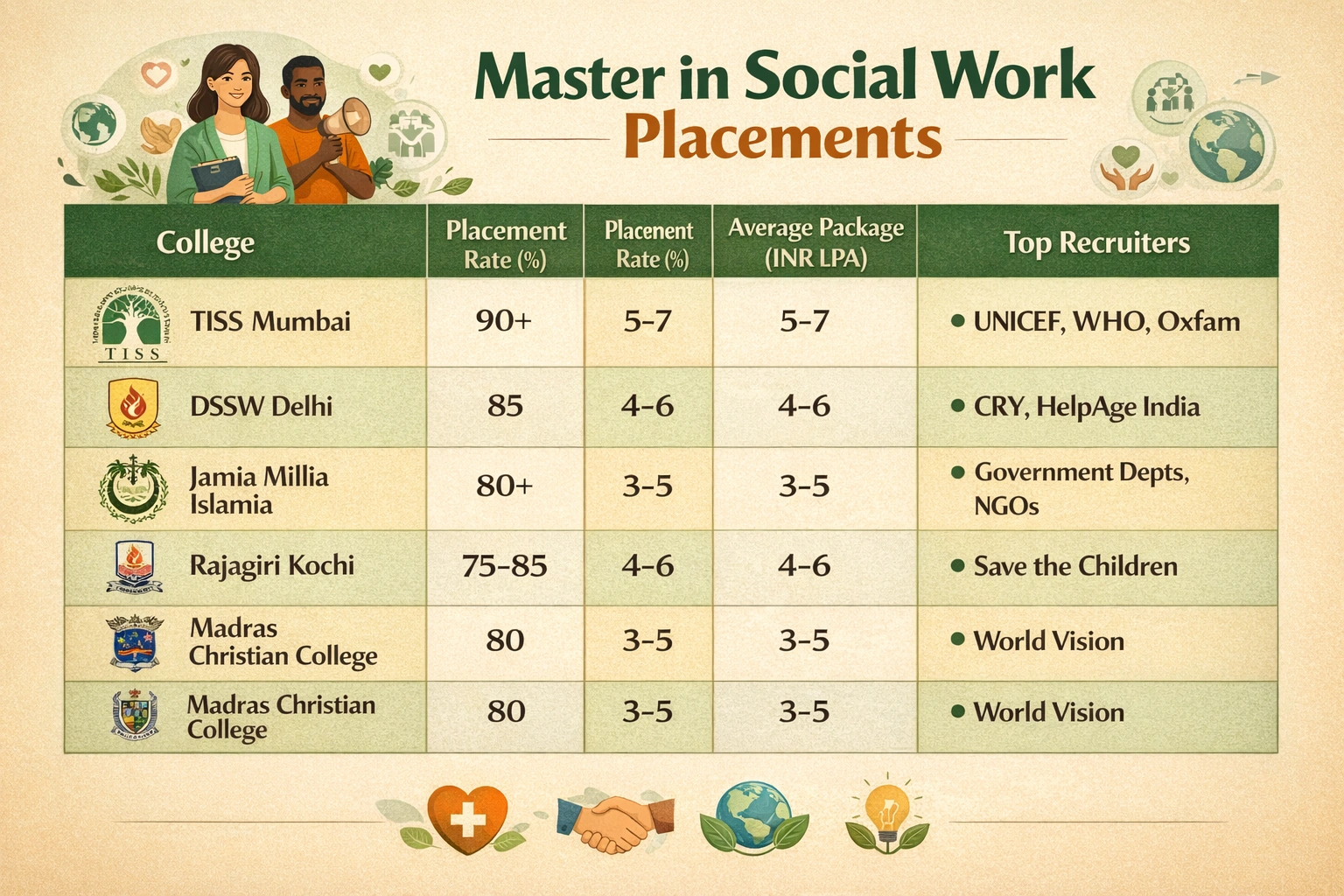
Placement statistics from top MSW institutes show rates of 70-90%, with median packages around INR 4-6 LPA. Colleges like TISS report strong outcomes due to their reputation. Recruiters prioritize fieldwork experience and soft skills.
Opportunities in Different Sectors
MSW opens doors across sectors, from grassroots NGOs to corporate CSR, applying skills to address inequalities. Healthcare focuses on patient support, while education involves child welfare programs.
Sector
Key Opportunities
Examples
NGOs/Social Services
Program management, advocacy
CRY, Goonj
Healthcare
Medical social work, counseling
AIIMS, Apollo
Government
Policy implementation, welfare schemes
Social Justice Depts
CSR/Corporate
Sustainability projects
Tata, Reliance
Education
School counseling, community education
Universities
International Aid
Global development
UNICEF, WHO
Research/Academia
Studies on social issues
Think Tanks
Global Opportunities
MSW graduates have increasing global opportunities in organizations like UN agencies and international NGOs, particularly in development and humanitarian aid. Countries like USA, Canada, and UK seek skilled social workers for migration and refugee programs, with salaries $40,000+ annually. Specialized experience in human rights enhances visas like H-1B or skilled worker permits.
Master in Social Work Scholarships
Scholarships for Master in Social Work (MSW) students in India are essential for supporting aspiring social workers from diverse backgrounds, given the program’s focus on societal impact rather than high-paying careers. These aids cover tuition, fieldwork expenses, and living costs, encouraging more individuals to enter the field amid growing needs in areas like mental health and community development. As of December 2025, numerous scholarships are available for the 2026 batch, offered by government, NGOs, foundations, and universities, targeting merit, need, or specific groups like women or minorities.
Eligibility often includes enrollment in MSW at recognized institutions, good academic records (e.g., 50%+ in bachelor’s), and family income limits (below INR 2.5-8 lakhs). Applications require documents like marksheets, income proofs, and essays on social commitment. Deadlines vary, with many opening in January 2026. Students can apply to multiple, combining with loans if needed.
Types of Scholarships
Scholarships fall into merit-based (for academic excellence), need-based (for financial hardship), category-based (for SC/ST/OBC/EWS/PwD), and special ones (for women, rural students, or field-specific like child welfare). Government schemes promote equity, while private ones often include mentorship.
Top 20% in graduation, income2,000 monthlyNov 2026
TISS Scholarships
TISS
Merit/need-based for enrolled students
Partial to full waiver
Post-admission
Rajiv Gandhi National Fellowship
UGC
SC/ST, pursuing MSW/PhD
25,000 monthly + contingencies
Mar 2026
Maulana Azad National Fellowship
UGC
Minorities, NET qualified
25,000 monthly
Apr 2026
Women Scientist Scheme
DST
Women in social sciences
Variable support
May 2026
Institute-specific (e.g., DSSW)
Universities
Varies by college
Partial tuition
Admission time
MSW Vs Other Courses
Master in Social Work (MSW) is a professional postgraduate degree focused on equipping students with practical skills for social interventions, community development, and advocacy. When compared to other related courses like MA in Social Work and MBA in Social Entrepreneurship, MSW stands out for its emphasis on fieldwork, ethical practice, and direct client engagement. This comparison helps prospective students understand the nuances in curriculum, career trajectories, and suitability based on their interests in hands-on social work versus theoretical research or business-oriented social impact.
Parameter
MSW
MA Social Work
MBA Social Entrepreneurship
Duration
2 years (4 semesters)
2 years (4 semesters)
2 years (4 semesters)
Eligibility
Bachelor’s in any discipline with 50% marks; entrances like CUET PG, TISSNET
Bachelor’s preferably in social sciences with 50% marks; merit or university tests
Bachelor’s in any field; entrances like CAT, XAT; work experience often preferred
Focus
Practical fieldwork, case work, group interventions, ethical social practice
Theoretical frameworks, sociological analysis, research methodologies
Business strategies for social impact, entrepreneurship, sustainable models
Curriculum
Social policies, human behavior, fieldwork, specializations like community development
Social theories, policy studies, advanced research, electives in sociology
Social innovation, finance management, marketing for NGOs, CSR projects
Average Fees (INR/year)
20,000-1 lakh
10,000-50,000
5-20 lakhs
Average Starting Salary (INR LPA)
3-6
3-5
6-12
Career Paths
Social worker, counselor, NGO coordinator, community organizer
Social entrepreneur, CSR manager, impact investor, startup founder
Top Institutes
TISS Mumbai, DSSW Delhi, Rajagiri Kochi
JNU Delhi, BHU Varanasi, Aligarh Muslim University
XLRI Jamshedpur, IRMA Anand, SPJIMR Mumbai
Entrance Exams
CUET PG, TISSNET, institute-specific
University entrances, merit-based
CAT, XAT, GMAT
Practical Component
High (mandatory fieldwork, internships)
Moderate (research projects)
High (business plans, live projects)
Long-term prospects differ: MSW leads to specialized roles in welfare organizations with steady growth through experience; MA opens doors to PhD and academia; MBA facilitates leadership in impact-driven businesses with potential for higher earnings. Ultimately, MSW’s unique blend of empathy and action makes it a preferred choice for committed social changemakers.
FAQs
What is the duration and structure of Master in Social Work?
The MSW program spans two years, divided into four semesters with a blend of classroom learning, fieldwork, and research. It includes foundational courses in social work principles, advanced specializations, and practical internships to develop intervention skills, ensuring graduates are equipped for professional roles in welfare and development sectors.
What are the eligibility criteria for Master in Social Work?
Candidates need a bachelor’s degree in any discipline with at least 50% marks (45% for reserved categories). No specific background is mandatory, though social sciences are preferred. Provisional applications for final-year students are allowed, with no age limit, making it accessible for diverse applicants committed to social causes.
What specializations are available in Master in Social Work?
Specializations include Medical and Psychiatric Social Work, Community Development, Human Resource Management, Family and Child Welfare, Criminology and Correctional Administration, and Mental Health. These focus on targeted interventions, allowing students to align studies with interests in areas like healthcare, labor rights, or child protection for specialized careers.
Which entrance exams are required for Master in Social Work admission?
Common exams are CUET PG for central universities, TISSNET for TISS, and CPGET for state institutions. They assess social awareness, reasoning, and general knowledge. Some colleges offer merit-based admissions, requiring strong graduation scores and sometimes interviews to evaluate commitment to social work.
What is the admission process for Master in Social Work in 2026?
Applications open in December 2025, followed by entrances like CUET PG in March-April 2026. Shortlisting based on scores leads to counseling in May-June, with document verification and fee payment. Reservations ensure inclusivity, and the process emphasizes candidates’ aptitude for social interventions through potential interviews.
What does the Master in Social Work syllabus cover?
The syllabus covers social work history, case and group work, research methods, Indian society, economics, constitution, labor welfare, disaster management, and specializations. It progresses from foundations to advanced topics, with mandatory fieldwork and dissertations emphasizing practical application and ethical practice in addressing societal issues.
What are the expected cut offs for top Master in Social Work colleges in 2026?
Projected cut offs include TISS at 60+ in TISSNET, Delhi University at 200+ in CUET PG, and Jamia Millia at 55+. Based on 2025 trends, high entrance scores and academics are crucial, with relaxations for reserved categories influencing final merit lists.
What career opportunities exist after Master in Social Work?
Graduates pursue roles like social worker, counselor, project coordinator in NGOs, healthcare, government, and CSR sectors. Starting salaries range from 3-6 LPA, with growth to senior positions. Opportunities include international aid, policy advocacy, or academia, focusing on impactful contributions to social justice and welfare.
Abhijeet Chatterjee is a professional Content and Copy specialist with over five years of experience in crafting compelling content around the Edtech domain. His portfolio includes notable work for companies such as PhysicsWallah, Roar Media, Jagran Josh, etc. Academically, Abhijeet holds a Master's in Mass Communication, where he was awarded a gold medal for his outstanding performance. He has also qualified for the UGC NET in Mass Communication, demonstrating his expertise and a deep understanding of the field. His academic foundation is built on a Bachelor's degree in English Literature. Beyond his professional work, Abhijeet is an avid writer and a cinephile. His personal interests include scriptwriting, film criticism, and reading novels.