Master of Business Administration (MBA) Finance 2026 Complete Guide – Eligibility, Admission, Syllabus, Top Colleges, Placements
The Master of Business Administration (MBA) in Finance is a postgraduate degree that provides in-depth knowledge in financial management, investment strategies, and economic principles. Tailored for graduates with a bachelor’s degree in any discipline, this program emphasizes analytical skills, risk assessment, and decision-making to address complex financial challenges. It prepares professionals for dynamic roles in banking, corporate finance, and investment sectors, bridging academic theory with practical applications. Amid evolving global markets, MBA Finance graduates are essential in driving financial stability and growth in industries like banking, consulting, and asset management.
An MBA in Finance boosts career opportunities by enabling access to leadership positions, competitive salaries, and involvement in strategic financial planning. The curriculum integrates core business subjects with specialized finance courses, including case studies, simulations, and internships. Institutions often partner with financial firms, ensuring alignment with industry trends. Graduates typically pursue careers as financial analysts, investment bankers, or portfolio managers, with the degree also facilitating advanced certifications like CFA.
The two-year program, structured into four semesters, includes foundational management courses, finance electives, and a capstone project. Admissions are merit-based, primarily through national exams, followed by group discussions and interviews. Scholarships and financial aid support talented candidates. Ultimately, an MBA in Finance is a strategic investment, empowering professionals to navigate financial complexities and contribute to organizational success.
The MBA in Finance program stands out for its focus on financial acumen and strategic thinking, ideal for aspiring finance professionals. Spanning two years full-time, it offers a blend of theoretical and practical learning. Entrance exams are key for admissions, selecting candidates with strong analytical abilities. Fees differ by institution, with government colleges being more affordable. Graduates benefit from lucrative career paths with attractive compensation.
Key highlights encompass diverse specializations, industry internships, and modern facilities. The program stresses ethical finance, innovation, and global perspectives. Placements involve renowned firms, boosting employability. Scholarships aid meritorious students. This overview assists in understanding the program’s value for informed choices.
Particular
Details
Duration
2 years (4 semesters)
Eligibility
Bachelor’s degree with minimum 50% aggregate (45% for reserved categories)
To enroll in an MBA in Finance, applicants must satisfy criteria defined by colleges and exam bodies. A bachelor’s degree in any field from a recognized institution is required. The minimum aggregate is usually 50%, with concessions for reserved groups. Strong performance in national or state entrance exams is vital for top programs. Some schools hold their own assessments for non-qualified candidates.
Equivalent degrees may be considered with approval. Professional experience enhances applications for executive programs but is optional for standard entries. No age restrictions apply, accommodating working individuals. Foreign applicants need equivalence documents. Fulfilling these ensures efficient applications and quality education access.
Strict eligibility upholds standards and equity. Verification occurs during admissions. Candidates should ready themselves to improve selection odds.
Criteria
Requirement
Educational Qualification
Bachelor’s degree in any discipline
Minimum Marks
50% aggregate (45% for SC/ST)
Entrance Exam
Valid CAT/XAT score or equivalent
Work Experience
Preferred for executive MBA
Age Limit
None
MBA Finance Courses and Specialisations
MBA in Finance encompasses core management courses alongside specialized finance modules, addressing varied interests in the field. Programs deliver advanced insights into financial markets, corporate finance, and risk management, matching industry demands. Common areas include investment banking, financial modeling, and international finance. Each focus area covers essential theories, tools, and applications via projects and analyses.
Selection hinges on prior education and aspirations. Curricula evolve with market trends, preparing graduates for real-world roles. Electives enable personalization. This lists prominent courses with overviews for guidance.
Specializations adapt to economic shifts, opening doors in high-growth areas. Interdisciplinary elements encourage comprehensive thinking and adaptability.
Specialisation
Description
Duration
Corporate Finance
Focuses on financial planning, capital budgeting, and corporate valuation
2 years
Investment Banking
Covers mergers, acquisitions, IPOs, and advisory services
2 years
Financial Markets
Explores stock markets, derivatives, and trading strategies
2 years
Risk Management
Emphasizes risk assessment, insurance, and hedging techniques
2 years
International Finance
Deals with forex, global markets, and cross-border transactions
2 years
Fintech
Integrates technology with finance, including blockchain and digital payments
2 years
Behavioral Finance
Studies psychological influences on financial decisions
2 years
Sustainable Finance
Focuses on ESG investing and green finance
2 years
MBA Finance Syllabus
The MBA Finance syllabus is crafted to develop expertise over four semesters in two years. It combines core business subjects, finance specials, case studies, and a project. Year one builds foundations in management and economics; year two advances to specialized finance and strategy. This progression fosters from basics to applied research.
Variations occur by institution, but alignment with industry is key. Updates incorporate fintech and sustainability. Students join simulations and internships for practice. Assessments mix exams, assignments, and presentations. This details a standard syllabus for MBA Finance.
Syllabi support planning and goal alignment. Institutes provide outlines per semester.
MBA Finance First Year Syllabus
Year one establishes basics with management and economic courses. Semester 1 covers fundamentals; Semester 2 introduces finance tools.
MBA Finance Semester 1 Syllabus
Semester 1 focuses on core management. Subjects build business understanding and quantitative skills.
MBA Finance is a business-oriented degree emphasizing financial strategy and management, differing from programs like M.Com or MS Finance. It suits those seeking broad business skills with finance focus, leading to roles in banking and consulting. M.Com is more accounting-centric, ideal for commerce backgrounds. MS Finance is technical, fitting quantitative roles.
Compared to M.Com, MBA Finance offers practical business applications; MS Finance delves deeper into analytics. For finance depth with management, MBA is ideal; for pure finance, MS. Each aligns with career paths.
Differences aid program selection. MBA Finance targets managerial finance, M.Com accounting, MS advanced finance. MBA Finance integrates business and finance for leadership. M.Com focuses on commerce theory. MS emphasizes financial modeling.
Programme
Duration
Focus Area
Eligibility
Career Prospects
Average Fees (INR)
Suitable For
MBA Finance
2 years
Financial management, strategy
Bachelor’s 50% + CAT
Finance Manager, Banker
2,00,000 – 25,00,000
Business leaders
M.Com
2 years
Accounting, commerce
B.Com 50%
Accountant, Auditor
50,000 – 2,00,000
Commerce specialists
MS Finance
1-2 years
Quantitative finance
Bachelor’s + GRE
Analyst, Quant
5,00,000 – 15,00,000
Technical experts
MBA General
2 years
Broad management
Bachelor’s + CAT
Manager, Consultant
2,00,000 – 25,00,000
Generalists
MFin
1 year
Advanced finance
Bachelor’s + Entrance
Financial Specialist
10,00,000 – 20,00,000
Finance pros
Table overviews differences. Choice based on goals.
MBA Finance Admission Process
Admission to MBA Finance is competitive, centered on exams like CAT. Qualified applicants join counseling or direct applications. Forms submitted online, deadlines Nov-Dec post-results. Verification and payment follow allotment. Some offer direct for experienced. Process transparent, merit-driven. Exam prep key for top seats.
Step
Description
Timeline (2026 Cycle)
Required Actions/Documents
1. Entrance Registration
Apply for CAT/XAT
Aug-Sep 2025
Form, photo, fee
2. Entrance Exam
Take test
Nov 2025
Admit card, ID
3. Results
Check scores
Jan 2026
Scorecard
4. Application
Apply to colleges
Jan-Feb 2026
Form, scores
5. GD/PI
Attend rounds
Feb-Mar 2026
Call letter
6. Allotment
Receive offer
Apr 2026
Accept
7. Verification
Submit docs
May 2026
Marks, certs
8. Confirmation
Join
Jun-Jul 2026
Orientation
MBA Finance Cut off
Cutoffs are pivotal in MBA Finance admissions, establishing the minimum percentiles required for shortlisting and final selection. There are primarily two types: qualifying cutoffs determined by the exam conducting body like IIMCAT for CAT, which are the baseline scores to be eligible for the exam’s scorecard, and admission cutoffs issued by individual B-schools or through common admission processes.
Qualifying cutoffs are standardized nationwide and differ by exam paper, category, and year, affected by elements such as test difficulty, candidate volume, and score distribution. Admission cutoffs are school-specific and generally higher, indicating the competition for seats in elite programs. These are usually CAT percentiles, not raw scores.
For sought-after specializations like Finance in premier IIMs, admission cutoffs for the General category often surpass 98-99 percentile, with sectional requirements ensuring balanced performance. Reserved categories (NC-OBC, SC/ST, EWS, PwD) receive relaxations, typically 5-10 percentile points lower than General.
Analyzing previous cutoffs assists candidates in setting achievable goals, strategizing preparation, and prioritizing colleges during applications. Cutoffs fluctuate yearly based on seat availability, applicant quality, and policy updates. Aspirants should refer to official sites like iimcat.ac.in for qualifying details and college portals for admission specifics.
Besides CAT, exams like XAT or GMAT have their own cutoffs; for instance, XAT qualifying is around 95 percentile for top schools. Cutoff data post each admission cycle helps refine strategies for subsequent years.
Qualifying Cutoffs
The table below presents expected CAT 2025 qualifying cutoffs (percentiles) for popular categories, derived from recent patterns. These qualify candidates for shortlisting but do not assure admission.
Category
Overall Percentile
VARC Percentile
DILR Percentile
QA Percentile
General/EWS
90
80
80
80
NC-OBC
82
72
72
72
SC
60
50
50
50
ST/PwD
45
40
40
40
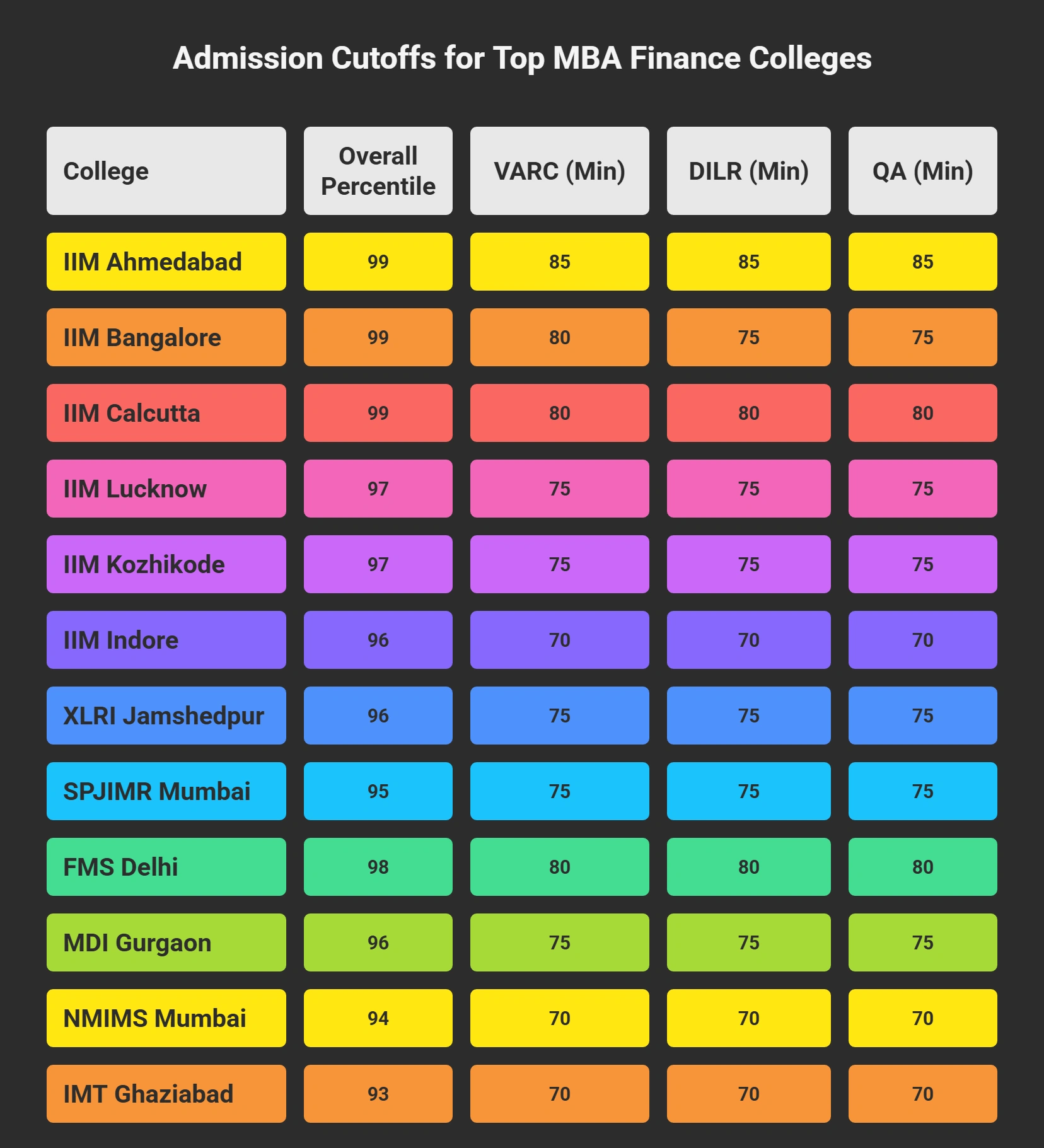
Top MBA Finance Colleges Cutoffs
Admission cutoffs vary by institution and program. The table summarizes expected CAT percentiles for the General category in select top IIMs and B-schools for 2025, applicable to 2026 cycles, focusing on MBA Finance or general programs with finance electives. Data sourced from official announcements and may adjust slightly. For reserved categories, cutoffs are generally lower: NC-OBC (85-90% of General), SC/ST (60-70% of General).
These are projected based on 2025 data; actuals may vary. For specialized Finance programs, refer to institute-specific criteria. Higher cutoffs in top IIMs reflect fierce competition, while mid-tier offer broader access.
Top MBA Finance Colleges in India
India’s finance education ecosystem is a curious blend of legacy institutions, high-intensity business hubs, and specialized management schools that treat balance sheets the way astronomers treat star charts—maps of possibility. MBA Finance remains one of the most sought-after management specialisations because it opens doors to investment banking, corporate finance, fintech, consulting, equity research, and risk management. Colleges differ not just in brand value but in the depth of their curriculum, industry immersion, and placement opportunities.
MBA Finance programs across India generally focus on financial modelling, corporate valuation, portfolio theory, derivatives, behavioural finance, global markets, and the strange but thrilling mathematics that keeps the modern economy upright. Below are the leading institutions in both the public and private sector.
Top Government MBA Finance Colleges
Government-run business schools tend to be the quiet powerhouses of management education—strong academic fundamentals, rigorous coursework, and enviable placement networks built over decades.
IIM Ahmedabad, IIM Bangalore and IIM Calcutta routinely grab the limelight for their finance-heavy ecosystems. Calcutta, for instance, has a long history of feeding quant-oriented roles in banks and consultancies. FMS Delhi offers perhaps the country’s best ROI, pairing low fees with elite placements. JBIMS Mumbai has the advantage of living inside India’s financial capital, where investment banks and trading desks are practically neighbours.
College Name
Total Fees (INR)
Application Deadline (2026 Cycle)
Entrance Exam
Why Apply
Brochure Link
Average Placement Salary (LPA)
NIRF Ranking
IIM Ahmedabad
25,00,000
Jan 2026
CAT
Premier institute with global faculty, rigorous curriculum, excellent finance placements.
Private institutions bring a different flavour—industry-driven curricula, modern campuses, and strong corporate partnerships. Many of these colleges operate like miniature financial ecosystems, hosting trading labs, Bloomberg terminals, live market simulations, and finance clubs that behave like in-house investment firms.
XLRI sits at the peak of this category with its one-year PGP, drawing global recruiters and mid-career professionals looking for acceleration. SPJIMR Mumbai’s finance specialisation is known for its “value-based leadership” mould, blending quantitative rigor with ethical decision-making. NMIMS Mumbai, with its proximity to Dalal Street, keeps its courses tightly aligned to banking and analytics needs. Symbiosis (SIBM Pune) and TAPMI Manipal also maintain robust links with BFSI, fintech and consulting sectors.
MBA Finance placements have remained consistently strong, especially in institutes located near major financial hubs. Graduates typically step into roles across banking, consulting, corporate finance, fintech and investment firms. Most B-schools run dedicated placement cells that organise recruitment drives, mock interviews, skill-training workshops and summer internships, helping students build confidence before final interviews.
Placement outcomes depend on factors such as specialisation strength, student performance, industry exposure and the overall reputation of the institute. In 2025, top B-schools recorded placement rates of around 80–95%, with average salaries ranging from 10–30 LPA and significantly higher packages for finance-focused campuses in Mumbai, Bangalore and Delhi.
Placements usually begin in the final year with aptitude tests, case rounds and interviews. A noticeable trend in recent years is the rise of fintech hiring, thanks to the growth of digital banking, payments and analytics. This section of the MBA ecosystem highlights job roles, salary growth, industry demand and sector-wise opportunities—showing how finance remains one of the most resilient specialisations.
MBA Finance Job Roles and Salaries
MBA Finance graduates fit into strategic roles that blend financial insight with analytical problem-solving. Entry-level profiles often include analyst positions in banks, consulting firms and corporates. Freshers generally earn between 10–20 LPA, with top-tier graduates landing packages in the 25–35 LPA range. Demand for finance talent keeps compensation competitive, and professionals with 2–5 years of experience can earn 25–50 LPA depending on the complexity of their portfolio.
Job Role
Average Salary (LPA)
Key Skills Required
Financial Analyst
12-25
Analysis, modeling, Excel
Investment Banker
20-40
M&A, valuation, negotiation
Finance Manager
15-30
Budgeting, reporting, leadership
Risk Analyst
12-25
Risk assessment, stats
Portfolio Manager
18-35
Investment strategy, markets
Fintech Specialist
15-28
Tech, blockchain, payments
Corporate Treasurer
20-35
Cash management, funding
Financial Consultant
10-22
Advisory, planning
2025 data; vary by factors.
MBA Finance Career Growth Projections
Career growth in MBA Finance is strong, with opportunities to rise to senior leadership positions over time. Many professionals reach managerial roles within 3–5 years and move to director-level responsibilities within 6–10 years, depending on performance. Salary increments typically fall in the 15–20% annual range for high performers.
Fintech, ESG finance (environmental, social, governance), and financial analytics are projected to grow 25–35% by 2030, expanding the scope of hybrid roles that combine finance with technology.
Experience Level
Projected Role
Average Salary Projection (LPA by 2030)
0-2 Years
Analyst
15-25
3-5 Years
Senior Analyst/Manager
30-45
6-10 Years
Director
50-70
10+ Years
CFO
80+
MBA Finance Placement Statistics and Top Recruiters
MBA Finance placement statistics remain impressive across premier institutes. In 2025, leading campuses such as IIM Ahmedabad, Bangalore and Calcutta recorded 85–95% placement rates. Average packages hovered around 25–35 LPA, with the highest offers exceeding 60 LPA, especially in consulting, investment banking and global finance roles.
Institute
Placement Rate (%)
Average Salary (LPA)
Highest Salary (LPA)
IIM Ahmedabad
95
35
60
IIM Bangalore
92
34
55
IIM Calcutta
90
35
58
XLRI
88
30
50
SPJIMR
85
33
52
Top recruiters include global banks, consulting firms and leading corporates: JP Morgan, Goldman Sachs, Deloitte, HDFC, KPMG, McKinsey, BCG, Axis Bank, ICICI and PwC. Analyst and consulting roles dominate, followed by managerial profiles in private banks and corporates.
Opportunities in Different Sectors
MBA Finance graduates find opportunities across a wide range of industries. Banking remains the most prominent sector, offering roles in credit analysis, investment banking and wealth management. Consulting firms recruit heavily for financial advisory and business strategy profiles. Fintech companies hire for product management, digital payments, and financial innovation.
PSUs provide stable finance officer roles, while investment firms offer positions in equity research and portfolio management. Emerging sectors like ESG finance, sustainability analytics and crypto-based services are also expanding.
Sector
Key Opportunities
Average Salary (LPA)
Banking
Credit, Investment Banking
15-30
Consulting
Financial Advisory
20-40
Fintech
Product Management
18-35
Corporate
Treasury, FP&A
15-28
PSUs
Finance Officer
12-20
Investment
Portfolio Management
20-35
Insurance
Risk, Actuarial
14-25
Global Opportunities after MBA Finance
MBA Finance also opens pathways to international careers. Countries such as the USA, UK, Singapore, UAE and Canada offer high-demand roles in investment banking, consulting, risk analytics and global markets. Many Indian graduates pursue overseas jobs or continue studies through MS or PhD programs. Post-study work visas in the UK and Canada make global mobility easier.
Typical salaries for finance professionals abroad range from USD 70,000 to 150,000 depending on location and role. Certifications like CFA significantly expand global employability.
Country
Key Opportunities
Average Salary (USD)
USA
Wall Street, Consulting
100,000-150,000
UK
City of London, Fintech
70,000-120,000
Singapore
Asia Finance Hub
80,000-130,000
UAE
Tax-Free Banking
90,000-140,000
Canada
Risk Management
80,000-120,000
MBA Finance Scholarships
Scholarships significantly reduce the financial burden of pursuing an MBA in Finance. They are offered by the government, private organisations and management institutes based on merit, performance, income criteria or category. Entrance exam scores play a major role in securing these awards.
Many modern scholarships now support students pursuing fintech, analytics and sustainable finance. Applications typically require academic transcripts, entrance exam scores, income certificates and identity documents. Most deadlines fall between August and December.
Scholarship Name
Eligibility
Amount (INR)
Application Deadline (2025-26)
IDFC FIRST MBA
Income <6L, merit
2,00,000
Dec 2025
Aditya Birla
Merit, top colleges
1,75,000
Nov 2025
ONGC
SC/ST, merit
48,000 pa
Oct 2025
Central Sector
Top rank, income <4.5L
20,000 pm
Dec 2025
Post Matric SC/ST
SC/ST, income limit
Full tuition
Jan 2026
Merit-cum-Means Minorities
Minorities, income <2.5L
30,000
Dec 2025
Pragati Girls
Girls, income <8L
50,000
Nov 2025
Saksham Disabled
Disabled, income <8L
50,000
Nov 2025
Swanath Orphans
Orphans, technical
50,000
Nov 2025
GyanDhan
Merit, no GPA
2,50,000
Feb 2026
PM Scholarship
Wards ex-servicemen
3,000 pm
Nov 2025
UGC PG
SC/ST, qualified
7,800 pm
Dec 2025
National Means
EWS, merit
12,000 pa
Oct 2025
Ishan Uday NER
NER, income <4.5L
7,800 pm
Dec 2025
GSK Pharma
Merit science
1,00,000
Dec 2025
FAQs
What is the eligibility criteria for MBA Finance?
To be eligible for MBA Finance, candidates need a bachelor’s degree in any discipline from a recognized university, with at least 50% aggregate marks (45% for reserved categories). A valid score in entrance exams like CAT or XAT is required, and work experience is preferred for executive programs, though not mandatory for regular admissions.
How can I get admission into MBA Finance programs?
Admission to MBA Finance involves qualifying in exams like CAT, followed by group discussions, interviews, and counseling. Register for the exam, prepare well, and apply to colleges post-results. Shortlisted candidates attend GD/PI rounds. Document verification and fee payment finalize the seat, with some offering direct based on merit.
What is the syllabus for MBA in Finance?
The MBA Finance syllabus covers four semesters, including managerial economics, financial accounting, corporate finance, investment analysis, and risk management. It features electives, projects, and internships. First year focuses on core management, second on finance specials to equip for strategic roles in finance sectors.
Which are the top colleges for MBA Finance in India?
Top government colleges include IIM Ahmedabad, Bangalore, Calcutta, Lucknow, and Kozhikode, renowned for finance excellence and low fees. Private like XLRI, SPJIMR, MDI, NMIMS, and IMT offer innovative programs and strong networks. Admissions via CAT/XAT scores and rankings guide selection.
What are the placement prospects after MBA Finance?
MBA Finance graduates secure roles in banking, consulting, with averages 10-30 LPA, higher in tops. Positions include financial analyst, investment banker. Recruiters like JP Morgan, Goldman Sachs hire via campus, with rates over 85% in premier institutes, emphasizing fintech and analytics.
What is the difference between MBA Finance and M.Com?
MBA Finance emphasizes strategic financial management and business skills, with practical focus and dissertation. M.Com is theory-oriented in accounting and commerce. Both two years, but MBA suits managerial roles, M.Com academic or accounting careers, depending on institution and goals.
Is CAT compulsory for MBA Finance admissions?
CAT is vital for top colleges like IIMs, ensuring merit selection. However, some accept XAT, MAT, or GMAT. Non-CAT can apply to institutions with own tests or direct admissions, but CAT provides access to scholarships and premier opportunities in finance programs.
What specializations are available in MBA Finance?
MBA Finance offers specializations like corporate finance, investment banking, financial markets, risk management, international finance, fintech, behavioral finance, and sustainable finance. Each includes advanced topics, projects, aligning with industry. Selection based on background, goals, with electives for tailoring.
What scholarships are available for MBA Finance students?
Scholarships include IDFC FIRST (2L for low income), Aditya Birla (1.75L merit), ONGC (48k pa SC/ST). Merit-need based via NSP require scores, income proofs. Reduce burdens, apply early through portals for financial support in MBA Finance.
Abhijeet Chatterjee is a professional Content and Copy specialist with over five years of experience in crafting compelling content around the Edtech domain. His portfolio includes notable work for companies such as PhysicsWallah, Roar Media, Jagran Josh, etc. Academically, Abhijeet holds a Master's in Mass Communication, where he was awarded a gold medal for his outstanding performance. He has also qualified for the UGC NET in Mass Communication, demonstrating his expertise and a deep understanding of the field. His academic foundation is built on a Bachelor's degree in English Literature. Beyond his professional work, Abhijeet is an avid writer and a cinephile. His personal interests include scriptwriting, film criticism, and reading novels.