Master of Commerce (M.Com) 2026 Complete Guide- Eligibility, Admission, Syllabus, Top Colleges, Placements
The Master of Commerce (M.Com) is a postgraduate degree that deepens understanding in commerce, accounting, economics, and business management. Aimed at graduates with a bachelor’s in commerce or related fields, this program stresses theoretical knowledge, analytical tools, and research methods to tackle intricate business issues. It readies individuals for advanced roles in accounting, finance, taxation, and academia, linking foundational concepts with practical insights. In a globalized economy, M.Com holders are vital for ensuring financial accuracy, compliance, and strategic planning in sectors like auditing, banking, and corporate governance.
An M.Com advances career paths by providing specialized skills for higher roles, improved pay, and research opportunities. The syllabus combines core subjects with electives, featuring projects, seminars, and dissertations. Many universities tie up with professional bodies for certifications like CA or CMA. Graduates often become accountants, auditors, or lecturers, with the degree paving the way for Ph.D. studies. In today’s competitive environment, M.Com offers an edge, nurturing proficiency in areas such as international trade, e-commerce, and financial analysis.
The two-year course, split into four semesters, covers advanced commerce topics and a thesis. Admissions are often merit-based or via entrance tests, with scholarships for outstanding students. Overall, M.Com is a worthwhile pursuit, equipping commerce experts to influence business practices and economic policies.
The M.Com program is valued for its emphasis on commerce expertise and research orientation, suitable for aspiring accountants and educators. Lasting two years full-time, it allows thorough exploration of subjects. Entrance exams or merit determine admissions, picking capable students. Fees range by college, with public ones more economical. Alumni find rewarding jobs with solid earnings.
Highlights feature varied electives, research projects, and access to libraries. The program promotes analytical thinking, ethics, and current business trends. Numerous colleges provide internships, improving job readiness. Financial assistance supports needy scholars. This summary helps in grasping key elements for decision-making.
Particular
Details
Duration
2 years (4 semesters)
Eligibility
B.Com with minimum 50% aggregate (45% for reserved categories)
To join M.Com, aspirants must fulfill standards set by universities. A bachelor’s in commerce from an accredited body is essential. Typically, 50% aggregate is needed, relaxed for reserved groups. Entrance scores from national/state tests are key for leading universities. Some admit on merit for non-entrance applicants.
Equivalent qualifications like BBA may qualify with consent. Experience aids part-time but not required for full-time. No age caps, suiting professionals. Overseas students need equivalence certs. Compliance smooths applications and education access.
Rigorous eligibility maintains quality and fairness. Verification at admission confirms adherence. Prepare to boost chances.
Criteria
Requirement
Educational Qualification
B.Com or equivalent
Minimum Marks
50% aggregate (45% for SC/ST)
Entrance Exam
Valid score or merit-based
Work Experience
Optional
Age Limit
None
MCom Courses and Specialisations
M.Com provides diverse specializations in commerce domains. Courses impart advanced commerce knowledge, matching professional needs. Popular include accounting, finance, taxation, and business management. Each specialization delves into theories, practices, and applications via studies and research.
Choice relies on undergrad and aims. Updates include contemporary topics, readying for jobs. Electives customize. Section lists main with descriptions.
Specializations advance with economy, offering prospects in demand areas. Interdisciplinary fosters broad views.
Specialisation
Description
Duration
Accounting and Finance
Focuses on advanced accounting, financial reporting, analysis
Deals with online business, digital marketing, tech
2 years
International Business
Explores global trade, forex, export-import
2 years
Economics
Advanced economic theories, policy, econometrics
2 years
Statistics
Focuses on data analysis, quantitative methods
2 years
MCom Syllabus
The M.Com syllabus is carefully designed to cultivate advanced proficiency in commerce subjects over four semesters in two academic years. It incorporates core courses, elective options, practical components, seminars, and a final dissertation or research project. The curriculum progresses from fundamental commerce principles to specialized and research-focused topics, enabling students to apply theoretical knowledge to practical scenarios.
Syllabus differences exist among universities, but a standard framework complies with UGC guidelines and industry relevance. Periodic revisions integrate contemporary issues such as digital commerce, GST reforms, and sustainable business practices. Students engage in case studies, group discussions, and fieldwork to develop analytical and ethical decision-making skills. Evaluation methods encompass internal assessments, end-semester exams, project reports, and viva voce.
This section outlines a typical syllabus for M.Com in Accounting and Finance, a popular specialization. It divides the content year-wise, with semester subsections detailing core subjects, electives, practicals, and key topics. Universities like Delhi University or Banaras Hindu University follow comparable patterns, assigning credits (e.g., 4 for core theory, 2 for practicals). Students need to earn around 80-100 credits for completion, including research components. Detailed syllabi facilitate effective study planning, exam readiness, and career alignment.
MCom First Year Syllabus
The first year establishes a solid foundation in commerce disciplines with theoretical and quantitative courses. Semester 1 introduces core concepts in accounting and economics, while Semester 2 applies them to business scenarios. This phase builds analytical capabilities essential for advanced studies.
Semester 1
In Semester 1, students explore foundational advanced topics. Core subjects focus on enhancing understanding of financial systems, economic principles, and statistical tools. Practicals reinforce theory through data application, and electives provide initial specialization options.
Category
Subjects/Components
Key Topics/Subsections
Credits
Core Subjects
Advanced Financial Accounting
Consolidated statements, partnership accounts, company accounts, accounting standards (Ind AS), valuation of goodwill and shares
4
Core Subjects
Managerial Economics
Demand forecasting, production analysis, cost functions, pricing strategies under different market structures, game theory applications
3
Core Subjects
Business Statistics
Descriptive statistics, probability distributions, sampling techniques, hypothesis testing, correlation and regression analysis
MS Excel for data analysis, Tally for accounting entries, basic database management with Access
2
Other
Seminar on Current Affairs
Discussions on economic policies, budget analysis, global trade issues
1
This semester’s structure ensures conceptual clarity, with assessments including quizzes, assignments, and practical exams. Total credits: approximately 16-18.
Semester 2
Semester 2 advances to functional commerce areas, introducing management and research tools. It emphasizes practical learning to bridge theory and application.
Category
Subjects/Components
Key Topics/Subsections
Credits
Core Subjects
Corporate Accounting
Amalgamation, absorption, reconstruction of companies, holding company accounts, banking company accounts
4
Core Subjects
Research Methodology in Commerce
Research types, hypothesis formulation, data collection methods (primary/secondary), sampling designs, report writing
3
Core Subjects
Cost and Management Accounting
Marginal costing, standard costing, variance analysis, budgetary control, activity-based costing
3
Electives
Elective 2 (e.g., Marketing Management)
Market segmentation, product life cycle, promotion mix, consumer behavior models
3
Labs/Practicals
Statistical Analysis Lab
Using SPSS for hypothesis testing, regression models, ANOVA
2
Other
Mini Research Project
Group study on a commerce topic, preliminary data analysis and presentation
2
End-semester projects promote collaboration and critical thinking. Total credits: approximately 17-19. By the year’s end, students possess a robust base for specialization.
MCom Second Year Syllabus
The second year prioritizes specialization and research. Semester 3 offers advanced electives and project work, while Semester 4 is dedicated to dissertation and comprehensive reviews.
Semester 3
Semester 3 transitions to specialized commerce topics and initial research. It includes in-depth studies in taxation, auditing, and international aspects, with significant project emphasis.
Banking regulations, types of insurance, risk management in finance
3
Labs/Practicals
Advanced Project Work
Case studies on taxation, auditing simulations using software
4
Other
Advanced Business Statistics
Time series analysis, index numbers, econometric models
2
This semester involves dissertation topic selection and literature review. Total credits: approximately 18-20. Focus on applied research prepares for thesis.
Semester 4
Semester 4 is heavily research-oriented, culminating in a dissertation. It includes internships for real-world application and seminars for dissemination.
Category
Subjects/Components
Key Topics/Subsections
Credits
Core Subjects
Dissertation/Thesis
Independent research on commerce topic, data collection, analysis, conclusions, thesis drafting
12
Core Subjects
Seminar on Research Findings
Presentation of dissertation results, peer feedback, industry relevance discussion
2
Electives
Elective 4 (if any)
Advanced topics like e-commerce or corporate law (optional)
3
Labs/Practicals
Internship/Fieldwork
Practical experience in accounting firms or banks (2-3 months), report submission
4
Other
Viva Voce
Oral examination on thesis, questions on contributions and methodology
2
The dissertation may result in journal submissions. Total credits: approximately 20-23. Completion signifies preparedness for professional or academic pursuits.
Overall, the M.Com Accounting and Finance syllabus provides comprehensive training, adaptable to other specializations by modifying electives. Differences across institutions (e.g., more practicals in private colleges) should be confirmed. This detailed framework ensures relevance and depth in the evolving commerce landscape.
MCom Syllabus PDF
Download below the latest MCom syllabus in pdf format for your reference.
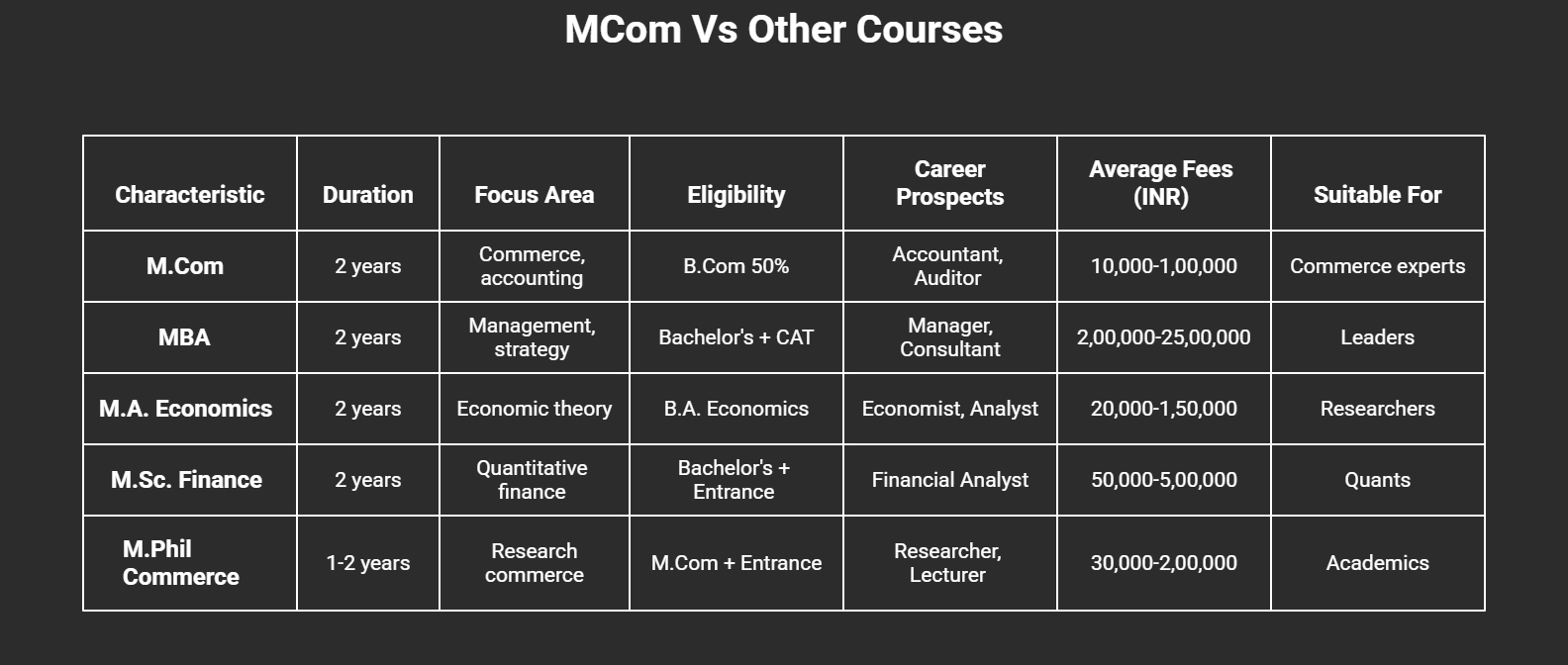
M.Com is a specialised postgraduate programme built around commerce, accounting, and financial systems. It differs in purpose and design from degrees like the MBA or an M.A. in Economics. A student who wants to deepen their grasp of commerce theory—particularly for careers in accounting, taxation, auditing, or teaching—usually finds M.Com more aligned with their goals.
MBA programmes are broader and more practice-oriented, focusing on management, strategy, leadership, and organisational behaviour. They suit students aiming for corporate leadership or consulting. M.A. Economics takes yet another direction, emphasising economic theory, policy, and quantitative tools for research-driven roles.
In simple terms, M.Com builds advanced commerce expertise, MBA builds managerial capability, and M.A. Economics builds analytical and policy-focused skills. Each programme leads to distinct pathways, helping students choose based on career ambition rather than prestige alone.
MCom Admission Process
Admission to M.Com programmes happens either through merit or through entrance tests such as DUET, depending on the university. Most institutions open applications online between April and June, after undergraduate results are declared. Selection usually involves merit lists, entrance scores, counselling, document verification, and final fee payment.
Some universities offer direct admission based on B.Com scores, while others follow structured entrance-based procedures. Regardless of the mode, the overall process is transparent and competitive, rewarding consistent academic performance and timely application.
The general workflow includes registration, qualifying exams (if required), result checks, counselling or direct allotment, verification, and confirming admission by paying the first-semester fee.
Step
Description
Timeline (2026 Cycle)
Required Actions/Documents
1. Registration
Apply university
Apr-May 2026
Form, photo, fee
2. Entrance
Test if required
Jun 2026
Admit, ID
3. Results
Check
Jul 2026
Score
4. Merit/Counsel
List/allot
Jul-Aug 2026
Choices
5. Verification
Docs
Aug 2026
Marks, certs
6. Payment
Fees
Aug 2026
Receipt
7. Confirmation
Join
Sep 2026
Orientation
MCom Cut off 2026
Cutoffs are essential in M.Com admissions, setting the minimum marks or ranks needed for eligibility and seat allotment. There are two primary types: qualifying cutoffs established by the exam authority, such as NTA for CUET PG, which are the baseline scores to qualify for the exam, and admission cutoffs published by individual universities or through centralized processes like CUET counseling.
For popular M.Com programs in central universities like DU, BHU, and JNU, admission cutoffs in the General category can range from 150-200 marks or more, depending on the institution and demand. Reserved categories (OBC, SC/ST, EWS) enjoy relaxations, often 10-20 marks lower than General. Reviewing past cutoffs helps candidates establish realistic targets, prepare effectively, and select preferences during counseling.
Admission cutoffs are finalized after results through counseling rounds, beginning with higher scores and filling gaps later. For instance, in DU, allocations consider CUET PG scores plus academics for some. Additionally, some state universities use merit from B.Com marks without entrances, where cutoffs are percentages like 85-95% for General in top colleges. Requests should align with legal and ethical standards.
Qualifying Cutoffs
The following table shows expected CUET PG 2026 qualifying cutoffs (marks out of 300) for M.Com, based on 2025 trends. These qualify for counseling but do not ensure seats.
Category
Expected Marks (Out of 300)
General/EWS
230-240
OBC
220-230
SC
200-210
ST/PwD
180-190
Admission Cutoffs for Top MCom Colleges in India
Admission cutoffs differ by university and specialization. Below is a table summarizing CUET PG marks (out of 300) for the General category in select top colleges for 2025, projected for 2026, focusing on M.Com programs. Data compiled from official sources and may vary slightly. For reserved categories, cutoffs are typically lower: OBC (90% of General), SC/ST (70-80% of General).
College
General Cutoff Marks (Out of 300)
OBC (Approx.)
SC/ST (Approx.)
SRCC Delhi
190-203
171-183
133-142
Hindu College Delhi
174-179
157-161
122-125
BHU Varanasi
200-220
180-198
140-154
JNU Delhi
70-75 (Percentile equiv ~210-225 marks)
63-68
50-55
Loyola College Chennai
85% merit (equiv ~255 marks)
76.5%
59.5%
Christ University Bangalore
90% merit (equiv ~270 marks)
81%
63%
St. Xavier’s Kolkata
95% merit (equiv ~285 marks)
85.5%
66.5%
St. Joseph’s Bangalore
85-90% merit
76.5-81%
59.5-63%
Madras Christian College
80-85% merit
72-76.5%
56-59.5%
Stella Maris Chennai
80% merit
72%
56%
Symbiosis Pune
85-90% (SET equiv)
76.5-81%
59.5-63%
Jain University Bangalore
80-85% (JET equiv)
72-76.5%
56-59.5%
These cutoffs are indicative and based on 2025 data; actuals may fluctuate. For merit-based admissions, percentages from B.Com are used; for entrance-based, CUET PG marks. Higher cutoffs in DU colleges reflect high competition, while others offer more accessibility.
Top MCom Colleges in India
Top M.Com colleges in India are known for strong academics, active research output, and deep industry engagement. Public universities—such as those under Delhi University—are preferred for their affordability and consistent quality, while private institutions offer modern infrastructure and a more industry-aligned learning experience. Students generally make their choice based on rankings, fees, location, faculty expertise, and placement performance.
Most colleges uphold rigorous academic standards with admission through entrance tests or merit lists. Specializations vary widely, and students benefit from experienced faculty, updated syllabi, equipped labs, and extensive libraries. Many institutions boast an influential alumni network across finance, accounting, taxation, and corporate sectors.
Top Government MCom Colleges in India
Government institutions tend to offer low tuition fees and are typically positioned high in national rankings. They emphasize research-led teaching, strong academic networks, and wide accessibility.
M.Com graduates consistently see stable placement outcomes, especially in accounting, finance, and audit functions. Placement cells conduct training sessions, internships, and recruitment drives. Outcomes depend on specialization, academic performance, and the institution’s reputation.
For 2025, most colleges reported placement rates between 60–80%, with average salaries ranging from 4–10 LPA. Students with internships, certifications, and practical exposure tend to secure higher packages. The recruitment process typically peaks in the final semester, with increasing demand for digital accounting and analytics roles.
M.Com remains a reliable pathway to careers in finance, taxation, banking, and corporate roles, with certifications like CMA, ACCA, or CA further enhancing prospects.
M.Com Job Roles and Salaries
M.Com graduates are employable across a range of commerce and finance roles where analytical skills and accuracy are essential. Freshers typically earn between 4–8 LPA, with experienced professionals crossing 10–20 LPA. Government roles offer stable pay scales, while corporate finance roles offer growth and bonuses.
Job Role
Average Salary (LPA)
Key Skills Required
Accountant
4-8
Bookkeeping, Tally, compliance
Auditor
5-10
Audit standards, risk assessment
Tax Consultant
6-12
Tax laws, planning, GST
Financial Analyst
5-9
Analysis, forecasting, Excel
Cost Accountant
5-10
Costing, variance
Bank Officer
4-8
Banking ops, customer service
Lecturer
4-7
Teaching, research
Research Analyst
5-9
Data, economics
M.Com Career Growth Projections
Career growth in commerce is steady, with opportunities to progress from junior roles to managerial and leadership positions. Over 5–10 years, professionals typically move into senior accountant, finance manager, or controller roles with salaries rising 10–15% annually. Demand in auditing and taxation is expected to grow 15–25% by 2030 due to increasing regulatory compliance.
Certifications like CMA or ACCA accelerate growth. Those inclined toward academia can pursue M.Phil or PhD, while others may venture into consultancy or entrepreneurship.
Experience Level
Projected Role
Average Salary Projection (LPA by 2030)
0-2 Years
Junior Accountant
5-9
3-5 Years
Senior Accountant
10-15
6-10 Years
Manager
15-25
10+ Years
Director
30+
M.Com Placement Statistics and Top Recruiters
Placement statistics for 2025 remained steady, with Delhi University colleges achieving 70–80% placements and average packages ranging from 5–8 LPA. The highest packages at top institutes touched 15 LPA. Compliance, taxation, and auditing roles dominated recruitment.
Institute
Placement Rate (%)
Average Salary (LPA)
Highest Salary (LPA)
SRCC Delhi
80
8
15
Hindu College
75
7
12
Loyola Chennai
70
6
10
Christ Bangalore
72
6
11
St. Xavier’s
78
7
13
Top MCom Recruiters
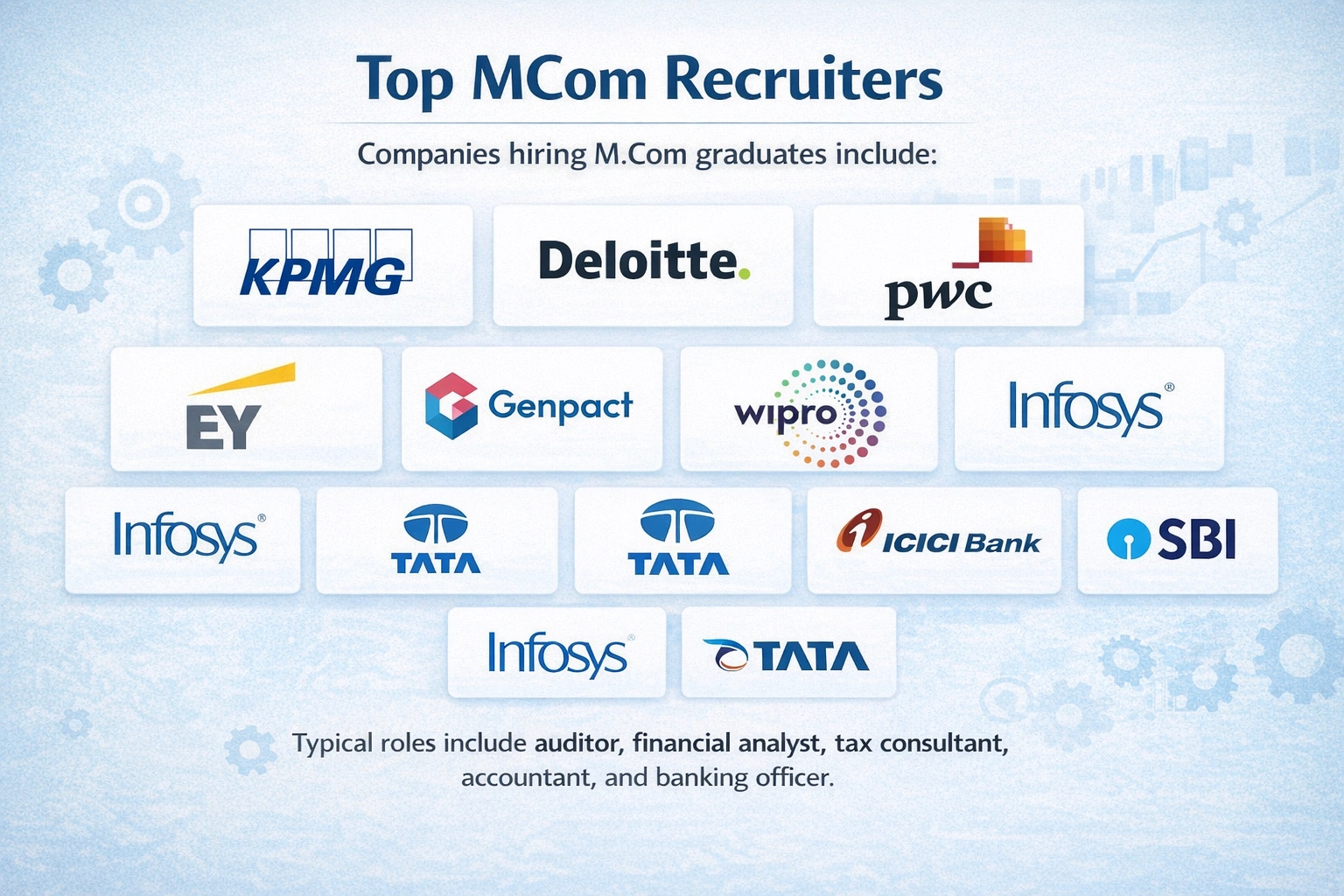
Companies hire M.Com graduates for roles like auditor, financial analyst, tax consultant, accountant, and banking officer.
Opportunities in Different Sectors
M.Com graduates can work across accounting, banking, corporate finance, government departments, and academia. The rise of fintech, digital bookkeeping, and compliance has expanded opportunities, especially in taxation and auditing.
Sector
Key Opportunities
Average Salary (LPA)
Accounting Firms
Audit, Tax
5-10
Banking
Operations, Compliance
4-8
Education
Teaching, Research
4-7
Corporate
Finance, Accounts
5-9
Government
Tax, Audit
5-8
Consulting
Advisory
6-12
Insurance
Underwriting
5-9
Global Opportunities after M.Com
M.Com graduates can pursue international career paths or higher studies abroad. Countries like the USA, UK, Canada, and Australia offer strong prospects in accounting, finance, and consulting. Employers often prefer candidates with certifications like ACCA, CMA, or CPA. Academic pathways such as M.Phil or PhD also remain attractive.
Average salaries abroad range from $50,000 to $90,000 annually, depending on role and location. Australia and Canada offer favourable post-study work opportunities.
Country
Key Opportunities
Average Salary (USD)
USA
Audit, Tax
60,000-90,000
UK
Accounting, Consulting
50,000-80,000
Canada
Finance, Education
55,000-85,000
Australia
Audit, Banking
60,000-90,000
UAE
Tax-Free Accounting
50,000-80,000
MCom Scholarships
Pursuing a Master of Commerce (M.Com) degree can be financially demanding, but numerous scholarships are available to support eligible students based on merit, financial need, category (such as SC/ST/OBC/minorities), gender, or other criteria. These scholarships are primarily offered by the Government of India through bodies like the University Grants Commission (UGC) and the Ministry of Education, as well as state governments and private foundations.
For the 2026-27 academic session, applications are typically processed through the National Scholarship Portal (NSP) or specific portals, with deadlines often falling between July and December 2026 (check the portals for exact dates as they may vary). Students are encouraged to verify eligibility and apply early, as funds are limited. Below is a table highlighting some key scholarships applicable to M.Com students in India for the 2026-27 session.
Scholarship Name
Eligibility
Amount
Deadline
Apply Link
Central Sector Scheme of Scholarship for College and University Students
Students in the top 20th percentile of Class 12 marks, family income ≤ ₹4.5 lakh, pursuing regular PG courses like M.Com.
To be eligible for M.Com, candidates need a B.Com or equivalent degree from a recognized university, with at least 50% aggregate marks (45% for reserved categories). Entrance exams or merit-based selection is common, and work experience is optional, though beneficial for part-time programs.
How can I get admission into M.Com programs?
Admission to M.Com is through merit or entrances like DUET, followed by counseling. Apply online to universities, submit scores or marks, and attend verification. Document submission and fee payment confirm the seat, with some offering direct admissions based on undergraduate performance.
What is the syllabus for M.Com in Accounting?
The M.Com Accounting syllabus covers four semesters, including advanced accounting, corporate finance, taxation, auditing, and research methodology. It includes electives, projects, and dissertation. First year focuses on core commerce, second on specials for in-depth knowledge in financial reporting and analysis.
Which are the top colleges for M.Com in India?
Top government colleges include SRCC Delhi, Hindu College, BHU Varanasi, JNU, and Aligarh Muslim University, known for quality and low fees. Private like Loyola Chennai, Christ Bangalore, St. Xavier’s Kolkata, St. Joseph’s, and Madras Christian offer modern facilities. Admissions via entrances or merit.
What are the placement prospects after M.Com?
M.Com graduates find placements in accounting, auditing, with averages 4-10 LPA, higher with experience. Roles include accountant, auditor, tax consultant. Recruiters like KPMG, Deloitte hire via campus, with rates 60-80% in top colleges, focusing on compliance and digital tools.
What is the difference between M.Com and MBA?
M.Com emphasizes theoretical commerce, accounting, suitable for academic or specialist roles. MBA focuses on practical management, strategy. Both two years, but M.Com for commerce depth, MBA for leadership, depending on goals and institution.
Is entrance exam compulsory for M.Com admissions?
Entrance like DUET is required for many top universities, ensuring merit. However, some admit on merit from bachelor’s marks. Non-entrance can apply to colleges with direct or university tests, but entrances offer better access to premier institutions and scholarships.
What specializations are available in M.Com?
M.Com offers specializations like accounting and finance, taxation, business management, banking and insurance, e-commerce, international business, economics, and statistics. Each includes advanced topics, research, aligning with careers. Selection based on background, with electives for customization.
What scholarships are available for M.Com students?
Scholarships include Post Matric for SC/ST (full tuition), Merit-cum-Means for minorities (30,000), Central Sector (20,000 pm). Apply via NSP with marks, income proofs. Reduce costs, available for merit, need, category students in M.Com programs.
Abhijeet Chatterjee is a professional Content and Copy specialist with over five years of experience in crafting compelling content around the Edtech domain. His portfolio includes notable work for companies such as PhysicsWallah, Roar Media, Jagran Josh, etc. Academically, Abhijeet holds a Master's in Mass Communication, where he was awarded a gold medal for his outstanding performance. He has also qualified for the UGC NET in Mass Communication, demonstrating his expertise and a deep understanding of the field. His academic foundation is built on a Bachelor's degree in English Literature. Beyond his professional work, Abhijeet is an avid writer and a cinephile. His personal interests include scriptwriting, film criticism, and reading novels.