Master of Science (M.Sc) Computer Science 2026 Complete Guide – Eligibility, Admission, Syllabus, Top Colleges, Placements
The Master of Science (M.Sc) in Computer Science is a postgraduate program that delves into advanced concepts in computing, algorithms, data structures, and emerging technologies. Designed for graduates with a background in computer-related fields, it enhances skills in software development, artificial intelligence, and system design to tackle real-world computational problems. This degree equips professionals for roles in IT, research, and innovation sectors, combining theoretical foundations with practical implementations. In a rapidly digitizing economy, M.Sc Computer Science graduates play a crucial role in advancing technology solutions across industries like software services, e-commerce, and data analytics.
An M.Sc in Computer Science opens doors to specialized careers, offering opportunities for higher earnings and involvement in cutting-edge projects. The curriculum includes core subjects, electives, and research components, often incorporating labs, simulations, and dissertations. Many institutions collaborate with tech companies to align with market needs. Graduates commonly enter positions such as software engineers, data scientists, or system analysts, and the program supports further pursuits like Ph.D. or certifications in cloud computing.
The two-year course, divided into four semesters, features foundational computing courses, advanced topics, and a thesis. Admissions are based on merit through national or university exams, followed by interviews. Financial assistance through scholarships aids deserving candidates. Overall, an M.Sc in Computer Science is a valuable pursuit for those aiming to excel in the tech landscape and drive digital transformation.
The M.Sc in Computer Science program is notable for its emphasis on computational theory and practical applications, suitable for aspiring tech experts. Lasting two years full-time, it provides a mix of classroom learning and hands-on projects. Entrance tests are essential for entry, identifying candidates with strong logical and programming aptitude. Tuition varies by college type, with public institutions more economical. Alumni enjoy promising job prospects with competitive pay.
Highlights include varied electives, industry collaborations, and state-of-the-art labs. The course promotes problem-solving, innovation, and ethical computing practices. Placement drives attract leading firms, enhancing career starts. Funding options support academic excellence. This summary helps gauge the program’s benefits for decision-making.
Particular
Details
Duration
2 years (4 semesters)
Eligibility
Bachelor’s degree in Computer Science or related with minimum 50% aggregate (45% for reserved categories)
Entrance Exams
IIT JAM, CUET PG, GATE, TANCET
Average Fees (INR)
20,000 – 2,00,000 total
Average Salary (LPA)
5 – 15
Top Job Roles
Software Engineer, Data Scientist, System Analyst, AI Specialist
To pursue an M.Sc in Computer Science, candidates must meet standards set by universities and testing agencies. A bachelor’s degree in computer science, IT, or equivalent from an accredited body is mandatory. Typically, a 50% aggregate is required, with relaxations for reserved categories. Solid scores in national or institutional entrances are critical for premier courses. Some places conduct their exams for unqualified applicants.
Comparable qualifications may qualify with endorsement. Work experience bolsters applications for specialized tracks but is not compulsory for regular intakes. Age limits are absent, welcoming professionals. International students need equivalence proofs. Meeting these facilitates smooth applications and access to quality training.
Rigorous criteria maintain quality and fairness. Checks happen during selection. Aspirants should prepare to boost chances.
Criteria
Requirement
Educational Qualification
Bachelor’s in Computer Science/IT/BCA or equivalent
Minimum Marks
50% aggregate (45% for SC/ST)
Entrance Exam
Valid IIT JAM/CUET PG score or equivalent
Work Experience
Optional, preferred for some
Age Limit
None
M.Sc Computer Science Courses and Specialisations
M.Sc in Computer Science includes fundamental computing courses plus focused modules, catering to diverse interests in tech. Programs offer deep knowledge in algorithms, databases, and networking, meeting sector requirements. Popular areas encompass artificial intelligence, data science, cybersecurity, and cloud computing. Each track explores key principles, tools, and uses through assignments and studies.
Choice depends on prior studies and objectives. Syllabi update with tech advances, readying graduates for practical duties. Options allow customization. This outlines major courses with descriptions for orientation.
Specializations adjust to tech evolutions, unlocking paths in expanding fields. Cross-disciplinary aspects foster broad thinking and flexibility.
Specialisation
Description
Duration
Artificial Intelligence
Focuses on machine learning, neural networks, and intelligent systems
2 years
Data Science
Covers data mining, big data analytics, and visualization
2 years
Cybersecurity
Explores ethical hacking, network security, and forensics
2 years
Cloud Computing
Deals with virtualization, cloud architecture, and DevOps
2 years
Software Engineering
Emphasizes development methodologies, testing, and project management
2 years
Full Stack Development
Integrates front-end and back-end technologies for web apps
2 years
Machine Learning
Studies algorithms, predictive modeling, and applications
2 years
Internet of Things
Focuses on embedded systems, sensors, and connectivity
2 years
MSc Computer Science Syllabus
The M.Sc Computer Science syllabus is designed to build strong technical proficiency across four semesters over two years. It brings together core subjects, specialization papers, analytical courses, practical labs, and a final research project. The first year focuses on essential concepts in programming, systems, and mathematics, while the second year moves into advanced technologies, electives, and research-oriented learning. This structure creates a steady progression from foundational knowledge to applied innovation.
Although the exact curriculum varies by university, most programmes regularly update their content to match industry needs, especially in areas like artificial intelligence and cybersecurity. Students gain hands-on experience through coding labs, practical assignments, and internships. Evaluation usually includes exams, project work, lab assessments, and presentations. The outline below reflects a typical M.Sc Computer Science syllabus commonly followed across institutions. Universities provide detailed semester-wise breakdowns for scheduling and academic planning.
M.Sc Computer Science First Year Syllabus
The first year establishes the fundamental base in computing and mathematics. Semester 1 covers essential concepts, while Semester 2 adds software development and system-level subjects.
M.Sc Computer Science Semester 1 Syllabus
Semester 1 focuses on building core computing competencies, particularly in algorithms, data structures, operating systems, and mathematical foundations.
Assessments via exams and labs. Total credits: 21.
M.Sc Computer Science Semester 2 Syllabus
Semester 2 strengthens understanding of networks, software development processes, and foundational AI and compiler design.
Category
Subjects/Components
Key Topics/Subsections
Credits
Core Subjects
Computer Networks
TCP/IP, OSI model, routing, security
4
Core Subjects
Software Engineering
Models, testing, agile, requirements
4
Core Subjects
Object Oriented Analysis and Design
UML, patterns, inheritance
4
Core Subjects
Artificial Intelligence
Search, knowledge representation, logic
4
Core Subjects
Compiler Design
Lexical analysis, parsing, code generation
3
Other
DBMS Lab
SQL queries, database design
2
Emphasis on application. Total credits: 21.
M.Sc Computer Science Second Year Syllabus
The second year introduces advanced modules, specialization options, and research work leading to a dissertation.
M.Sc Computer Science Semester 3 Syllabus
Semester 3 focuses on advanced technologies and elective specializations.
Category
Subjects/Components
Key Topics/Subsections
Credits
Core Subjects
Machine Learning
Supervised, unsupervised, neural nets
4
Core Subjects
Big Data Analytics
Hadoop, Spark, data processing
4
Core Subjects
Cyber Security
Encryption, threats, firewalls
4
Electives
Elective 1 (e.g., Cloud Computing)
AWS, Azure, virtualization
3
Labs/Practicals
AI Lab
Python, simulations
2
Other
Research Methodology
Proposal, data analysis
2
Thesis prep. Total credits: 19.
M.Sc Computer Science Semester 4 Syllabus
Semester 4 is dedicated to the final dissertation, industry exposure, and one advanced elective.
Category
Subjects/Components
Key Topics/Subsections
Credits
Core Subjects
Distributed Systems
Concurrency, fault tolerance
4
Core Subjects
Internet of Things
Sensors, protocols
4
Electives
Elective 2 (e.g., Blockchain)
Crypto, smart contracts
3
Other
Dissertation/Project
Research, defense
6
Other
Internship
Industry practice
3
Ends with presentation. Total credits: 20.
The syllabus equips learners with a blend of theoretical depth and practical skills, preparing them for evolving careers in software development, data science, cybersecurity, research, and emerging technologies.
MSc Computer Science Syllabus PDF
Here is the updated semester-wise M.Sc Computer Science syllabus in PDF format for download.
M.Sc Computer Science is fundamentally science-driven, focusing on theoretical computing, algorithms, and research. It differs from programmes like MCA and M.Tech in both approach and career orientation. The M.Sc path suits students who want to explore the foundations of computation and systems, often leading to research and development roles.
MCA is more application-oriented and prepares graduates for software development and IT management. M.Tech, meanwhile, is engineering-focused and ideal for those aiming to work on technical innovation, system design, and advanced engineering problems.
In comparison with MCA, the M.Sc provides deeper research exposure, while M.Tech offers a stronger engineering and hardware-system perspective. Students interested in computational theory and scientific inquiry often prefer the M.Sc. Those inclined toward practical software applications lean toward MCA, and those seeking advanced engineering roles typically choose M.Tech.
Programme
Duration
Focus Area
Eligibility
Career Prospects
Average Fees (INR)
Suitable For
M.Sc Computer Science
2 years
Theoretical computing, research
B.Sc CS 50% + Entrance
Data Scientist, Researcher
20,000 – 2,00,000
Research enthusiasts
MCA
2 years
Application development, IT
BCA 50%
Software Developer, IT Manager
50,000 – 3,00,000
Application specialists
M.Tech CS
2 years
Engineering, innovation
B.Tech + GATE
System Engineer, Tech Lead
1,00,000 – 5,00,000
Technical experts
M.Sc IT
2 years
Information tech, management
B.Sc IT + Entrance
IT Consultant, Analyst
30,000 – 2,50,000
IT generalists
MS CS
1-2 years
Advanced research
Bachelor’s + GRE
Researcher, Academic
2,00,000 – 10,00,000
Research pros
M.Sc Computer Science Admission Process
Admission to M.Sc Computer Science is competitive and largely merit-based, with many universities accepting scores from entrance exams such as CUET PG or IIT JAM. After the exam, qualified candidates proceed to counselling rounds or apply directly to specific institutions. Application forms are usually available online, and deadlines fall between October and November once results are released. Seat allocation is followed by document verification and fee payment.
Some universities also offer direct admission based on academic merit or prior experience. Overall, the process is structured, transparent, and designed to assess both aptitude and preparedness for the programme. Strong preparation is essential for securing seats in top institutions.
Step
Description
Timeline (2026 Cycle)
Required Actions/Documents
1. Entrance Registration
Apply for CUET PG/JAM
Dec-Jan 2026
Form, photo, fee
2. Entrance Exam
Take test
Mar 2026
Admit card, ID
3. Results
Check scores
Apr 2026
Scorecard
4. Application
Apply to universities
Apr-May 2026
Form, scores
5. Counseling/Interview
Attend sessions
May-Jun 2026
Call letter
6. Allotment
Get offer
Jun 2026
Accept
7. Verification
Submit docs
Jul 2026
Marks, certs
8. Confirmation
Enroll
Aug 2026
Orientation
M.Sc Computer Science Cut off
Cutoffs play a pivotal role in M.Sc Computer Science admissions, determining the minimum scores or ranks required for shortlisting and final selection. There are two main types: qualifying cutoffs set by exam authorities such as NTA for CUET PG or IITs for JAM/GATE, which serve as the initial eligibility threshold, and admission cutoffs released by individual universities or through centralized counseling processes.
Qualifying cutoffs are standardized across the country and vary based on the exam section, candidate category, and year-specific factors like paper difficulty, number of applicants, and score normalization. Admission cutoffs, on the other hand, are institution-specific and typically higher, indicating the level of competition for limited seats. These are often expressed as percentiles or ranks rather than raw scores to account for variations in exam difficulty.
For competitive programs in premier institutions like IITs and NITs, general category cutoffs frequently surpass 90 percentile or top ranks, with mandatory sectional cutoffs to ensure comprehensive performance. Reserved categories (OBC, SC/ST, EWS, PwD) benefit from relaxations, usually 5-10 percentile points or equivalent rank adjustments, promoting inclusivity.
Qualifying MSc CS Cutoffs
The table below presents expected qualifying cutoffs for key entrances like CUET PG, IIT JAM, and GATE for the 2026 cycle, based on 2025 trends. These thresholds qualify candidates for further processes but do not ensure admission.
Exam
Category
Overall Cutoff (Marks/Percentile)
Sectional Notes
CUET PG
General/EWS
200-220 marks
Balanced across sections: Reasoning, Aptitude, Domain Knowledge
CUET PG
OBC
180-200 marks
Relaxation in each section
CUET PG
SC/ST/PwD
150-180 marks
Lower thresholds for inclusivity
IIT JAM (CS)
General
25-30 marks
Based on 2025: ~29 marks for top ranks
IIT JAM (CS)
OBC
22-27 marks
~26 marks in recent years
IIT JAM (CS)
SC/ST
15-20 marks
~19 marks qualifying
GATE (CS)
General
28-30 marks
2025: 29.2; sectional vary by paper
GATE (CS)
OBC
25-27 marks
2025: 26.2
GATE (CS)
SC/ST/PwD
18-20 marks
2025: 19.4
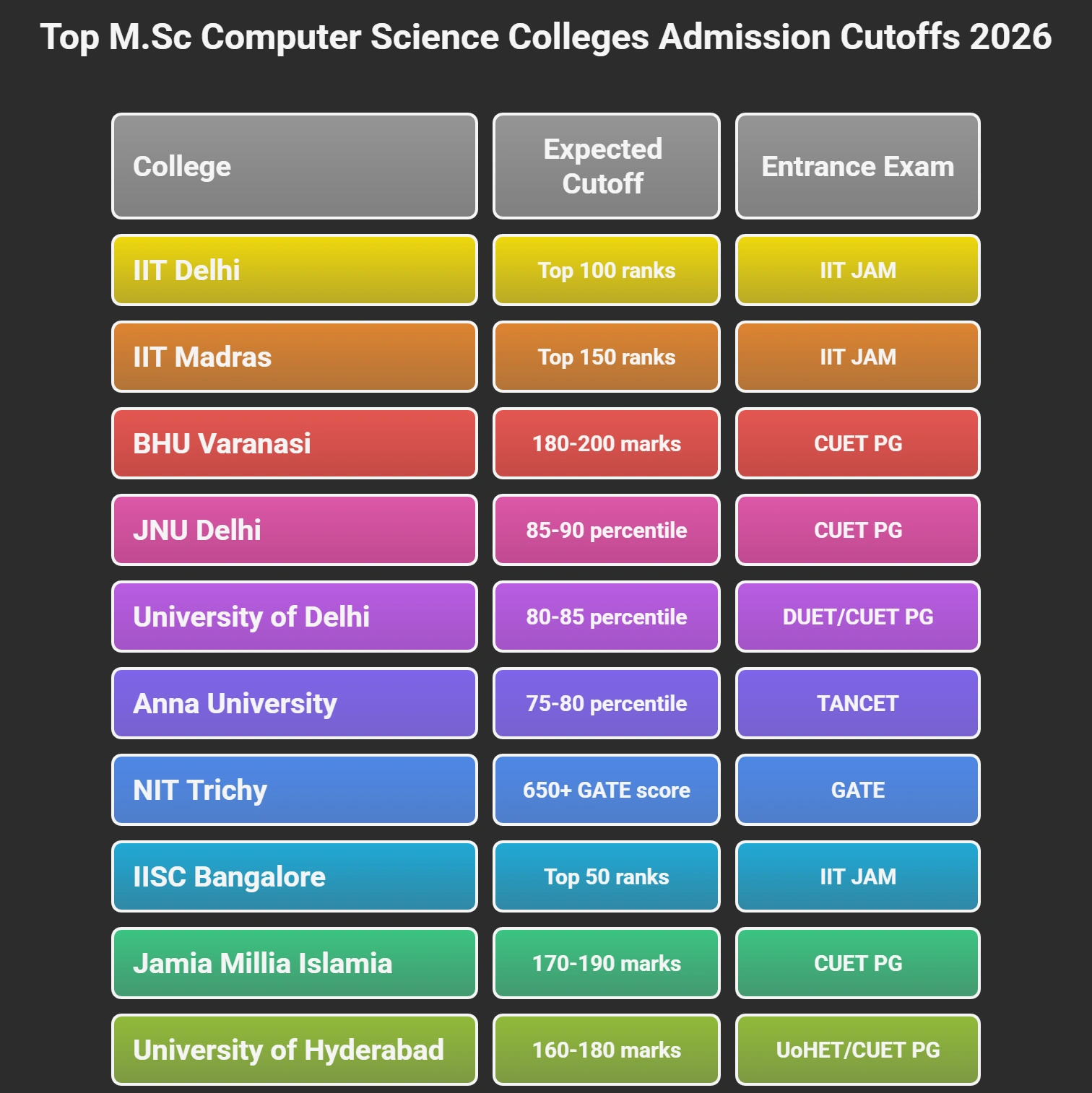
Top M.Sc Computer Science Colleges Admission Cutoffs 2026
Admission cutoffs vary by institution, program, and entrance exam. The table below summarizes expected cutoffs for the General category in selected top colleges for the 2026 cycle, derived from 2025 data. For reserved categories, cutoffs are typically lower: OBC (90-95% of General), SC/ST (70-80% of General), with similar adjustments for EWS and PwD.
These are projections; actual cutoffs may differ based on the applicant pool and policy changes. Candidates should refer to institute-specific announcements for precise details, especially for specialized tracks like AI or Data Science.
Top M.Sc Computer Science Colleges in India
India’s computer science education ecosystem is a vibrant blend of legacy institutions, innovative tech hubs, and specialized schools that treat code as a canvas for innovation and problem-solving. M.Sc Computer Science is one of the most sought-after postgraduate programs, as it paves the way for careers in software engineering, artificial intelligence, data analytics, cybersecurity, and emerging fields like blockchain and IoT. Colleges vary not just in reputation but in the rigor of their curriculum, research opportunities, industry collaborations, and placement records.
M.Sc Computer Science programs typically emphasize advanced topics such as algorithms, machine learning, database systems, network security, and computational theory, complemented by practical components like labs, projects, and internships. Institutions often feature cutting-edge facilities, including high-performance computing clusters, AI labs, and collaborations with tech giants for real-world exposure. This section highlights leading government and private colleges, helping aspirants choose based on factors like affordability, location, and career prospects.
Selecting the right college involves considering accreditation, faculty expertise, alumni success, and alignment with personal goals. Government colleges often provide cost-effective education with strong foundational training, while private ones offer modern infrastructure and flexible specializations. Both sectors contribute to India’s growing tech talent pool, driving advancements in digital transformation.
Top Government M.Sc Computer Science Colleges
Government-run institutions are the bedrock of computer science education, offering robust academic frameworks, extensive research resources, and established networks built over decades. These colleges emphasize theoretical depth alongside practical skills, preparing students for roles in academia, research, and industry.
Banaras Hindu University (BHU) and University of Delhi stand out for their comprehensive curricula and vibrant campus life. Anna University and University of Madras leverage their location in tech-savvy Chennai for industry ties. Osmania and Bangalore University provide affordable options with solid placements. Pondicherry University offers a serene environment with focus on emerging technologies. These institutions often have lower fees and scholarships, making them accessible to a wide range of students.
Private institutions bring a dynamic edge with industry-driven curricula, state-of-the-art campuses, and strong corporate partnerships. Many operate like mini tech ecosystems, featuring advanced labs, Bloomberg-like terminals for data, live coding simulations, and clubs that function as in-house startups.
Loyola College and Christ University emphasize ethical computing and innovation. VIT and SRM benefit from their tech-focused environments in Vellore and Chennai. Fergusson and St Xavier’s offer balanced education with research focus. Amity and Manipal provide global exposure. Symbiosis SICSR and PSG CAS are known for practical training and placements. St Joseph’s and NMIMS round out with urban advantages and specialized tracks.
M.Sc Computer Science placements are consistently strong, especially at institutes located near major technology hubs. Graduates move into software development, AI, data-driven roles, and research positions across industry and academia. Most universities have dedicated placement cells that conduct recruitment drives, mock interviews, technical workshops, and internship support to prepare students for the hiring process.
Placement outcomes typically depend on specialization, academic performance, practical exposure, and institutional reputation. In 2025, leading institutes recorded placement rates of 80–90%, with average packages ranging from ₹5–15 LPA and top offers crossing ₹20 LPA in cities with dense IT and research activity. Recruitment generally begins in the final year through written tests, coding rounds, and technical interviews. Hiring trends continue to shift toward AI and machine learning as digital adoption accelerates. This section outlines key roles, salary ranges, sector-wise opportunities, and overall career growth—reflecting the resilience and versatility of the field.
M.Sc Computer Science Job Roles and Salaries
Graduates typically step into analytical and development-oriented positions that blend technical competence with problem-solving abilities. Entry-level roles include software developer and data analyst positions. Freshers usually earn between ₹4–8 LPA, while graduates from top institutes may start at ₹10–15 LPA. Demand for skilled professionals keeps salary growth steady; with 2–5 years of experience, packages often rise to ₹10–20 LPA.
Job Role
Average Salary (LPA)
Key Skills Required
Software Engineer
5-12
Programming, debugging
Data Scientist
8-15
Analytics, ML, Python
System Analyst
6-12
Requirements, design
AI Specialist
10-18
Neural nets, algorithms
Cybersecurity Analyst
7-14
Security, ethics
Full Stack Developer
6-13
Web tech, databases
Research Associate
5-10
Methodology, papers
Cloud Engineer
8-15
AWS, deployment
2025 data; vary by elements.
M.Sc Computer Science Career Growth Projections
Career growth in computer science remains strong, with graduates progressing to senior roles within 3–5 years and moving into leadership positions in 6–10 years depending on performance and specialization. Salary increments of 15–25% annually are common for high performers. Sectors such as AI, data science, and cybersecurity are projected to expand by 30–40% by 2030, promoting hybrid roles that combine technical and domain expertise.
Experience Level
Projected Role
Average Salary Projection (LPA by 2030)
0-2 Years
Junior Developer
6-10
3-5 Years
Senior Analyst
12-20
6-10 Years
Tech Lead
25-40
10+ Years
CTO
50+
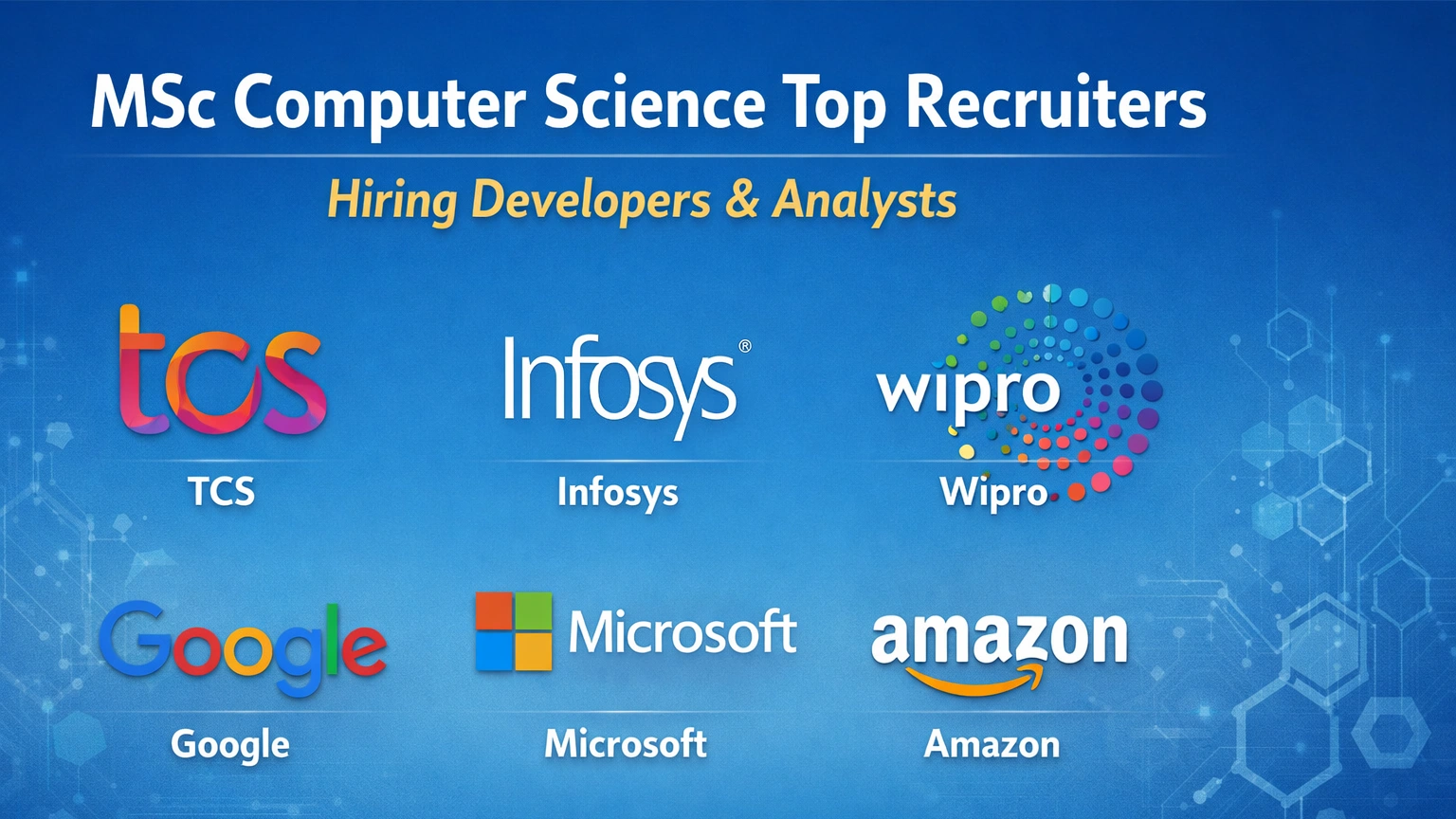
M.Sc Computer Science Placement Statistics and Top Recruiters
Top universities report impressive placement statistics for M.Sc Computer Science. In 2025, institutions such as IITs and BHU recorded 80–95% placement rates. Average packages typically ranged from ₹8–15 LPA, with the highest offers touching ₹25 LPA in areas like AI, ML, and data engineering.
M.Sc Computer Science graduates work across a wide range of industries. IT services remain core employers for software and consulting roles, while fintech organizations hire extensively for data and analytics positions. Healthcare increasingly uses AI-based diagnostic tools, opening new roles in medical technology. Opportunities also exist in e-commerce, government research bodies, and emerging fields like blockchain and IoT.
Sector
Key Opportunities
Average Salary (LPA)
IT Services
Development, testing
5-12
Fintech
Data analysis
8-15
Healthcare
AI diagnostics
7-14
E-commerce
Systems, ML
6-13
Government
Research officer
5-10
Education
Lecturer
4-8
Telecom
Networks
6-12
Global Opportunities after M.Sc Computer Science
The degree also opens pathways to international careers. Countries such as the USA, UK, Canada, Australia, and Germany offer high-demand roles in AI, cybersecurity, cloud computing, and software engineering. Many graduates pursue overseas jobs or enrol in PhD programs for advanced research. Immigration programs in Canada and the UK are particularly supportive of tech professionals.
Depending on country and job market, salaries typically range between USD 70,000 and 150,000 annually. Professional certifications such as AWS, Azure, and cybersecurity credentials can further increase prospects.
Country
Key Opportunities
Average Salary (USD)
USA
Silicon Valley, AI
100,000-150,000
UK
London tech
70,000-120,000
Canada
Data roles
80,000-120,000
Australia
Cybersecurity
90,000-130,000
Germany
Engineering
70,000-110,000
M.Sc Computer Science Scholarships
Pursuing a Master of Science (M.Sc) in Computer Science can be financially demanding, but numerous scholarships are available to support eligible students based on merit, financial need, category (such as SC/ST/OBC/minorities), gender, or other criteria. These scholarships are primarily offered by the Government of India through bodies like the University Grants Commission (UGC) and the Ministry of Education, as well as state governments and private foundations.
For the 2026-27 academic session, applications are typically processed through the National Scholarship Portal (NSP) or specific portals, with deadlines often falling between July and December 2026 (check the portals for exact dates as they may vary). Students are encouraged to verify eligibility and apply early, as funds are limited. Below is a table highlighting some key scholarships applicable to M.Sc Computer Science students in India for the 2026-27 session.
Scholarship Name
Eligibility
Amount
Deadline
Apply Link
Central Sector Scheme of Scholarship for College and University Students
Students in the top 20th percentile of Class 12 marks, family income ≤ ₹4.5 lakh, pursuing regular PG courses like M.Sc Computer Science.
What is the eligibility criteria for M.Sc Computer Science?
To qualify for M.Sc Computer Science, applicants need a bachelor’s in computer science or related from a recognized university, with at least 50% marks (45% for reserves). A valid entrance score like CUET PG is necessary, and experience is optional for standard programs.
How can I get admission into M.Sc Computer Science programs?
Admission involves passing exams like CUET PG, then counseling or direct apps. Register, prepare, apply after results. Shortlisted attend interviews. Docs check and payment secure seat, some direct on merit.
What is the syllabus for M.Sc in Computer Science?
The syllabus spans four semesters, covering data structures, algorithms, AI, databases, and electives. Includes projects, labs. First year basics, second advanced and thesis for tech readiness.
Which are the top colleges for M.Sc Computer Science in India?
Top govt: IIT Delhi, Madras, BHU, JNU, DU for excellence and affordability. Private: VIT, SRM, Loyola, Amity, Christ for innovation and networks. Entry via CUET/JAM, rankings guide.
What are the placement prospects after M.Sc Computer Science?
Graduates get software, data roles with 5-15 LPA averages, higher in tops. Positions: engineer, scientist. Recruiters TCS, Infosys hire campus, rates 80%+ in elites, focus AI, data.
What is the difference between M.Sc Computer Science and MCA?
M.Sc emphasizes theory and research in computing, with projects. MCA application-oriented for IT. Both two years, M.Sc for research, MCA development, per goals.
Is CUET PG compulsory for M.Sc Computer Science admissions?
CUET PG crucial for many like BHU, JNU for merit. Some accept JAM, GATE, or own. Non-CUET to unis with tests or direct, but CUET accesses aids, scholarships.
What specializations are available in M.Sc Computer Science?
Specials: AI, data science, cybersecurity, cloud, software engineering, ML, IoT. Each advanced topics, projects. Choose per background, with options for custom.
What scholarships are available for M.Sc Computer Science students?
Include Post Matric (full for SC/ST), Merit-cum-Means (30k minorities), Central (20k pm top). Via NSP with scores, proofs. Apply early for support.
Abhijeet Chatterjee is a professional Content and Copy specialist with over five years of experience in crafting compelling content around the Edtech domain. His portfolio includes notable work for companies such as PhysicsWallah, Roar Media, Jagran Josh, etc. Academically, Abhijeet holds a Master's in Mass Communication, where he was awarded a gold medal for his outstanding performance. He has also qualified for the UGC NET in Mass Communication, demonstrating his expertise and a deep understanding of the field. His academic foundation is built on a Bachelor's degree in English Literature. Beyond his professional work, Abhijeet is an avid writer and a cinephile. His personal interests include scriptwriting, film criticism, and reading novels.