Master of Technology (M.Tech) 2026 Complete Guide- Eligibility, Admission, Syllabus, Top Colleges, Placements
Key takeaways
M.Tech is a two-year postgraduate program requiring a B.E./B.Tech with 60% aggregate and a valid GATE score for admission to premier institutes.
The rigorous curriculum emphasizes advanced technical knowledge, research, and practical applications in specialized fields like AI and Data Science.
Graduates secure high-demand roles such as Data Scientist and Project Manager, with average salaries ranging from 5 to 12 LPA, significantly higher at top IITs.
Top institutions like IITs and NITs offer excellent placement rates and strong industry collaborations, with GATE qualifiers receiving monthly stipends.
The Master of Technology (M.Tech) is a postgraduate engineering degree that equips graduates with advanced technical knowledge and skills in specialized fields. Designed for those holding a bachelor’s degree in engineering or related disciplines, this program focuses on in-depth study, research, and practical applications to solve complex engineering problems. It bridges the gap between undergraduate education and professional expertise, preparing individuals for roles in industry, research, and academia. With rapid advancements in technology, M.Tech graduates are in high demand across sectors like information technology, manufacturing, renewable energy, and infrastructure development.
Pursuing an M.Tech enhances career prospects by offering opportunities for higher positions, better remuneration, and contributions to innovative projects. The curriculum emphasizes both theoretical foundations and hands-on experience through labs, projects, and internships. Many institutions collaborate with industries, ensuring relevance to real-world challenges.
Graduates often secure roles as design engineers, project managers, or researchers, with the degree also serving as a stepping stone for doctoral studies. In a competitive job market, an M.Tech provides a distinct advantage, fostering expertise in emerging areas like artificial intelligence, data science, and sustainable engineering. Overall, M.Tech is an investment in professional growth, enabling engineers to lead technological advancements and drive economic progress.
The M.Tech program offers key features that make it an attractive choice for aspiring engineers. It provides specialized knowledge in various engineering domains, with a focus on practical skills and research. The duration is generally two years, full-time, allowing for comprehensive learning. Entrance exams play a crucial role in admissions, ensuring selection of qualified candidates. Fees vary across institutions, but government colleges often have lower costs compared to private ones. Graduates enjoy promising career opportunities with competitive salaries.
Highlights include flexibility in specializations, industry collaborations for internships, and access to state-of-the-art facilities. The program emphasizes innovation, problem-solving, and ethical practices in engineering. Many institutions offer placements with top companies, enhancing employability. Additionally, scholarships and financial aid are available to support deserving students. This section summarizes the essential aspects to help prospective students make informed decisions.
Particular
Details
Duration
2 years (4 semesters)
Eligibility
B.E./B.Tech with minimum 60% aggregate (55% for reserved categories)
Entrance Exams
GATE, SRMJEEE PG, VITMEE, BITS HD
Average Fees (INR)
50,000 – 3,00,000 per year
Average Salary (LPA)
5 – 12
Top Job Roles
Software Engineer, Project Manager, Research Scientist, Data Analyst
To pursue an M.Tech, candidates must meet specific eligibility criteria set by institutions and entrance exam authorities. A bachelor’s degree in engineering or technology from a recognized university is mandatory. The minimum aggregate score required is typically 60%, with relaxation for reserved categories. Valid scores from national or state-level entrance exams are essential for admission to premier institutes. Some universities conduct their own tests for non-GATE qualified applicants.
Candidates with equivalent qualifications, such as AMIE, may also apply, subject to approval. Work experience is advantageous for sponsored seats but not compulsory for regular admissions. Age limits are generally not imposed, allowing working professionals to enroll. International students must fulfill additional requirements like equivalence certificates. Meeting these criteria ensures a smooth application process and access to quality education.
Detailed eligibility ensures fairness and maintains academic standards. Institutions verify documents during admission to confirm compliance. Aspiring students should prepare accordingly to enhance their chances of selection.
Criteria
Requirement
Educational Qualification
B.E./B.Tech or equivalent in relevant discipline
Minimum Marks
60% aggregate (55% for SC/ST)
Entrance Exam
Valid GATE score or university-specific test
Work Experience
Preferred for sponsored candidates
Age Limit
No upper limit
MTech Courses and Specialisations
M.Tech offers a wide range of specializations catering to diverse engineering interests. These courses are designed to provide advanced knowledge in specific areas, aligning with industry needs. Popular streams include computer science, mechanical, civil, electrical, and emerging fields like artificial intelligence and biotechnology. Each specialization focuses on core concepts, advanced topics, and practical applications through projects and labs.
Choosing the right course depends on undergraduate background and career goals. Institutions update curricula to incorporate latest technologies, ensuring graduates are industry-ready. Electives allow customization, enhancing skill sets. This section lists key courses with brief descriptions to guide selection.
Specializations evolve with technological advancements, offering opportunities in high-demand sectors. Students benefit from interdisciplinary approaches, fostering innovation and problem-solving abilities.
Specialization
Description
Duration
Computer Science and Engineering
Focuses on software development, algorithms, and systems design
2 years
Artificial Intelligence
Covers machine learning, neural networks, and AI applications
2 years
Mechanical Engineering
Emphasizes design, manufacturing, and thermal sciences
2 years
Civil Engineering
Includes structural, geotechnical, and transportation engineering
2 years
Electrical Engineering
Deals with power systems, electronics, and control engineering
2 years
Data Science
Explores data analysis, big data, and predictive modeling
2 years
Biotechnology
Combines biology with engineering for medical and environmental solutions
2 years
Cyber Security
Addresses network security, cryptography, and ethical hacking
2 years
MTech Syllabus
The M.Tech syllabus is meticulously structured to foster advanced expertise across four semesters, typically spanning two academic years. It encompasses a blend of core subjects, elective courses, laboratory work, seminars, and a culminating dissertation or thesis. The curriculum is designed to progressively build from foundational concepts to specialized applications and independent research.
For illustrative purposes, this section details a typical syllabus for M.Tech in Computer Science and Engineering (CSE), a highly sought-after specialization. It breaks down the curriculum year-wise, with subsections for each semester highlighting core subjects, electives, labs, and key topics. Institutions like IITs and NITs often follow similar patterns, with credits assigned to each component (e.g., 3-4 credits per theory course, 1-2 for labs). Students must accumulate a minimum of 60-70 credits to graduate, including mandatory research credits. Detailed syllabi aid in academic planning, exam preparation, and aligning studies with career objectives.
MTech First Year Syllabus
The first year lays the groundwork with advanced theoretical courses and practical sessions. Semester 1 introduces core concepts in algorithms and systems, while Semester 2 delves into intelligent systems and software methodologies. This phase focuses on building analytical and programming skills essential for advanced topics.
MTech Semester 1 Syllabus
In Semester 1, students tackle foundational advanced topics. Core subjects emphasize problem-solving efficiency, data management, and network principles. Labs reinforce theory through implementation, and electives allow early specialization.
Implementation of algorithms in C++/Java, Network simulation using NS2/NS3, Database projects with MySQL/PostgreSQL
2
Other
Seminar
Presentation on emerging technologies, Literature review techniques
1
This semester’s curriculum ensures a strong base, with assessments including mid-term exams, assignments, and lab evaluations. Total credits: approximately 16-18.
MTech Semester 2 Syllabus
Semester 2 builds on Semester 1 by introducing machine intelligence and system design. It emphasizes application-oriented learning, preparing students for research in subsequent years.
Hadoop ecosystem, Spark processing, Data streaming (Kafka), MapReduce algorithms
3
Labs/Practicals
AI Lab
ML models using Python (Scikit-learn, Keras), OS simulations, Software project development
2
Other
Mini Project
Group project on real-world application, Report and presentation
2
End-of-semester projects foster teamwork and innovation. Total credits: approximately 17-19. By year-end, students have a solid foundation for advanced research.
MTech Second Year Syllabus
The second year prioritizes research and application. Semester 3 involves specialized electives and project work, while Semester 4 is dedicated to dissertation and professional development.
MTech Semester 3 Syllabus
Semester 3 shifts focus to emerging technologies and preliminary research. It includes advanced topics in data handling and security, with substantial project components.
Implementation of cloud-based applications, Data analysis projects using R/Python
4
Other
Research Methodology
Research design, Statistical tools, Paper writing, Ethics in research
2
This semester includes preliminary dissertation proposals. Total credits: approximately 18-20. Emphasis on independent learning prepares for thesis work.
MTech Semester 4 Syllabus
Semester 4 is research-intensive, culminating in a dissertation. It includes internships for practical exposure and seminars for knowledge dissemination.
Category
Subjects/Components
Key Topics/Subsections
Credits
Core Subjects
Dissertation/Thesis
Independent research on chosen topic, Literature survey, Methodology development, Results analysis, Thesis writing
12
Core Subjects
Seminar
Presentation of research findings, Peer reviews, Industry trends discussion
2
Electives
Elective 4 (if any)
Advanced topics like Quantum Computing or Robotics (optional based on institute)
3
Labs/Practicals
Internship
Industry placement (2-3 months), Application of learned concepts, Report submission
4
Other
Viva Voce
Oral defense of thesis, Questions on research contributions
2
The dissertation often leads to publications. Total credits: approximately 20-23. Successful completion marks readiness for professional or academic careers.
Overall, the M.Tech CSE syllabus equips students with cutting-edge skills, adaptable to specializations like AI or Cybersecurity by swapping electives. Variations across institutes (e.g., IITs may include more research credits) should be verified. This detailed structure ensures depth, breadth, and relevance in a fast-evolving field.
Download MTech Syllabus PDF
Below we have provided the latest MTech Syllabus in downloadable PDF format for your reference:
M.Tech, or Master of Technology, is a specialized postgraduate engineering program that delves deeply into technical and research-oriented aspects of engineering disciplines. It is particularly suited for those aiming to enhance their technical expertise and pursue careers in research, development, or advanced engineering roles. When comparing M.Tech with other postgraduate programs, it’s essential to consider factors such as curriculum focus, duration, eligibility, career outcomes, and suitability based on professional goals. For instance, while M.Tech emphasizes practical engineering applications and innovation, other programs like M.E. (Master of Engineering), M.S. (Master of Science), MBA (Master of Business Administration), and M.Sc. (Master of Science) cater to different aspirations, ranging from management to pure scientific research.
One key distinction is the program orientation. M.Tech is heavily inclined towards technology and engineering specializations, incorporating hands-on projects, industry collaborations, and a dissertation that often involves real-world problem-solving. In contrast, M.E. is similar but sometimes more theoretically oriented, especially in institutions where it’s offered as an equivalent to M.Tech. M.S. programs, common in international contexts, focus on research and can be more flexible, often leading to Ph.D. pursuits. MBA shifts entirely to business management, strategy, and leadership skills, making it ideal for engineers seeking managerial positions. M.Sc., on the other hand, is science-centric, suitable for those interested in theoretical studies or interdisciplinary fields like applied physics or environmental science.
Furthermore, the investment in time and cost differs. M.Tech is usually a two-year program with moderate fees in government institutions, offering good ROI through placements. M.S. might extend to 1-2 years with higher costs if pursued internationally. MBA is intensive, often 1-2 years, with a focus on networking. Understanding these nuances ensures informed decisions, especially in a competitive educational landscape where specialization drives career growth.
B.Tech/B.E. + Entrance (GATE or institute-specific)
Design Engineer, Academic Roles
40,000 – 2,50,000
Theory-oriented engineers
M.S.
1-2 years
Research-intensive, interdisciplinary studies
Bachelor’s + GRE/TOEFL (for abroad)
Researcher, Ph.D. Candidate
5,00,000 – 20,00,000 (international)
Research enthusiasts
MBA
1-2 years
Management, business strategy, leadership
Bachelor’s + CAT/GMAT
Manager, Entrepreneur, Executive
5,00,000 – 25,00,000
Management aspirants
M.Sc.
2 years
Scientific theories, applied sciences
B.Sc. + JAM or equivalent
Scientist, Analyst, Teacher
20,000 – 1,50,000
Science researchers
This table provides a concise overview, highlighting how M.Tech stands out for its balance of theory and practice in engineering. Ultimately, the choice depends on whether one seeks depth in technology or breadth in management/science.
MTech Admission Process
The admission process for M.Tech programs is rigorous and merit-based, primarily revolving around national-level entrance examinations in India. It begins with preparation for exams like GATE (Graduate Aptitude Test in Engineering), which assesses technical knowledge and aptitude. Post-exam, candidates apply through centralized counseling platforms such as CCMT (Centralized Counseling for M.Tech) for NITs and IIITs, or COAP (Common Offer Acceptance Portal) for IITs. The process ensures transparency and allocates seats based on ranks, preferences, and availability. For private institutions, university-specific tests like VITMEE or SRMJEEE PG are common.
Key steps include registering for the entrance exam, typically between September and October, followed by the exam in February. Results are declared in March, leading to counseling rounds from April to July. Candidates must fill choices for colleges and specializations, attend document verification, and pay fees upon seat allotment.
Sponsored candidates from industries may have separate quotas, requiring work experience certificates. Direct admissions for high GATE scorers or through management quotas exist in some colleges, but merit remains paramount.
Step
Description
Timeline (2026 Cycle)
Required Actions/Documents
1. Entrance Exam Registration
Apply for GATE or other exams
September-October 2025
Online form, photo, signature, fee payment
2. Entrance Exam
Appear for the test
February 2026
Admit card, ID proof
3. Result Declaration
Check scores and ranks
March 2026
Download scorecard
4. Counseling Registration
Register for CCMT/COAP
April 2026
GATE score, personal details, fee
5. Choice Filling & Locking
Select colleges/specializations
May 2026
Online portal access
6. Seat Allotment
Receive allotment based on rank
June 2026
Accept/reject option
7. Document Verification & Fee Payment
Verify docs at reporting center
June-July 2026
Mark sheets, certificates, payment receipt
8. Admission Confirmation
Join the institute
July-August 2026
Hostel allotment, orientation
MTech Cut off
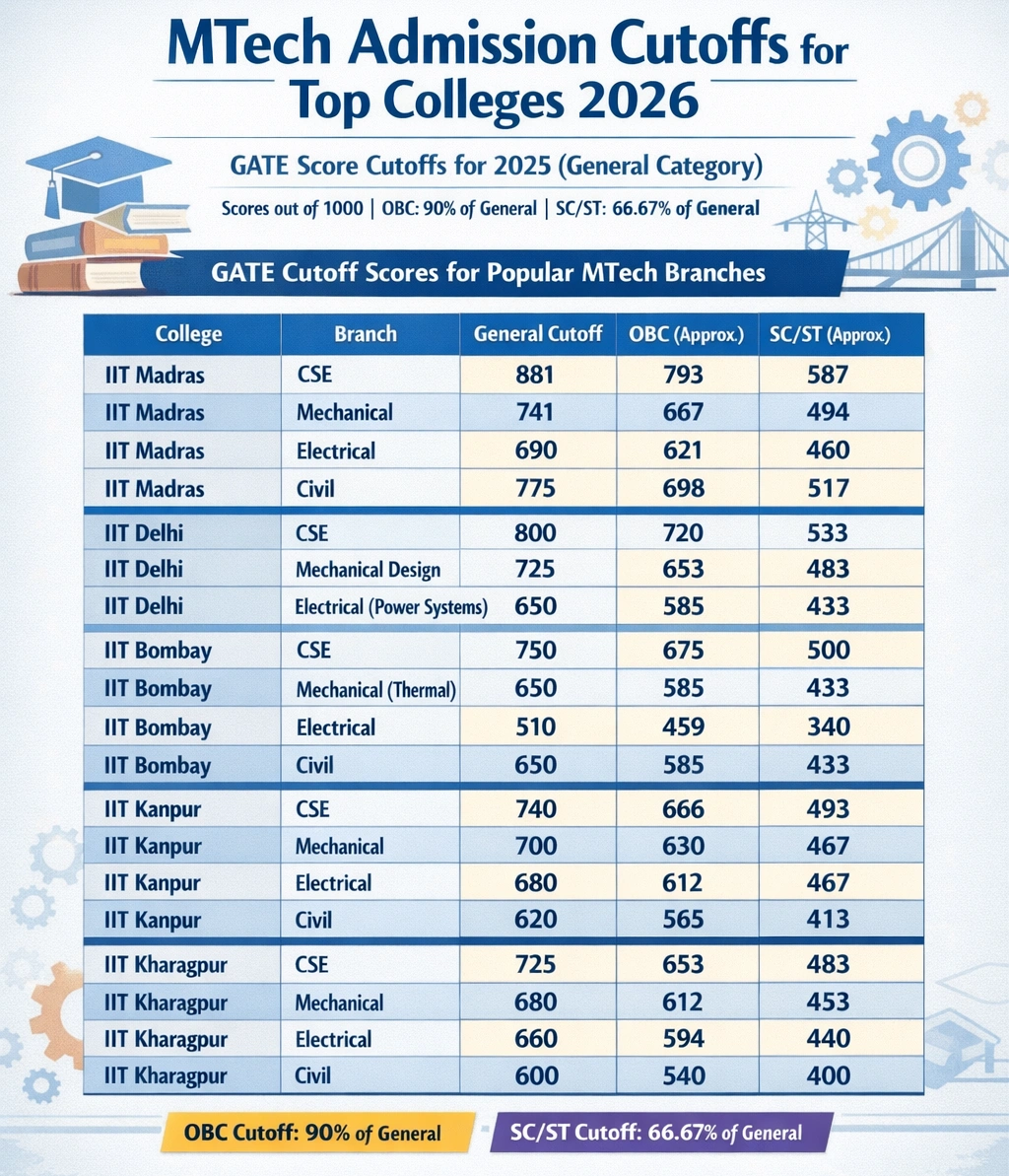
Cutoffs play a critical role in M.Tech admissions, determining the minimum scores or ranks required for eligibility and seat allocation. There are two main types: qualifying cutoffs set by the GATE organizing institute, which are the minimum marks needed to qualify the exam, and admission cutoffs released by individual institutions or through centralized counseling like COAP for IITs and CCMT for NITs. Qualifying cutoffs are uniform across the country and vary by paper/branch, category, and year, influenced by factors such as exam difficulty, number of candidates, and performance distribution. Admission cutoffs, however, are institute-specific and often higher, reflecting competition for seats in prestigious programs. These are typically GATE scores out of 1000, not raw marks.
For popular branches like Computer Science and Engineering (CSE), admission cutoffs in top IITs can exceed 700-800 for the General category, while core branches like Mechanical or Civil may have slightly lower thresholds. Reserved categories (OBC, SC/ST, EWS) benefit from relaxations, usually 10-20% lower than General. Understanding past cutoffs helps aspirants set realistic targets, prepare strategically, and choose preferences during counseling. Variations occur annually due to seat matrix changes, applicant pool, and reservation policies. Candidates should check official portals like gate.iit.ac.in for qualifying cutoffs and institute websites for admission details.
Qualifying Cutoffs for Master of Technology
The following table shows sample GATE qualifying cutoffs (marks out of 100) for popular branches, based on recent trends. These ensure eligibility for admissions but do not guarantee seats.
Branch
General
OBC
SC/ST
CSE
25
22.5
16.6
Mechanical
35.8
32.2
23.8
Electrical
30.7
27.6
20.4
Civil
28.3
25.4
18.8
Electronics
29
26.1
19.3
Chemical
34
30.6
22.6
MTech Admission Cutoffs for Top Colleges
Admission cutoffs vary by institute and specialization. Below is a table summarizing GATE scores (out of 1000) for the General category in select top IITs for 2025, focusing on popular branches like CSE, Mechanical, Electrical, and Civil. Data is compiled from official sources and may vary slightly by sub-specialization. For reserved categories, cutoffs are typically lower: OBC (90% of General), SC/ST (66.67% of General).
Top MTech Colleges in India
Top colleges for M.Tech in India are recognized for their exceptional academic standards, cutting-edge research facilities, and strong industry connections. These institutions attract the brightest minds and provide a conducive environment for advanced learning in engineering disciplines. Government colleges, primarily IITs and NITs, are favored for their affordability, rigorous curricula, and high return on investment through placements. Private colleges, on the other hand, stand out for their modern infrastructure, flexible programs, and emphasis on practical skills development. Choosing among these depends on factors like specialization, location, fees, and career goals.
These top colleges maintain high admission standards, often requiring strong GATE scores or institution-specific exams. They offer diverse specializations, from traditional branches like mechanical and civil to emerging fields such as AI, cybersecurity, and renewable energy. Faculty comprises experienced academicians and industry experts, ensuring a blend of theory and application. Campuses are equipped with advanced labs, libraries, and innovation centers, fostering research and entrepreneurship. Alumni from these institutions hold prominent positions globally, enhancing the network value.
Top Government MTech Colleges in India
Government colleges for M.Tech are highly sought after due to their low tuition fees, excellent faculty, and robust research ecosystems. Institutions like IITs and NITs receive substantial government funding, enabling state-of-the-art facilities and diverse specializations. Admissions are primarily through GATE, ensuring merit-based selection. These colleges have strong placement cells, attracting top recruiters from IT, manufacturing, and core engineering sectors. NIRF rankings highlight their consistent performance in academic and research metrics.
Studying in government colleges offers advantages like stipends for GATE qualifiers, access to national labs, and opportunities for interdisciplinary research. Campuses promote inclusivity with reservations and support for diverse backgrounds. Alumni networks are extensive, aiding career progression. These institutions emphasize ethical engineering practices and societal contributions, preparing graduates for roles in public sector undertakings and academia.
College Name
1st Year Fees (INR)
Application Deadline (2026 Cycle)
Entrance Exam
Why Apply
Brochure Link
Average Placement Salary (LPA)
NIRF Ranking
IIT Madras
50,000
April 2026
GATE
Top-ranked institute with world-class faculty, cutting-edge research facilities, and strong industry collaborations for innovative projects and career advancement.
Private colleges for M.Tech offer innovative curricula, state-of-the-art infrastructure, and greater flexibility in admissions. They often conduct their own entrance exams alongside GATE, allowing more opportunities for candidates. These institutions invest heavily in faculty development, international tie-ups, and placement training. NIRF rankings reflect their rising prominence in engineering education, with emphasis on employability and entrepreneurship.
Advantages include smaller class sizes for personalized attention, modern hostels, and extracurricular activities for holistic development. Private colleges frequently update programs to include industry certifications and skill-based electives. They provide scholarships based on merit and need, making education accessible. Strong industry partnerships lead to internships and live projects, enhancing resumes. Graduates from these colleges are well-prepared for dynamic job markets in tech and consulting.
College Name
1st Year Fees (INR)
Application Deadline (2026 Cycle)
Entrance Exam
Why Apply
Brochure Link
Average Placement Salary (LPA)
NIRF Ranking
VIT Vellore
1,93,000
April 12, 2026
VITMEE
Excellent infrastructure, international collaborations, and high placement records in tech sectors.
M.Tech placements in India are highly competitive and rewarding, with graduates from top institutions securing positions in leading companies across various sectors. Placement cells in colleges facilitate campus recruitment drives, pre-placement training, internships, and skill enhancement workshops to prepare students for the job market. Factors influencing placements include the candidate’s specialization, academic performance, GATE score, and institute reputation.
In recent years, particularly in 2025, placement rates have been strong, with averages ranging from 70% to 90% in premier institutes like IITs and NITs. Salaries vary by branch, with IT-related fields like CSE and AI commanding higher packages. Institutions collaborate with industries to align curricula with market needs, ensuring high employability. Many graduates also opt for higher studies or entrepreneurship post-M.Tech.
Overall, M.Tech enhances career trajectories by offering specialized knowledge, leading to faster promotions and leadership roles compared to B.Tech graduates. Networking through alumni events and industry meets further boosts opportunities.
MTech Job Roles and Salaries
M.Tech graduates are equipped for advanced technical roles that require expertise in engineering principles and innovation. Common job roles include software engineers in IT firms, design engineers in manufacturing, and research scientists in R&D labs. Salaries for freshers typically start at 5-12 LPA, but those from top IITs can secure 15-28 LPA based on specialization and company. For instance, in Computer Science, roles like Data Scientist or AI Engineer often fetch higher pay due to market demand. Experience plays a key role; with 2-5 years, salaries can double to 20-40 LPA.
Job roles vary by branch: Mechanical engineers may become Project Managers, while Civil graduates excel as Structural Consultants. Competitive packages include perks like bonuses, stock options, and relocation allowances. Government jobs through PSUs offer stability with salaries starting at 7-10 LPA plus benefits.
Research Methodology, Technical Writing, Innovation
Design Engineer
7-14
CAD Software, Engineering Design Principles
Systems Analyst
9-16
System Architecture, Problem-Solving, IT Infrastructure
Cybersecurity Specialist
12-22
Network Security, Ethical Hacking, Cryptography
Biotechnology Engineer
8-15
Biological Processes, Lab Techniques, Data Interpretation
These figures are based on 2025 data, actual salaries may vary by location and economic conditions.
MTech Career Growth Projections
Career growth after M.Tech is promising, with opportunities for rapid advancement in technical and managerial roles. Within 5-10 years, graduates can progress to senior positions like Technical Lead or Department Head, with salary increments of 15-20% annually. The demand for specialized skills in areas like AI, renewable energy, and cybersecurity is projected to grow by 20-30% by 2030, according to industry reports. M.Tech holders often pursue certifications like PMP or Six Sigma to enhance prospects.
For those inclined towards academia, roles evolve from Assistant Professor to Professor, with research grants and international collaborations. In the corporate sector, growth leads to C-level positions like CTO. Entrepreneurship is another path, with many starting tech startups leveraging their expertise. Overall, M.Tech provides a strong foundation for lifelong learning and adaptability in a dynamic job market.
Projections indicate a shift towards interdisciplinary roles, combining engineering with management or data sciences, leading to hybrid careers with global mobility.
Experience Level
Projected Role
Average Salary Projection (LPA by 2030)
0-2 Years
Junior Engineer/Analyst
10-18
3-5 Years
Senior Engineer/Team Lead
20-35
6-10 Years
Manager/Consultant
40-60
10+ Years
Director/CTO
70+
MTech Placement Statistics and Top Recruiters
Placement statistics for M.Tech in 2025 show high success rates, with IITs achieving 80-95% placements. Average packages range from 15-28 LPA at top institutes, with highest offers exceeding 50 LPA in tech sectors. NITs and IIITs report 70-85% placements with averages of 10-15 LPA. Key trends include increased hiring in AI and data science, with virtual recruitment drives post-pandemic.
Top recruiters include multinational corporations seeking skilled talent for innovation-driven roles. Statistics from IIT Madras indicate 85% placement for Electrical Engineering at 26 LPA average, while IIT Bombay reports 90% for CSE.
Institute
Placement Rate (%)
Average Salary (LPA)
Highest Salary (LPA)
IIT Madras
85
21
50
IIT Delhi
90
20
45
IIT Bombay
88
23.5
52
NIT Tiruchirappalli
82
12
30
VIT Vellore
80
9.9
25
Top recruiters: Google (25 LPA, Software Engineer), Microsoft (20 LPA, Data Scientist), TCS (8 LPA, Project Manager), Intel (15 LPA, Hardware Engineer), Amazon (22 LPA, Cloud Engineer), Goldman Sachs (18 LPA, Analyst), Samsung (16 LPA, R&D Engineer), Infosys (7 LPA, Systems Analyst), Adobe (20 LPA, AI Specialist), GE India (14 LPA, Design Engineer).
Opportunities in Different Sectors
M.Tech opens doors across sectors, from IT and software to manufacturing and healthcare. In IT, opportunities abound in software development and cybersecurity. Manufacturing sectors seek expertise in automation and quality control. Renewable energy offers roles in sustainable design, while biotechnology integrates engineering with life sciences.
Government sectors like PSUs (ONGC, BHEL) provide stable jobs through GATE. Consulting firms value analytical skills for problem-solving. Emerging sectors like electric vehicles and space technology are growing rapidly.
Sector
Key Opportunities
Average Salary (LPA)
IT/Software
Software Development, AI, Data Analytics
10-20
Manufacturing
Design, Production, Quality Assurance
8-15
Renewable Energy
Solar/Wind Projects, Energy Management
9-16
Biotechnology
Research, Product Development
8-14
Government/PSUs
Engineering Services, Research
7-12
Consulting
Technical Consulting, Strategy
12-18
Automotive
EV Design, Automation
10-17
Global Opportunities after MTech
M.Tech from India paves the way for international careers, with many graduates pursuing jobs or further studies abroad. Countries like the USA, Germany, and Canada value Indian M.Tech qualifications for roles in tech giants. Campus placements at IITs often include international offers from companies like Google US or Microsoft.
Options include MS/PhD abroad, leading to research positions, or direct employment via H-1B visas. Germany offers 18-month post-study work visas for M.Tech equivalents. Salaries abroad start at $70,000-100,000 annually. Networking through alumni and certifications like TOEFL/GRE enhances prospects.
Global sectors like semiconductors and AI have high demand for Indian talent, with opportunities in R&D and consulting.
Country
Key Opportunities
Average Salary (USD)
USA
Tech Firms, Research Labs
80,000-120,000
Germany
Engineering, Automotive
60,000-90,000
Canada
IT, Renewable Energy
70,000-100,000
UK
Consulting, Academia
50,000-80,000
Australia
Mining, Infrastructure
70,000-95,000
MTech Scholarships
Scholarships for M.Tech programs play a vital role in alleviating financial constraints for deserving students, enabling them to focus on academic and research pursuits. These financial aids are offered by government bodies, private foundations, corporations, and institutions, based on criteria such as merit, financial need, category reservation, gender, or specific disabilities. For GATE-qualified candidates, stipends are particularly common, providing monthly support throughout the program. Beyond tuition coverage, many scholarships include allowances for books, accommodation, and professional development, fostering inclusivity and encouraging talent from diverse backgrounds to enter advanced engineering fields.
The landscape of M.Tech scholarships in India has evolved to support emerging technologies and national development goals, with increased funding for specializations in AI, renewable energy, and biotechnology. Applications typically require online submissions through portals like the National Scholarship Portal (NSP) or specific organization websites, involving documents such as academic transcripts, income certificates, GATE scorecards, and category proofs. Deadlines vary but often fall between August and December for the upcoming academic year. Timely preparation and adherence to guidelines are crucial to secure these opportunities.
Government MTech Scholarships
Government scholarships, administered by bodies like AICTE, UGC, and through NSP, form the backbone of financial support for M.Tech students. These are merit-cum-need based, prioritizing GATE qualifiers and reserved categories. They ensure accessibility to quality education in AICTE-approved institutions, with stipends disbursed directly to bank accounts.
Key schemes include AICTE PG Scholarship for GATE holders and targeted programs like Pragati for girls and Saksham for differently-abled students. These promote diversity and skill development in engineering.
Private and Foundation MTech Scholarships
Private scholarships from corporations and foundations emphasize innovation and leadership. They often include holistic development components like internships and mentoring, beyond monetary aid. Examples include Reliance Foundation and GyanDhan scholarships, which support high-potential students in cutting-edge fields.
These schemes have competitive selection processes involving essays, interviews, and aptitude tests, rewarding excellence and commitment to societal impact.
Application Process and Tips
The application process generally involves online registration, document upload, and verification. For NSP schemes, students register on scholarships.gov.in, while AICTE applications go through aicte.gov.in. Tips include starting early, gathering all documents, writing compelling statements of purpose, and tracking deadlines. Common requirements: Aadhaar-linked bank account, valid GATE score, and income below specified limits for need-based aids.
Rejections often occur due to incomplete forms or mismatches; hence, double-check submissions. Counseling from college scholarship cells can aid the process.
MTech Scholarship Name
Eligibility
Amount (INR)
Application Deadline (2026-27) (tentative)
AICTE PG Scholarship (GATE/GPAT)
Valid GATE/GPAT score, admitted to AICTE-approved M.Tech/M.E. programs, not receiving other central scholarships
12,400 per month for up to 24 months
December 2026
Reliance Foundation Postgraduate Scholarships
First-year PG in specified fields (AI, CS, etc.), GATE 550+ or UG CGPA 7.5+, Indian citizen
Up to 6,00,000 over the program duration
September 2026
AICTE Pragati Scholarship for Girls
Girl students in technical education, family income <8 LPA, admitted via merit
50,000 per year (tuition + incidentals)
November 2026
AICTE Saksham Scholarship
Differently-abled students (40%+ disability) in technical degree, family income <8 LPA
50,000 per year
November 2026
AICTE Swanath Scholarship
Orphans or wards of deceased armed forces/COVID-19 victims, in technical education
50,000 per year
November 2026
National Scholarship for Post Graduate Studies
EWS students pursuing PG, family income <2.5 LPA, minimum 50% in UG
15,000 per month for 10 months
October 2026
Central Sector Scheme of Scholarships
Top 20% in Class 12, pursuing PG in engineering, family income <4.5 LPA
Up to 1,25,000 per year for engineering courses
December 2026
Post Matric Scholarship for SC/ST
SC/ST students in PG, family income <2.5 LPA for SC, <2 LPA for ST
Full tuition + maintenance allowance (variable)
January 2026
Merit-cum-Means Scholarship for Minorities
Minority communities, family income <2.5 LPA, 50% in previous exam
Up to 30,000 per year + maintenance
December 2026
Ishan Uday Special Scholarship for NER
Students from North Eastern Region, family income <4.5 LPA, in technical courses
7,800 per month
December 2026
GyanDhan Scholarship
UG/PG/diploma students in India/abroad, no GPA requirement
2,50,000 one-time
February 2026
Prime Minister’s Scholarship Scheme
Wards of ex-servicemen/police personnel, in professional courses
3,000 per month for boys, 3,600 for girls
November 2026
UGC PG Scholarship for Professional Courses
SC/ST students in M.Tech, GATE qualified
7,800 per month for duration
December 2026
National Means Cum-Merit Scholarship
Merit-based for economically weaker, continuing to PG
12,000 per year
October 2026
GlaxoSmithKline Pharmaceuticals Scholarships
Merit-based for science/engineering PG students
Variable, up to 1,00,000
December 2026
This table encompasses major scholarships; amounts and deadlines are indicative based on 2025-26 data. Students should consult official portals for updates and apply promptly to maximize chances.
FAQs
What is the eligibility criteria for M.Tech?
To be eligible for M.Tech, candidates need a B.E. or B.Tech degree or equivalent in a relevant discipline from a recognized university, with at least 60% aggregate marks (55% for reserved categories). A valid GATE score or university-specific entrance exam is often required, and work experience is preferred for sponsored seats, though not mandatory for regular admissions.
How can I get admission into M.Tech programs?
Admission to M.Tech typically involves qualifying in entrance exams like GATE, followed by centralized counseling through CCMT or COAP. Register for the exam, prepare thoroughly, and after results, fill choices for colleges during counseling. Document verification and fee payment confirm the seat, with some institutions offering direct admissions for high-merit or sponsored candidates.
What is the syllabus for M.Tech in Computer Science?
The M.Tech CSE syllabus spans four semesters, covering advanced algorithms, database systems, machine learning, operating systems, cloud computing, and data mining. It includes electives, labs, projects, and a dissertation. The first year focuses on core concepts, while the second emphasizes research and practical applications to prepare for industry or academia.
Which are the top colleges for M.Tech in India?
Top government colleges include IIT Madras, IIT Delhi, IIT Bombay, IIT Kanpur, and IIT Kharagpur, known for research and low fees. Private options like VIT Vellore, BITS Pilani, SRM Chennai, Thapar Institute, and Amity Noida offer modern facilities and industry ties. Selection depends on GATE scores and rankings.
What are the placement prospects after M.Tech?
M.Tech graduates enjoy strong placements in IT, manufacturing, and research sectors, with average salaries of 5-12 LPA, higher in top institutes. Roles include software engineer, data scientist, and project manager. Recruiters like Google, Microsoft, and TCS participate in campus drives, with placement rates often exceeding 80% in premier colleges.
What is the difference between M.Tech and M.E.?
M.Tech focuses on advanced technical skills, research, and practical applications in engineering, often with a dissertation. M.E. is similar but may emphasize theoretical aspects and design principles. Both are two-year programs, but M.Tech is more industry-oriented, while M.E. suits academic or design-focused careers, depending on the institution.
Is GATE compulsory for M.Tech admissions?
GATE is essential for admissions to top government colleges like IITs and NITs, ensuring merit-based selection. However, some private institutions accept their own entrance exams like VITMEE or SRMJEEE PG. Non-GATE candidates can apply to universities with direct admissions or alternative tests, but GATE offers scholarships and better opportunities.
What specializations are available in M.Tech?
M.Tech offers specializations like Computer Science, Artificial Intelligence, Mechanical Engineering, Civil Engineering, Electrical Engineering, Data Science, Biotechnology, and Cyber Security. Each focuses on advanced topics, practical labs, and research, aligning with industry needs. Choices depend on undergraduate background and career goals, with electives for customization.
What scholarships are available for M.Tech students?
Scholarships include AICTE PG for GATE qualifiers (12,400/month), Reliance Foundation (up to 6,00,000), and category-based like Post Matric for SC/ST. Merit-cum-means options support low-income students. Applications via NSP or institutional portals require GATE scores, income proofs, and academic records, reducing financial burdens significantly.
Abhijeet Chatterjee is a professional Content and Copy specialist with over five years of experience in crafting compelling content around the Edtech domain. His portfolio includes notable work for companies such as PhysicsWallah, Roar Media, Jagran Josh, etc. Academically, Abhijeet holds a Master's in Mass Communication, where he was awarded a gold medal for his outstanding performance. He has also qualified for the UGC NET in Mass Communication, demonstrating his expertise and a deep understanding of the field. His academic foundation is built on a Bachelor's degree in English Literature. Beyond his professional work, Abhijeet is an avid writer and a cinephile. His personal interests include scriptwriting, film criticism, and reading novels.