DDVL (Diploma in Dermatology, Venereology and Leprosy) Full Form, Admission Process, Colleges, Entrance Exams, Syllabus, Jobs, Scope, Salary 2026
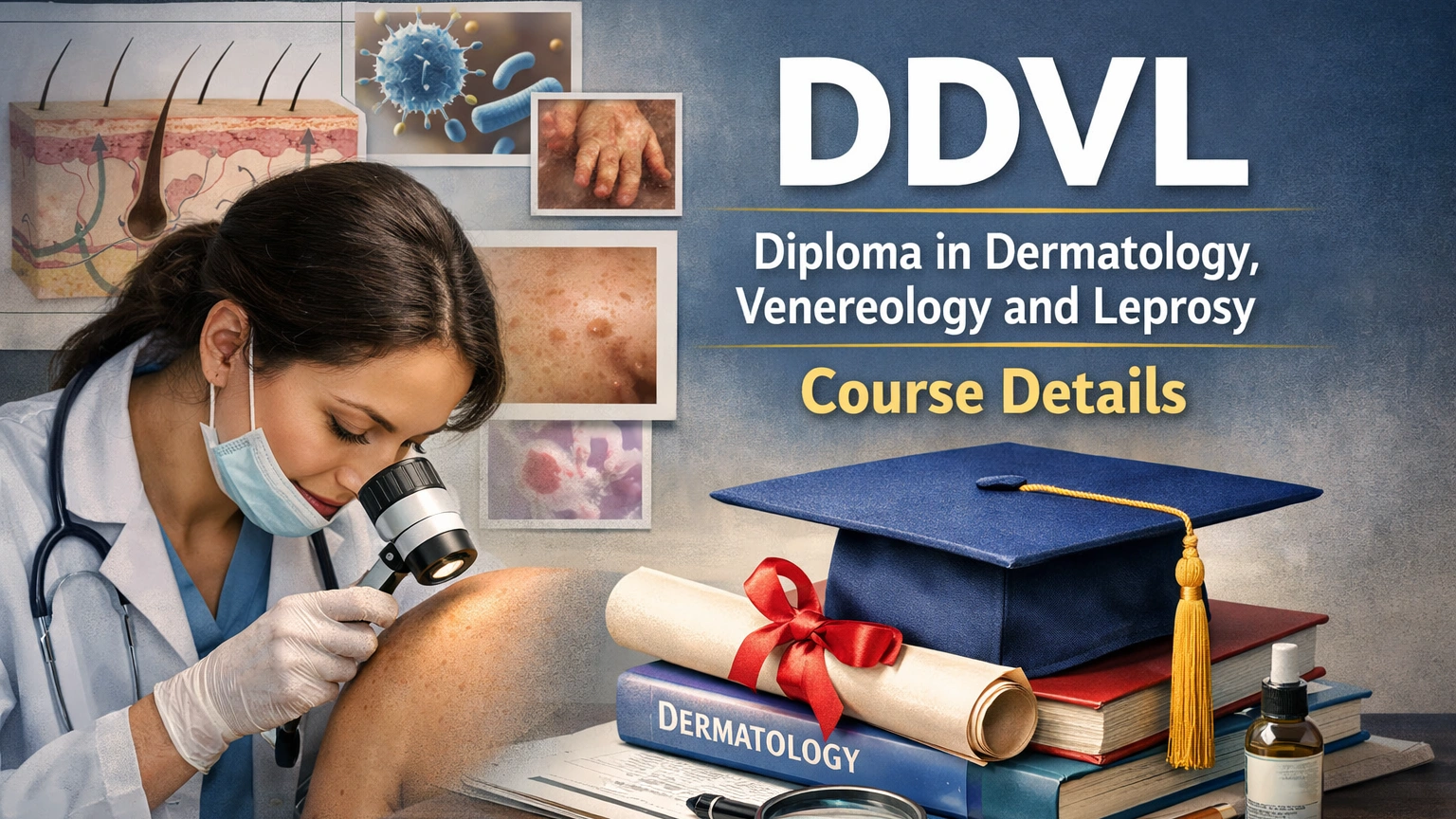
The Diploma in Dermatology, Venereology and Leprosy (DDVL) is a specialised postgraduate diploma program. It equips medical graduates with deep expertise in diagnosing and managing skin disorders, sexually transmitted infections (STIs), and leprosy (Hansen’s disease). As a 2-year course (sometimes extended to 3 years in certain institutions), DDVL covers both clinical and cosmetic aspects of dermatology. This includes common skin conditions, dermatosurgery, leprosy care, and venereology challenges such as HIV-associated dermatoses.
In an era where skin health connects with aesthetics, infectious diseases, and public health, DDVL graduates play a vital role in hospitals, clinics, and community programs. Rising demand for dermatological care comes from growing awareness of cosmetic procedures, STD prevalence, and leprosy management. This qualification opens doors to rewarding careers.
This full guide covers the DDVL full form in medical, what the degree entails, the admission process, key entrance exams (primarily NEET PG), syllabus details (with PDF download options), top colleges in India, comparisons with DNB DVL and DVD, emerging job trends, career scope, and expected salary in 2026.
DDVL Full Form in Medical
DDVL stands for Diploma in Dermatology, Venereology and Leprosy. It is a widely recognized postgraduate medical diploma in India, awarded after completing specialized training in the diagnosis, treatment, and management of skin diseases, sexually transmitted infections (STIs), and leprosy.
The diploma covers three core domains:
- Dermatology – focusing on skin, hair, nail, and mucous membrane disorders, ranging from acne, eczema, and psoriasis to cosmetic procedures and dermatosurgery.
- Venereology – dealing with sexually transmitted diseases such as syphilis, gonorrhoea, herpes, chlamydia, and HIV-related skin conditions.
- Leprosy – addressing the clinical care, treatment, prevention, and rehabilitation of Hansen’s disease, a chronic condition caused by Mycobacterium leprae affecting skin and nerves.
What is a DVD Medical Degree?
DVD stands for Diploma in Venereology and Dermatology (also commonly referred to as Diploma in Dermatology and Venereology in some older contexts). It is a postgraduate diploma qualification in India, awarded after MBBS, focusing on the diagnosis and management of skin diseases, hair and nail disorders, and sexually transmitted infections (venereology).
This 2-year program (similar in duration to DDVL) emphasises practical clinical training in dermatological conditions like acne, eczema, psoriasis, fungal infections, and cosmetic issues, along with venereal diseases such as syphilis, gonorrhoea, herpes, and related complications.
DDVL Admission Process
Admission to the Diploma in Dermatology, Venereology and Leprosy (DDVL) in India is merit-based and centralised through the NEET PG exam conducted by NBEMS. Candidates must hold an MBBS degree, complete a one-year compulsory rotating internship (by the specified cutoff, usually September 30 for the 2026 session), and have permanent or provisional registration with NMC or a State Medical Council.
- Complete MBBS from an NMC-recognised institution and finish the compulsory one-year rotating internship (by the cutoff date, typically September 30 for the 2026 session).
- Register and apply online for NEET PG on the NBEMS website (nbe.edu.in), fill in the details, upload documents, and pay the fee.
- Appear for the NEET PG computer-based exam, the single national entrance for all PG diplomas, including DDVL.
- Qualify NEET PG by scoring above the category-wise cutoff percentile and check your rank/result.
- Register for counseling: All India Quota (50% seats) via MCC (mcc.nic.in) and/or state quota (remaining seats) through respective state authorities.
- Fill and lock choices for preferred DDVL colleges and courses during counseling rounds.
- Receive seat allotment based on NEET PG rank, category reservations, and availability; report to the allotted college for document verification and fee payment to confirm admission.
| Step | Description | Key Details / Authority |
| Eligibility Check | MBBS + 1-year internship + NMC/State registration | Internship cutoff: Sept 30, 2026 (tentative) |
| NEET PG Registration | Online form on NBEMS website | Form filling, documents, fee payment |
| Appear for Exam | Computer-based NEET PG test | Single entrance for all PG courses |
| Result & Scorecard | Qualifying rank/percentile released | Category-wise cutoff |
| Counseling Registration | Register for AIQ and/or state counseling | MCC for AIQ; State bodies for state quota |
| Choice Filling & Lock | Select preferred DDVL colleges | Based on rank and preferences |
| Seat Allotment | Multiple rounds (including mop-up) | Merit + reservation basis |
| Reporting & Admission | Join college, verify documents, pay fees | Final admission confirmation |
DDVL Course Eligibility
To pursue the Diploma in Dermatology, Venereology and Leprosy (DDVL), candidates must meet the standard postgraduate medical diploma eligibility set by the National Medical Commission (NMC).
| Criterion | Details |
| Educational Qualification | MBBS degree or equivalent from an NMC-recognized medical college/institution |
| Internship | Completion of compulsory one-year rotating internship (by the specified cutoff date, typically September 30 for the 2026 session) |
| Registration | Permanent or provisional registration with NMC or any State Medical Council |
| Entrance Exam | Qualification in NEET PG with the required percentile/rank |
| Age Limit | No upper age limit |
| Attempts Limit | No restriction on number of attempts |
| Reserved Categories | Relaxation in qualifying percentile as per NEET PG guidelines (e.g., 40th percentile for SC/ST/OBC/PwD vs. 50th for General) |
| Foreign Medical Graduates | Must qualify FMGE (if applicable), complete an internship, and hold a valid Indian registration |
Top Entrance Exams for DDVL
The primary and mandatory entrance exam for admission to the Diploma in Dermatology, Venereology and Leprosy (DDVL) in India is NEET PG, conducted by the National Board of Examinations in Medical Sciences (NBEMS). No other separate entrance exams are required or widely accepted for DDVL seats, as NEET PG serves as the single national-level qualifier for all postgraduate medical diplomas and degrees, including DDVL. Other exams like NEET UG or state-level tests do not apply for this postgraduate diploma.
Top Entrance Exams for DDVL 2026
| Exam Name | Conducted By | Registration Date | Exam Date |
| NEET PG | National Board of Examinations in Medical Sciences (NBEMS) | To be announced (tentative: last week of April to last week of May 2026) | August 30, 2026 (tentative, Sunday) |
Note: Dates for NEET PG 2026 are tentative as per the latest NBEMS notification (released January 2026); official registration and other details will be confirmed in the information brochure on natboard.edu.in or nbe.edu.in. NEET PG remains the sole entrance route for DDVL admissions nationwide.
DDVL Syllabus 2026
The DDVL syllabus covers objectives, skills, basic sciences, clinical topics, infections, therapeutics, STD/venereology, leprosy, practical exams, and additions like dermoscopy/cosmetic dermatology and CME.
| Section | Brief Description/Key Areas Covered |
| Objectives & Goals | Independent diagnosis/management of common skin/STD/leprosy; emergencies; prevention; teaching skills; compassionate care; investigations. |
| Skills to Be Learnt | History-taking; cutaneous description; common/uncommon disease management; STD/HIV evaluation; emergencies (e.g., TEN, pemphigus); pediatric cases; lab tests. |
| Allied Basic Sciences | Skin structure/function; immunology/genetics; epidermal kinetics; lipids/absorption; sweat/hair/nail/melanocyte biology; connective tissue; metabolism; wound healing/inflammation; microbiology; histopathology/immunofluorescence. |
| Clinical Dermatology | Epidemiology; psycho-cutaneous; pruritus; papulo-squamous (psoriasis, lichen planus, ichthyoses); vesiculo-bullous (pemphigus, bullous pemphigoid); appendages (acne, rosacea); tumours; pigmentation (vitiligo); inflammatory dermis; subcutaneous; mucocutaneous; altered reactivity (urticaria, eczema); mechanical/physical; photobiology; drug reactions; vascular; age-related; nutritional/metabolic; systemic manifestations; genodermatoses; rheumatologic/connective tissue; neurocutaneous. |
| Infections | Bacterial (pyodermas, TB, actinomycetoma); fungal (superficial/deep); viral (herpes, HPV, molluscum); parasitic/protozoal (scabies, pediculosis). |
| Therapeutics | Topical (glucocorticoids, antimicrobials, sunscreens, retinoids); systemic (antibiotics, retinoids, immunosuppressives, biologics); dermatosurgery/cosmetic (lasers, peels, botox, fillers, cryotherapy, hair transplant, Mohs); phototherapy (NB-UVB, PUVA). Basics of dermoscopy/trichoscopy. |
| STD (Venereology) | Clinical approach: viral/bacterial/chlamydial/fungal/protozoal/ectoparasitic; syndromic management; HIV/ART (diagnosis, prophylaxis, toxicity, failure); prevention; national programs; medicolegal/social aspects. |
| Leprosy | Approach; epidemiology; pathogenesis/classification; immunology; clinical features/reactions; systemic involvement; treatment/new drugs; disabilities/rehabilitation; national elimination program. |
| Practical/Clinical Examination | Long case (80 marks); short cases (60 marks); viva (80 marks); spotters (50 marks); histopath slides (30 marks). Total: 300 marks. |
| Continuing Medical Education | Sponsored CMEs (dermatopathology, dermoscopy, genodermatoses, etc.); faculty training; foreign conferences; enhanced digital library resources (e.g., JAAD, JEADV). |
Download DDVL Syllabus PDF
Provided below is the latest DDVL syllabus in a downloadable PDF format:
DDVL Syllabus
Top Colleges for DDVL
The Diploma in Dermatology, Venereology and Leprosy (DDVL) is offered in select government and private medical colleges across India, with seats allotted through NEET PG counseling (MCC for All India Quota and state authorities for state quota). Top colleges are chosen based on reputation, infrastructure, faculty expertise, patient load, clinical exposure, and cutoff trends from recent years. Government colleges often have lower fees and high competition, while private/deemed ones offer more seats but higher fees.
| College Name | Location | Type | Approx. Annual Fees (INR) | Key Notes / Highlights |
| Madras Medical College | Chennai, Tamil Nadu | Government | 15,000 – 50,000 | One of the oldest and most reputed; excellent clinical exposure in skin/STD/leprosy cases. |
| Christian Medical College (CMC) | Vellore, Tamil Nadu | Private (Deemed) | 10,000 – 50,000 (varies) | Renowned for high-quality training, research, and patient diversity. |
| Maulana Azad Medical College (MAMC) | New Delhi | Government | 20,000 – 1 Lakh | Premier institute with strong dermatology department and urban patient load. |
| Kasturba Medical College (KMC) | Manipal, Karnataka | Private (Deemed) | 10–15 Lakh | Excellent facilities, cosmetic dermatology focus, and good infrastructure. |
| Amrita School of Medicine | Kochi, Kerala | Private (Deemed) | 5–10 Lakh | Modern setup with emphasis on venereology, HIV-related care, and academics. |
| Lady Hardinge Medical College | New Delhi | Government | 20,000 – 50,000 | Strong in women’s health-related dermatology and leprosy management. |
| Andhra Medical College | Visakhapatnam, Andhra Pradesh | Government | 30,000 – 1 Lakh | Good for southern India; high case volume in tropical skin diseases. |
| Armed Forces Medical College (AFMC) | Pune, Maharashtra | Government (Defense) | Low (service bond) | Prestigious; requires service commitment; excellent training. |
| PSG Institute of Medical Sciences & Research | Coimbatore, Tamil Nadu | Private | 5–10 Lakh | Reputed private college with modern dermatosurgery and cosmetic focus. |
| Mahatma Gandhi Institute of Medical Sciences (MGIMS) | Wardha, Maharashtra | Private (Deemed) | 5–12 Lakh | Known for community-oriented leprosy and skin disease programs. |
DDVL vs DNB DVL vs DVD
In India, DDVL, DNB DVL, and DVD are postgraduate qualifications in the field of Dermatology, Venereology, and Leprosy (DVL), pursued after MBBS. They enable doctors to specialize in skin disorders, sexually transmitted infections (STIs), leprosy management, and cosmetic dermatology. All are recognised by the National Medical Commission (NMC) for practice as dermatologists/venereologists.
- DDVL (Diploma in Dermatology, Venereology and Leprosy) is a 2-year diploma focused on practical clinical skills.
- DVD (Diploma in Venereology and Dermatology, or sometimes Diploma in Dermatology and Venereology) is an older/equivalent diploma (often interchangeable with DDVL in practice), historically with a similar curriculum but sometimes less emphasis on leprosy.
- DNB DVL (Diplomate of National Board in Dermatology, Venereology and Leprosy) is a 3-year (post-MBBS) or 2-year (post-diploma) program by the National Board of Examinations in Medical Sciences (NBEMS), equivalent in status to MD DVL and often considered superior to diplomas for academic/teaching roles.
| Parameter | DDVL (Diploma in Dermatology, Venereology and Leprosy) | DVD (Diploma in Venereology and Dermatology) | DNB DVL (Diplomate of National Board in Dermatology, Venereology and Leprosy) |
| Full Form | Diploma in Dermatology, Venereology and Leprosy | Diploma in Venereology and Dermatology (or Dermatology and Venereology) | Diplomate of National Board in Dermatology, Venereology and Leprosy |
| Duration | 2 years (sometimes 3 in select institutions) | 2 years | 3 years (post-MBBS primary); 2 years (post-diploma secondary) |
| Entrance Exam | NEET PG (mandatory) | NEET PG (mandatory) | NEET PG for primary 3-year; DNB PDCET for post-diploma 2-year |
| Awarding Body | State universities / NMC-recognized colleges | State universities / older MCI/NMC programs | National Board of Examinations in Medical Sciences (NBEMS) |
| Recognition & Equivalence | NMC-recognized diploma; valid for practice, but lower than MD/DNB | NMC-recognized diploma; often treated as equivalent to DDVL | Equivalent to MD DVL; higher prestige, better for teaching/academia/govt jobs |
| Focus & Curriculum | Practical clinical skills, emergencies, lab work; leprosy emphasis | Similar to DDVL; historically more venereology-focused, less leprosy | full; includes thesis/research (in 3-year); advanced training |
| Seats Availability | Limited (mostly government/private colleges) | Fewer now (phasing out in some places) | Available in accredited hospitals; competitive |
| Career Scope & Preference | Good for private practice/clinics; faster entry | Similar to DDVL; good private practice | Preferred for hospitals, teaching, higher studies; better salary/acceptance |
| Job Opportunities | Dermatologist in clinics, hospitals; cosmetic procedures | Similar; sometimes higher private demand | Broader: teaching, research, senior roles; post-diploma option for diploma holders |
| Approx. Salary (starting, 2026) | ₹8–15 Lakh per annum (private); varies by location | ₹8–18 Lakh per annum | ₹12–25 Lakh per annum (higher in govt/hospitals) |
| Pros | Shorter duration; quicker specialization; good clinical exposure | Similar to DDVL; established in some regions | Higher equivalence to MD; better recognition; research component |
| Cons | Lower academic value; limited teaching roles | Older nomenclature; fewer new seats | Longer (3 years); highly competitive; thesis required |
Job Trends after DDVL
Completing the Diploma in Dermatology, Venereology and Leprosy (DDVL) opens diverse career paths in India, driven by rising demand for skin care, cosmetic procedures, STI management, and leprosy control. Graduates can start independent practice quickly (due to the shorter 2-year duration) or join hospitals/clinics. Key trends in 2026 include strong private sector growth in aesthetic dermatology (lasers, peels, Botox), increasing urban clinics, and opportunities in multispecialty hospitals. Government jobs offer stability via state/central health services or teaching roles (often requiring experience or further qualifications). Placements are good in private chains and hospitals, with many opting for their own clinics after 1-2 years.
| Aspect | Details | Approx. Figures / Notes (2026) |
| Common Job Profiles | Dermatologist / Consultant Dermatologist; Cosmetic Dermatologist; Venereologist; Dermatology Consultant; Assistant Professor (after experience); Private Clinic Owner | High demand in cosmetics and general skin/STD care. |
| Placements & Trends | Strong in private sector (clinics, chains like Kaya/Oliva); Multispecialty hospitals; Government hospitals (via state PSC or direct recruitment); Teaching in medical colleges | Private practice/clinics most popular; 70-80% start private after 1-2 years experience; Government roles competitive but stable. |
| Starting Salary (Fresh) | ₹8-15 LPA (private clinics/hospitals); ₹6-10 LPA (government/resident roles) | Varies by location (higher in metros like Delhi/Mumbai/Bengaluru). |
| Mid-Level Salary (3-8 Years) | ₹15-30 LPA (private); ₹12-20 LPA (government/hospitals) | Boost from cosmetics/aesthetics; incentives add 20-50%. |
| Senior/Experienced Salary (10+ Years) | ₹25-50 LPA+ (private practice/cosmetic specialists); ₹15-25 LPA (government/senior consultant) | Own clinic or high-volume aesthetics can exceed ₹50 LPA. |
| Top Recruiters / Employers | Kaya Skin Clinic; Oliva Skin & Hair Clinics; Fortis Hospitals; Apollo Hospitals; Medanta; Private chains (Dermafelix, Kolors Healthcare); Government hospitals (AIIMS affiliates, state-run); Multispecialty like CMC Vellore, Manipal | Private chains dominate; hospitals seek experienced DDVL for OPD/IPD. |
| Other Opportunities | Own dermatology/cosmetic clinic; Corporate wellness; Medical representative (pharma like Cipla, GSK); Research/teaching (after further quals) | Growing aesthetic market; freelance procedures common. |
DDVL Scope
The Diploma in Dermatology, Venereology and Leprosy (DDVL) offers one of the broadest and most versatile career scopes among all postgraduate medical diplomas in India. This 2-year qualification allows graduates to work independently as skin specialists very early in their career and covers three major interrelated domains:
- Medical Dermatology – Diagnosis and treatment of all types of skin, hair, nail and mucous membrane diseases
- Cosmetic / Aesthetic Dermatology – One of the fastest growing and most financially rewarding areas
- Venereology (STDs / HIV related skin diseases) – Management of sexually transmitted infections
- Leprosy – Diagnosis, treatment, reactions, disability prevention and rehabilitation
| Area of Practice / Work Setting | Nature of Work | Earning Potential |
| Own Dermatology / Cosmetic Clinic | Independent practice, OPD, procedures, lasers, peels, Botox, fillers | Very High (₹25L – 1 Cr+ / year) |
| Cosmetic & Aesthetic Dermatology | Laser hair removal, skin rejuvenation, anti-aging treatments, chemical peels | Extremely High |
| Multispecialty / Corporate Hospitals | Full-time / visiting consultant dermatologist | High (₹15–40L / year) |
| Private Skin / Hair / Laser Chains | Kaya, Oliva, Richfeel, Dr. Batra’s, Dr. Paul’s, etc. | High + incentives |
| Government Hospitals & Medical Colleges | Specialist Medical Officer, Assistant Professor (after experience) | Moderate + perks |
| Leprosy Control Programme | District leprosy officer, medical officer under NLEP | Moderate |
| STD / HIV Clinics & NACO Centres | Venereologist, ART centre doctor | Moderate to good |
| Medical Tourism & High-end Aesthetic Centres | Procedures for international patients | Very High |
| Pharmaceutical Companies / Medical Advisor | Advisor, trainer for derma products | Good |
| Further Studies | DNB DVL (2 years post diploma), fellowships in lasers/cosmetics/dermatosurgery | Increases future earning |
FAQs
1. What is the full form of DDVL and what does the course cover?
DDVL stands for Diploma in Dermatology, Venereology and Leprosy. It is a 2-year postgraduate diploma (sometimes 3 years in select institutions) after MBBS, focusing on diagnosing and managing skin, hair, nail disorders, sexually transmitted infections (STIs), HIV-related skin issues, and leprosy (including reactions, disabilities, and rehabilitation). The syllabus emphasizes practical clinical skills, emergencies, therapeutics, dermatosurgery, and cosmetic procedures.
2. What is the eligibility criteria for DDVL admission in 2026?
Candidates must hold an MBBS degree from an NMC-recognized institution, complete a compulsory one-year rotating internship (by the cutoff date, usually September 30 for the 2026 session), and have permanent or provisional registration with NMC or a State Medical Council. There is no upper age limit or attempt restriction. Qualification in NEET PG is mandatory.
3. How is admission to DDVL done in 2026?
Admission is through NEET PG conducted by NBEMS. After qualifying, candidates participate in centralized counseling: 50% All India Quota seats via MCC and 50% state quota via state authorities. Seats are allotted based on NEET PG rank, category reservations, and choices filled for DDVL in government/private/deemed colleges.
4. What is the typical duration and fee structure for DDVL?
The course duration is 2 years (full-time; occasionally 3 years). Fees vary widely: government colleges charge ₹15,000–₹1 lakh per year, while private/deemed institutions range from ₹1–15 lakh per year (or more in some cases). Exact fees depend on the college and quota (government vs. Management).
5. How does DDVL differ from MD/DNB in Dermatology, Venereology & Leprosy?
DDVL is a 2-year diploma focused on practical skills for quicker clinical entry. MD and DNB DVL are 3-year degrees (or 2-year post-diploma DNB) with deeper academics, research/thesis, and higher equivalence for teaching/government jobs. DDVL is valid for independent practice but ranks lower than MD/DNB for academia.
6. What are the main job opportunities and salary after DDVL?
Graduates work as dermatologists in private clinics, hospitals, cosmetic chains (e.g., Kaya, Oliva), government setups, or start their own practice. Starting salary is ₹8–15 LPA in private; higher with cosmetics (up to ₹25–50 LPA+ mid-career). Government jobs offer stability with ₹6–12 LPA initially.
7. What is the career scope and future prospects after DDVL in 2026?
Scope is excellent due to rising demand in cosmetics, aesthetics, STI/HIV care, and leprosy programs. Many open independent clinics for high earnings. Options include multispecialty hospitals, teaching (after experience), further DNB upgrade, or fellowships in lasers/cosmetics. Private aesthetic practice offers the best financial growth.
8. Is DDVL sufficient to practice as a dermatologist in India?
Yes, DDVL qualifies you as a specialist in dermatology, venereology, and leprosy for independent practice, including procedures and cosmetics (with additional certifications if needed). It is NMC-recognized, though MD/DNB holders may have preference in teaching or certain government roles.