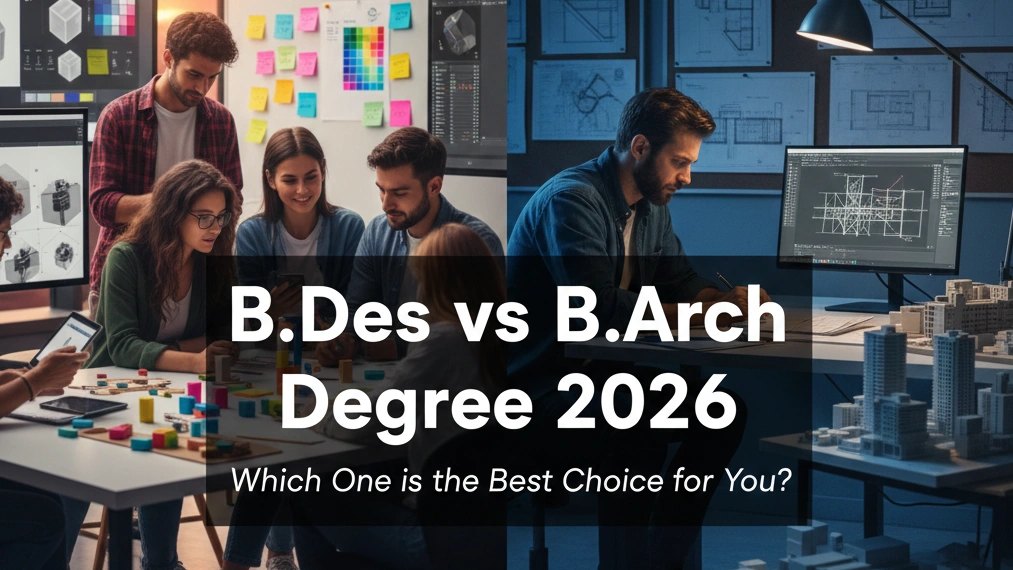
BDes vs BArch Degree: In 2026, choosing between Bachelor of Design (BDes) and Bachelor of Architecture (BArch) is a defining decision for creative students passionate about shaping spaces, products, or experiences. While both degrees attract artistic minds, they differ significantly in curriculum, career paths, duration, and earning potential. This detailed comparison helps you decide which aligns better with your interests, lifestyle preferences, and long-term goals in India’s evolving job market.
With India’s digital economy and infrastructure boom running parallel, BDes offers flexibility and quicker industry entry, whereas BArch provides deeper technical authority and higher long-term earnings. This blog gives insights into course duration, eligibility, top colleges, and career scope to help you make the right decision for 2026 admissions.
BDes is interdisciplinary and flexible. You can specialize in UX/UI, fashion, product, communication, animation, or interior design. The curriculum emphasizes design thinking, prototyping, user research, and tools like Figma, Rhino, and Adobe Suite. Projects are studio-based with minimal mathematics beyond basic geometry.
BArch is highly technical and structured. You study structural engineering, building materials, climatology, bylaws, and construction management alongside design studios. Software includes AutoCAD, Revit, Lumion, and STAAD.Pro. Mathematics, physics, and regulatory compliance are mandatory throughout five years.
Core Subjects
BDes
BArch
Design Studios
70–80% weightage
50–60% weightage
Engineering & Structures
Minimal/none
Compulsory (15–20 credits)
User Experience / Research
High
Moderate
Software Tools
Figma, Blender, Illustrator
Revit, AutoCAD, Lumion
BDes vs BArch Admission Process and Difficulty (2026 Cycle)
BDes: Multiple pathways — UCEED (IITs), NID DAT, NIFT, CUET, private tests. Competition ratio ~1:60. Preparation revolves around sketching, visualization, and general awareness.
BArch: Primarily NATA or JEE Main Paper 2. NATA is considered easier than JEE Paper 2; competition ~1:40. Requires strong Physics, Math, and drawing skills. Some states accept CUET scores too.
BDes vs BArch Fees
The overall cost of a design or architecture degree is heavily influenced by the institution’s type (Government vs. Private) and the program’s duration. Generally, B.Arch is slightly more expensive due to its longer academic period and the highly resource-intensive nature of its labs and studio spaces.
Parameter
B.Des (Bachelor of Design)
B.Arch (Bachelor of Architecture)
Duration
4 years
5 years
Impact on Fees
Shorter duration means fewer years of tuition fees.
Longer duration inherently results in a higher total program cost.
The greatest variance in fees exists between government-funded and private institutions:
Government Institutions (NID, IIT, SPA, NIT):
B.Des (IIT/NID): Typically lower, ranging from INR 2.5 – 4.5 Lakhs per year.
B.Arch (IIT/SPA/NIT): Comparable or slightly higher, ranging from INR 1 – 3 Lakhs per year. Fees are often heavily subsidized, making them the most affordable option.
Example: IIT B.Des fees are significantly lower than private design colleges.
Top Private Institutions (CEPT, MITID, Symbiosis, Pearl):
B.Des: Fees are high, generally ranging from INR 4 – 6 Lakhs per year, with total course costs potentially reaching INR 16 – 25 Lakhs.
B.Arch: Fees are also high, often ranging from INR 3 – 6 Lakhs per year.
Note: Private design fees (B.Des) can sometimes be the highest due to the cost of niche specialization studios (UX/UI, Product Design) and specialized faculty.
In summary, while B.Arch is longer and therefore has a higher total cost, specialized B.Des programs at top private institutes can often have a higher annual fee due to the niche digital skills and intense studio-based pedagogy involved.
BDes vs BArch: Career Opportunities and Industry Demand
BDes graduates enter diverse fields:
UX/UI Designer (tech giants)
Fashion Designer / Stylist
Product Designer (consumer goods, automotive)
Communication / Graphic Designer
Interior Designer (non-licensed projects)
Animation & Game Design
BArch graduates have a protected title “Architect” and can:
Sign and submit building plans (mandatory for construction)
Lead large-scale projects
Work in real estate, urban planning, PMC
Pursue M.Arch and license for independent practice
Job Role
BDes Salary 2026
BArch Salary 2026
Fresher
INR 5.5 lakhs avg
INR 5.0 lakhs avg
5 Years Exp
INR 12–18 lakhs
INR 10–15 lakhs
10+ Years (Principal/Director)
INR 25–40 lakhs
INR 30–80 lakhs+
BDes vs. BArch Placement and Salary Comparison (Top Institutes)
Infrastructure, Construction Firms (L&T, TATA), Urban Planning Agencies, Government Bodies, Design Consultancies
5-Year Career Outlook
Design Lead, Principal Designer: INR 25–40 LPA
Senior Architect, Urban Planner: INR 15–25 LPA
Key Differentiator
Salary scale aligns with the high-value, high-growth technology sector where digital product expertise is compensated aggressively.
Salary scale aligns with the traditional construction and infrastructure sector, which offers stable but less explosive growth.
Work-Life Balance and Lifestyle
BDes: Generally better work-life balance, especially in tech and product companies. Remote/hybrid options common. Creative freedom is high.
BArch: Site visits, client meetings, and deadline pressure during construction phases. Long hours during project execution, but independent practice offers flexibility later.
BDes vs BArch: Which One Should You Choose in 2026?
Choose BDes if you:
Love variety and want to explore fashion, digital, or product design
Prefer creative freedom over technical regulations
Want to enter the industry in 4 years
Are excited by tech, apps, branding, or animation
Dislike heavy mathematics and structural engineering
Choose BArch if you:
Are passionate about buildings, cities, and construction
Want the legal authority to sign drawings
Aim for very high long-term earnings (top architects earn crores)
Enjoy technical problem-solving and site work
Are ready for a rigorous 5-year program
BDes vs BArch: Final Verdict
Choosing between BDes and BArch ultimately depends on your interests and career goals. If you love creativity, aesthetics, and visual design, BDes offers a flexible and innovation-driven path across diverse industries. However, if you’re passionate about space planning, structural design, and sustainable construction, BArch provides a more technical and regulated professional route. Both degrees promise rewarding careers, but your success will depend on your passion, skill development, and design vision. This blog gives you all the clarity needed to make a confident and informed decision for your 2026 admissions journey.
FAQs
1. What is the difference between BDes and BArch degrees? BDes focuses on design fields like graphic, product, or fashion design, while BArch deals with architecture, planning, and construction of functional, aesthetic buildings and structures.
2. Which course is better, BDes or BArch? Both are excellent choices; BDes suits creative design enthusiasts, while BArch is ideal for students interested in structural design, planning, and architectural work following COA guidelines.
3. What are the eligibility criteria for BDes and BArch 2026? For BDes, candidates must pass 10+2 from any stream. For BArch, students need Physics, Chemistry, and Mathematics in 10+2 with at least 50% marks.
4. What entrance exams are required for BDes and BArch? BDes aspirants can take exams like UCEED, NID DAT, or AIEED, while BArch admissions usually require NATA or Paper 2 of JEE Main 2026.
5. What is the course duration for BDes and BArch? BDes is a 4-year undergraduate program, while BArch is a 5-year professional degree focusing on architecture, structural design, and sustainable construction methods.
6. Which colleges are best for BDes in India? Top BDes colleges include NID, IIT Bombay, Pearl Academy, and UPES. They offer industry-oriented design programs with strong placement and innovation opportunities for students.
7. Which institutes offer the best BArch programs in India? Leading BArch colleges are IIT Roorkee, SPA Delhi, CEPT University, and Sir JJ College of Architecture, offering COA-approved architecture programs with excellent design and technical exposure.
8. What are the career options after completing a BDes degree? BDes graduates can pursue careers as product designers, UX/UI designers, fashion designers, or creative directors in design studios, startups, and multinational corporations globally.
9. What are the career opportunities after a BArch degree? BArch graduates can work as architects, urban planners, interior designers, or landscape architects in construction firms, design consultancies, and government infrastructure departments.
10. Which degree offers better salary potential, BDes or BArch? Salary potential depends on skills and experience. Generally, BArch graduates earn ₹4–8 LPA, while BDes professionals earn ₹3–10 LPA, especially in UI/UX and product design.
Abhijeet Chatterjee is a professional Content and Copy specialist with over five years of experience in crafting compelling content around the Edtech domain. His portfolio includes notable work for companies such as PhysicsWallah, Roar Media, Jagran Josh, etc. Academically, Abhijeet holds a Master's in Mass Communication, where he was awarded a gold medal for his outstanding performance. He has also qualified for the UGC NET in Mass Communication, demonstrating his expertise and a deep understanding of the field. His academic foundation is built on a Bachelor's degree in English Literature. Beyond his professional work, Abhijeet is an avid writer and a cinephile. His personal interests include scriptwriting, film criticism, and reading novels.