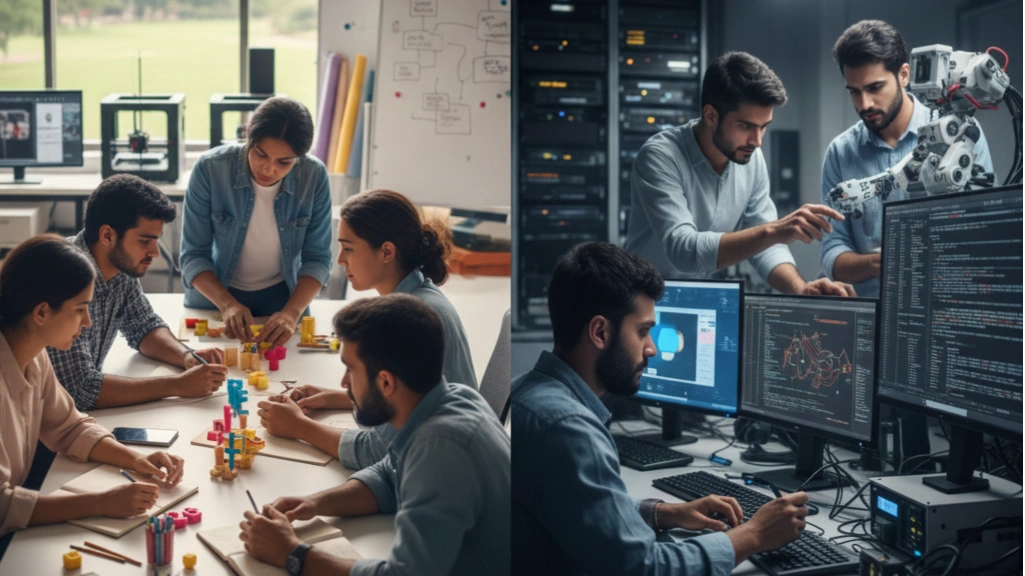
Choosing between Bachelor of Design (B.Des) and Bachelor of Technology (B.Tech) is one of the most crucial decisions for Class 12 students in India. While B.Tech has long been the default choice for science stream students, B.Des has rapidly gained prominence with the growth of design-driven industries such as UX/UI, product innovation, fashion, and digital experiences. This guide presents a clear, side-by-side comparison of curriculum structure, focus areas, skills developed, admission process, top colleges, and long-term career outcomes to help students and parents make an informed choice.
Both are 4-year undergraduate programs, but they operate on fundamentally different philosophies: B.Tech is rooted in engineering principles and scientific rigor, whereas B.Des is built on creative thinking, human-centered problem solving, and aesthetics. The choice ultimately depends on whether you are driven more by analytical logic or creative expression.
Design methods, material exploration, digital tools (Figma, Rhino, Adobe Suite), user research
Core engineering subjects (DSA, Circuits, Thermodynamics, Mechanics), advanced math
Year 3
Specialization studios (UX, Product, Fashion, etc.), live industry projects, internships
Branch-specific subjects (ML, VLSI, Structural Engg., etc.), electives, minor projects
Year 4
Graduation project (6–12 months), portfolio development, thesis on design innovation
Major project, industrial training, advanced electives, research papers (optional)
In B.Des, 50–60% of credits come from studio submissions and jury evaluations. In B.Tech, credits are split between theory exams (60–70%), labs, and projects.
Core Focus Areas and Specializations
B.Des specializations are experience-oriented and interdisciplinary:
Communication Design (Graphic, Branding, Motion)
User Experience Design (UX/UI, Interaction)
Product & Industrial Design
Fashion & Textile Design
Interior & Spatial Design
Animation & Game Design
B.Tech specializations are technology & domain-specific:
Computer Science & Engineering
Electronics & Communication
Mechanical / Civil / Chemical
Artificial Intelligence & Data Science
Biotechnology / Aerospace
Skills Developed: B.Des vs B.Tech
B.Des Skills
B.Tech Skills
Design thinking & empathy
Algorithmic & logical thinking
Visual communication & storytelling
Programming & system architecture
Prototyping (physical + digital)
Mathematical modeling & simulation
User research & testing
Hardware-software integration
Portfolio building & presentation
Coding & debugging at scale
BDes vs BTech Admission Process
B.Des admission is multi-stage and creativity-focused:
Written entrance (UCEED/NID DAT Prelims) – visualization, observation, aesthetics
Studio Test / Situation Test – material handling, model making
Portfolio + Personal Interview
B.Tech admission is purely rank-based:
JEE Main → JEE Advanced (for IITs)
Or state/private exams (MHT-CET, BITSAT, VITEEE)
Counselling & seat allocation
B.Des cut-offs are subjective; even rank 500 in UCEED can secure NID Ahmedabad in some categories, whereas JEE Advanced rank < 500 is typically needed for top IIT branches.
Google, Microsoft, Goldman Sachs, Jane Street, Atlassian
5-Year Growth
INR 18–35 LPA (UX Lead, Design Manager)
INR 40–80 LPA (Staff Engineer, Architect)
BDes vs BTech: Long-Term Career Paths
B.Des graduates often move into:
UX/UI Designer → Design Lead → Head of Design
Product Designer → Design Entrepreneur
Creative Director in advertising/media
Design Researcher / Academic
B.Tech graduates typically follow:
Software Engineer → Senior Engineer → Tech Lead → CTO
Consultant → Manager → Partner (in consulting)
Research Scientist → Professor
Entrepreneur (deep-tech startups)
BDes vs BTech: Which One Should You Choose?
Choose B.Des if:
You love sketching, visual storytelling, or solving problems through empathy
You want a studio-based, creative learning environment
You are passionate about user experience, fashion, products, or spaces
Portfolio matters more to you than coding
Choose B.Tech if:
You enjoy mathematics, logic puzzles, and building systems
You want higher starting packages and global tech opportunities
You are comfortable with rigorous theory and competitive exams
You aim for roles in software, core engineering, or research
Conclusion: Two Different Worlds, Equal Potential
B.Des and B.Tech are not superior or inferior to each other—they cater to fundamentally different mindsets. A creative thinker will struggle in B.Tech’s mathematical intensity, while a logical mind may feel restricted in B.Des’s subjective evaluations. Both fields are future-proof: India needs brilliant engineers AND brilliant designers to build world-class products. Choose the path that lets you wake up excited every day—success and fulfillment will follow.
FAQs
1. Is B.Tech a better degree than B.Des because the starting salaries are often higher?
Not necessarily. While top-tier B.Tech (CS) packages can be higher (INR 15–25 LPA), elite B.Des (UX/UI) graduates from NID/IITs also command high starting packages (INR 8–12 LPA). The choice depends on aptitude: B.Tech focuses on logic and systems; B.Des focuses on creative, human-centered problem-solving. Success hinges on passion, not just initial pay.
2. Which entrance exam is considered tougher: JEE Advanced (for B.Tech) or UCEED/NID DAT (for B.Des)?
JEE Advanced is considered tougher in terms of subject depth (Physics, Chemistry, Maths) and rank competition, as admission is purely merit-based. UCEED/NID DAT is equally competitive but in a different way, requiring strong visualization skills, aesthetics, and creative problem-solving ability in the studio test and interview stages.
3. Can a student from any stream (Science, Commerce, Arts) pursue a B.Des degree?
Yes, generally, B.Des programs are accessible to students from any stream (Science, Commerce, or Arts) who have completed Class 12. The admission process prioritizes creative aptitude, observational skills, and the portfolio/studio test performance over specific subject marks, unlike B.Tech, which typically requires a Science background (PCM).
4. Which program offers better long-term career growth in India?
Both offer excellent long-term growth. B.Tech leads to high-salary technical paths like Staff Engineer/CTO (INR 40–80 LPA). B.Des leads to high-impact strategic roles like Head of Design/Design Manager (INR 18–35 LPA). Growth is strong in both, but B.Tech has a higher ceiling in large-scale tech/quant firms.
5. Is a B.Des curriculum mostly theoretical, or is it more practical?
The B.Des curriculum is overwhelmingly practical and studio-based, with 60–70% of the credits coming from hands-on projects, material exploration, and jury submissions. Conversely, a B.Tech curriculum is more lecture and theory-heavy in the early years, transitioning to practical labs and a major final project.
6. Can a B.Des graduate pursue an MBA or M.Tech degree later on?
Yes, a B.Des graduate is eligible to pursue an MBA for managerial roles and an M.Des for advanced design specialization. While they generally cannot pursue a traditional M.Tech directly due to the lack of core engineering prerequisites, some interdisciplinary programs in fields like Interaction Design may be open to them.
7. Why is the course fee for B.Des often higher at private institutes than B.Tech?
The fee for private B.Des programs tends to be high (INR 4–6 lakhs annually) because they require expensive, low-student-ratio studio spaces, specialized materials, high-end digital tools, and a greater reliance on experienced industry professionals as faculty for continuous project mentoring.
Abhijeet Chatterjee is a professional Content and Copy specialist with over five years of experience in crafting compelling content around the Edtech domain. His portfolio includes notable work for companies such as PhysicsWallah, Roar Media, Jagran Josh, etc. Academically, Abhijeet holds a Master's in Mass Communication, where he was awarded a gold medal for his outstanding performance. He has also qualified for the UGC NET in Mass Communication, demonstrating his expertise and a deep understanding of the field. His academic foundation is built on a Bachelor's degree in English Literature. Beyond his professional work, Abhijeet is an avid writer and a cinephile. His personal interests include scriptwriting, film criticism, and reading novels.