
Last Updated on December 3, 2025 by amay mathur
The Common Entrance Examination for Design (CEED) is a national-level exam conducted annually by IIT Bombay on behalf of the Ministry of Education for admission to M.Des programs at IISc Bangalore, IIT Bombay, IIT Delhi, IIT Guwahati, IIT Hyderabad, IIT Kanpur, IIT Roorkee, and PhD in Design at select institutes. It assesses candidates’ drawing skills, visual perception, creativity, and problem-solving through Part A (computer-based screening with aptitude questions) and Part B (pen-paper creative tasks evaluated only for Part A qualifiers), with a total score of 100 and results valid for one year.
CEED 2026 Eligibility Criteria
Qualifying Degrees/Diplomas
Candidates must have completed or be appearing in one of the following:
| Category | Qualification | Minimum Duration |
| 1 | Bachelor’s degree in Engineering / Design / Architecture / Interior Design | 3 years after 10+2 |
| 2 | GDPD / PGDPD from NID | As per the program |
| 3 | Professional Diploma in Design (NID / CEPT or equivalent) | 4 years |
| 4 | BFA (4-year professional program, after 10+2) | 4 years |
| 5 | Master’s degree in Arts / Science / Computer Applications | 2 years after 10+2+3 |
Key Conditions
- Final-year students: Eligible to apply (provisional admission if selected).
- No minimum marks required in the qualifying exam.
- No age limit.
- No restriction on the number of attempts.
Result Usage
- CEED score is valid for 1 year from the result announcement.
- Qualifying CEED does not guarantee admission—separate institute applications required.
CEED 2026 Exam Dates
CEED 2026, conducted by IIT Bombay, follows a two-part format: Part A (online aptitude test) and Part B (pen-and-paper design test). Below is the official schedule as of November 2025. Note: The exact exam date and some post-exam dates are yet to be announced—check ceed.iitb.ac.in for updates.
| Event | Date(s) |
| Online Registration (Regular Fee) | October 1, 2025 – November 5, 2025 |
| Online Registration (Late Fee) | November 6, 2025 – November 10, 2025 (5:00 PM) |
| Admit Card Download | January 2, 2026 onwards |
| CEED Exam (Part A & B) | To be announced (9:00 AM – 12:00 Noon) |
| Draft Answer Key for Part A | To be announced |
| Comments on Draft Answer Key | To be announced |
| Final Answer Key for Part A | To be announced |
| Part A Cutoff Announcement | To be announced |
| Results Declaration | March 4, 2026 |
| Score Cards Download | March 10, 2026 onwards (valid until July 31, 2026) |
CEED Part A Qualifying Cutoff: How It Works
The CEED Part A cutoff is the minimum score required to qualify for Part B evaluation. It is calculated using the formula:
δ = μ + (σ² / 10) (rounded to 2 decimal places), where μ is the mean and σ is the standard deviation of all Part A scores. Reserved categories get relaxations: OBC-NCL/EWS (0.9 × δ), SC/ST/PwD (0.5 × δ). Part B has no fixed cutoff (subjective evaluation), and the final CEED score = 0.25 × Part A marks + 0.75 × Part B marks (out of 100).
Previous Years’ Part A Cutoff Trends
Below is a table summarising the official mean (μ), standard deviation (σ), and calculated qualifying cutoff (δ) for Part A across recent years. Values are sourced from the IIT Bombay releases.
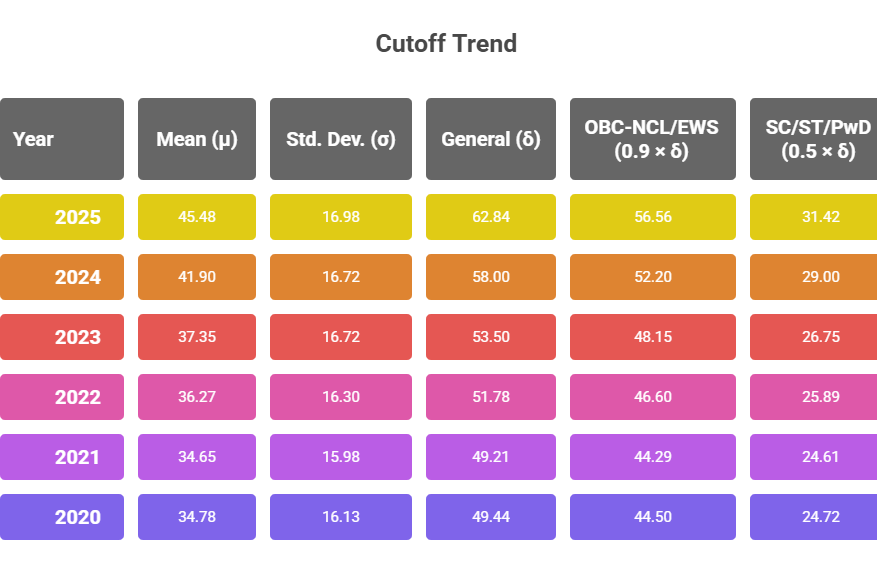
- Admission Cutoffs: These vary by institute (e.g., IIT Bombay M.Des often requires top 100-200 ranks, ~60-70 final score). Qualifying Part A does not guarantee admission—apply separately to institutes.
- Trends: Cutoffs rise with exam difficulty and candidate performance; aim for 50+ in Part A for safety.
- 2026 Expectations: Based on trends, General δ ~60-65 (monitor official site ceed.iitb.ac.in post-exam).
Top Colleges in India Accepting CEED 2026 Scores
CEED scores are primarily accepted by premier IITs and IISc for M.Des and PhD programs, with additional result-sharing institutes using them for admissions. The official list from IIT Bombay includes 10+ participating institutes, offering ~300-350 seats across specialisations like Industrial Design, Communication Design, and Mobility & Vehicle Design. Below is a curated list of top colleges based on NIRF rankings (2025), reputation, and seat availability. These are ranked by overall NIRF score, where applicable; apply separately to each institute post-results.
Top Participating Institutes (Direct Admission via CEED)
These are the core IITs/IISc, considered the best for design education due to faculty, infrastructure, and placements (avg. package ₹10-20 LPA).
| Rank | Institute | NIRF 2025 Rank (Overall) | Key Programs & Seats (M.Des) | Approx. Annual Fees (₹) | Cutoff Trend (Final Score for Gen) |
| 1 | IIT Madras | 1 | Industrial Design (20) | 50,000-1 Lakh | 62-72 |
| 2 | IIT Delhi | 2 | Industrial Design (23) | 50,000-1 Lakh | 60-70 |
| 3 | IIT Bombay | 3 | Industrial Design (24), Animation (15), Interaction (15), Mobility (10) | 50,000-1 Lakh | 65-75 |
| 4 | IIT Kanpur | 4 | Industrial Design (18) | 40,000-80,000 | 58-68 |
| 5 | IISc Bangalore | 1 (University) | Product Design & Manufacturing (15) | 30,000-60,000 | 60-70 |
| 6 | IIT Kharagpur | 5 | Industrial Design (20) | 40,000-80,000 | 58-68 |
| 7 | IIT Roorkee | 6 | Industrial Design (20) | 40,000-80,000 | 55-65 |
| 8 | IIT Guwahati | 7 | Design (Electronic Product, Furniture; 15) | 40,000-80,000 | 55-65 |
| 9 | IIT Hyderabad | 8 | Visual Design (15) | 50,000-1 Lakh | 55-65 |
| 10 | IIT (BHU) Varanasi | 10 | Product Design (15) | 40,000-80,000 | 52-62 |
| 11 | IIT Jodhpur | 28 | Industrial Design (15) | 50,000-1 Lakh | 50-60 |
Top Result-Sharing Institutes (Use CEED for Shortlisting)
These private/universities accept CEED alongside their own processes; they offer diverse specialisations and higher seat intake but may have higher fees.
| Rank | Institute | NIRF 2025 Rank (Overall) | Key Programs & Seats (M.Des) | Approx. Annual Fees (₹) | Cutoff Trend (Final Score for Gen) |
| 12 | IIITDM Jabalpur | 82 | Design (Mechanical/Electronic; 20) | 1-1.5 Lakh | 50-60 |
| 13 | UPES Dehradun | 50 | Industrial Design (20) | 2-3 Lakh | 48-58 |
| 14 | VIT Chennai | 13 | Industrial Design (25) | 1.5-2.5 Lakh | 45-55 |
| 15 | Jain (Deemed-to-be) University, Bengaluru | 85 (University) | Visual Communication, User Experience (20) | 2-3 Lakh | 45-55 |
| 16 | Mahindra University, Hyderabad | New (Unranked) | Industrial Design (15) | 3-4 Lakh | 45-55 |
Key Notes
- Admission Process: Qualify CEED (aim for 60+ final score for top IITs), then apply via institute portals (deadlines: March-May 2026). Selection often includes interviews/portfolios.
- New for 2026: GLS University (Gujarat) added as a result-sharing institute for M.Des.
- Trends: IIT Bombay/Delhi are the most competitive (top 50-100 ranks); private ones like VIT/UPES are more accessible.
- Total Seats: ~302 for M.Des across participating institutes; PhD seats vary (10-20 per IIT).
- For latest updates, check ceed.iitb.ac.in or individual websites.
Colleges Accepting Low CEED Scores Below 30
A final CEED score below 30 (out of 100) is generally too low for admission to any IITs or IISc Bangalore, as these require 50+ (often 60+) for M.Des programs based on 2025 trends (e.g., ranks 500+ correspond to ~40-50 marks). However, some result-sharing private institutes use CEED for shortlisting but have more lenient thresholds, sometimes accepting scores as low as 25-35 if supplemented by strong portfolios, interviews, or other exams. Below is a list of such colleges, based on reported 2025 data. Note: Exact cutoffs aren’t published; these are estimates from admission patterns. Always verify on the institute’s websites.
| Institute | NIRF 2025 Rank (Overall) | Key M.Des Programs | Approx. Annual Fees (₹) | Estimated Min. CEED Score (Gen Category) | Notes |
| Srishti Manipal Institute of Art, Design and Technology, Bengaluru | 101-150 (University) | Digital Design, Human Centered Design (20 seats) | 4-6 Lakh | 25-35 | Portfolio-heavy selection; CEED ~20-30% weightage; accepts low scores with strong creative work. |
| UPES School of Design, Dehradun | 50 | Industrial & Product Design (20 seats) | 2-3 Lakh | 28-40 | Shortlists via CEED but final call on interview; lower scores viable for reserved categories. |
| World University of Design, Sonipat | Unranked | Product/Interior Design (15 seats) | 3-4 Lakh | 25-35 | Uses CEED for eligibility; flexible for mid/low scores with DAT (Design Aptitude Test). |
| Dr. Vishwanath Karad MIT World Peace University, Pune (New for 2025) | Unranked | User Experience Design (10 seats) | 2.5-3.5 Lakh | 25-35 | Result-sharing; accepts scores below 30 with additional assessment; focus on holistic profile. |
| GLS University, Ahmedabad (New for 2026) | Unranked | Visual Communication (15 seats) | 2-3 Lakh | 28-40 | Preliminary data suggests low CEED threshold; portfolio and interview key. |
Key Notes
- No IITs/IISc: Impossible for <30; e.g., IIT Jodhpur (lowest among IITs) needs ~45-55.
- Admission Process: Apply directly post-CEED results (March-May 2026); low scores may qualify for waitlists or if seats remain.
- Trends: Scores <30 suit niche private colleges emphasising practical skills over exam rank.
CEED 2026 Syllabus
The CEED 2026 syllabus, released by IIT Bombay, evaluates candidates’ design aptitude through two parts: Part A (online, objective-type questions: MCQ, MSQ, NAT; 240 marks; 1 hour) and Part B (offline, subjective drawing/writing tasks; 60 marks; 2 hours). Part A is mandatory for all; only qualifiers proceed to Part B evaluation. Focus on visualisation, creativity, and practical skills—no prescribed books, but practice drawing and past papers. Below is a topic-wise breakdown.
Part A Syllabus (Computer-Based; Tests Aptitude)
Covers six key areas with multiple-choice, multiple-select, and numerical questions.
| Section | Topics & Description |
| Visualization & Spatial Ability | Understanding 2D/3D forms, transformation of shapes (rotation, scaling, mirroring), spatial relationships, mental folding/unfolding, pattern recognition, and orthographic/perspective projections. |
| Practical & Scientific Knowledge | Everyday materials (properties, uses), basic mechanics (force, motion, friction), energy/electricity basics, environmental awareness (pollution, sustainability), and simple scientific principles applied to design. |
| Observation & Design Sensitivity | Historical eras (ancient to modern) and their design impacts, cultural artefacts, societal trends, ethical design (inclusivity, sustainability), and global/local environmental factors. |
| Environment & Society | Historical eras (ancient to modern) and their design impacts, cultural artifacts, societal trends, ethical design (inclusivity, sustainability), and global/local environmental factors. |
| Analytical & Logical Reasoning | Patterns, sequences, analogies, syllogisms, data interpretation (charts/graphs), and problem-solving via deduction/induction. |
| Language & Creativity | Reading comprehension (passages on design/general topics), grammar/vocabulary, creative expression (storytelling, metaphors), and innovative idea generation. |
| Design Thinking & Problem Solving | Empathy mapping, ideation techniques, prototyping basics, user-centred design, and scenario-based solutions for real-world problems. |
Part B Syllabus (Pen-and-Paper; Tests Creativity)
Subjective tasks emphasising sketching and communication (evaluated only for Part A qualifiers).
| Section | Topics & Description |
| Drawing Ability | Accurate freehand sketching of 3D objects/scenes (e.g., from imagination or reference), proportion, perspective, shading, and rendering techniques (pencil/pen). |
| Design Aptitude | Conceptualising solutions to design briefs (e.g., product/service redesign), human figures in context, and visual compositions balancing form/function. |
| Communication Skills | Written descriptions/explanations of sketches (clarity, conciseness), storytelling via visuals/text, and articulating design rationale. |
Check Out: CEED Previous Year Question Papers with Solutions PDF
CEED 2026 Study Material
IIT Bombay does not prescribe official study materials for CEED, emphasising self-preparation aligned with the syllabus. Focus on building visualisation, creativity, and drawing skills through practice. Below is a curated list of recommended books (section-wise for Part A & B), free resources, and online platforms based on expert consensus from toppers and coaching institutes. Prioritise books with practice questions and past papers.
Recommended Books for Part A (Aptitude & Knowledge)
These cover objective topics like spatial ability, reasoning, and design sensitivity.
| Book Title | Author/Publisher | Key Focus | Why Recommended |
| Design Drawing | Francis D.K. Ching | Visualization, perspective, spatial relations | Builds foundational drawing and 3D thinking with diagrams. |
| Perspective Drawing Handbook | Joseph D’Amelio | Orthographic projections, perspective techniques | Essential for spatial ability; includes exercises. |
| Art Perception | David Cycleback | Visual perception, observation skills | Sharpens design sensitivity and analytical reasoning. |
| Universal Principles of Design | William Lidwell et al. | Design thinking, problem-solving principles | Covers creativity, ergonomics, and societal awareness. |
| Thinking with Type | Ellen Lupton | Typography, communication in design | Aids language & creativity sections. |
Recommended Books for Part B (Drawing & Communication)
Emphasise subjective sketching and ideation.
| Book Title | Author/Publisher | Key Focus | Why Recommended |
| Keys to Drawing | Bert Dodson | Freehand sketching, shading techniques | Step-by-step for accurate human figures and compositions. |
| Sketching: The Basics | Koos Eissen & Roselien Steur | Conceptual sketching, ideation | Practical for design briefs and visual storytelling. |
| Freehand Drawing and Discovery | James Richards | Exploratory sketching, creativity exercises | Boosts innovation in problem-solving tasks. |
CEED 2026 Preparation Guide
With CEED 2026 registration closed (ended Nov 10, 2025) and the exam tentatively in January 2026, focus on intensive revision, mock tests, and sketching practice over the next 6-8 weeks. Aim for 4-6 hours daily: 2 hours Part A aptitude, 2-3 hours Part B drawing, and 1 hour review. Below is a structured strategy, updated study materials, and resources.
Preparation Strategy & Tips
- Understand Exam Pattern: Part A (1 hour, 240 marks: MCQ/MSQ/NAT; negative marking -0.25/-1) qualifies for Part B (2 hours, 60 marks: subjective sketches/writing). Final score: 25% Part A + 75% Part B. Prioritise Part A cutoff (~60 for Gen).
- Section-Wise Approach:
- Part A: Build speed in visualisation/spatial ability (30% weight) via puzzles; cover awareness topics daily. Practice 50 questions/day.
- Part B: Daily 1-hour sketching (perspective, human figures); focus on quick ideation for briefs.
- Topper Tips: Start with syllabus weak areas; solve 3-4 previous papers/week; analyse errors. Build a portfolio early for interviews (post-qualifiers).
- Common Mistakes to Avoid: Over-relying on theory—practice timed mocks; ignoring negative marking in Part A.
- Health Balance: Include breaks, sleep; join online forums for motivation.
CEED 3-Month Study Plan (Nov 2025 – Jan 2026)
| Phase | Duration | Focus Areas | Weekly Goals |
| Revision Build-Up | Nov 17 – Dec 15 (4 weeks) | Syllabus coverage: Part A topics (visualization, reasoning, awareness); basic sketches. | 20 hours/week theory + 10 hours drawing; 2 full mocks. |
| Intensive Practice | Dec 16 – Dec 31 (2 weeks) | Mock tests + error analysis; advanced Part B briefs (e.g., product redesign). | 25 hours/week: 3-4 mocks + review; daily 30-min creativity exercises. |
| Final Polish | Jan 1 – Exam Day | Timed simulations; light revision; portfolio tweaks. | 15-20 hours/week: 1 mock/day + relaxation; focus on strengths. |
CEED 2026 Exam Pattern (Latest – As per IIT Bombay)
| Aspect | Details |
| Conducting Body | IIT Bombay (on behalf of Ministry of Education) |
| Mode | Part A: Computer-based (Online) Part B: Pen-and-paper (Offline) |
| Duration | Total 3 hours Part A: 1 hour → Part B: 2 hours (back-to-back) |
| Language | English only |
| Total Marks | Part A: 240 marks → Part B: 60 marks → Final Score out of 100 |
| Final Score Calculation | 25% Part A + 75% Part B (normalized to 100) |
| Qualifying Criteria | Must clear Part A cutoff to get Part B evaluated |
Part A (Screening Test – Online)
| Question Type | No. of Questions | Marks per Question | Negative Marking | Total Marks |
| NAT (Numerical Answer Type) | 8–10 | +3 | No | ~30 |
| MSQ (Multiple Select) | 10–12 | +4 (partial marks) | –1 (for wrong selections) | ~45 |
| MCQ (Multiple Choice) | 25–30 | +3 | –0.75 | ~90-100 |
| Total | ≈ 50–55 | 240 |
- Covers: Visualisation & Spatial Ability, Environmental & Social Awareness, Analytical & Logical Reasoning, Language, Observation & Design Sensitivity, Design Thinking.
- Only Part A qualifiers (cutoff ≈60 for General in recent years) move to Part B evaluation.
Part B (Creative Test – Pen & Paper)
| Question Type | No. of Questions | Marks | Evaluation Criteria |
| Sketching | 1–2 | 20–30 | Proportion, perspective, shading, creativity |
| Design Aptitude | 1–2 | 15–20 | Ideation, problem-solving, innovation |
| Visual/Communication | 1 | 10–15 | Storytelling, layout, clarity |
| Total | 4–5 questions | 60 | Subjective (evaluated by experts) |
- Answer booklet provided; use only a black ball-point pen or pencil.
- No choices – all questions compulsory.
Key Changes & Notes (2025–2026)
- Part A now has partial marking in MSQs (e.g., 2 correct out of 4 = +2 marks).
- No re-evaluation for Part B (subjective).
- The scorecard is valid only for 1 year.
- The exam is usually held on a single Sunday in January (9 AM – 12 Noon).
Top CEED 2026 Coaching Institutes in India
With the CEED 2026 exam approaching in January, coaching can provide structured guidance, mock tests, and expert feedback on sketching/ideation. Based on recent success rates, faculty expertise, and coverage (offline, online, hybrid), here are the leading options. BRDS and SILICA top the list with 700+ qualifiers in recent years. Fees vary by mode/duration; contact for exact quotes (typically ₹20,000-60,000 for 3-6 months).
Offline/Branch-Based Coaching
These offer classroom sessions with hands-on sketching; ideal for Part B practice.
| Institute | Key Locations | Highlights | Approx. Fees (₹) | Success Rate/Notes |
| BRDS (Rathore Design) | Delhi, Mumbai (Dadar), Jaipur, Pune, Kolkata, Lucknow | 20+ years exp.; 1,410+ CEED qualifiers since 2005; study kits with 4,000+ exercises; crash courses available. | 25,000-50,000 (6 months) | Highest selections; strong in Part B creativity. |
| SILICA Institute | Mumbai, Bangalore (BTM & Malleshwaram), Pune, Delhi | IIT/NID alumni faculty; 10+ branches; personalised mentoring; proven IIT admissions. | 20,000-40,000 (3-6 months) | 100+ students to IITs; focus on both parts. |
| Pahal Design | Delhi, Bangalore, Pune, Lucknow, Mumbai, Ahmedabad, Kolkata | Highest selection rate; hybrid options; portfolio guidance. | 15,000-35,000 (4 months) | 5,000+ students placed; expert-led mocks. |
| Ignite India Education | Bangalore, Delhi, Ahmedabad | ISO-certified; innovative teaching; career counselling. | 18,000-30,000 (3 months) | Top-ranked, interactive sessions for beginners. |
| DQ Labs | Bangalore | 25+ years mentoring; founders from Jaguar/GM; global design focus. | 25,000-45,000 (6 months) | Oldest for creative exams; project-based learning. |
Online/Hybrid Coaching
Flexible for working students; includes live classes, recorded videos, and virtual mocks.
| Institute | Mode | Highlights | Approx. Fees (₹) | Success Rate/Notes |
| SILICA Online | Fully Online (15/30/45/90-day courses) | Video lectures on syllabus; PYQs solved; doubt sessions; app access. | 10,000-25,000 | Tailored for Part A/B; free demo classes. |
| BRDS Online | Live/Hybrid (regular/weekend/crash) | 20+ mocks; YouTube tutorials; aligned with 2026 pattern. | 15,000-30,000 | 735 qualifiers in 2022; self-paced kits. |
| Creative Edge (TopRankers) | Online (demo classes) | Personalized feedback; aptitude quizzes; 2026-specific modules. | 12,000-20,000 (4 months) | Beginner-friendly; integrated with UCEED prep. |
| AFD India | Online (Kochi-based but pan-India) | 25+ years legacy; domain-specific (product/animation); crash courses. | 8,000-15,000 (2-3 months) | Strong results; alumni from NID/IIT. |
Key Notes
- Selection Criteria: Institutes chosen based on 2025 results (e.g., BRDS/SILICA lead with IIT conversions), faculty (IIT/NID grads), and resources (mocks, materials).
- Prep Tips: Enroll now (post-registration phase); combine with self-study (PYQs from ceed.iitb.ac.in). Aim for 4-6 months; focus 60% on Part B.
- Free Demos: Most offer trial classes—start with SILICA or BRDS YouTube for basics.
- For updates, visit official sites or ceed.iitb.ac.in.
CEED 2026 Registration Details
As of November 17, 2025, the CEED 2026 registration process has concluded (the late fee deadline was November 10, 2025). If you missed it, you cannot apply for this cycle—mark your calendar for CEED 2027 (likely starting September/October 2026). Below is a summary of the process for reference. All info is from the official IIT Bombay site; download the Information Brochure PDF for full details.
Registration Dates (Closed)
| Phase | Dates |
| Regular Fee | October 1, 2025 (5:00 PM) – November 5, 2025 |
| Late Fee | November 6, 2025 – November 10, 2025 (5:00 PM) |
- Portal: https://ceedapp.iitb.ac.in/ (now closed for 2026).
Fees Structure
Fees are category-wise and non-refundable (exact amounts in Brochure PDF; e.g., General: ~₹3,000 regular, +₹500 late; SC/ST/PwD: ~₹1,500 regular). Pay online via net banking/card.
How to Apply (For Future Reference)
- Visit https://ceedapp.iitb.ac.in/ and create/login to your account.
- Fill the online form: Personal details, academic info, exam city choice (38 cities available, e.g., Mumbai, Delhi, Bengaluru).
- Upload documents (scanned, specified formats/sizes in Brochure).
- Pay the fee and submit—receive confirmation email.
- Report issues via the form’s “Report Problem” button; email ceed@iitb.ac.in for queries (Mon-Fri, 9:30 AM-5:30 PM).
Required Documents
- Photo & signature (JPEG, 10-200 KB).
- Category certificate (SC/ST/OBC-NCL/EWS; if applicable).
- PwD certificate (for scribe request in Part A; form in Brochure p.15).
- Degree/diploma proof (for eligibility verification post-results).
Eligibility Quick Reminder
- Bachelor’s degree (min. 3 years post-10+2) in relevant fields, OR final-year students (by July 2026), OR GD Arts diploma (10+5 level).
- No age/attempt limit; no minimum marks.
Key Notes
- Admit Card: Download from January 2, 2026 (print clearly; exam city confirmed here).
- Exam: January 2026 (TBA; 9 AM-12 Noon; Part A online, Part B offline).
- Results: March 4, 2026; scorecards from March 10 (valid till July 31, 2026).
- New for 2026: Result-sharing with GLS University, Jain University, and Mahindra University.
- CEED qualifies for M.Des/PhD at IITs/IISc but requires separate institute applications.
FAQs
What is the CEED exam used for?
CEED is primarily used for admission to M.Des programs at IITs and IISc and select PhD programs in design. Some result-sharing private universities also use CEED scores for shortlisting. However, clearing the exam does not guarantee admission—you must apply separately to each institute and go through their interview/portfolio stages.
Is there any age limit or attempt limit for CEED 2026?
There is no upper age limit and no restriction on the number of attempts. Candidates can appear as many times as they want, provided they meet the minimum educational eligibility criteria.
Who is eligible to apply for CEED 2026?
Anyone who has completed, or is in the final year of, a bachelor’s degree of at least 3 years (Engineering/Architecture/Design/Fine Arts, etc.) is eligible. Master’s degree holders and students from NID’s GDPD/PGDPD and Professional Diplomas in Design are also eligible. No minimum marks are required.
What is the exam pattern for CEED 2026?
The exam has two parts conducted consecutively:
- Part A (1 hour, online) tests aptitude, spatial ability, reasoning, and awareness.
- Part B (2 hours, offline) tests drawing, creativity, and design problem-solving.
Final CEED score = 25% Part A + 75% Part B.
What score is considered good for CEED 2026?
Based on recent years, a final score of 60+ is competitive for top IITs like Bombay, Delhi, and IISc. Scores around 45–55 may be sufficient for IITs with lower cutoffs or for IIITDM and other result-sharing institutes. Scores below 30 generally do not qualify for any IIT but may work for certain private design schools.
How long is the CEED score valid?
The CEED 2026 scorecard is valid for one year from the date of result announcement. Admissions for 2026–27 must be completed within this validity period.
Can I get admission to IITs with only the CEED score?
No. Qualifying CEED is only the first step. IITs and IISc require you to apply separately after results, shortlist candidates for interviews, and evaluate portfolios before offering admission.
What are the best books and materials for CEED 2026 preparation?
For Part A, recommended books include Design Drawing (Ching), Universal Principles of Design (Lidwell), and Perspective Drawing Handbook (D’Amelio). For Part B, Keys to Drawing (Dodson), Sketching: The Basics (Eissen & Steur), and Freehand Drawing and Discovery (Richards) are preferred. Practice with previous papers and mock tests is essential.
Which coaching institutes are best for CEED preparation?
BRDS and SILICA have the strongest track records with high IIT conversion rates. Pahal Design, Ignite India, DQ Labs, and Creative Edge also provide good online and offline options. Fees range from ₹15,000 to ₹60,000 depending on duration and mode.