
Last Updated on December 3, 2025 by amay mathur
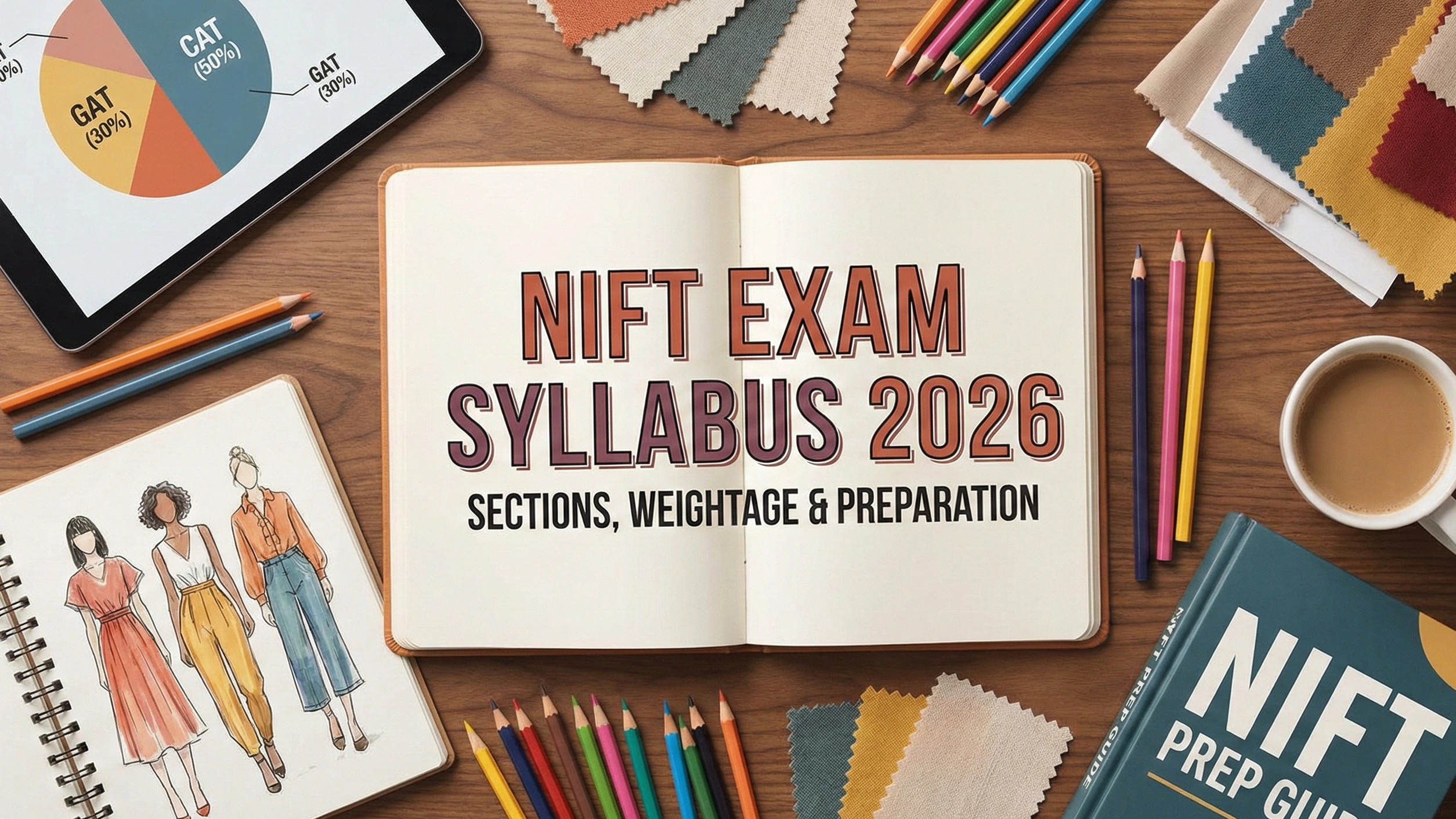
The NIFT Exam Syllabus for 2026 remains consistent with the previous year, offering a structured approach for aspiring designers. It covers various stages like the Creative Ability Test (CAT), General Ability Test (GAT), and Situation Test for undergraduate programs, and GAT and Personal Interview for postgraduate programs. Understanding the syllabus is crucial for effective preparation and success in the NIFT entrance exam. Also read – NIFT Admit Card
| Aspect | Details |
| B.Des Weightage | CAT: 50%, GAT: 30%, Situation Test: 20% |
| B.F.Tech Weightage | GAT Section A: 30%, GAT Section B: 70% |
| M.Des Weightage | GAT: 30%, CAT: 40%, Personal Interview: 30% |
| M.F.Tech & M.F.M Weightage | GAT: 70%, Personal Interview: 30% |
NIFT Exam Syllabus Breakdown
The NIFT Exam Syllabus for undergraduate programs includes the Bachelor of Design (B.Des) and Bachelor of Fashion Technology (B.F.Tech). B.Des candidates face a 50% weightage on the Creative Ability Test (CAT), 30% on the General Ability Test (GAT), and 20% on the Situation Test. B.F.Tech candidates, on the other hand, are evaluated solely on the GAT, split into Section A (30%) and Section B (70%).
Postgraduate programs at NIFT include Master of Design (M.Des), Master of Fashion Technology (M.F.Tech), and Master of Fashion Management (M.F.M). M.Des candidates are assessed with a 30% weightage on GAT, 40% on CAT, and 30% on the Personal Interview. Both M.F.Tech and M.F.M candidates have a 70% weightage on GAT and 30% on the Personal Interview.
The NIFT Exam Syllabus for the Creative Ability Test (CAT) focuses on creativity, design skills, and drawing fundamentals. It includes sub-topics like creative thinking, design theory, and color theory. Candidates are tested on their ability to develop themes, use colors effectively, and express ideas through drawing and illustration.
- Creative Thinking & Writing: Develops imaginative and innovative thinking.
- Design Theory: Covers elements and principles of design.
- Drawing Fundamentals: Includes freehand sketching and perspective drawing.
- Color Theory: Focuses on color terminology and psychology.
The NIFT Exam Syllabus remains unchanged for 2026, ensuring a stable framework for candidates to prepare effectively. A thorough understanding of the syllabus components will aid in achieving success in the NIFT entrance exam.
NIFT CAT Syllabus Breakdown
Key Topics in the Creative Ability Test (CAT) for NIFT 2026 include creative thinking, design theory, and drawing fundamentals.
- Creative Thinking & Writing: Imaginative and innovative thinking, creative story and theme development.
- Design Theory: Elements and Principles of Design, Form and Function, Visual Logic, Composition.
- Drawing Fundamentals: Freehand sketching, perspective drawing, shading, proportion, foreshortening.
- Observation & Visualization: Memory drawing, observation of real-life objects/scenes, visualizing abstract concepts.
- Color Theory: Colour terminology, colour families, colour psychology, contrasts, tones, harmonies.
- Imagination & Doodling: Exercises on creativity, lateral thinking, imaginative sketches, expression and emotion.
- Theme Development & Innovation: Developing themes related to culture, environment, festivals, lifestyle, social messages.
- Graphics & Pictograms: Creation of symbols, icons, and graphic representation of ideas.
These key topics form the core of the CAT syllabus, ensuring a comprehensive assessment of design skills.
Download NIFT Syllabus PDF
Below is the latest NIFT exam syllabus PDF which you can download for your reference.
NIFT Exam Subjects
Subject Areas for the NIFT 2026 entrance exam are divided into specific stages with designated weightages. The exam structure remains consistent with the previous year, ensuring candidates can prepare effectively. Understanding these areas is crucial for success in the upcoming exam.
The undergraduate programs include Bachelor of Design (B.Des) and Bachelor of Fashion Technology (B.F.Tech). B.Des candidates face the Creative Ability Test (CAT), General Ability Test (GAT), and Situation Test. B.F.Tech candidates are evaluated through two sections of the GAT.
Postgraduate programs such as Master of Design (M.Des), Master of Fashion Technology (M.F.Tech), and Master of Fashion Management (M.F.M) also have specific weightages. These programs focus on the GAT and include a Personal Interview for M.Des, M.F.Tech, and M.F.M.
- B.Des: CAT (50%), GAT (30%), Situation Test (20%)
- B.F.Tech: GAT Section A (30%), GAT Section B (70%)
- M.Des: GAT (30%), CAT (40%), Personal Interview (30%)
- M.F.Tech: GAT (70%), Personal Interview (30%)
- M.F.M: GAT (70%), Personal Interview (30%)
NIFT Exam Subjects Weightage
| Program | Stage | Weightage (%) |
| B.Des | Creative Ability Test (CAT) | 50% |
| B.Des | General Ability Test (GAT) | 30% |
| B.Des | Situation Test | 20% |
| B.F.Tech | GAT Section A (CBT) | 30% |
| B.F.Tech | GAT Section B (CBT) | 70% |
| B.F.Tech opting for B.Des | GAT Section A (CBT) | 30% |
| B.F.Tech opting for B.Des | Creative Ability Test (CAT) | 50% |
| B.F.Tech opting for B.Des | Situation Test | 20% |
| M.Des | General Ability Test (GAT) | 30% |
| M.Des | Creative Ability Test (CAT) | 40% |
| M.Des | Personal Interview | 30% |
| M.F.Tech | General Ability Test (GAT) | 70% |
| M.F.Tech | Personal Interview | 30% |
| M.F.M | General Ability Test (GAT) | 70% |
| M.F.M | Personal Interview | 30% |
NIFT Exam GAT Topics
Core Subjects in the General Ability Test (GAT) for NIFT 2026 include key areas essential for success. These subjects are consistent across undergraduate and postgraduate programs. They form the foundation of the exam’s structure.
- Communication Ability & English Comprehension
- Quantitative Ability
- Analytical & Logical Ability
- Current Affairs & General Knowledge
- Case Study (for specific programs)
These core subjects remain unchanged from NIFT 2025, ensuring a stable framework for preparation. Candidates should focus on mastering these areas to excel in the GAT. The weightage of these subjects varies by program but remains crucial for all.
Elective Topics
Elective Topics in the General Ability Test (GAT) for NIFT 2026 include a variety of subjects. These topics are crucial for candidates preparing for both undergraduate and postgraduate programs. The GAT assesses a range of skills necessary for success in the design and fashion technology fields.
- Communication Ability & English Comprehension
- Quantitative Ability
- Analytical & Logical Ability
- Current Affairs & General Knowledge
- Case Study (for specific programs)
These Elective Topics remain consistent with the NIFT 2025 exam structure. Candidates should focus on these areas to enhance their performance in the upcoming exam. Preparation in these topics will help in achieving a competitive edge.
NIFT Marking Scheme
Scoring Rules for the NIFT 2026 entrance exam vary by program. For the undergraduate B.Des, the Creative Ability Test (CAT) holds 50% weightage. The General Ability Test (GAT) and Situation Test contribute 30% and 20% respectively.
- B.F.Tech candidates face a different structure with GAT Section A at 30% and Section B at 70%.
- B.F.Tech students opting for B.Des follow the B.Des scoring pattern.
- Postgraduate M.Des candidates have GAT at 30%, CAT at 40%, and Personal Interview at 30%.
- M.F.Tech and M.F.M programs both allocate 70% to GAT and 30% to Personal Interview.
These Scoring Rules remain unchanged from NIFT 2025, ensuring consistency for candidates preparing for the exam.
NIFT CAT Exam Analysis
For undergraduate programs, the Bachelor of Design (B.Des) includes 15 questions on Analytical & Logical Ability within the GAT, accounting for 30% of the total score. The Bachelor of Fashion Technology (B.F.Tech) has a similar distribution in Section A with 15 questions, but Section B also includes 15 questions on analytical skills, contributing to 70% of the total score. B.F.Tech candidates opting for B.Des follow the same structure as B.Des.
Postgraduate programs also emphasise Analytical & Logical Ability. The Master of Design (M.Des) GAT includes 25 questions on this topic, making up 30% of the total score. Both Master of Fashion Technology (M.F.Tech) and Master of Fashion Management (M.F.M) have 25 questions each on analytical skills, contributing to 70% of their total scores.
The NIFT 2026 exam structure remains unchanged from 2025, ensuring consistency in evaluating Analytical Skills across all programs.
- B.Des: 15 questions in GAT (30% weightage)
- B.F.Tech: 15 questions in Section A, 15 questions in Section B (30% and 70% weightage respectively)
- M.Des: 25 questions in GAT (30% weightage)
- M.F.Tech and M.F.M: 25 questions in GAT (70% weightage)
Quantitative Skills
Applicants should prepare thoroughly for these sections to enhance their Quantitative Skills and improve their chances of admission.
- B.Des: 20 Quantitative Ability questions
- B.F.Tech: 20 in GAT Section A, 15 in GAT Section B
- M.Des: 20 Quantitative Ability questions
- M.F.Tech: 30 Quantitative Ability questions
- M.F.M: 20 Quantitative Ability questions
NIFT Study Materials
Books on design and creativity are essential for NIFT 2026 preparation. They help candidates understand the Creative Ability Test (CAT) syllabus. The CAT focuses on intuitive ability, observation, and design skills.
- Creative Thinking & Writing: Books like “The Artist’s Way” by Julia Cameron enhance imaginative thinking.
- Design Theory: “Universal Principles of Design” by William Lidwell covers elements and principles of design.
- Drawing Fundamentals: “Drawing on the Right Side of the Brain” by Betty Edwards improves freehand sketching skills.
- Color Theory: “Interaction of Color” by Josef Albers explains color psychology and harmonies.
| Exam Section | Topic | Book Title | Author / Publisher | Key Utility & Description |
| CAT (Creative Ability) | Sketching & Visualization | Design Drawing | Francis D.K. Ching | The “Bible” for Sketching: Excellent for learning perspective, orthographic projections, and visual communication. A must for 3D composition questions. |
| Observation & Basics | Keys to Drawing | Bert Dodson | Fundamental Skills: Teaches you to draw what you see rather than what you know, which is critical for the observation-based sketching questions in NIFT. | |
| Creativity & Ideation | NIFT Creative Ability | Kiran Sethi / Arihant | Exam Specific: Tailored specifically for the NIFT format, offering exercises on concept development, creative thinking, and visual narration. | |
| Color & Design Theory | Universal Principles of Design | Lidwell, Holden, & Butler | Design Logic: Helps in understanding why a design works. Useful for adding rationale to your design concept write-ups. | |
| GAT (General Ability) | Quantitative Ability | Quantitative Aptitude | R.S. Aggarwal | Math Core: The standard text for all competitive exams in India. Focus on arithmetic, profit/loss, percentages, and basic algebra. |
| English Comprehension | Word Power Made Easy | Norman Lewis | Vocabulary Builder: The most effective book for building the high-level vocabulary required for the English section synonyms/antonyms. | |
| High School English Grammar | Wren & Martin | Grammar Rules: Essential for sentence correction, error spotting, and filling in the blanks. | ||
| Reasoning (Logical) | A Modern Approach to Verbal & Non-Verbal Reasoning | R.S. Aggarwal | Logic Practice: Covers widely asked topics like series, coding-decoding, blood relations, and pattern matching. | |
| General Knowledge | Manorama Yearbook | Malayala Manorama | Current Affairs: Provides a yearly digest of major events. Focus heavily on awards, sports, and major government schemes. | |
| Comprehensive Guides | All-in-One Strategy | NIFT/NID/IIFT Entrance Exam Guide | Arihant Experts | Solved Papers: Best used for its collection of previous years’ papers and mock tests to understand the actual exam format and timing. |
| NIFT Exam Guide | Dr. R.P. Datason | Pattern Overview: A good supplementary guide that covers both GAT and CAT sections in a summarized format. |
These books provide valuable insights into the themes and skills tested in the CAT section of the NIFT 2026 exam. They are crucial for developing a strong foundation in design and creativity. Choose books that align with the specific sub-topics of the CAT syllabus for effective preparation.
Online Resources
Online Resources provide essential information for NIFT 2026 exam preparation. They detail the section-wise weightages for both undergraduate and postgraduate programs. These resources help candidates understand the exam structure and focus their study efforts effectively. Go to YouTube channels like:
- Physics Wallah Design
- Creative Zone by Top Rankers
- TestBook
- Sanyukta Singh Studio
- Artistic Zone
NIFT Sample Papers
Where to find NIFT sample papers for the 2026 entrance exam? Aspirants can access these resources from various educational platforms.
- Toprankers offers a range of NIFT sample papers.
- Careers360 provides detailed practice tests.
- PW Live has updated materials for NIFT 2026.
- Shiksha, CollegeDekho, and Rathore Design also host sample papers.
These platforms help students prepare for the Creative Ability Test (CAT) and General Ability Test (GAT) sections of the exam. The CAT focuses on creativity and design skills, while the GAT tests communication, quantitative, and analytical abilities.
Accessing where to find these sample papers is crucial for effective preparation and understanding the exam structure.
FAQs
What is the weightage of the Creative Ability Test (CAT) for B.Des in the NIFT 2026 exam?
The Creative Ability Test (CAT) for B.Des in the NIFT 2026 exam carries a weightage of 50%. This is part of the total 100% weightage for the B.Des program.
How many questions are there in the General Ability Test (GAT) for B.Des in the NIFT 2026 exam?
The GAT for B.Des in the NIFT 2026 exam consists of 100 questions. These are distributed across Communication Ability & English Comprehension (40 questions), Quantitative Ability (20 questions), Analytical & Logical Ability (15 questions), and Current Affairs & General Knowledge (25 questions).
What is the weightage of the Situation Test for B.Des in the NIFT 2026 exam?
The Situation Test for B.Des in the NIFT 2026 exam has a weightage of 20%. This contributes to the total 100% weightage for the B.Des program.
What is the weightage distribution for B.F.Tech in the NIFT 2026 exam?
For B.F.Tech in the NIFT 2026 exam, GAT Section A carries a weightage of 30%, and GAT Section B carries a weightage of 70%, totaling 100%.
How many questions are there in GAT Section B for B.F.Tech in the NIFT 2026 exam?
GAT Section B for B.F.Tech in the NIFT 2026 exam contains 50 questions. These are distributed across Quantitative Ability (15 questions), Analytical & Logical Ability (15 questions), and Case Study (20 questions).
What is the weightage of the Creative Ability Test (CAT) for M.Des in the NIFT 2026 exam?
The Creative Ability Test (CAT) for M.Des in the NIFT 2026 exam has a weightage of 40%. This is part of the total 100% weightage for the M.Des program.
How many questions are there in the General Ability Test (GAT) for M.Des in the NIFT 2026 exam?
The GAT for M.Des in the NIFT 2026 exam consists of 120 questions. These are distributed across Communication Ability & English Comprehension (50 questions), Quantitative Ability (20 questions), Analytical & Logical Ability (25 questions), and General Knowledge & Current Affairs (15 questions).
What is the weightage of the Personal Interview for M.F.Tech in the NIFT 2026 exam?
The Personal Interview for M.F.Tech in the NIFT 2026 exam carries a weightage of 30%. This is part of the total 100% weightage for the M.F.Tech program.
How many questions are there in the General Ability Test (GAT) for M.F.Tech in the NIFT 2026 exam?
The GAT for M.F.Tech in the NIFT 2026 exam consists of 150 questions. These are distributed across Communication Ability & English Comprehension (45 questions), Case Study (25 questions), Quantitative Ability (30 questions), Analytical & Logical Ability (25 questions), and General Knowledge & Current Affairs (25 questions).
Read More:
NIFT Mumbai
NIFT Delhi
NIFT Ahemdabad