
Last Updated on December 3, 2025 by amay mathur
Rishihood University in Sonipat offers a dynamic Bachelor of Design (BDes) program, blending creativity with practical innovation for aspiring designers. Established in 2020, the university’s School of Design provides a four-year residential course across specializations like UX/UI Design, Communication Design, Product Design, Fashion & Textile Design, and Interior Architecture. This guide covers the 2026 admission process, eligibility criteria, RSAT exam pattern, fee structure, and placement prospects, equipping candidates with essential details for a successful application.
The program emphasizes interdisciplinary learning, integrating technology, entrepreneurship, and real-world projects to prepare students for India’s evolving design landscape. With a focus on hands-on studios and industry collaborations, Rishihood fosters designers who can address contemporary challenges in digital interfaces, sustainable products, and visual storytelling.
Rishihood University BDes Program: Highlights
Rishihood University’s BDes stands out for its residential model and merit-based scholarships. The following table outlines core aspects for quick reference, including specializations, eligibility, and fees.
| Specialization | Duration | Eligibility | Annual Tuition Fee (INR) | Key Features |
| UX/UI Design | 4 years | 10+2 with 50% marks | 4,20,000 | Digital prototyping, user research |
| Communication Design | 4 years | 10+2 with 50% marks | 4,20,000 | Branding, visual storytelling |
| Product Design | 4 years | 10+2 with 50% marks | 4,20,000 | Prototyping, sustainable materials |
| Fashion & Textile Design | 4 years | 10+2 with 50% marks | 4,20,000 | Pattern making, textile innovation |
| Interior Architecture | 4 years | 10+2 with 50% marks | 4,20,000 | Spatial planning, ergonomics |
Rishihood University BDes Eligibility Criteria 2026
To qualify for Rishihood University’s BDes program in 2026, candidates must have completed Class 12 or equivalent from a recognized board with at least 50% aggregate marks or a CGPA of 5.0. This applies across all streams—Science, Commerce, or Arts—ensuring accessibility for diverse backgrounds. No specific subjects like Mathematics or Physics are mandated, allowing creative talents from humanities to apply seamlessly.
| Criterion | Requirement | Details |
| Minimum Education | Class 12 or equivalent from a recognized board. | Must be completed across any stream (Science, Commerce, or Arts). |
| Minimum Marks | 50% aggregate marks or a CGPA of 5.0. | No specific subject requirements (e.g., Math or Physics). |
| Age Limit | Not imposed. | Applicants should be prepared for the program’s rigorous residential format. |
| International Candidates | Equivalent qualification validated by AIU. | English proficiency: IELTS (6.0) or TOEFL (80). |
| Reservation (UGC Norms) | Follows standard UGC norms. | SC (15%), ST (7.5%), OBC-NCL (27%), EWS (10%), PwD (5% Supernumerary). |
| Evaluation Emphasis | Holistic Evaluation | Emphasis is placed on creative potential demonstrated through portfolios/extracurriculars (e.g., art exhibitions, design clubs). |
| Portfolio Requirement | Basic sketchbook portfolio. | Showcase 10-15 works in drawing, ideation, or digital tools. |
| Lateral Entry/Transfers | Credits from recognized institutions are assessed case-by-case. | Typically, up to 50% of the curriculum can be transferred. |
Holistic evaluation includes academic transcripts, but emphasis lies on creative potential demonstrated through portfolios or extracurriculars like art exhibitions or design clubs. Early preparation involves building a basic sketchbook portfolio, showcasing 10-15 works in drawing, ideation, or digital tools. This criterion aligns with the university’s goal of admitting passionate innovators rather than just high scorers.
For lateral entry or transfers, credits from recognized institutions are assessed case-by-case, typically up to 50% of the curriculum. Meeting these ensures a strong foundation, as the program builds on innate creativity amplified by structured learning.
Rishihood University BDes Admission Process 2026
The BDes admission cycle for 2026 at Rishihood University commences in November 2025, with applications open via the official portal at rishihood.edu.in. The process is online, starting with registration for INR 1,000, followed by form submission including personal details, academics, and optional portfolio uploads. Round 1 closes on January 31, 2026, with subsequent rounds until June 30, 2026, for late applicants.
Entrance Exams Accepted: Candidates can submit scores from UCEED, CUET, NID DAT, NIFT, SAT India, or ACT.
- Candidates without these scores must take the in-house RSAT.
Specialization Selection: Chosen during application, but switches are possible post-admission based on availability.
Evaluation Weightage: Selection is based on a weighted system:
- 50%: Entrance Exam Score
- 30%: Academics/Extracurriculars
- 20%: Personal Interview
Interview Details:
- Held virtually or on-campus from February-April 2026 (15-20 minutes).
- Focuses on design philosophy using prompts (e.g., “Redesign a public space for accessibility.”).
Timeline and Confirmation:
- Shortlisting notification via email within two weeks.
- Offer letters issue by May 2026.
- Confirmation requires fee payment within three days.
- Document verification (mark sheets, ID proofs) follows.
NRI/Foreign Applicants: 15% seats reserved; applications routed through the international office.
Rishihood University RSAT Exam Pattern for BDes 2026
The Rishihood Scholarship and Aptitude Test (RSAT) serves as the primary in-house entrance for BDes 2026, conducted online in multiple phases from December 2025 to May 2026. Designed to assess creative and analytical aptitude, it lasts 90 minutes with 100 multiple-choice questions (MCQs), carrying 100 marks total—no negative marking encourages bold attempts.
| Section | Questions | Marks | Weightage (%) | Content and Skills Tested |
| 1. Quantitative & Reasoning Aptitude | 40 | 40 | 40% | Logical puzzles, Data Interpretation, Spatial Visualization, and basic Math (e.g., geometry for design proportions, pattern recognition). |
| 2. Verbal Aptitude | 30 | 30 | 30% | Reading Comprehension, Vocabulary, Narrative Skills, Synonyms/Antonyms (relevant to branding/design). Builds communication prowess. |
| 3. Design-Specific Aptitude | 30 | 30 | 30% | Observation, Aesthetics, and Ideation. Includes image-based queries on color theory, form-function balance, and critiquing interface layouts (UCEED-inspired elements, no sketching required). |
| Total | 100 | 100 | 100% | |
| Key Metrics | ||||
| Time Management Goal | Aim for 50 seconds per question. | |||
| Validity | Scores are valid only for the 2026 intake. | |||
| Shortlisting Cutoff | Expected cutoffs are around 70/100, varying by specialization. |
Rishihood University BDes Exams Accepted
Rishihood University accommodates national exams for BDes 2026, offering flexibility.
| Exam Name | Conducting Body/Focus | Exam Date/Timeline | Total Marks/Duration | Key Requirements & Emphasis |
| UCEED | IIT Bombay (Visualization/Design Sensitivity) | January 18, 2026 (Results: March 4) | 300 Marks / 3 Hours | Part A (MCQs) and Part B (Sketching). Qualifying score typically above 200. Emphasizes analytical drawing. |
| CUET UG | Aptitude (General Test/English) | From March 2026 | N/A (Focus on Score) | Requires English and General Test domains. Score of 500+ is generally sufficient. |
| NID DAT | National Institute of Design (Creativity/Innovation) | Prelims in January, Mains in April | Holistic Scoring | Prelims (Written tests) and Mains (Studio tasks). Assesses creativity through holistic scoring on innovation. |
| SAT India | College Board (Transcripts) | November/December 2025 | 1600 Marks | Score requirement of 1200+. Transcripts are uploaded directly during application. |
| NIFT Entrance | National Institute of Fashion Technology | January | 300 Marks (200 GAT + 100 CAT) | Evaluates GAT (General Knowledge/Quant) and CAT (Creativity Ability Test). |
| Validity | All exams | Aligned with 2026 admission cycles. | N/A | Candidates submit scores during application. RSAT is available as a backup for non-qualifiers. |
Choosing alternatives depends on strengths—UCEED for technical depth, CUET for breadth. Rishihood equates scores via internal mapping, ensuring fair comparison. Preparation resources like Arihant guides or online portals aid convergence of skills across formats.
Rishihood University Fees Structure BDes 2026
Below is the detailed Rishihood University Fees Breakdown for the year 2026:
| Fee Component | Amount | Frequency | Details |
| Total Tuition | INR 16.8 Lakhs | Over 4 Years | Covers instruction, studios, and materials. |
| Annual Tuition | INR 4.2 Lakhs | Annually | Included in the total tuition. |
| Security Deposit | INR 50,000 | One-time, at Enrollment | Refundable post-graduation (minus dues). |
| Annual Hostel Fees | INR 1.8 Lakhs | Annually (Mandatory) | Covers double-occupancy rooms, meals, utilities, and laundry. |
| First-Year Total | $\sim$ INR 6 Lakhs | One-time | Tuition + Hostel + Security Deposit. |
| Subsequent Years Total | $\sim$ INR 6 Lakhs | Annually | Tuition + Hostel. |
| Mandatory Equipment | $\sim$ INR 1 Lakh value | One-time | MacBook issuance (owned by student post-graduation). |
| Estimated Field Trips | $\sim$ INR 20,000 | Annually | Additional cost. |
| Estimated Hidden Expenses | $\sim$ INR 25,000 | Annually | Software licenses ($\sim$ ₹10,000) and personal supplies ($\sim$ ₹15,000). |
| Payment Structure | 3 Installments | Per Annum | 50% at admission, 25% per subsequent semester. |
| Annual Hike Cap | 5% | Annually | Ensures predictability in fee structure. |
Rishihood University Scholarships and Financial Aid
Rishihood University extends up to 100% tuition scholarships via merit, need, or diversity categories for BDes 2026.
| Scholarship Category | Eligibility Criteria | Award Amount / Benefit | Disbursement |
| Merit Scholarship | RSAT/UCEED toppers (above 90th percentile). Must maintain CGPA of 8.0+ per semester. | 50% – 100% Tuition Waiver | Semester-wise |
| Need-Based Aid | Family income proof below INR 8 Lakhs. Assessed during interview. | 25% – 50% Fee Coverage | N/A (Assessed during interview) |
| Vividha Samman | National awardees in design or crafts. | INR 1 – 2 Lakhs Annually | Annually |
| Special Grants | Single-parent or first-generation learners. | INR 50,000 Grant | N/A |
| Government Schemes | SC/ST candidates (Post-Matric Scholarships). OBC candidates. | Full Tuition Coverage (SC/ST); Reimbursements (OBC). | Via NSP portal |
Loans from SBI or HDFC integrate seamlessly, with university co-guarantees easing approvals at 8-10% interest. Over 30% students benefit, reducing net costs to INR 2-3 lakhs/year for qualifiers. Renewal mandates 80% attendance and project submissions, fostering sustained excellence. Contact financialaid@rishihood.edu.in for personalized plans.
Rishihood University Campus Facilities and Student Life
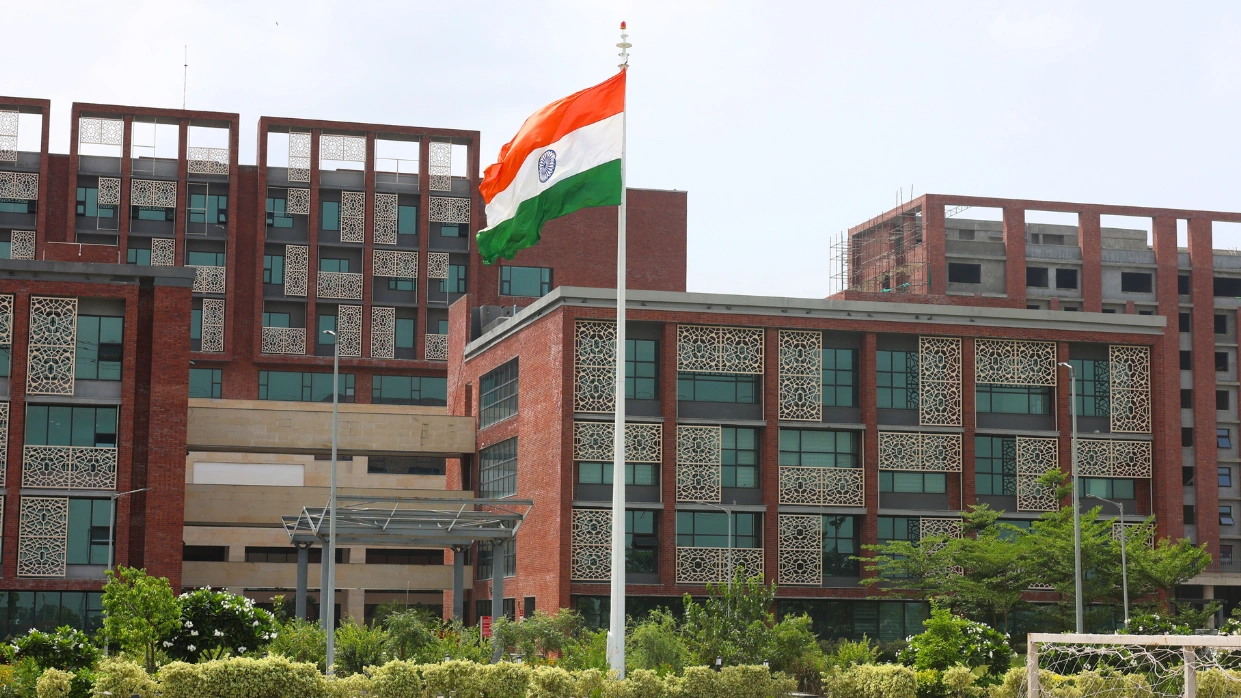
Rishihood’s 25-acre Sonipat campus, 40 km from Delhi, features design-centric infrastructure:
- Design-Centric Infrastructure: The 25-acre Sonipat campus (40 km from Delhi) is equipped with sunlit studios, a materials library (2,000+ samples), and a Fab Lab featuring 3D printers and laser cutters for rapid prototyping.
- Digital Hub & Access: Students have 24/7 access to a Digital Hub offering over 100 MacBooks and the full Adobe Creative Suite.
- Residential Facilities: Air-conditioned double-occupancy halls include study nooks and high-speed Wi-Fi. Messes provide balanced meals with regional/dietary options.
- Wellness and Recreation: Facilities include a gym, squash courts, yoga decks, and a Wellness Centre for counseling. The campus hosts active clubs (e.g., Design Collective) and annual events like Rishihood Creatives.
- Location Advantage: Proximity to NCR allows for easy access to industry connections, including guest lectures (e.g., NID alumni) and visits to cultural centers (e.g., India Habitat Centre).
Rishihood University Placements and Career Opportunities
Rishihood University boasts 100% placements for BDes graduates. The table below depicts the complete Rishihood University Placement Landscape:
| Placement Metric | Detail / Figure | Key Information |
| Placement Rate (2025) | 100% | All BDes graduates placed. |
| Highest Package (2025) | INR 12.5 Lakhs | Top offer received. |
| Average Package (2025) | INR 7.5 Lakhs | Average salary across placed students. |
| Recruiting Season | Starts October | Drives orchestrated by the Career Advancement Cell. |
| Number of Recruiters | 50+ | Includes major companies like Adobe, FabIndia, and Bosch. |
| Top Roles | UX/UI, Communication Design, Product Design. | Recruiters include Tata Elxsi and Raymond (Fashion). |
| Pre-Placement Offers | 80% | Percentage of students receiving offers before graduation. |
| Alumni Salaries (Example) | INR 8-10 Lakhs | Typical salary range for Product Design alumni at Tata Elxsi. |
| Internship Stipend | INR 15,000 – 25,000/month | Mandatory internship in Year 3. |
| PPO Conversion Rate | 40% | Rate at which internships are converted into Pre-Placement Offers (PPOs). |
Entrepreneurship support via incubators has launched five design startups, like an eco-textile venture funded at INR 5 lakhs. Global exchanges with Parsons School yield overseas internships. Long-term, mid-career salaries hit INR 15-20 lakhs in consultancies like IDEO. Networks via alumni portals sustain opportunities, ensuring sustained career trajectories.
Rishihood University Faculty and Curriculum Insights
- Rishihood’s 40-member design faculty includes PhDs from IITs and practitioners from Frog Design, maintaining a 1:12 ratio for personalized mentoring.
- Sessions blend lectures with studios, like Prof. Anita Rao’s UX labs simulating app redesigns for e-governance. Guest faculty from Meta conduct masterclasses on VR prototyping.
- The curriculum evolves annually, incorporating AI ethics in year 2 and sustainable design in capstones. Semesters alternate theory (20%) with projects (80%), culminating in industry briefs from HUL.
- Electives like Design for Social Impact allow customization. Research grants fund theses, with 10 publications yearly in journals like Design Studies.
- Assessment via continuous evaluation—portfolios (50%), presentations (30%), exams (20%)—hones practical skills. This faculty-driven approach positions Rishihood as a launchpad for thought leaders in Indian design.
Rishihood University Placements: Industry Collaborations and Internships
| Feature | Detail | Impact/Benefit |
| Strategic Ties | 100+ firms (e.g., Siemens, Reliance, Wipro) | Ensures curriculum reflects market needs (e.g., agile UX for fintech). |
| Live Projects | Embedded projects with firms like Siemens (product simulations) and Reliance (textile innovations). | Provides real-world experience and practical application of learning. |
| Internships | Mandatory from Year 2, lasting 8-12 weeks. | Stipends average INR 20,000/month. 70% occur in NCR hubs. |
| Certifications | Collaborations yield certifications in tools like Figma or AutoCAD. | Boosts student resumes and industry readiness. |
| Engagement | Annual summits host panels with industry leaders (e.g., Wipro designers). | Creates mentorship opportunities and facilitates networking. |
| Program Refinement | Continuous feedback loops between industry and university. | Bridges academia-industry gaps effectively. |
Rishihood University Alumni Success Stories
BDes alumni exemplify impact: Aarav Singh (UX/UI 2023) leads interfaces at Paytm, crediting RSAT prep for his edge; his redesign cut cart abandonment by 25%. Nisha Patel (Fashion 2024) launched a sustainable label, featured at Lakme Fashion Week, post-FabIndia internship.
Internationally, Karan Mehra (Product 2022) prototypes at Philips Netherlands via exchanges. Entrepreneur batch-mates founded a VR firm, scaling to INR 10 crore valuation. These narratives, shared at reunions, inspire cohorts, highlighting Rishihood’s role in global design narratives.
Conclusion: Why Rishihood University for BDes
Rishihood University’s BDes program transforms aspirations into expertise, through innovative admissions, robust support, and stellar outcomes. As design drives India’s creative economy, this residential haven equips you for leadership. With 2026 applications live, seize the opportunity at rishihood.edu.in—craft your future, one idea at a time.
FAQs
Is taking the RSAT mandatory if I have a valid UCEED or NID DAT score?
No, taking the RSAT is not mandatory if you have a valid score from national exams like UCEED, CUET, NID DAT, NIFT, SAT India, or ACT. The RSAT is the university’s in-house aptitude test and serves as a backup option for candidates who have not qualified or appeared for the other accepted design entrance exams.
What is the total estimated cost for the first year of the BDes program?
The estimated total cost for the first year is approximately INR 6 Lakhs. This figure combines the Annual Tuition Fee of INR 4.2 Lakhs, the mandatory Annual Hostel Fee of INR 1.8 Lakhs, and the one-time refundable Security Deposit of INR 50,000. Subsequent years cost around INR 6 Lakhs annually.
How competitive is the admission process, and what is the weightage of the entrance exam?
The admission process is holistic, emphasizing creative potential. The Entrance Exam Score (RSAT or National Exam) holds the highest weightage at 50%. Academics/Extracurriculars account for 30%, and the Personal Interview holds 20%. The holistic evaluation aims to admit passionate innovators, not just high scorers.
What is the difference between the RSAT and UCEED exam patterns for BDes admission?
UCEED is a 3-hour, 300-mark exam by IIT Bombay, including a compulsory sketching component (Part B), emphasizing analytical drawing. The RSAT is a 90-minute, 100-mark MCQ test that is fully online and does not require sketching, focusing on logical, verbal, and design-specific aptitude.
What career paths do graduates from the UX/UI Design specialization typically pursue?
Graduates from the UX/UI Design specialization typically secure roles as UX/UI Designers, Interaction Designers, or Product Specialists. Alumni have been placed at top companies like Adobe and Bosch, with Product Design alumni earning INR 8-10 Lakhs at firms like Tata Elxsi, reflecting strong career growth in digital interface roles.
What kind of financial aid is available, and what is the highest scholarship waiver offered?
Rishihood offers extensive financial aid, including Merit Scholarships providing a 50% to 100% tuition waiver for RSAT/UCEED toppers (above the 90th percentile). Need-based aid (25-50% coverage) and special grants (INR 50,000) for first-generation learners are also available, subject to eligibility.
What major industry collaborations does the university have for real-world experience?
The university has strategic ties with 100+ firms for live projects and mentorship. Examples include collaborating with Siemens for product simulations and Reliance for textile innovations. This partnership ensures the curriculum is industry-aligned and facilitates mandatory 8-12 week internships, often with stipends.