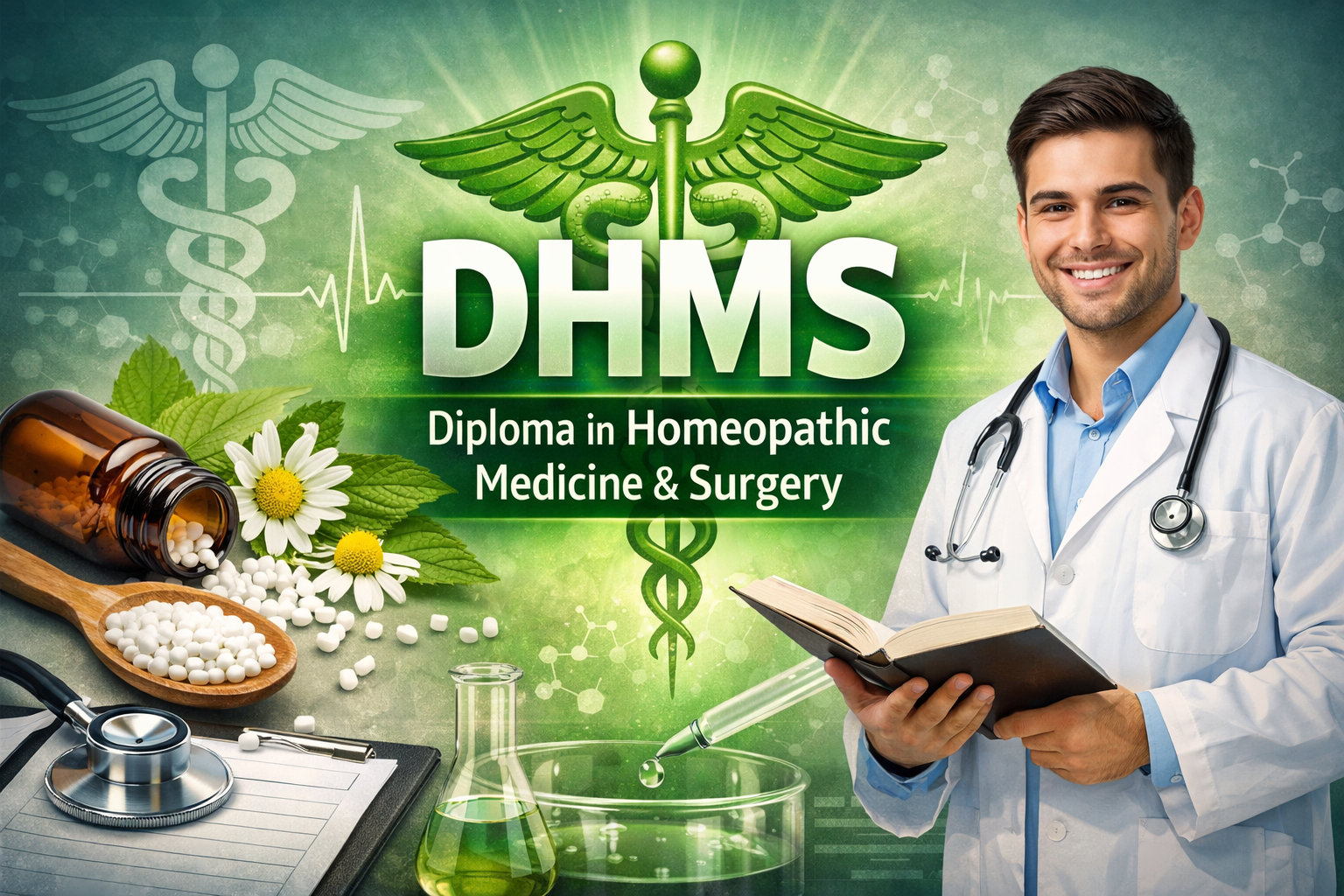
DHMS (Diploma in Homeopathic Medicine and Surgery): Admission Process, Syllabus & Jobs 2026
DHMS (Diploma in Homeopathic Medicine and Surgery): Overview
| Aspect | Details |
|---|---|
| Course Name | DHMS (Diploma in Homeopathic Medicine and Surgery) |
| Course Level | Diploma |
| Course Duration | 3–4 Years (including internship, varies by institute) |
| Eligibility | 10+2 with Science (Biology preferred) |
| Admission Process | Merit-based or Entrance Exam (varies by college) |
| Course Focus | Homeopathic medicine, diagnosis, basic surgery |
| Key Subjects | Anatomy, Physiology, Pathology, Homeopathic Pharmacy, Materia Medica |
| Mode of Study | Regular / Full-time |
| Career Options | Homeopathic Practitioner, Clinic Assistant, Medical Representative |
| Average Salary | ₹2–5 LPA (depends on experience and location) |
| Further Studies | BHMS, Certificate & Advanced Homeopathy Courses |
Why Choose DHMS (Diploma in Homeopathic Medicine and Surgery)?
DHMS is a suitable course for students who want to build a career in alternative medicine and holistic healthcare using natural treatment methods.
DHMS (Diploma in Homeopathic Medicine and Surgery) Eligibility Criteria
To apply for DHMS (Diploma in Homeopathic Medicine and Surgery), candidates must meet certain basic academic and age requirements set by colleges or state authorities. These criteria ensure that students have the required science background to understand medical subjects.
-
Educational Qualification:
Candidates must have passed Class 12 (10+2) from a recognized board. Science stream students are preferred, especially those who have studied Biology as a compulsory subject. In many colleges, Physics and Chemistry along with Biology are required. -
Minimum Marks Required:
Most institutes ask for a minimum of 45%–50% aggregate marks in Class 12. Reserved category students (SC/ST/OBC) may get relaxation in minimum marks as per government rules. -
Age Limit:
The minimum age to apply is usually 17 years at the time of admission. Some institutes may also set an upper age limit, which can vary by state or college. -
Nationality:
Candidates must be Indian citizens. Some colleges may also allow NRIs or foreign students as per their admission guidelines. -
Entrance Exam (if applicable):
While many colleges offer merit-based admission, some institutes may conduct an entrance exam or follow state-level admission procedures. -
Medical Fitness:
Applicants may be required to submit a medical fitness certificate at the time of admission.
Students are advised to check the official notification of the college or authority they are applying to, as eligibility rules may slightly differ from one institute to another.
| Eligibility Factor | Details |
|---|---|
| Course Name | DHMS (Diploma in Homeopathic Medicine and Surgery) |
| Educational Qualification | Passed Class 12 (10+2) from a recognized board |
| Required Stream | Science stream preferred |
| Mandatory Subjects | Biology (required), Physics & Chemistry (preferred) |
| Minimum Marks | 45%–50% aggregate (relaxation for reserved categories) |
| Age Limit | Minimum 17 years at the time of admission |
| Upper Age Limit | As per college or state guidelines |
| Nationality | Indian citizens (NRI/Foreign students as per institute rules) |
| Admission Basis | Merit-based or Entrance Exam |
| Medical Fitness | Medical fitness certificate may be required |
DHMS (Diploma in Homeopathic Medicine and Surgery) Admission Process
The admission process for DHMS (Diploma in Homeopathic Medicine and Surgery) is generally simple and varies slightly depending on the college or state authority. Most institutes offer admission through merit-based selection, while some may follow an entrance exam process.
Step 1: Check Eligibility
Candidates must first ensure they meet the eligibility criteria. This usually includes passing Class 12 (10+2) with Biology from a recognized board and meeting the minimum marks requirement set by the institute.
Step 2: Application Form
Students need to fill out the application form of the respective college or university. Application forms are usually available online on the official website or offline at the college campus. Candidates must provide personal details, academic information, and upload required documents.
Step 3: Merit-Based or Entrance-Based Selection
-
In merit-based admission, colleges prepare a merit list based on Class 12 marks, especially Biology.
-
In some states or private institutes, candidates may need to appear for an entrance exam conducted by the college or state authority.
Step 4: Counselling and Seat Allotment
Shortlisted candidates are called for counselling, where seats are allotted based on merit rank, availability of seats, and category reservation rules. During counselling, students can choose their preferred college if multiple options are available.
Step 5: Document Verification
Candidates must present original documents such as mark sheets, age proof, identity proof, and category certificates (if applicable) for verification.
Step 6: Fee Payment and Admission Confirmation
After successful verification, students must pay the admission fee to confirm their seat. Once the fee is paid, the admission process is completed, and the student can begin the DHMS course.
Students are advised to regularly check official notifications, as the admission process may differ slightly across states and institutions.
DHMS (Diploma in Homeopathic Medicine and Surgery) Syllabus
The DHMS syllabus is designed to provide students with strong knowledge of homeopathic principles, human anatomy, disease diagnosis, and basic medical science. The course combines theoretical learning with practical and clinical training to prepare students for real-world healthcare practice. The syllabus may vary slightly by institute, but the core subjects remain mostly the same.
First Year Syllabus
The first year focuses on building a foundation in basic medical sciences.
-
Anatomy and Physiology
-
Fundamentals of Homeopathy
-
Homeopathic Philosophy
-
Biochemistry
-
Basics of Human Anatomy
-
Introduction to Homeopathic Pharmacy
-
Practical Training (Anatomy & Physiology)
Second Year Syllabus
In the second year, students study disease processes and homeopathic medicines in detail.
-
Pathology
-
Microbiology
-
Homeopathic Materia Medica – I
-
Homeopathic Pharmacy – I
-
Psychology
-
Community Medicine
-
Practical & Clinical Training
Third Year Syllabus
The final year focuses on diagnosis, treatment, and patient care.
-
Practice of Medicine
-
Homeopathic Materia Medica – II
-
Homeopathic Pharmacy – II
-
Forensic Medicine & Toxicology
-
Basic Surgery
-
Gynecology & Obstetrics (Basics)
-
Clinical Training & Case Study
Internship / Practical Training
Most institutes include a mandatory internship or clinical training period, where students gain hands-on experience in:
-
Patient diagnosis
-
Case taking and analysis
-
Medicine selection
-
Follow-up treatment
-
Hospital or clinic-based practice
| Year | Major Subjects |
|---|---|
| First Year | Anatomy, Physiology, Homeopathic Philosophy, Biochemistry |
| Second Year | Pathology, Materia Medica, Pharmacy, Community Medicine |
| Third Year | Practice of Medicine, Surgery, Gynecology, Forensic Medicine |
| Practical | Clinical training, case studies, internship |
The DHMS syllabus aims to develop professional skills, ethical medical practice, and holistic healing knowledge, making students ready for careers in homeopathy and alternative healthcare.
DHMS (Diploma in Homeopathic Medicine and Surgery) Exam Pattern
The DHMS (Diploma in Homeopathic Medicine and Surgery) exam pattern is structured to evaluate both theoretical knowledge and practical skills of students. The examination system ensures that candidates understand homeopathic principles and can apply them in real medical situations. The exact pattern may vary slightly by institute, but the overall format remains similar.
Mode of Examination
-
Exams are usually conducted in offline (pen-and-paper) mode.
-
The medium of examination is generally English (some institutes may allow regional languages).
Type of Questions
Theory Papers:
-
-
Long answer questions
-
Short answer questions
-
Very short notes
-
Practical / Viva Voce:
-
-
Practical examinations
-
Oral viva based on subjects studied
-
Clinical case discussion (in later years)
-
Year-wise Examination Structure
-
Each academic year has separate theory and practical exams.
-
Students must pass both theory and practical papers to be promoted to the next year.
-
Internal assessments and sessional exams may also be conducted by colleges.
Marks Distribution
-
Theory exams generally carry 70–80% weightage.
-
Practical exams and viva carry 20–30% weightage.
-
Internal assessments may be included in the final result as per institute rules.
Passing Criteria
-
Students must score the minimum passing marks (usually around 40%–50%) separately in theory and practical exams.
-
Failing in one subject may require appearing in a supplementary exam.
Internship Assessment
During internship or clinical training, students are assessed on:
-
-
Patient handling
-
Case taking and diagnosis
-
Treatment planning
-
Professional conduct
-
| Exam Component | Details |
|---|---|
| Exam Mode | Offline (Written) |
| Question Type | Long answers, short answers, viva |
| Theory Weightage | 70–80% |
| Practical & Viva | 20–30% |
| Internal Assessment | Included (as per institute rules) |
| Passing Marks | 40%–50% (theory & practical separately) |
| Internship | Mandatory clinical assessment |
Skills Required for DHMS (Diploma in Homeopathic Medicine and Surgery) Students
Salary After DHMS (Diploma in Homeopathic Medicine and Surgery)
The salary after completing DHMS (Diploma in Homeopathic Medicine and Surgery) varies based on experience, skills, location, and type of employment. Since homeopathy is a practice-based profession, income generally increases with time, patient trust, and professional reputation.
Fresh DHMS graduates usually start their careers as clinic assistants, junior practitioners, or medical representatives. At the entry level, salaries are modest but improve steadily with hands-on experience. Those working in private clinics or hospitals in urban areas often earn more compared to rural areas.
Many DHMS holders choose private practice, which offers the highest earning potential. Income from private clinics depends on patient volume, treatment success, and years of practice. Additionally, professionals working with pharmaceutical companies or wellness centers may receive incentives and bonuses.
| Experience Level | Job Role | Average Salary |
|---|---|---|
| Fresher | Clinic Assistant / Junior Practitioner | ₹10,000–₹20,000 per month |
| 2–5 Years | Homeopathic Practitioner | ₹25,000–₹40,000 per month |
| Private Practice | Own Clinic | ₹30,000–₹1,00,000+ per month |
| Corporate Role | Medical Representative | ₹2–5 LPA |
| Wellness Sector | Health Consultant | ₹20,000–₹45,000 per month |
Higher Studies After DHMS (Diploma in Homeopathic Medicine and Surgery)
Students who wish to gain advanced knowledge and better career opportunities can pursue higher studies after DHMS. Further education helps in improving clinical skills, increasing earning potential, and gaining professional recognition in the healthcare field.
The most common choice after DHMS is BHMS (Bachelor of Homeopathic Medicine and Surgery), which is a recognized degree and allows graduates to practice independently with better job prospects. Apart from BHMS, students can also choose certificate and advanced diploma courses in specialized areas such as clinical homeopathy, pharmacy, nutrition, or wellness therapy.
For those interested in non-clinical roles, healthcare management courses open doors to administrative and managerial positions in hospitals and health organizations. With higher qualifications, DHMS graduates can also move into teaching, research, or academic roles.
| Course | Duration | Career Benefit |
|---|---|---|
| BHMS | 5.5 Years | Better clinical practice & recognition |
| MD (Homeopathy) | 3 Years (after BHMS) | Specialization & higher salary |
| Advanced Diploma Courses | 6 Months–2 Years | Skill enhancement |
| Certificate Courses | 3–12 Months | Short-term specialization |
| Healthcare Management | 1–2 Years | Administrative & managerial roles |
| Research & Teaching | Varies | Academic & research careers |
Government Jobs After DHMS (Diploma in Homeopathic Medicine and Surgery)
After completing DHMS (Diploma in Homeopathic Medicine and Surgery), graduates can apply for various government-sector jobs in the healthcare system. The government actively promotes alternative medicine systems like homeopathy under AYUSH, which creates steady job opportunities for qualified candidates.
DHMS holders can work in government homeopathic hospitals, dispensaries, primary health centers (PHCs), and community health centers (CHCs). Recruitment is usually done through state health departments, AYUSH boards, public service commissions, or contractual appointments. Job roles may vary depending on state policies and eligibility norms.
Apart from clinical roles, DHMS graduates can also work in public health awareness programs, rural healthcare missions, and NGOs funded by the government. With experience and further qualifications (like BHMS), opportunities expand to higher posts, supervisory roles, and teaching positions in government institutes.
| Job Role | Recruiting Authority | Work Location |
|---|---|---|
| Homeopathic Medical Officer | State Health Department / AYUSH | Govt. hospitals & dispensaries |
| Pharmacist (Homeopathy) | Govt. Health Services | Govt. pharmacies |
| Community Health Worker | National Health Mission (NHM) | Rural & urban health centers |
| Medical Assistant | Govt. Hospitals | PHCs / CHCs |
| Health Program Officer | Govt. NGOs / AYUSH schemes | Field & administrative offices |
| Teaching Assistant (with experience) | Govt. Institutes | Homeopathy colleges |
Top Colleges for DHMS (Diploma in Homeopathic Medicine and Surgery) in India
India has several recognized government and private institutions offering DHMS or equivalent diploma-level homeopathy courses. These colleges provide quality education, experienced faculty, and clinical exposure through attached hospitals. Admission criteria, fees, and course duration may vary across institutes.
Government colleges are generally preferred due to lower fees and better clinical exposure, while private colleges offer modern infrastructure and flexible admission processes. Students are advised to ensure that the college is recognized by the appropriate state authority or homeopathy council before taking admission.
Choosing a reputed college helps students gain better practical training, internship opportunities, and career support after completing the DHMS course.
| College Name | Location | College Type | Affiliation / Recognition | Approx. Fees (Per Year) | Key Highlights |
|---|---|---|---|---|---|
| National Institute of Homeopathy (NIH) | Kolkata, West Bengal | Government | Ministry of AYUSH, Govt. of India | ₹25,000–₹40,000 | One of the most reputed homeopathy institutes, excellent clinical exposure |
| Nehru Homeopathic Medical College & Hospital | New Delhi | Government | State Govt. / AYUSH | ₹20,000–₹35,000 | Attached hospital, strong faculty, good patient inflow |
| Dr. B.R. Sur Homeopathic Medical College | New Delhi | Government | Govt. of NCT Delhi | ₹20,000–₹40,000 | Known for academics and government hospital training |
| Government Homeopathic Medical College | Jaipur, Rajasthan | Government | State Govt. / AYUSH | ₹30,000–₹50,000 | Affordable fees, good internship opportunities |
| Government Homeopathic Medical College | Bhopal, Madhya Pradesh | Government | State Govt. | ₹25,000–₹45,000 | Focus on rural and community healthcare |
| Bakson Homeopathic Medical College | Greater Noida, UP | Private | AYUSH / State Authority | ₹1–2 Lakhs | Modern infrastructure, strong clinical practice |
| Bharati Vidyapeeth Homeopathic Medical College | Pune, Maharashtra | Private | Deemed University / AYUSH | ₹1.5–2.5 Lakhs | Reputed university, good academic support |
| Father Muller Homeopathic Medical College | Mangalore, Karnataka | Private | AYUSH / State Authority | ₹1–2 Lakhs | Quality education, hospital-based training |
| Parul Institute of Homeopathy | Vadodara, Gujarat | Private | Parul University / AYUSH | ₹1–2 Lakhs | Industry exposure, good campus facilities |
| Sri Sai Ram Homeopathic Medical College | Chennai, Tamil Nadu | Private | State Govt. / AYUSH | ₹1–1.8 Lakhs | Experienced faculty, good clinical training |
Advantages of Studying DHMS (Diploma in Homeopathic Medicine and Surgery)
Studying DHMS (Diploma in Homeopathic Medicine and Surgery) offers several benefits for students who are interested in alternative medicine and holistic healthcare. This course provides a balanced mix of theoretical knowledge and practical clinical training.
One of the biggest advantages of DHMS is its focus on natural and side-effect-free treatment. Homeopathy treats patients using natural remedies, making it a preferred choice for people seeking safe and long-term healing solutions. With increasing awareness of alternative medicine, the demand for qualified homeopathic practitioners is steadily growing in India.
Another major benefit is the affordable fee structure. Compared to other medical courses like MBBS or BDS, DHMS is cost-effective and accessible to students from diverse backgrounds. The course also offers flexible career options, allowing graduates to work in clinics, hospitals, wellness centers, or start their own private practice.
DHMS also provides a strong foundation for higher studies in homeopathy. Students can pursue BHMS, MD (Homeopathy), or specialized certificate courses to enhance their qualifications. Overall, DHMS is a good option for students who want a meaningful, service-oriented career in healthcare.
Challenges in DHMS (Diploma in Homeopathic Medicine and Surgery)
While DHMS has many advantages, students should also be aware of the challenges associated with the course and profession. One of the main challenges is slower career growth in the initial years. Fresh graduates may need time to build patient trust and professional experience, especially in private practice.
Another challenge is limited recognition in some sectors. Compared to allopathic medicine, homeopathy may have fewer job opportunities in large corporate hospitals. Government job openings may also be limited and competitive.
The profession requires patience and continuous learning. Homeopathic treatment often takes time to show results, and practitioners must stay updated with new research and practices. Additionally, income may vary depending on location, patient flow, and experience.
Despite these challenges, students who are dedicated, patient-focused, and committed to learning can build a stable and rewarding career in homeopathic medicine over time.
DHMS (Diploma in Homeopathic Medicine and Surgery) vs BHMS
| Feature | DHMS (Diploma in Homeopathic Medicine and Surgery) | BHMS (Bachelor of Homeopathic Medicine and Surgery) |
|---|---|---|
| Course Level | Diploma | Undergraduate Degree |
| Course Duration | 3–4 Years (including internship, varies by institute) | 5.5 Years (4.5 years study + 1-year internship) |
| Eligibility | 10+2 with Biology | 10+2 with Biology (Physics & Chemistry mandatory) |
| Admission Process | Merit-based / Entrance (college-wise) | Entrance exam (NEET-UG) |
| Depth of Study | Basic to intermediate homeopathy knowledge | In-depth and advanced homeopathy training |
| Clinical Exposure | Limited clinical practice | Extensive clinical training and hospital exposure |
| Recognition | Limited recognition | Fully recognized medical degree |
| Career Scope | Clinic assistant, junior practitioner | Independent homeopathic doctor, medical officer |
| Government Job Eligibility | Limited | Higher eligibility and preference |
| Private Practice | Possible with restrictions | Fully allowed |
| Higher Studies | Can pursue BHMS | Can pursue MD (Homeopathy) |
| Average Salary | ₹2–5 LPA (varies by experience) | ₹4–10 LPA (with experience) |
| Course Fees | Low to moderate | Moderate to high |
| Ideal For | Students seeking affordable entry into homeopathy | Students aiming for long-term medical career |
FAQs
1. What is DHMS (Diploma in Homeopathic Medicine and Surgery)?
DHMS is a diploma-level course in homeopathy that teaches natural treatment methods, basic medical science, diagnosis, and patient care for building a career in alternative healthcare.
2. What is the duration of the DHMS course?
The DHMS course duration is usually 3 to 4 years, including theoretical study and practical or clinical training, depending on the institute and state regulations.
3. What is the eligibility for DHMS admission?
Candidates must pass Class 12 with Biology from a recognized board. Some colleges also require Physics and Chemistry with minimum 45–50% aggregate marks.
4. Is DHMS better than BHMS?
DHMS is suitable for quick entry into homeopathy, while BHMS offers deeper knowledge, better recognition, and wider career opportunities. Choice depends on career goals and time availability.
5. Can I open my own clinic after DHMS?
Yes, DHMS graduates can open their own homeopathic clinic, subject to state rules and registration requirements, though income and recognition may grow with experience and higher qualifications.
6. What are the career options after DHMS?
After DHMS, graduates can work as homeopathic practitioners, clinic assistants, medical representatives, wellness consultants, or pursue higher studies in homeopathy-related fields.
7. What is the salary after DHMS in India?
The average salary after DHMS ranges from ₹2 to ₹5 LPA. Earnings increase with experience, private practice, location, and patient trust over time.
8. Are there government jobs after DHMS?
Yes, DHMS graduates can apply for government jobs in homeopathic hospitals, dispensaries, AYUSH departments, and health missions, depending on eligibility and state recruitment rules.
9. Which entrance exams are required for DHMS?
Most colleges offer merit-based admission, but some institutes may conduct their own entrance exams. NEET is usually not mandatory for DHMS admission.
10. Can I pursue higher studies after DHMS?
Yes, DHMS graduates can pursue BHMS, certificate courses, advanced diplomas, or healthcare management programs to improve career growth and professional opportunities.