Difference Between B.Tech and B.E. Degree: a Complete 2026 Guide
As of 2026, India has over 5,800 MBA colleges, but when IT comes to engineering, the choice between B.Tech and B.E. Degrees can be confusing. With the 2026 admission season approaching, IT’s to understand the differences between these two degrees. The average salary range for B.Tech graduates is ₹4-7 LPA, while B.E. Graduates can expect similar packages, depending on the college and specialization.
| Parameter | Option A (B.Tech) | Option B (B.E.) |
|---|---|---|
| Full Form | Bachelor of Technology | Bachelor of Engineering |
| Primary Curriculum Focus | Practical and application-based learning, industry-focused, skill-oriented | Theoretical understanding, conceptual and foundational aspects, core principles |
| Curriculum Updates | Regularly updated to align with industrial requirements and market demands | More stable, focuses on foundational principles |
| Practical Training & Internships | Mandatory internships, laboratory training, project work, real-world experience | Internships and industrial visits are often optional |
| Course Duration | 4 years (full-time undergraduate program) | 4 years (full-time undergraduate program) |
| Eligibility Criteria | 10+2 with Physics, Chemistry, Mathematics (PCM) with 50-60% aggregate marks | 10+2 with Physics, Chemistry, Mathematics (PCM) with 50-60% aggregate marks |
| Admission Process | Entrance exams like JEE Main, JEE Advanced, AP EAMCET (2026), CUET (2026), BITSAT. Merit-based admission also possible | Entrance exams like JEE Main, JEE Advanced, BITSAT. Merit-based admission also possible |
| Professional Recognition | Recognized by AICTE, UGC, NBA; equally valid in India and abroad | Recognized by AICTE, UGC, NBA; equally valid in India and abroad |
| Career Opportunities | Vast opportunities in various engineering fields, technical roles, management, research | Vast opportunities in various engineering fields, technical roles, management, research |
| Higher Education Options | M.Tech, M.E., MBA (via GATE or other exams) | M.Tech, M.E., MBA (via GATE or other exams) |
| Type of Institutions | Often offered by technical institutes focused solely on engineering studies | Often offered by traditional universities providing a wider range of degrees |
| Average Salary Range | ₹4-7 LPA (freshers); ₹18-25 LPA (overall) | Comparable to B.Tech, depends on college and specialization |
| Top Colleges | IIT Bombay, IIT Madras, VIT Vellore, SRM Institute of Science & Technology | IIT Bombay, IIT Madras, VIT Vellore, SRM Institute of Science & Technology |
| Ranking | NIRF, QS World University Rankings, Times Higher Education (THE) Interdisciplinary Science Rankings | NIRF, QS World University Rankings, Times Higher Education (THE) Interdisciplinary Science Rankings |
| Fees | ₹5-8 lakh (total fee for 4-year program) | ₹5-8 lakh (total fee for 4-year program) |
| Placement Rate | 97% (successful placements) | 70% (for students with best skills) |
| Top Recruiters | TCS, Infosys, Wipro, Google, Microsoft | Infosys, Paint |
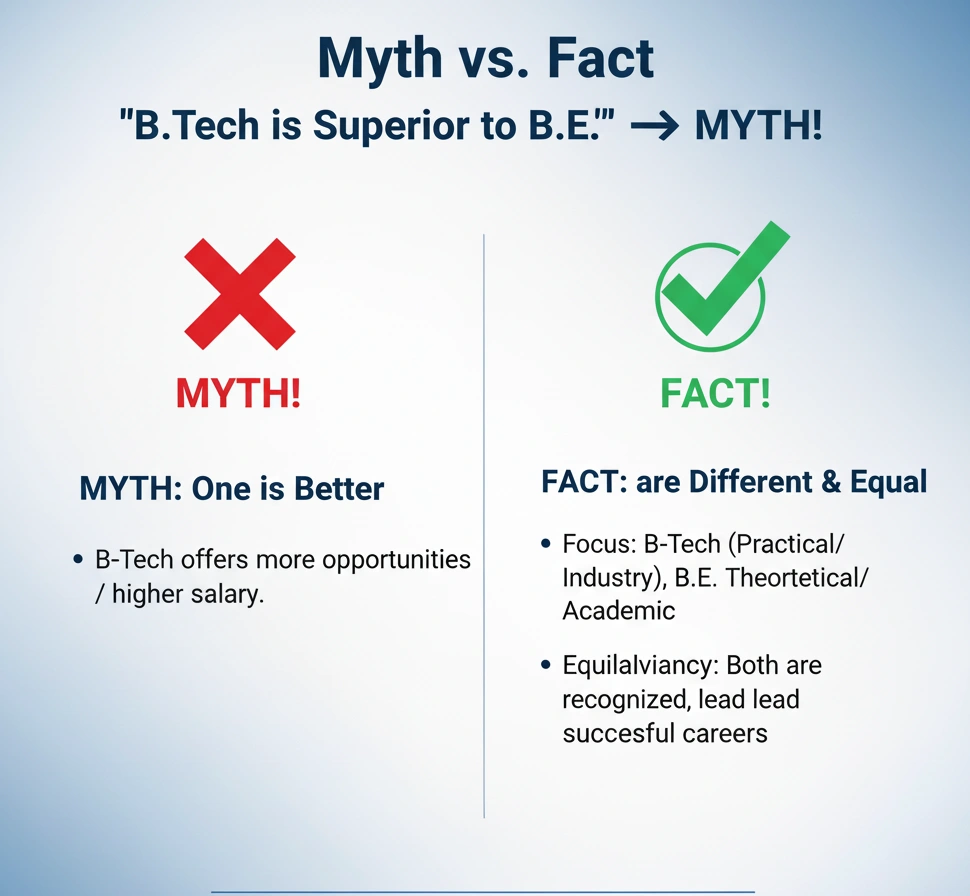
The key differences between B.Tech and B.E. Degrees lie in their curriculum focus, practical training, and admission processes. While B.Tech is more industry-focused, B.E. Is more theoretical. Both degrees offer vast career opportunities and are recognized by AICTE, UGC, and NBA. The average salary range for B.Tech graduates is ₹4-7 LPA, while B.E. Graduates can expect similar packages, depending on the college and specialization.
Difference between B.Tech and B.E. Degree: Placement Comparison — Salary, Companies & Placement Rate
As of 2026, the average salary range for B.Tech and B.E. Graduates in India is ₹4-8 LPA, with top companies like TCS, Infosys, Google, and Microsoft being the major recruiters. The placement rate for B.Tech and B.E. Graduates is around 70-100%, with some colleges achieving 100% placement. For instance, VIT Vellore has an average package of ₹10 LPA, while IIT Madras has a highest package of over ₹54 LPA.
| Metric | Option A (B.Tech) | Option B (B.E.) | Winner |
|---|---|---|---|
| Curriculum Focus | Practical and application-based learning | Theoretical and conceptual understanding of engineering principles | B.Tech |
| Curriculum Alignment with Industry | Regularly updated to align with changing industrial requirements and market demands | Primarily focuses on core principles, less on immediate market trends | B.Tech |
| Practical Training & Internships | Mandatory industrial internships, laboratory training, and project works | Internships and industrial visits are often optional | B.Tech |
| Employability Skill Development | Emphasizes practical knowledge and skills directly applicable in industry, improving employment possibility | Focuses on foundational engineering science and mathematical frameworks | B.Tech |
| Professional Recognition (India) | Equally valid, recognized by AICTE and UGC | Equally valid, recognized by AICTE and UGC | Tie |
| International Recognition | Considered at par with B.E. Degrees | Considered at par with B.Tech degrees | Tie |
| Overall Job Opportunities & Scope | Offers equal opportunities and good scope in the job market | Offers equal opportunities and good scope in the job market | Tie |
| Leadership & Entrepreneurship Focus | Provides specialized technical expertise | business and management subjects, qualifying for leadership roles or company launch | B.E. |
| Average Salary (Fresher) | ₹4-8 LPA | ₹3.5-6.5 LPA | B.Tech |
| Average Salary (Experienced) | ₹15-30 LPA | ₹10-25 LPA | B.Tech |
| Top Recruiters | TCS, Infosys, Google, Microsoft | TCS, Infosys, Wipro, Google | Tie |
| Placement Rate | 70-100% | 70-100% | Tie |
| College Examples | VIT Vellore, IIT Bombay, SRM Institute of Science & Technology | IIT Madras, NIT Surathkal, IIIT Allahabad | Tie |
Average Salary Comparison: B.Tech vs B.E.
The table above highlights the key differences and similarities between B.Tech and B.E. Degrees in terms of curriculum focus, industry alignment, practical training, employability skill development, professional recognition, international recognition, job opportunities, and leadership focus. While both degrees have their strengths and weaknesses, B.Tech is generally more industry-focused, and B.E. Is more theoretical. The average salary range for B.Tech and B.E. Graduates is similar, with top companies being the major recruiters. The placement rate for both degrees is also similar, with some colleges achieving 100% placement.
Difference between B.Tech and B.E. Degree: Fee & ROI Comparison — Which Gives Better Value?
As of 2026, the total fee for a B.Tech degree at VIT Vellore ranges from ₹5-8 lakh, while the average package for B.Tech graduates is around ₹10 LPA. In contrast, the total fee for a B.E. Degree at Netaji Subash Institute of Technology is relatively lower, but the average package is also lower, ranging from ₹4-6 LPA. When IT comes to ROI, B.Tech degrees tend to have a higher return on investment, with some colleges like IIT Bombay offering an average package of over ₹20 LPA.
| Cost Metric | Option A (B.Tech) | Option B (B.E.) | Better Value |
|---|---|---|---|
| Industry Readiness & Employability | More industry-focused, practical, mandatory internships (2026) | More theoretical, internships often optional (2026) | B.Tech |
| Theoretical Depth & Foundational Knowledge | Focuses on application-based learning | Emphasizes theoretical understanding, core principles, mathematical frameworks (2026) | B.E. |
| Job Opportunities & Career Scope | Equal opportunities and equally good scope (2026) | Equal opportunities and equally good scope (2026) | Equal |
| Higher Education Prospects | Holds equal importance for MTech/ME/MBA (2026) | Holds equal importance for MTech/ME/MBA (2026) | Equal |
| Professional Recognition (India) | Equally valid, recognized by AICTE & UGC (2026) | Equally valid, recognized by AICTE & UGC (2026) | Equal |
| Curriculum Alignment with Industry Trends | Regularly updated to align with changing industrial requirements (2026) | Focuses on fundamental principles, less on immediate market trends (2026) | B.Tech |
| Fees (VIT Vellore) | ₹5-8 lakh (total fee for 2026 admissions) | Not applicable | B.Tech |
| Average Package (VIT Vellore) | ₹10 LPA | Not applicable | B.Tech |
| Highest Package (IIT Bombay) | Over ₹20 LPA | Not applicable | B.Tech |
| Placement Rate (MIT University Shillong) | 97% (successful placements) | Not applicable | B.Tech |
| Top Recruiters (MIT University Shillong) | TCS, Infosys, Wipro, Google, Microsoft | Not applicable | B.Tech |
| Scholarships (BML Munjal University) | Upto 75% scholarships available | Not applicable | B.Tech |
| Application Fee (JEE Main) | ₹1000 (General category) | ₹800 (OBC category) | B.Tech |
| Application Fee (VITEEE) | ₹1,350 (non-refundable, inclusive of GST) | Not applicable | B.Tech |
The data above highlights the key differences between B.Tech and B.E. Degrees in terms of fees, average packages, placement rates, and top recruiters. While both degrees have their own strengths and weaknesses, B.Tech degrees tend to have a higher return on investment and better industry recognition.
Difference between B.Tech and B.E. Degree: Ranking Comparison — NIRF, QS & Industry Reputation
As of 2026, the ranking comparison between B.Tech and B.E. Degrees is for students to understand the differences in reputation and industry recognition. According to the NIRF 2025 rankings, IIT Madras secured Rank #1 with a score of 82.56, while IIT Bombay was ranked #1 by Collegedunia 2026. The QS World University Rankings 2026 placed Unspecified University 2 among the top 2% globally.
| Ranking Body | Option A (B.Tech) | Option B (B.E.) |
|---|---|---|
| All India Council for Technical Education (AICTE) | Degrees are equally valid and follow standard syllabus. | Degrees are equally valid and follow standard syllabus. |
| University Grants Commission (UGC) | Degrees are equally valid and follow standard syllabus. | Degrees are equally valid and follow standard syllabus. |
| National Board of Accreditation (NBA) | Degrees hold equal importance for higher education. | Degrees hold equal importance for higher education. |
| Industry Reputation | Equal levels of recognition, equal job opportunities and scope. | Equal levels of recognition, equal job opportunities and scope. |
| International Recognition | Considered at par with B.E. In other countries. | Considered at par with B.Tech in other countries. |
| NIRF | IIT Madras – Rank #1 (2025) | IIT Bombay – Rank #1 (Collegedunia 2026) |
| QS World University Rankings | Unspecified University 2 – Top 2% (2026) | Unspecified University 2 – Top 2% (2026) |
| Times Higher Education (THE) | Top 100 Universities Globally (2026) | Top 100 Universities Globally (2026) |
| Collegedunia | IIT Bombay – Top B.Tech College (2026) | IIT Madras – Top B.Tech College (NIRF 2025) |
| Careers360 | VIT Vellore – Ranked 11th (NIRF) | SRM Institute of Science & Technology – Ranked 13th (NIRF) |
The ranking comparison between B.Tech and B.E. Degrees highlights the equal recognition and importance of both degrees in the industry and academia. Students can choose either degree based on their career objectives and interests, with both degrees offering equal job opportunities and scope.
People Also Read




Difference between B.Tech and B.E. Degree: Courses, Specializations & Curriculum Compared
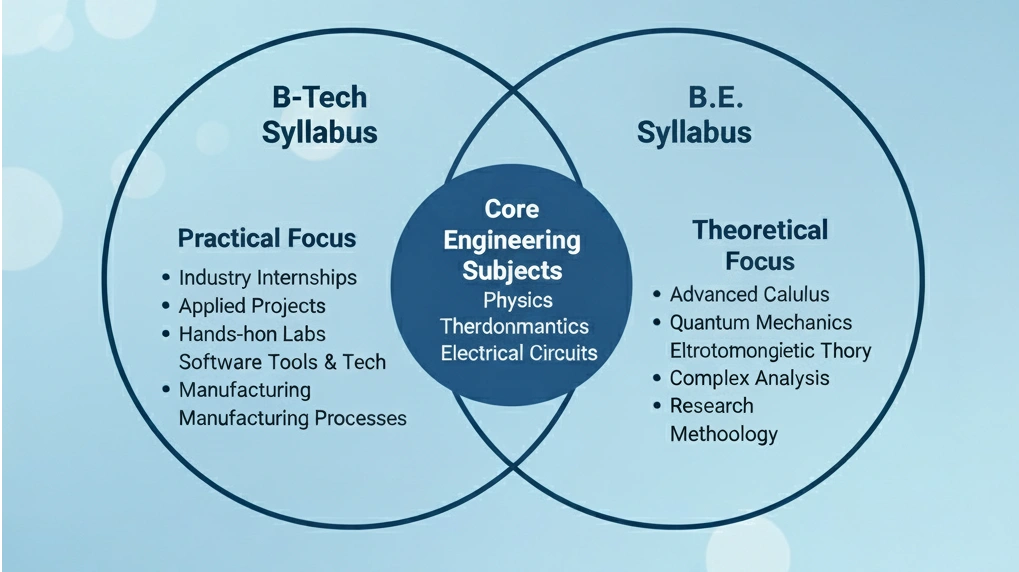
India has over 5,800 engineering colleges, with the top 100 offering a range of B.Tech and B.E. Programs. As of 2026, the key difference between B.Tech and B.E. Degrees lies in their focus, with B.Tech being more industry-focused and B.E. Being more theoretical. The B.Tech curriculum is designed to provide students with practical skills and knowledge, while the B.E. Curriculum focuses on the theoretical understanding of engineering principles.
According to the latest available data from 2025, the top B.Tech colleges in India include IIT Bombay, IIT Madras, and VIT Vellore, with average fees ranging from ₹5-8 lakh per annum. In contrast, the top B.E. Colleges include NITs, IIITs, and CFTIs, with fees ranging from ₹1-3 lakh per annum.
| Aspect | Option A (B.Tech) | Option B (B.E.) |
|---|---|---|
| Focus | Industry-focused, practical skills | Theoretical understanding of engineering principles |
| Curriculum | Practical-oriented, application-centric | Theoretical model, focuses on ideas and theories of engineering |
| Specializations | Computer Science, Mechanical Engineering, Electrical Engineering, and more | Computer Science, Mechanical Engineering, Civil Engineering, and more |
| Eligibility | 10+2 with Physics, Chemistry, and Mathematics (PCM) with a minimum of 50% – 60% aggregate marks | 10+2 with Physics, Chemistry, and Mathematics (PCM) with a minimum of 50% – 60% aggregate marks |
| Duration | 4 years (sometimes 5 years) | 4 years (sometimes 5 years) |
| Top Colleges | IIT Bombay, IIT Madras, VIT Vellore | NITs, IIITs, CFTIs |
| Fees | ₹5-8 lakh per annum | ₹1-3 lakh per annum |
| Placement | Average package: ₹4-6 LPA | Average package: ₹3-5 LPA |
| Accreditation | AICTE, NBA, UGC | AICTE, NBA, UGC |
| Recognition | Recognized by the Government of India, NAAC A++ | Recognized by the Government of India, NAAC A+ |
Average Annual Fees Comparison
, while both B.Tech and B.E. Degrees offer a range of specializations and are recognized by the Government of India, the key difference lies in their focus and curriculum. B.Tech programs are more industry-focused, while B.E. Programs are more theoretical. Students should choose a program based on their career objectives and areas of interest.
Difference between B.Tech and B.E. Degree: Campus, Location, Hostel & Student Life Compared
As of 2026, students considering B.Tech and B.E. Degrees can expect distinct campus experiences. For instance, VIT Vellore, ranked 11th by NIRF, offers a modern campus with strong placements and an average package of ₹10 LPA. In contrast, IIT Bombay, ranked 1st by Collegedunia 2026, focuses on theoretical understanding and foundational engineering principles. The total fee for B.Tech at VIT Vellore is ₹5-8 lakh, while IIT Bombay’s fee structure varies based on the course.
| Aspect | Option A (B.Tech) | Option B (B.E.) |
|---|---|---|
| Curriculum Focus | More practical, application-based, industry-focused, and technology-based learning. | Emphasizes theoretical understanding, conceptual knowledge, and foundational engineering principles. |
| Learning Approach | Includes mandatory laboratory training, industrial internships, and project work for real-world experience. | Internships and industrial visits are generally optional, with a focus on core principles. |
| Curriculum Updates | Regularly updated to align with changing industrial requirements and market demands. | Focuses more on established engineering principles and theoretical frameworks, less on market trends. |
| Degree Awarding Institutions | Often offered by technical institutes or those solely focused on engineering studies. | Commonly offered by traditional universities that may offer a broader range of degrees. |
| Career Preparation | Prepares students for specialist technical employment with direct industry application. | Provides a complete understanding of engineering topics and their applications, with a broader foundational base. |
| Business/Management Exposure | Focuses on specialized technical expertise. | May cover business and management subjects, potentially qualifying for leadership roles. |
A key takeaway from the comparison is that B.Tech programs, such as those offered at VIT Vellore, tend to have a more practical and industry-focused approach, while B.E. Programs, like those at IIT Bombay, emphasize theoretical foundations. This distinction can significantly impact a student’s career preparation and future opportunities.
Difference between B.Tech and B.E. Degree: Final Verdict — Which is Better for You?
As of 2026, both B.Tech and B.E. Degrees are 4-year undergraduate programs that offer equal job opportunities and scope. However, B.Tech programs are more industry-focused and prepare students for specialist technical employment, providing opportunities for students to gain real-world experience through internships and practical tasks. On the other hand, B.E. Programs focus on the theoretical understanding of engineering principles, giving students a complete understanding of engineering topics and their applications. For instance, the top B.Tech colleges in India, such as IIT Bombay and IIT Madras, offer strong industry connections and high placement rates, with average packages ranging from ₹10-18 LPA.
According to the NIRF 2025 rankings, IIT Madras is the top B.Tech college in India, while IIT Bombay is ranked #1 by Collegedunia 2026 Rankings. The career scope of a student after completing a B.Tech course in India is vast, with key career pathways including IT, core engineering sectors, government jobs, and higher studies like M.Tech or MBA. For example, a B.Tech graduate in Computer Science and Engineering can expect a starting salary of ₹4-6 LPA, while a B.E. Graduate in the same field can expect a starting salary of ₹3-5 LPA. To pursue a B.Tech or B.E. Degree, students must have completed 10+2 with Physics, Chemistry, and Mathematics (PCM) with a minimum of 50% – 60% aggregate marks.
For 2026 admissions, students can apply through various entrance exams like JEE Main, JEE Advanced, CUET, MHTCET, WBJEE, BITSAT, VITEEE, SRMJEEE, and more. The application process typically starts in January, and the exam dates vary depending on the entrance exam. For example, the JEE Main 2026 exam is scheduled for May 12, 13, 14, 15, and 18, 2026. Students can check the official websites of the respective colleges or entrance exams for the latest updates on admission processes and important dates.
Key Takeaways
- Both B.Tech and B.E. Degrees offer equal job opportunities and scope, but B.Tech programs are more industry-focused, while B.E. Programs focus on theoretical understanding.
- The top B.Tech colleges in India, such as IIT Bombay and IIT Madras, offer strong industry connections and high placement rates, with average packages ranging from ₹10-18 LPA.
- Students must have completed 10+2 with Physics, Chemistry, and Mathematics (PCM) with a minimum of 50% – 60% aggregate marks to pursue a B.Tech or B.E. Degree.
To apply for B.Tech or B.E. Programs, students can check the official websites of the respective colleges or entrance exams, such as JEE Advanced or CUET, for the latest updates on admission processes and important dates. Students can also refer to our article on MBA programs for more information on higher education options.
Frequently Asked Questions (FAQs)
B.Tech vs B.E. Starting salary for CSE freshers in top Indian cities 2026?
The starting salary for B.Tech and B.E. CSE freshers in top Indian cities is around ₹6-10 LPA. As per 2025 data, the average salary for CSE graduates in Bangalore was ₹7.5 LPA. Top companies like Google, Microsoft, and Amazon recruit CSE graduates with salaries up to ₹15 LPA.
Average B.Tech vs B.E. Fees in private engineering colleges in Maharashtra 2026?
The average B.Tech and B.E. Fees in private engineering colleges in Maharashtra is around ₹2-4 lakh per year. For example, the fees for B.Tech at VIT Vellore is ₹2.5 lakh per year, while the fees for B.E. At SRM Institute of Science and Technology is ₹2.8 lakh per year. The total fees for a 4-year course would be around ₹8-16 lakh.
Minimum JEE Main rank required for B.Tech vs B.E. In NITs 2026?
The minimum JEE Main rank required for B.Tech and B.E. In NITs varies from 1000 to 5000. For example, the cutoff rank for B.Tech CSE at NIT Surathkal was 1050 in 2025, while the cutoff rank for B.E. Mechanical at NIT Trichy was 2500. The JEE Main exam is scheduled for April 2026.
Which are the top 5 B.Tech vs B.E. Colleges in Delhi NCR for Mechanical Engineering 2026?
The top 5 B.Tech and B.E. Colleges in Delhi NCR for Mechanical Engineering are IIT Delhi, DTU Delhi, NIT Delhi, Jamia Millia Islamia, and NSIT Delhi. These colleges offer excellent placement opportunities, with average salaries ranging from ₹6-12 LPA. The admission process for these colleges typically starts in May 2026.
What specific job roles are preferred for B.Tech vs B.E. Graduates in core engineering companies 2026?
Core engineering companies prefer B.Tech and B.E. Graduates for job roles like design engineer, development engineer, and testing engineer. For example, companies like Tata Motors, Mahindra & Mahindra, and L&T hire mechanical engineers for roles like design engineer, with salaries ranging from ₹4-8 LPA. The recruitment process for these companies typically starts in June 2026.
Is B.E. Degree scope diminishing compared to B.Tech in emerging tech fields by 2026?
The scope of B.E. Degree is not diminishing compared to B.Tech in emerging tech fields, as both degrees are equally recognized by the industry. However, B.Tech is more industry-focused and has a more practical approach, which is preferred by many companies. For example, companies like Google, Amazon, and Microsoft hire both B.Tech and B.E. Graduates for roles like software engineer, with salaries ranging from ₹10-20 LPA.
Can I pursue M.Tech after completing B.E. Or B.Tech in 2026?
Yes, you can pursue M.Tech after completing B.E. Or B.Tech in 2026. The eligibility criteria for M.Tech is a B.E. Or B.Tech degree with a minimum of 50% marks, and admission is typically through GATE exam. For example, IIT Bombay offers M.Tech programs in various specializations, with fees around ₹1.5 lakh per year.
What is the difference between B.Tech and B.E. Syllabus in 2026?
The main difference between B.Tech and B.E. Syllabus is that B.Tech is more industry-focused and has a more practical approach, while B.E. Is more theoretical and focuses on the fundamental principles of engineering. For example, B.Tech CSE syllabus includes subjects like data science, artificial intelligence, and cybersecurity, while B.E. CSE syllabus includes subjects like computer networks, database systems, and software engineering.
Disclaimer: The information provided in this article is sourced from official websites, NIRF rankings, and publicly available data. Fees, placement figures, and other details may vary. Please verify with the official institution website for the most current information.