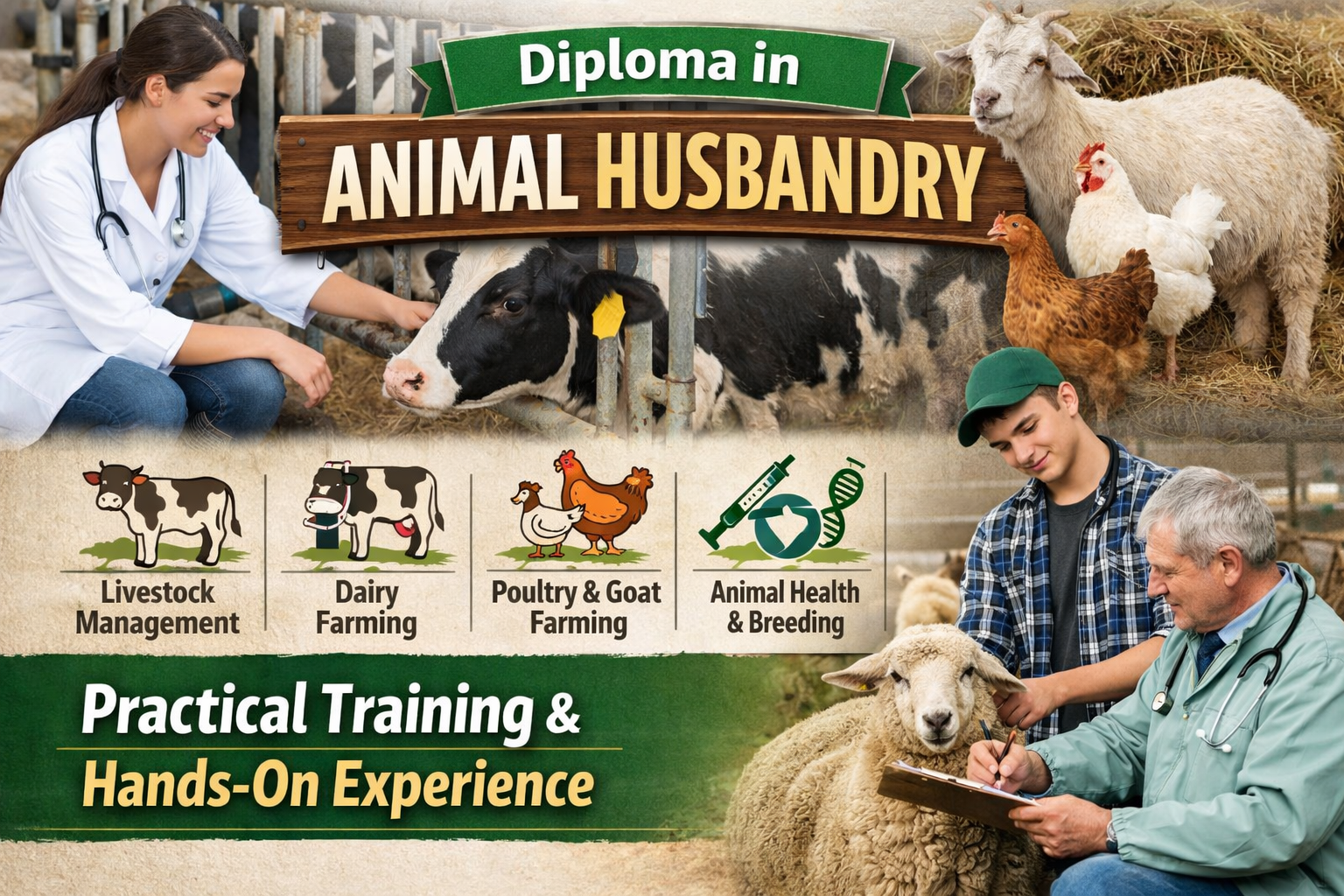
Diploma in Animal Husbandry: Course Details, Eligibility, Syllabus, Colleges, Salary & Career Scope
The Diploma in Animal Husbandry is a practical and career-oriented program designed for students who are interested in livestock management, dairy farming, poultry farming, and animal healthcare. Animal husbandry is an important part of the agricultural sector because it helps improve the production of milk, meat, eggs, and other animal-based products.
In India, animal farming plays a major role in rural employment and economic growth. This diploma course provides students with knowledge about animal nutrition, breeding, disease prevention, and farm management. It also offers hands-on training so that students can work directly with animals or start their own livestock business.
This blog explains everything about the course, including eligibility, syllabus, admission process, top colleges, career opportunities, salary, and future scope in simple and detailed language.
What is Diploma in Animal Husbandry?
A Diploma in Animal Husbandry is a short-term academic and practical course that focuses on the scientific management of farm animals such as cows, buffaloes, goats, sheep, and poultry birds. The course teaches students how to improve animal health and productivity through proper feeding, breeding, and disease control.
Students learn both theoretical concepts and practical skills such as vaccination methods, artificial insemination, livestock care, and dairy farm management. This course is suitable for students who want to work in agriculture-related industries or veterinary support services.
The diploma is especially helpful for rural students who want to start their own dairy or poultry farms. It also provides a strong foundation for higher education in veterinary science or agricultural studies.
Diploma in Animal Husbandry: Key Highlights
| Particulars | Details |
|---|---|
| Course Name | Diploma in Animal Husbandry |
| Course Level | Diploma |
| Course Duration | 1 to 2 Years (varies by institute) |
| Eligibility Criteria | 10th or 10+2 from a recognized board (Science/Agriculture preferred) |
| Admission Process | Merit-based or institute-level entrance (varies by college) |
| Course Focus | Livestock management, animal nutrition, breeding, and disease control |
| Mode of Study | Regular / Full-time (some institutes may offer distance or skill-based programs) |
| Average Course Fees | ₹5,000 to ₹50,000 per year (depends on institute type) |
| Practical Training | Included (farm training, veterinary assistance, field visits) |
| Top Specializations | Dairy Management, Poultry Management, Livestock Production |
| Job Roles | Livestock Supervisor, Veterinary Assistant, Dairy Farm Manager, Poultry Farm Manager |
| Average Starting Salary | ₹1.8 LPA to ₹3.5 LPA (depends on skills and experience) |
Importance of Animal Husbandry in India
Animal husbandry is one of the fastest-growing sectors in India because of the increasing demand for milk, eggs, and meat products. The sector supports millions of farmers and contributes significantly to the agricultural economy.
Livestock farming helps improve rural income and provides employment opportunities. With better animal care and scientific farming methods, farmers can increase production and reduce losses caused by diseases.
Government programs also promote animal husbandry to strengthen food security and improve the quality of livestock. Because of these developments, trained professionals in animal husbandry are in high demand across India.
Diploma in Animal Husbandry: Course Highlights
| Particulars | Details |
|---|---|
| Course Name | Diploma in Animal Husbandry |
| Course Level | Diploma |
| Duration | 1–2 Years |
| Eligibility | 10th or 10+2 (Science preferred) |
| Admission Process | Merit-based or Entrance-based |
| Course Mode | Regular / Distance |
| Average Fees | ₹10,000 – ₹80,000 |
| Average Salary | ₹2 LPA – ₹5 LPA |
| Career Areas | Dairy Farms, Poultry Farms, Veterinary Clinics |
Eligibility Criteria for Diploma in Animal Husbandry
The eligibility criteria for a Diploma in Animal Husbandry are designed to ensure that students have the basic academic background and physical ability required for learning animal care and livestock management. Although the exact requirements may differ slightly from one institute to another, most colleges follow similar guidelines.
Educational Qualification
Candidates are generally required to complete 10+2 (Class 12) from a recognized board. Science stream students are preferred because subjects like Biology, Agriculture, or Chemistry help in understanding animal health, nutrition, and breeding concepts. However, many institutes also allow 10th pass students to apply, especially for skill-based or rural training programs. Students from agriculture backgrounds often find the course easier because they already have basic knowledge of livestock practices.
Age Limit
Most colleges require students to be at least 17 years old at the time of admission. This age requirement ensures that students are mature enough to handle practical training involving animals. Some government institutes may define a maximum age limit, but private institutes usually do not enforce strict upper age restrictions. Age relaxation may also be provided for reserved categories as per state rules.
Medical Fitness
Animal husbandry involves physical activities such as feeding animals, assisting in vaccination, cleaning shelters, and farm management. Therefore, students should be physically fit and capable of working in farm environments. Some institutes may ask for a basic medical fitness certificate during admission.
Entrance Exams
Admission is mostly based on merit, calculated from 10th or 12th marks. However, certain government colleges may conduct entrance exams to evaluate students’ basic knowledge of science and agriculture. These tests are usually simple and focus on fundamental concepts.
Overall, the eligibility requirements are flexible, making the course accessible for both urban and rural students interested in livestock management.
| Criteria | Details |
|---|---|
| Educational Qualification | Candidates must pass 10+2 from a recognized board. Science subjects such as Biology or Agriculture are preferred. Some institutes also accept 10th pass students. |
| Minimum Age | The minimum age requirement is generally 17 years at the time of admission. |
| Maximum Age | Usually not specified, but some government institutes may set age limits as per category rules. |
| Medical Fitness | Students should be physically fit because the course includes practical training with animals and farm activities. |
| Entrance Requirement | Most colleges offer admission based on merit (10th or 12th marks). Some institutes may conduct entrance exams. |
| Nationality | Applicants must be Indian citizens (for most government institutes). |
| Documents Required | Mark sheets, ID proof, passport-size photographs, and category certificates (if applicable). |
Duration of Diploma in Animal Husbandry
The duration of a Diploma in Animal Husbandry typically ranges from one year to two years, depending on the institute, curriculum structure, and level of practical training included. The course is designed to provide both theoretical knowledge and hands-on experience in animal care.
One-Year Diploma
A one-year diploma mainly focuses on basic livestock management. Students learn about animal breeds, feeding practices, disease prevention, dairy management, and farm hygiene. This short-term program is ideal for farmers or students who want quick skill-based training to start working in the agriculture or dairy sector.
Two-Year Diploma
A two-year diploma provides advanced and detailed training. Along with basic topics, students study animal anatomy, breeding techniques, veterinary assistance, poultry management, and farm business practices. The longer duration allows more practical exposure through farm visits, laboratory sessions, and internships.
Distance Programs
Some institutes offer distance or part-time diploma programs for working individuals, farmers, or rural entrepreneurs. These programs include online learning materials along with short-term practical workshops at training centers.
In most institutes, the course includes classroom lectures, laboratory work, farm training, and practical demonstrations to help students gain real-world experience in animal handling and livestock production.
Admission Process for Diploma in Animal Husbandry
The admission process for a Diploma in Animal Husbandry is simple and designed to make the course accessible to students from different educational backgrounds. Most institutes follow a step-by-step procedure that includes application submission, selection, and enrollment.
Step 1: Application Form
Students must fill out the application form either online through the college website or offline by visiting the campus. The form requires basic personal details, educational qualifications, and contact information. Applicants should carefully check eligibility before submitting the form.
Step 2: Merit or Entrance Exam
Many colleges prepare a merit list based on marks obtained in Class 10 or Class 12. Institutes that receive a large number of applications may conduct a simple entrance exam to select candidates. The exam usually includes basic science and general knowledge questions.
Step 3: Document Verification
Shortlisted candidates must submit important documents such as academic mark sheets, identity proof, passport-size photographs, and category certificates (if applicable). This step confirms the authenticity of the student’s information.
Step 4: Fee Payment
After document verification, students need to pay the admission fee to confirm their seat. Fees vary depending on whether the institute is government or private.
Step 5: Course Enrollment
Once the admission process is completed, students begin their academic sessions along with practical training, farm visits, and laboratory work. Practical exposure plays a major role in helping students develop real skills in animal husbandry.
Overall, the admission process is straightforward and student-friendly, allowing interested candidates to easily begin their career journey in livestock and veterinary support fields.
Diploma in Animal Husbandry Syllabus (Detailed)
The syllabus of a Diploma in Animal Husbandry is structured to provide students with a strong foundation in livestock care, animal health, and farm management. The course combines theoretical learning with practical training so that students can understand real-life farm practices and veterinary support techniques. The curriculum is usually divided into semesters, where students gradually move from basic concepts to advanced applications.
| Semester | Subjects |
|---|---|
| Semester 1 | Basics of Animal Husbandry, Animal Anatomy, Animal Nutrition, Livestock Management |
| Semester 2 | Dairy Science, Poultry Farming, Sheep and Goat Farming, Animal Breeding |
| Semester 3 | Veterinary First Aid, Animal Diseases, Artificial Insemination, Farm Management |
| Semester 4 | Practical Training, Livestock Project, Entrepreneurship in Animal Husbandry |
Semester 1: Foundation of Animal Husbandry
The first semester focuses on introducing students to the basic concepts of animal husbandry and livestock care.
- Basics of Animal Husbandry helps students understand the importance of livestock in agriculture and rural economies. It covers animal types, breeding systems, and general farm practices.
- Animal Anatomy teaches the structure of animal bodies, including organs and systems. This subject helps students understand how animals function physically, which is important for identifying health problems.
- Animal Nutrition explains feeding practices, nutrient requirements, and balanced diet planning for different animals such as cows, goats, and poultry.
- Livestock Management introduces daily farm activities such as housing, sanitation, feeding schedules, and animal handling methods.
This semester builds the fundamental knowledge required for advanced learning.
Semester 2: Specialized Livestock Production
The second semester focuses on different livestock sectors and production techniques.
- Dairy Science teaches milk production, dairy animal breeds, milking techniques, and milk storage methods. Students also learn about improving milk yield through proper feeding and care.
- Poultry Farming covers broiler and layer management, poultry housing, feeding systems, and disease prevention.
- Sheep and Goat Farming introduces small livestock management, breeding practices, and commercial farming methods for wool and meat production.
- Animal Breeding helps students understand breeding methods, selection of healthy animals, and genetic improvement techniques.
This semester helps students gain knowledge of multiple livestock industries.
Semester 3: Animal Health and Farm Operations
The third semester focuses on animal healthcare and technical farm practices.
- Veterinary First Aid teaches basic treatment methods for minor injuries, infections, and emergency conditions in animals. Students learn how to assist veterinarians during treatment.
- Animal Diseases covers common livestock diseases, symptoms, prevention methods, and vaccination schedules.
- Artificial Insemination introduces modern breeding techniques used to improve animal productivity. Students learn both theoretical concepts and practical procedures.
- Farm Management explains record keeping, cost management, and efficient farm planning to improve productivity and profits.
This semester strengthens technical and healthcare skills.
Semester 4: Practical Training and Entrepreneurship
The final semester is mainly focused on practical learning and real-world exposure.
- Practical Training allows students to work on farms, dairy units, or veterinary centers to gain hands-on experience in animal care and management.
- Livestock Project helps students apply their knowledge by preparing a project related to dairy farming, poultry farming, or goat farming.
- Entrepreneurship in Animal Husbandry teaches business planning, farm setup, marketing of animal products, and financial management. This helps students start their own livestock-based businesses.
This semester prepares students for employment as well as self-employment opportunities.
Key Learning Areas in Diploma in Animal Husbandry
Animal Healthcare and Vaccination
Students learn disease prevention methods, vaccination schedules, and basic treatment techniques. This knowledge helps in reducing livestock mortality and improving animal productivity.
Dairy Production Techniques
The course teaches scientific dairy farming methods such as proper milking, feed management, and milk storage. Students also learn ways to improve milk quality and production.
Poultry and Goat Farming
Students gain practical knowledge about poultry and goat farm setup, housing systems, feeding management, and disease control methods for commercial production.
Animal Breeding Methods
Modern breeding techniques, including artificial insemination, help students understand how to improve animal quality and productivity through scientific methods.
Farm Business Management
Students learn budgeting, marketing, and farm planning. These skills are useful for starting their own dairy, poultry, or livestock farming business.
Practical Training in Diploma in Animal Husbandry
Practical training is one of the most important parts of this course. Students get hands-on experience in:
-
Dairy farms
-
Poultry farms
-
Veterinary hospitals
-
Livestock training centers
During training, students learn animal handling, vaccination techniques, feeding management, and disease identification.
Practical exposure improves confidence and prepares students for real-world work environments.
Skills Developed During Diploma in Animal Husbandry
This diploma helps students develop several professional skills:
-
Animal care and management
-
Veterinary assistance skills
-
Farm planning and management
-
Problem-solving ability
-
Communication with farmers
-
Basic business and entrepreneurship skills
These skills are useful for both employment and self-employment opportunities.
Top Colleges Offering Diploma in Animal Husbandry in India
Many agricultural and veterinary institutions in India offer diploma courses in animal husbandry. Some of the popular institutes include:
| College/Institute | Location | Type | Key Focus / Training Areas |
|---|---|---|---|
| National Dairy Research Institute (NDRI) | Karnal, Haryana | Government | Dairy science, livestock nutrition, breeding, farm management |
| Tamil Nadu Veterinary and Animal Sciences University | Chennai, Tamil Nadu | Government | Veterinary practices, livestock care, poultry & dairy training |
| Punjab Agricultural University | Ludhiana, Punjab | Government | Livestock production, animal health, farm systems |
| Kerala Veterinary and Animal Sciences University | Pookode, Kerala | Government | Veterinary science, animal welfare, dairy & poultry farming |
| Govind Ballabh Pant University of Agriculture and Technology | Pantnagar, Uttarakhand | Government | Animal husbandry, livestock management, nutrition |
| ICAR-Affiliated Institutes | Various States | Government/Research | Animal science research, livestock extension & training |
| Chhattisgarh Kamdhenu Vishwavidyalaya | Durg, Chhattisgarh | Government | Cattle science, animal breeding, dairy & farm practices |
| Veterinary College and Research Institute | Tirunelveli, Tamil Nadu | Government | Livestock health, disease control, field training |
| Acharya N.G. Ranga Agricultural University (ANGRAU) | Guntur, Andhra Pradesh | Government | Animal husbandry, livestock extension, farm planning |
| MJ College of Agriculture and Technology | Hisar, Haryana | Private | Animal husbandry technology, livestock care, feed management |
| Krishi Vigyan Kendra (KVK) Centers | Across India | Government Extension | Short-term training in livestock, dairy, entrepreneurship |
| Rajasthan College of Agriculture | Udaipur, Rajasthan | Government | Livestock management, dairy practices, field exposure |
| Haryana Agricultural University | Hisar, Haryana | Government | Animal science, farm systems, livestock rearing |
| Pandit Deendayal Upadhyay Veterinary University | Mathura, Uttar Pradesh | Government | Veterinary care, animal diseases, livestock training |
| Assam Agricultural University | Jorhat, Assam | Government | Animal husbandry, dairy & poultry extension |
| Orissa University of Agriculture and Technology | Bhubaneswar, Odisha | Government | Livestock management, animal care & field learning |
These institutes provide strong academic support along with farm-based practical training.
Course Fees for Diploma in Animal Husbandry
Course fees vary depending on the type of college.
| College Type | Average Fees |
|---|---|
| Government Colleges | ₹10,000 – ₹30,000 per year |
| Private Colleges | ₹30,000 – ₹80,000 per year |
Government colleges are generally more affordable, while private colleges may provide additional facilities.
Career Opportunities After Diploma in Animal Husbandry
After completing the diploma, students can work in different sectors related to livestock and veterinary services.
-
Veterinary Assistant
-
Dairy Farm Supervisor
-
Poultry Farm Manager
-
Livestock Inspector
-
Animal Health Worker
-
Farm Technician
Students can also start their own dairy or poultry farms.
Government Jobs After Diploma in Animal Husbandry
Government departments regularly recruit trained professionals for livestock development programs.
Popular government sectors include:
-
Veterinary hospitals
-
Animal husbandry departments
-
Rural development programs
-
Dairy development boards
Government jobs offer job security and stable income.
Private Sector Jobs After Diploma in Animal Husbandry
The private sector also offers many opportunities.
-
Dairy companies
-
Poultry farms
-
Animal feed companies
-
Veterinary clinics
-
Livestock product companies
Private jobs often provide faster career growth based on experience.
Salary After Diploma in Animal Husbandry
Salary depends on job role, experience, and location.
| Job Role | Average Salary |
|---|---|
| Veterinary Assistant | ₹2 – ₹3 LPA |
| Dairy Farm Supervisor | ₹3 – ₹5 LPA |
| Poultry Farm Manager | ₹3 – ₹4 LPA |
| Livestock Inspector | ₹2.5 – ₹4 LPA |
With experience or business ownership, income can increase significantly.
Self-Employment Opportunities in Animal Husbandry
Many diploma holders prefer starting their own businesses.
Popular options include:
-
Dairy farming
-
Poultry farming
-
Goat farming
-
Animal feed production
-
Milk product business
With proper planning, these businesses can generate strong income.
Higher Education After Diploma in Animal Husbandry
Students can continue their studies after completing the diploma.
Popular options include:
-
B.Sc Animal Husbandry
-
B.V.Sc (Veterinary Science)
-
B.Sc Agriculture
-
Certification in Dairy Technology
Higher education improves career opportunities and salary growth.
Future Scope of Diploma in Animal Husbandry
The future scope of this course is strong because of the increasing demand for livestock products.
Key growth factors include:
-
Rising dairy consumption
-
Expansion of poultry industry
-
Government livestock schemes
-
Scientific farming techniques
Skilled professionals in animal husbandry will continue to be in demand.
Benefits of Studying Diploma in Animal Husbandry
-
Short-duration professional course
-
Strong practical training
-
Good employment opportunities
-
Low course fees
-
Suitable for rural entrepreneurship
-
Foundation for higher education
This course provides both job and business opportunities.
Conclusion
The Diploma in Animal Husbandry is an excellent course for students interested in livestock care, veterinary support, and agricultural development. It provides practical knowledge about animal health, dairy farming, poultry management, and farm business operations.
With increasing demand for animal-based products and government support for livestock development, career opportunities in this field are growing rapidly. Students can work in veterinary clinics, dairy farms, poultry industries, or start their own businesses.
This diploma also acts as a stepping stone for higher education in veterinary and agricultural sciences. Overall, it is a practical and career-focused program that offers stable job opportunities and long-term growth.
FAQs