Diploma in Civil Engineering 2026: Course, Colleges, Fees, Eligibility & Career Scope India
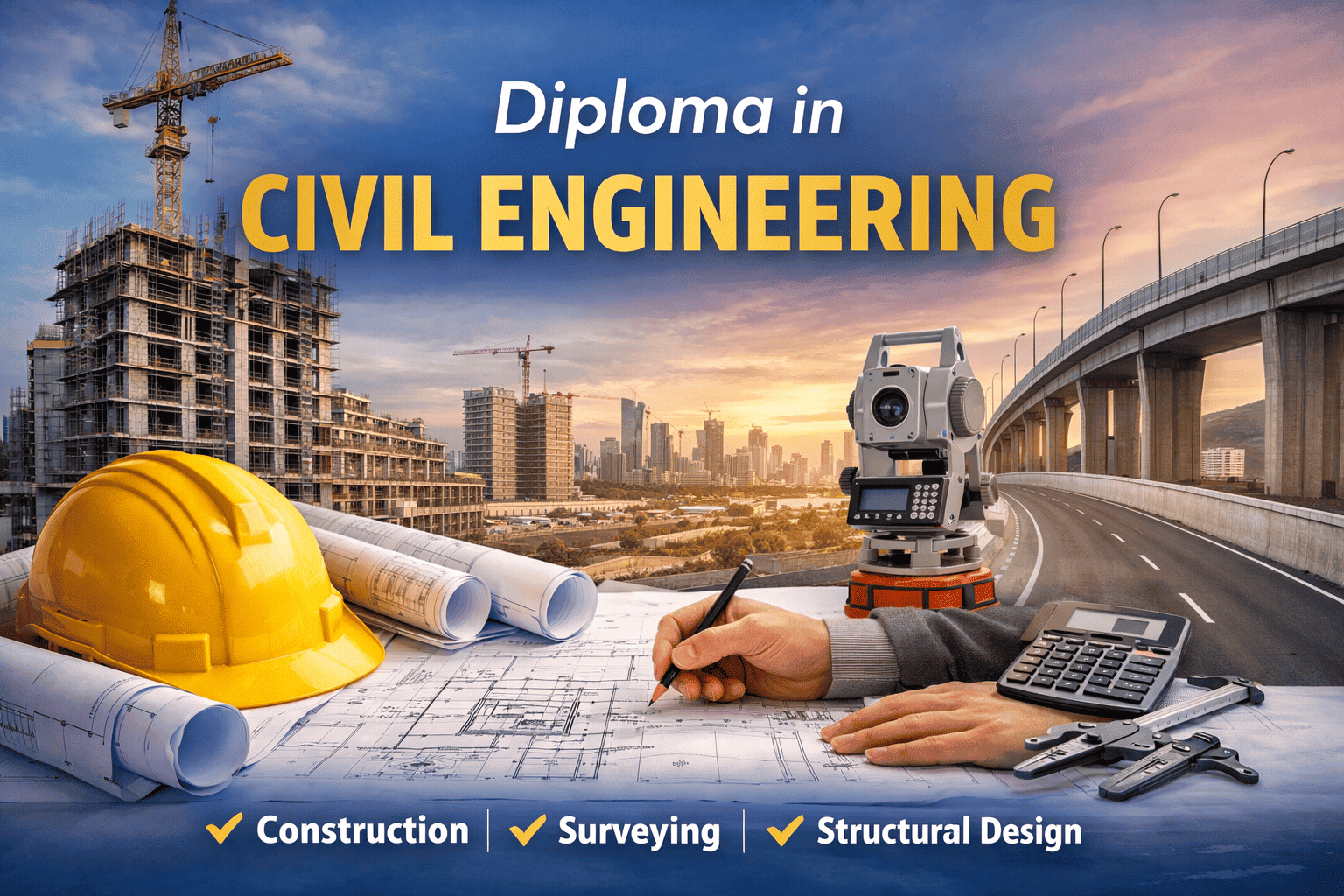
Diploma in Civil Engineering is a three-year technical course that focuses on the planning, design, construction, and maintenance of infrastructure projects such as buildings, roads, bridges, dams, and canals. The course emphasizes practical training along with basic engineering concepts to prepare students for industry-ready roles.
Students can pursue this diploma after completing Class 10, and in some institutes, after Class 12. Admission usually takes place through merit or state-level polytechnic entrance exams. The course is approved by AICTE and is offered by government and private polytechnic colleges across India.
After completion, students can work in government departments, construction companies, or opt for higher studies like BTech through lateral entry.
| Particulars | Details |
|---|---|
| Course Name | Diploma in Civil Engineering |
| Degree Type | Diploma |
| Typical Duration | 3 Years |
| Eligibility (India) | Passed Class 10 with Mathematics and Science |
| Common Entrance Exams (India) | State Polytechnic Entrance Tests |
| Average Annual Fees (India) | ₹25,500 – ₹46,100 per year |
| Top Recruiting Companies | PWD, CPWD, Indian Railways, L&T, Tata Projects |
| Average Starting Salary (India) | ₹2.5 LPA – ₹5 LPA |
| Career Options | Construction, Design, Infrastructure sectors |
| UGC/AICTE Approved | AICTE Approved |
Diploma Civil Eligibility
Students must meet certain basic requirements to take admission in a Diploma in Civil Engineering course in India. Eligibility rules may vary slightly depending on the state board or polytechnic institute, but most colleges follow similar criteria.
1. Educational Qualification
Candidates must pass Class 10 from a recognised board such as CBSE, ICSE, or any State Board. Some institutes also allow admission after Class 12, especially for lateral entry or direct second-year admission.
2. Minimum Marks Requirement
Most government and private polytechnic colleges require at least 35%–50% aggregate marks in Class 10. Top institutes or entrance-based colleges may ask for higher scores.
3. Subject Requirements
Students should study Mathematics and Science as compulsory subjects in Class 10. Basic understanding of these subjects helps in engineering concepts and technical training.
4. Age Limit
Generally, candidates should be at least 14–15 years old at the time of admission. Most institutes do not set an upper age limit, but rules may differ by state.
5. Entrance Exam Requirement
Some states conduct polytechnic entrance exams like JEECUP, Delhi CET, or other state-level tests. Many private colleges also offer merit-based admission without entrance exams.
6. Lateral Entry Eligibility
Students who complete Class 12 with PCM or ITI in a relevant trade can apply for lateral entry directly into the second year of the diploma course.
Students should always check the official admission brochure of their chosen college or state polytechnic board for exact eligibility rules before applying.
| Eligibility Parameter | Details |
|---|---|
| Educational Qualification | Passed Class 10 from a recognised board |
| Minimum Marks | 35%–50% aggregate (varies by institute/state) |
| Required Subjects | Mathematics and Science |
| Age Limit | Minimum 14–15 years; no upper age limit in most states |
| Admission Mode | Merit-based or Entrance Exam |
| Entrance Exams | JEECUP, Delhi CET, State Polytechnic Exams |
| Lateral Entry Eligibility | Class 12 (PCM) or ITI in relevant trade |
| Year of Admission (Lateral Entry) | Direct entry into 2nd year |
Diploma in Civil Engineering Syllabus 2026
The Diploma in Civil Engineering syllabus focuses on building strong fundamentals and practical skills required in the construction and infrastructure sector. The course covers core subjects such as surveying, structural engineering, construction materials, and environmental engineering. The syllabus may vary slightly by institute, but the overall structure remains similar across polytechnic colleges in India.
| Semester | Major Subjects / Topics |
|---|---|
| Semester 1 | Engineering Mathematics, Engineering Physics, Engineering Chemistry, Communication Skills, Engineering Drawing |
| Semester 2 | Applied Mathematics, Applied Mechanics, Basics of Electrical Engineering, Computer Applications, Workshop Practice |
| Semester 3 | Strength of Materials, Building Construction, Surveying-I, Concrete Technology |
| Semester 4 | Structural Engineering, Surveying-II, Hydraulics, Irrigation Engineering |
| Semester 5 | Transportation Engineering, Environmental Engineering, RCC Structures, Construction Planning & Management |
| Semester 6 | Estimation & Costing, Highway Engineering, Advanced Construction Technology, Project Work / Industrial Training |
Skills Required for Diploma in Civil Engineering Students
Students pursuing a Diploma in Civil Engineering need a mix of technical knowledge, practical abilities, and soft skills to succeed in academics and the construction industry. Developing these skills during the course helps students perform better in site work, office roles, and higher studies.
Technical and Core Skills
Civil engineering students must understand basic engineering concepts such as surveying, construction materials, strength of materials, and structural drawings. Skills in reading blueprints, site layouts, and bar bending schedules are important for real-world projects. Knowledge of estimation, costing, and basic software like AutoCAD gives students an added advantage.
Practical and Site Skills
Hands-on skills play a major role in civil engineering. Students should know how to conduct site measurements, supervise construction activities, and maintain quality standards. Understanding safety rules, material testing, and basic equipment handling helps students work confidently on construction sites.
Problem-Solving and Analytical Skills
Civil engineers often face on-site challenges related to design changes, material shortages, or time management. Students must develop logical thinking and problem-solving skills to find practical solutions while maintaining project quality and deadlines.
Communication Skills
Good communication helps civil engineering students interact effectively with engineers, contractors, workers, and clients. Clear verbal and written communication is essential for explaining site instructions, preparing reports, and coordinating with teams.
Time Management and Teamwork
Construction projects follow strict schedules. Students must learn how to manage time, prioritize tasks, and work efficiently in a team environment. Teamwork helps in smooth coordination between different departments on a project site.
Adaptability and Field Readiness
Civil engineering work often involves outdoor conditions and frequent travel. Students should stay physically fit, adaptable, and ready to work in changing environments. A positive attitude and willingness to learn on-site techniques improve career growth.
Basic Computer and Software Skills
Knowledge of computers, MS Excel, AutoCAD, and basic project management tools supports planning, documentation, and reporting tasks. These skills increase employability in both government and private sectors.
Developing these skills during a Diploma in Civil Engineering course prepares students for entry-level jobs and creates a strong foundation for advanced studies and long-term career growth.
Career Scope After Diploma in Civil Engineering
A Diploma in Civil Engineering offers wide career opportunities in India due to continuous growth in infrastructure, housing, highways, railways, and smart city projects. After completing the diploma, students can choose jobs, government careers, or higher studies based on their interests and long-term goals.
Job Opportunities in the Private Sector
Diploma holders can work in construction companies, real estate firms, infrastructure developers, and consultancy agencies. Common job roles include Junior Engineer, Site Supervisor, Civil Draftsman, Surveyor, Quality Control Assistant, and Billing Engineer. Large companies like L&T, Tata Projects, Shapoorji Pallonji, and NCC regularly hire diploma civil engineers for site and planning roles.
Government Jobs and Public Sector Careers
Government departments offer stable and respected jobs for diploma civil engineers. Students can apply for positions such as Junior Engineer in PWD, CPWD, Irrigation Department, Municipal Corporations, Indian Railways, and State Electricity Boards. Recruitment takes place through state PSCs, SSC JE, RRB exams, and other departmental exams.
Opportunities in Infrastructure and Core Projects
With major national projects like highways, metro rail, airports, and smart cities, the demand for skilled civil engineering professionals continues to rise. Diploma holders play a key role in site execution, supervision, surveying, and project monitoring.
Higher Studies and Career Advancement
After completing a diploma, students can pursue BTech or BE in Civil Engineering through lateral entry directly into the second year. Higher education improves technical knowledge, salary potential, and leadership opportunities. Some students also opt for certifications in AutoCAD, STAAD, Primavera, or project management.
Self-Employment and Entrepreneurship
Diploma civil engineers can start their own work as contractors, site supervisors, estimators, or consultants after gaining experience. Many also work as government-approved contractors or take up small-scale construction and renovation projects.
Salary Growth and Long-Term Scope
Entry-level salaries usually range from ₹2.5 LPA to ₹4 LPA. With experience, skills, and certifications, professionals can earn higher salaries and take on senior roles such as Project Engineer or Site Manager.
Salary After Diploma in Civil Engineering
Salary after completing a Diploma in Civil Engineering depends on factors such as job role, sector, location, skills, and experience. Fresh diploma holders usually start with entry-level positions, but salaries increase steadily with experience and technical expertise. Government jobs offer stable pay with allowances, while private companies provide faster growth and performance-based increments.
Salary After Diploma in Civil Engineering (Job Role–Wise)
| Job Role | Sector | Average Monthly Salary | Average Annual Salary |
|---|---|---|---|
| Junior Engineer | Government / Private | ₹25,000 – ₹45,000 | ₹3 – ₹5.5 LPA |
| Site Supervisor | Private | ₹20,000 – ₹40,000 | ₹2.5 – ₹5 LPA |
| Civil Draftsman | Private | ₹18,000 – ₹35,000 | ₹2.2 – ₹4.2 LPA |
| Surveyor | Government / Private | ₹22,000 – ₹40,000 | ₹2.8 – ₹5 LPA |
| Billing Engineer | Private | ₹25,000 – ₹45,000 | ₹3 – ₹5.5 LPA |
| Quality Control Engineer | Private | ₹28,000 – ₹50,000 | ₹3.5 – ₹6 LPA |
Experience-Based Salary Growth
| Experience Level | Expected Salary Range |
|---|---|
| Fresher (0–1 Year) | ₹2.5 – ₹4 LPA |
| 2–5 Years | ₹4 – ₹7 LPA |
| 5+ Years | ₹7 – ₹12 LPA or more |
Government vs Private Sector Salary Comparison
| Sector | Salary Range | Additional Benefits |
|---|---|---|
| Government Sector | ₹3 – ₹6 LPA | DA, HRA, pension, job security |
| Private Sector | ₹2.5 – ₹8 LPA | Incentives, bonuses, faster growth |
Higher Studies After Diploma in Civil Engineering
After completing a Diploma in Civil Engineering, many students choose higher studies to improve technical knowledge, career growth, and salary potential. Higher education opens doors to better job roles, government exams, and leadership positions. Students can select degree courses, professional certifications, or specialised training based on their career goals.
| Higher Study Option | Course Name | Duration | Eligibility | Career Benefits |
|---|---|---|---|---|
| Degree Course (Lateral Entry) | BTech / BE in Civil Engineering | 3 Years | Diploma in Civil Engineering | Higher salary, better job roles, eligibility for PSU and senior positions |
| Engineering Degree (Alternative) | AMIE (Associate Member of Institution of Engineers) | Flexible | Diploma holders | Equivalent to BTech for many jobs, suitable for working professionals |
| Post Diploma Courses | Advanced Diploma in Construction / Structural Engineering | 1–2 Years | Diploma in Civil Engineering | Specialised skills, better site and design roles |
| Design & Software Courses | AutoCAD, STAAD Pro, ETABS, Revit | 3–12 Months | Diploma in Civil Engineering | Improves technical skills and employability |
| Project Management Courses | Construction Project Management, Primavera | 6–12 Months | Diploma or work experience | Leadership roles, planning and management jobs |
| Government Exam Preparation | SSC JE, State JE, RRB Exams | Varies | Diploma in Civil Engineering | Entry into government departments |
| Management Courses | Diploma / MBA in Construction Management | 1–2 Years | Diploma / Degree (varies) | Managerial and administrative roles |
| Entrepreneurship Training | Contractor Licence Courses | Short-term | Diploma + experience | Start own construction or contracting business |
Choosing the right higher study option depends on individual interests, financial planning, and long-term career goals. With the right qualifications and skills, diploma holders can achieve strong professional growth in the civil engineering field.
Top Institutes for Diploma in Civil Engineering in India
Choosing the right college for Diploma in Civil Engineering plays a major role in shaping your technical skills and career opportunities. Here’s a list of some well-known polytechnic institutes across India that offer quality education, practical training, and industry exposure for civil diploma students.
| Institute Name | Location | Type | Key Highlights |
|---|---|---|---|
| Veermata Jijabai Technological Institute (VJTI) | Mumbai, Maharashtra | Government/Autonomous | Highly reputed polytechnic with strong academic and placement records. |
| Government Polytechnic, Mumbai | Mumbai, Maharashtra | Government | One of the oldest diploma institutes with quality civil engineering program. |
| Government Polytechnic, Amravati | Amravati, Maharashtra | Government | AICTE-approved institute offering civil diploma with decent infrastructure. |
| Guru Gobind Singh Polytechnic | Nashik, Maharashtra | Private | Offers practical training and project work in civil engineering. |
| Cooch Behar Polytechnic | Cooch Behar, West Bengal | Government | Established government polytechnic with civil engineering diploma. |
| Jamia Millia Islamia (Diploma Programs) | New Delhi | Central University | Offers diploma programs with good campus facilities and industry links. |
| Lovely Professional University | Jalandhar, Punjab | Private | Offers diploma courses with modern infrastructure and labs. |
| Pusa Polytechnic / Puran Murti Campus | Delhi / Sonipat (NCR) | Govt/Private | Well-known Delhi/NCR options with placement support and infrastructure. |
These institutes represent a mix of government, autonomous, and private polytechnic colleges that offer Diploma in Civil Engineering with practical labs, industry exposure, and placement support. Always check current admission details, fee structure, and eligibility requirements on the official college websites before applying.
Advantages of Studying Diploma in Civil Engineering
Diploma in Civil Engineering is a practical and career-oriented course that helps students enter the engineering and construction field at an early stage. The course offers several academic and professional benefits, especially for students who prefer hands-on learning.
-
Early Career Entry
Students can start their professional journey soon after completing Class 10, which saves time compared to degree programs and allows early earning opportunities. -
Strong Practical Exposure
The course focuses heavily on practical training, site visits, workshops, and lab work. This helps students understand real construction activities and industry requirements. -
Wide Job Opportunities
Civil engineering diploma holders can work in construction companies, infrastructure firms, real estate projects, and government departments across India. -
Affordable Education
Diploma courses usually have lower fees compared to BTech programs, making them suitable for students from diverse financial backgrounds. -
Government Job Eligibility
Students become eligible for junior-level government jobs such as Junior Engineer in PWD, CPWD, Railways, and municipal departments. -
Option for Higher Studies
After completing the diploma, students can pursue BTech or BE through lateral entry and improve career growth and salary prospects. -
Growing Industry Demand
With ongoing infrastructure development, smart cities, highways, and metro projects, the demand for civil engineering professionals continues to rise.
Challenges in Diploma in Civil Engineering
While a Diploma in Civil Engineering offers many benefits, students should also be aware of certain challenges associated with the course and profession.
-
Physically Demanding Work
Civil engineering often involves site work, outdoor conditions, and long working hours, which can be physically tiring. -
Limited Initial Salary
Entry-level salaries after a diploma may be lower compared to engineering degree holders, especially in the private sector. -
Need for Continuous Skill Upgradation
Students must regularly upgrade their skills in software tools, new construction techniques, and safety standards to stay competitive. -
Academic Rigor
Subjects like strength of materials, surveying, and structural engineering require strong basics in mathematics and science. -
Work Pressure and Deadlines
Construction projects run on strict timelines, which can lead to work pressure and responsibility at job sites. -
Career Growth Takes Time
Reaching senior positions requires experience, certifications, or higher education, which demands patience and long-term planning.
Understanding both the advantages and challenges helps students make informed decisions and prepare better for a successful career in civil engineering.
Diploma in Civil Engineering vs Diploma in Logistics / Aviation Management
Choosing the right diploma course depends on career interests, work environment preferences, and long-term goals. While Diploma in Civil Engineering focuses on construction and infrastructure development, Diploma in Logistics or Aviation Management prepares students for careers in supply chain, airport operations, and the aviation industry. The table below explains the key differences in detail.
| Parameter | Diploma in Civil Engineering | Diploma in Logistics / Aviation Management |
|---|---|---|
| Course Focus | Design, construction, and maintenance of buildings, roads, bridges, and infrastructure | Management of logistics, supply chain, airport operations, and airline services |
| Course Duration | 3 Years | 1–3 Years (varies by institute) |
| Eligibility | Class 10 (Maths & Science required) | Class 10 or 12 (English preferred) |
| Skill Type | Technical and practical engineering skills | Management, communication, and operational skills |
| Nature of Work | Fieldwork, site supervision, and technical office work | Office-based, airport operations, warehouse, and customer handling |
| Practical Exposure | Site visits, surveying, lab work, construction projects | Airport training, industry internships, case studies |
| Core Subjects | Surveying, Structural Engineering, Construction Technology, Estimation & Costing | Logistics Management, Supply Chain, Airport Operations, Aviation Safety |
| Career Roles | Junior Engineer, Site Supervisor, Surveyor, Civil Draftsman | Logistics Executive, Airport Operations Executive, Cargo Supervisor |
| Government Job Scope | High (PWD, CPWD, Railways, SSC JE) | Limited (mostly private sector roles) |
| Private Sector Demand | High in construction, real estate, infrastructure companies | High in airlines, logistics firms, shipping companies |
| Work Environment | Construction sites, outdoor and indoor | Airports, offices, warehouses |
| Salary at Entry Level | ₹2.5 – ₹4 LPA | ₹2 – ₹4.5 LPA |
| Career Growth | Experience-based growth; higher studies improve scope | Faster growth with communication skills and industry exposure |
| Higher Studies Options | BTech/BE (Lateral Entry), AMIE, MTech | MBA in Logistics, Aviation Management, Supply Chain |
| Suitability | Students interested in engineering, construction, and technical work | Students interested in management, aviation, and customer-oriented roles |
Both diploma courses offer good career opportunities but suit different interests. Students who enjoy technical, field-based work may prefer Civil Engineering, while those inclined toward management, logistics, and aviation operations may choose Logistics or Aviation Management.
FAQs
1. What is a Diploma in Civil Engineering?
A Diploma in Civil Engineering is a three-year technical course that focuses on construction, surveying, structural design, and infrastructure development with strong practical and industry-oriented training.
2. Who is eligible for Diploma in Civil Engineering in India?
Students who have passed Class 10 with Mathematics and Science from a recognised board are eligible to apply for Diploma in Civil Engineering in most polytechnic colleges.
3. What is the duration of Diploma in Civil Engineering?
The Diploma in Civil Engineering course usually takes three years to complete and is divided into six semesters with theory classes, labs, and project work.
4. What are the career options after Diploma in Civil Engineering?
After completing the diploma, students can work as Junior Engineers, Site Supervisors, Surveyors, Draftsmen, or pursue higher studies like BTech through lateral entry.
5. Is Diploma in Civil Engineering good for government jobs?
Yes, diploma holders can apply for government jobs such as Junior Engineer in PWD, CPWD, Railways, municipal corporations, and other public sector departments.
6. What is the average salary after Diploma in Civil Engineering?
The average starting salary ranges between ₹2.5 lakh to ₹4 lakh per year, depending on skills, experience, location, and the hiring organisation.
7. Can I do BTech after Diploma in Civil Engineering?
Yes, students can pursue BTech or BE in Civil Engineering through lateral entry and get direct admission into the second year after completing the diploma.
8. What skills are required for Diploma in Civil Engineering students?
Students should have basic technical knowledge, problem-solving ability, communication skills, site management understanding, and familiarity with tools like AutoCAD and Excel.
9. What are the subjects in Diploma in Civil Engineering?
Key subjects include surveying, building construction, strength of materials, environmental engineering, transportation engineering, estimation, and project work.
10. Is Diploma in Civil Engineering better than other diploma courses?
Diploma in Civil Engineering suits students interested in construction and infrastructure, while other diploma courses may suit different interests. The best choice depends on career goals.
Q: What is the average fees for Diploma in Civil Engineering 2026 in India?
The average fees for a Diploma in Civil Engineering 2026 in India typically range from ₹40,000 to ₹1,50,000 per year for government colleges and ₹70,000 to ₹2,50,000 per year for private institutions. These figures are estimates for the 3-year duration of the diploma.
Q: What are the eligibility criteria for Diploma in Civil Engineering 2026 admission in India?
To be eligible for a Diploma in Civil Engineering 2026, candidates must have passed their 10th standard (SSLC/Matriculation) examination from a recognized board with a minimum aggregate of 35-45% marks. Some states may also require a minimum of 40% in Science and Mathematics subjects.
Q: Which are the top government colleges for Diploma in Civil Engineering 2026 in India?
Some of the top government colleges for a Diploma in Civil Engineering 2026 in India include Government Polytechnic Mumbai, Delhi Technological University (DCE) for its diploma programs, and various state-run polytechnics like those in Karnataka and Uttar Pradesh. These institutions often boast high placement rates, sometimes exceeding 70%.
Q: What is the average salary after Diploma in Civil Engineering 2026 in India in 2026?
The average starting salary for a Diploma in Civil Engineering 2026 graduate in India in 2026 is expected to be between ₹2.5 LPA to ₹4.5 LPA. With 2-3 years of experience, a civil engineering diploma holder can expect to earn ₹4.5 LPA to ₹7 LPA, depending on the company and location.
Q: What are the career opportunities after Diploma in Civil Engineering 2026 in India?
After completing a Diploma in Civil Engineering 2026, graduates can find opportunities as Junior Engineers, Site Supervisors, Draughtsmen, or Surveyors in construction companies, government departments (like PWD), and infrastructure firms. The construction sector is projected to grow by over 8% annually, ensuring robust demand.
Q: Can I study abroad after Diploma in Civil Engineering 2026 from India?
Yes, after completing a Diploma in Civil Engineering 2026 from India, you can pursue further studies abroad. Many universities in countries like Canada, Australia, and the UK offer advanced diplomas or direct entry into the second year of a Bachelor’s degree in Civil Engineering, requiring a minimum of 6.0-6.5 IELTS score.