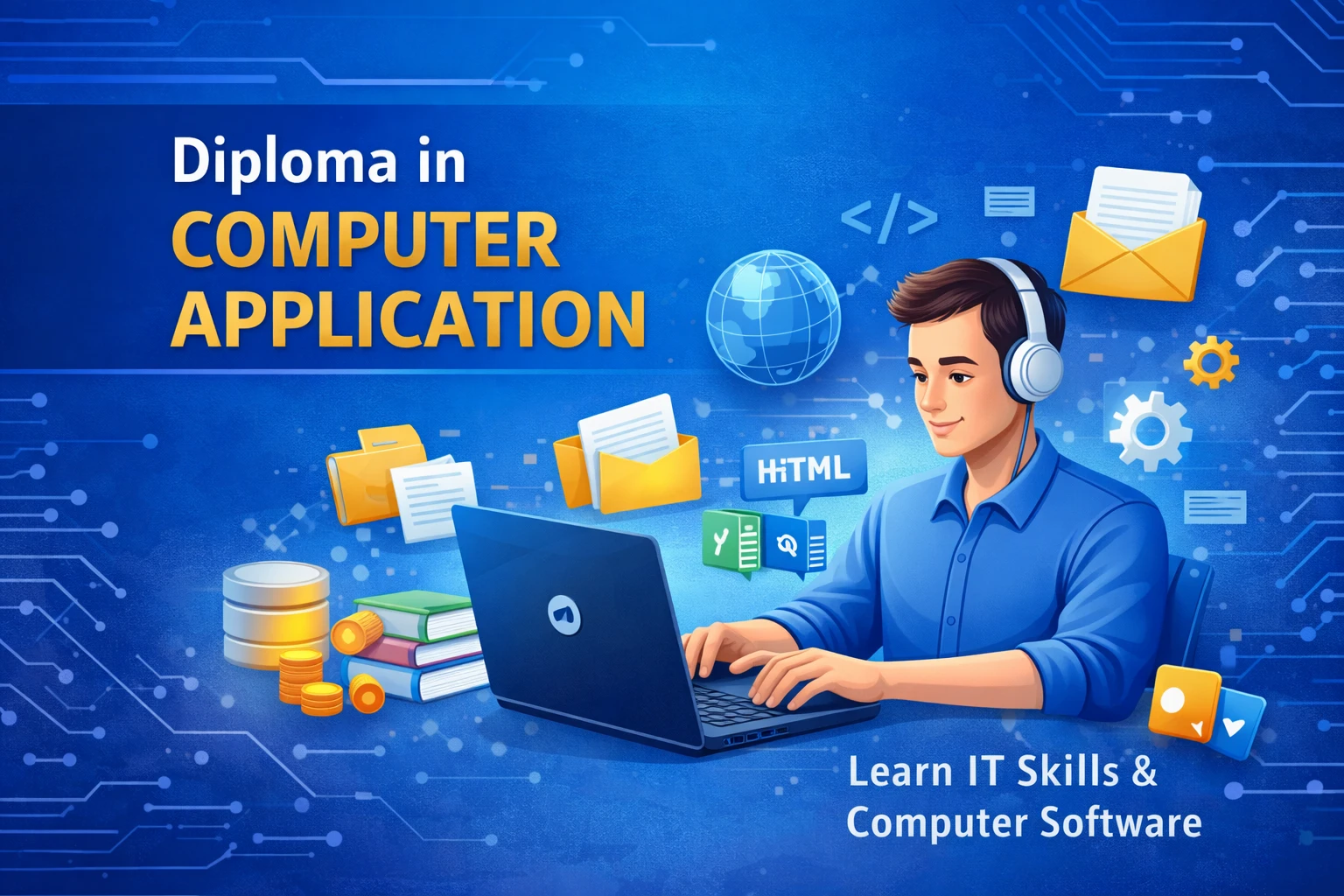
Diploma in Computer Application (DCA): Course, Fees, Syllabus & Jobs
The Diploma in Computer Applications (DCA) is a skill-oriented programme that provides students with core computer knowledge and practical application abilities relevant to industry needs. It targets individuals aiming to start careers in information technology, software assistance, office automation, basic web development, database management, and similar areas. The course remains widely chosen for its brief duration, reasonable fees, and strong connection to entry-level IT and computer-based employment opportunities.
This programme suits learners seeking early entry into the IT sector, development of hands-on computer skills, or a foundation for pursuing higher qualifications such as the Post Graduate Diploma in Computer Applications (PGDCA) or Advanced Diploma in Computer Applications (ADCA).
What is the Diploma in Computer Applications?
The DCA course covers fundamental principles of computer technology, essential software tools, application software, and workplace-ready computing skills. It emphasises proficiency in widely used programs including MS Office suite, introductory programming ideas, internet and networking basics, elementary web page creation, and database operations. Participants acquire direct experience with tools and applications commonly required across various sectors.
The programme is generally provided by universities, polytechnic colleges, vocational training institutions, and online learning platforms. It is available in full-time, part-time, or distance learning formats, based on the preference and availability for the student.
Along with the basic Diploma in Computer Application (DCA), students can also pursue advanced variants such as the Post Graduate Diploma in Computer Application (PGDCA) and the Advance Diploma in Computer Application (ADCA), which offer deeper technical knowledge and enhanced practical exposure based on the learner’s academic level and career goals.
Post Graduate Diploma in Computer Application (PGDCA)
A PGDCA is a one-year postgraduate diploma for graduates who want deeper IT knowledge, especially in areas such as programming, web development, DBMS, and office automation. PGDCA enhances career prospects and provides a more advanced understanding than the basic DCA.
Advance Diploma in Computer Application (ADCA)
The Advance Diploma in Computer Application offers advanced and specialised training beyond the basic diploma, often including enhanced practical modules, updated tools, and more in-depth software exposure. It is ideal for students who want more full industry-ready skills.
Diploma in Computer Application — Course Highlights
| Aspect | Details |
|---|---|
| Course Name | Diploma in Computer Application (DCA) |
| Duration | Generally 6 months to 1 year (1 academic year) |
| Eligibility | 10+2 pass or equivalent (varies by institute) |
| Programme Type | Diploma / Certificate |
| Modes | Full-time / Part-time / Online |
| Entry Level | After Class 12 or equivalent |
| Advanced Options | Post Graduate Diploma in Computer Application (PGDCA), Advance Diploma in Computer Application (ADCA) |
| Typical Fees | ₹6,000 – ₹50,000 (varies by college) |
Eligibility Criteria for DCA and Related Programmes
The eligibility requirements for computer application diplomas vary depending on the level of the course — from basic to advanced and postgraduate diplomas. Below are the detailed and institute-accepted eligibility norms:
1. Eligibility for Diploma in Computer Application (DCA)
The basic diploma in computer application is designed for students who want foundational computing skills and PC application knowledge.
General Eligibility
-
10+2 pass or equivalent from a recognised board (most common requirement).
-
Some institutes also admit Class 10 pass students, sometimes with additional training or bridging modules.
-
No specific stream required; students from Science, Commerce or Arts can apply.
-
Age Limit: Usually no upper age limit, though some institutes may set a minimum age (e.g., 17+).
-
Basic Computer Knowledge: Not mandatory but advantageous.
People Also Read


2. Eligibility for Advance Diploma in Computer Application (ADCA)
The advance diploma in computer application builds on the basic DCA and often covers more in-depth tools, programming skills, and practical exposure.
Typical Eligibility
-
10+2 pass or equivalent from a recognised board.
-
Some institutes may prefer candidates who have completed a basic diploma (like DCA).
-
No strict percentage cut-off in most colleges.
-
Age and stream criteria generally similar to basic diploma (no fixed upper age / no stream requirement).
Admission Variations
Institute policies differ — some may prefer foundation knowledge or require a short interview/test.
3. Eligibility for Post Graduate Diploma in Computer Application (PGDCA)
The post graduate diploma in computer application is usually pursued after graduation and prepares students for more advanced IT roles.
| Criterion | Requirement |
|---|---|
| Educational Qualification | Bachelor’s degree in any discipline from a recognised university. |
| Minimum Marks | Many institutes require 45%–50% aggregate (with 5% relaxations for reserved categories). |
| Entrance Test | Optional in many colleges; some may conduct their own entrance tests or merit-based selection. |
| Mathematics Requirement | Some institutions may require Mathematics at 10+2 or graduation; others offer bridge courses. |
| Age Criteria | Generally no upper age limit unless specified by a particular institution. |
Diploma in Computer Application Admission Process
The admission process for a Diploma in Computer Application is generally straightforward and designed to be accessible for students after completing their 10+2 education. Most colleges follow a merit-based selection, but a few may involve institution-specific entrance tests or interviews.
1. Application Form Submission
-
Candidates fill out the admission form either online (via the college/university portal) or offline at the campus.
-
Required documents include 10+2 marksheet, identity proof, and passport-size photographs.
2. Document Verification
-
Colleges verify academic records and eligibility documents submitted by the candidate.
-
Original certificates may be required during verification.
3. Merit Evaluation / Shortlisting
-
Most institutions shortlist candidates based on 10+2 marks, giving priority to higher scores.
-
Some colleges may consider additional criteria like academic performance in related subjects.
4. Entrance Test (If Applicable)
-
While most DCA admissions do not require a common entrance exam, a few institutes may hold their own entrance test or interview for selection.
-
For example, some colleges admit through state or institute-level polytechnic tests (like DCECE, TS POLYCET, JEECUP) when DCA is offered via polytechnic branches.
-
5. Seat Allotment / Admission Offer
-
Based on merit or test performance (if applicable), colleges issue formal admission offers or intimation letters.
-
Candidates confirm their seat by paying the course fees within the stipulated deadline.
6. Fee Payment and Enrollment
-
After acceptance, students pay the programme tuition fee and complete registration formalities.
-
Some colleges provide installment options for fee payment.
Diploma in Computer Application Syllabus (Semester-Wise)
The Diploma in Computer Application syllabus is designed to provide strong foundational knowledge of computers along with hands-on practical skills. The curriculum typically focuses on basic IT concepts, office productivity tools, programming fundamentals, web technologies, and database management.
Most institutes offer the diploma over 1 year (2 semesters), though some advanced or extended programmes may span 3–6 semesters.
Semester 1: Computer Fundamentals & Office Applications
| Subject Name | Key Topics Covered |
|---|---|
| Fundamentals of Computers | History of computers, generations, types of computers, input/output devices, memory, CPU, hardware vs software |
| Operating Systems | Basics of operating systems, Windows OS features, file & folder management, system utilities |
| MS Word | Document creation, formatting, tables, mail merge, templates, page layout |
| MS Excel | Spreadsheets, formulas, functions, charts, data analysis, pivot tables |
| MS PowerPoint | Slide creation, animations, transitions, presentation techniques |
| Internet Fundamentals | Web browsers, search engines, internet services, cloud storage basics |
| Email & Digital Communication | Email creation, attachments, etiquette, collaboration tools |
| Practical Lab I | Hands-on practice with MS Office, OS navigation, basic computer operations |
Semester 2: Programming, Web & Database Basics
| Subject Name | Key Topics Covered |
|---|---|
| Programming Fundamentals | Logic building, algorithms, flowcharts, introduction to C/C++ or Python |
| Database Management Systems | Database concepts, data types, tables, keys, relationships |
| SQL Basics | CRUD operations, SELECT queries, WHERE clause, joins, basic database handling |
| Web Development Fundamentals | HTML structure, tags, forms, hyperlinks, basic website layout |
| Multimedia & Graphics Tools | Image editing basics, graphic formats, basic design principles |
| Computer Networking Basics | LAN/WAN concepts, networking devices, IP addressing basics |
| Cyber Safety & Digital Security | Online safety, viruses, malware, antivirus tools, data protection |
| Practical Lab II | Programming exercises, basic website creation, database practice |
| Mini Project / Assignment | Small application or website project applying learned concepts |
Download the Diploma in Computer Application Syllabus here.
Diploma in Computer Application Course Fees
The Diploma in Computer Application course fees vary widely by institute type, mode of study, duration, and infrastructure offered. Below are commonly found fee structures across different categories in India.
1. Government/Public College Fees
Government institutions tend to offer the most affordable options because of subsidised tuition and lower operational costs.
| Institute Type | Approx. Fee (Full Course) | Notes |
|---|---|---|
| Government degree/polytechnic | ₹2,000 – ₹15,000 | Very low tuition (e.g., ~₹2,000–₹2,200 at some public colleges) |
| Distance/online government diploma | ₹18,000 – ₹22,000 | Accredited online options from govt distance boards |
| Government PG Diploma (PGDCA) | ₹20,000 – ₹30,000 (approx) | Total for 2-year programme at some polytechnics |
2. Private College/University Fees
Private institutes typically charge higher fees due to better infrastructure, placement support, and practical labs.
| College | Approx. Fee (₹) | Duration |
|---|---|---|
| ICFAI University, Raipur | ~₹13,800 | 1 year |
| AKS University, MP | ~₹22,000 | 1 year |
| Some private colleges (varying) | ₹10,000 – ₹80,000 | Depends on reputation & facilities |
| National colleges (premium) | ₹40,000 – ₹90,000+ | Elite/metro institutes (varies widely) |
3. Online & Distance Learning Fees
Online and distance diploma programmes offer better flexibility and often cost less than full campus programmes:
| Mode | Fee Range (₹) | Typical Duration |
|---|---|---|
| Online DCA (various providers) | ₹10,000 – ₹30,000 | 1 year (or flexible) |
| Online diploma (semester basis) | ~₹20,000 – ₹30,000 total | 2 semesters |
| Online from private universities | ₹20,000 – ₹50,000 | Per academic year (may include exam fees) |
Read more: Bachelor of Computer Applications (BCA)
Top Colleges for Diploma in Computer Application in India
India has many institutions offering Diploma in Computer Application, ranging from government bodies to private institutes and online platforms. These colleges focus on practical computer skills, job readiness, and affordability.
| Category | Colleges / Institutes |
|---|---|
| Government Institutes | NIELIT (National Institute of Electronics & IT), State Polytechnic Colleges |
| Universities (PGDCA) | IGNOU, Delhi University (DU SOL), Osmania University, Annamalai University |
| Private Institutes | NIIT, Aptech Computer Education, Jetking, Arena Animation |
| Online / Distance | IGNOU, Amity Online, Lovely Professional University (Distance), Sikkim Manipal University |
Diploma in Computer Application Jobs & Salary in India
The salary after completing a Diploma in Computer Application depends on skill level, certification type (DCA / ADCA / PGDCA), job role, and experience. While entry-level salaries are modest, strong practical skills can lead to steady growth.
Average Salary After DCA
On average, DCA graduates earn between ₹1.8 LPA and ₹4.5 LPA at the entry level. Advanced diplomas and PGDCA holders often receive better starting packages.
Salary Breakdown by Experience
| Experience Level | Average Salary Range | Typical Job Roles |
|---|---|---|
| Freshers | ₹1.8 LPA – ₹3 LPA | Data Entry Operator, Computer Operator, Office Assistant |
| Mid-Level Professionals (2–5 Years) | ₹3.5 LPA – ₹6 LPA | Technical Support Executive, Web Assistant, Junior Developer |
| Experienced Professionals (5+ Years) | ₹6 LPA – ₹10 LPA | IT Support Manager, System Administrator, Senior Software Assistant |
Salary by Job Role (DCA / ADCA / PGDCA)
| Job Role | Average Salary Range | Key Responsibilities |
|---|---|---|
| Computer Operator | ₹2 LPA – ₹3.5 LPA | Office system handling, documentation, data processing |
| Data Entry Executive | ₹1.8 LPA – ₹3 LPA | Database updating, digital record maintenance |
| Technical Support Executive | ₹3 LPA – ₹6 LPA | Hardware/software troubleshooting, user support |
| Web Assistant / Junior Web Developer | ₹4 LPA – ₹8 LPA | Website maintenance, HTML/CSS support, content updates |
| Office Automation Executive | ₹3 LPA – ₹5 LPA | Advanced MS Office usage, reporting, workflow management |
Top Recruiters
Employers commonly recruiting diploma holders include both IT and non-IT organisations such as:
- TCS
- HCL Technologies
- Wipro
- Infosys
- Accenture
- IBM
- Tech Mahindra
- Amazon
Career Scope and Progression
A diploma in computer application offers a good foundation for:
- Entry-level technical jobs
- IT support and office automation roles
- Freelance work in web design and content management
- Further studies such as PGDCA, BCA (Bachelor of Computer Applications), or specialised certificates in web or network technologies
With experience and further skill building, professionals can move into roles like systems analyst, programmer, database administrator, and IT consultant.
Frequently Asked Questions (FAQs)
Q1. What is the duration of a Diploma in Computer Application?
Most diploma programmes range from 6 months to 1 year. Some online options extend to 2 years.
Q2. Can I do a diploma in computer application after 10th?
Some institutes allow entry after 10th, but many require 10+2 for admission.
Q3. What is the difference between DCA and PGDCA?
DCA is a basic diploma, while PGDCA offers more advanced IT and programming knowledge for graduates.
Q4. What jobs can I get after this diploma?
Graduates can become computer operators, web designers, software developers, IT support specialists, and more.
Q5. Is advance diploma in computer application useful?
Yes, ADCA offers deeper practical knowledge and boosts employability for specialised roles.
Q6. What is the average salary after completing a diploma in computer application?
Freshers typically earn between ₹1.8 LPA and ₹3 LPA. With experience and advanced skills, salaries can increase up to ₹6–10 LPA, especially after ADCA or PGDCA.
Q7. Is a diploma in computer application recognised for government jobs?
Yes, a diploma in computer application from a recognised institute is accepted for many government and semi-government roles, particularly for clerical, data entry, and computer operator positions.
Q8. Can I pursue higher studies after completing DCA or ADCA?
Yes, after completing a diploma in computer application, students can opt for ADCA, PGDCA, or even degree programmes like BCA, BSc IT, or certification courses in programming, data analytics, or web development.