Diploma in Computer Science: Eligibility, Colleges, Fees & Salary in India
The demand for skilled computer science and engineering professionals is growing rapidly, making a diploma in computer science and engineering a valuable qualification. This diploma equips students with the skills and knowledge needed to thrive in this dynamic field. Typically, a multi-year program, a diploma in computer science and engineering requires a solid foundation in mathematics and science.
This article provides an in-depth look at the diploma in computer science and engineering, covering top colleges in India (both government and private), fees, syllabus, and placement opportunities. By the end, you’ll have a clear understanding of the course and its potential benefits for your future.
Diploma in Computer Science and Engineering: Overview
🔔 Admission Alerts 2026
- Apply Now: Diploma in Computer Engineering admissions open for 2026.
- Direct Admission: MIT University Sikkim offers Diploma Engineering without entrance exams.
- Eligibility: Diploma in Computer Engineering requires 10th/12th with 45% marks.
- MIT Sikkim: Diploma Engineering admission 2026 requires 40-50% in Class 10th.
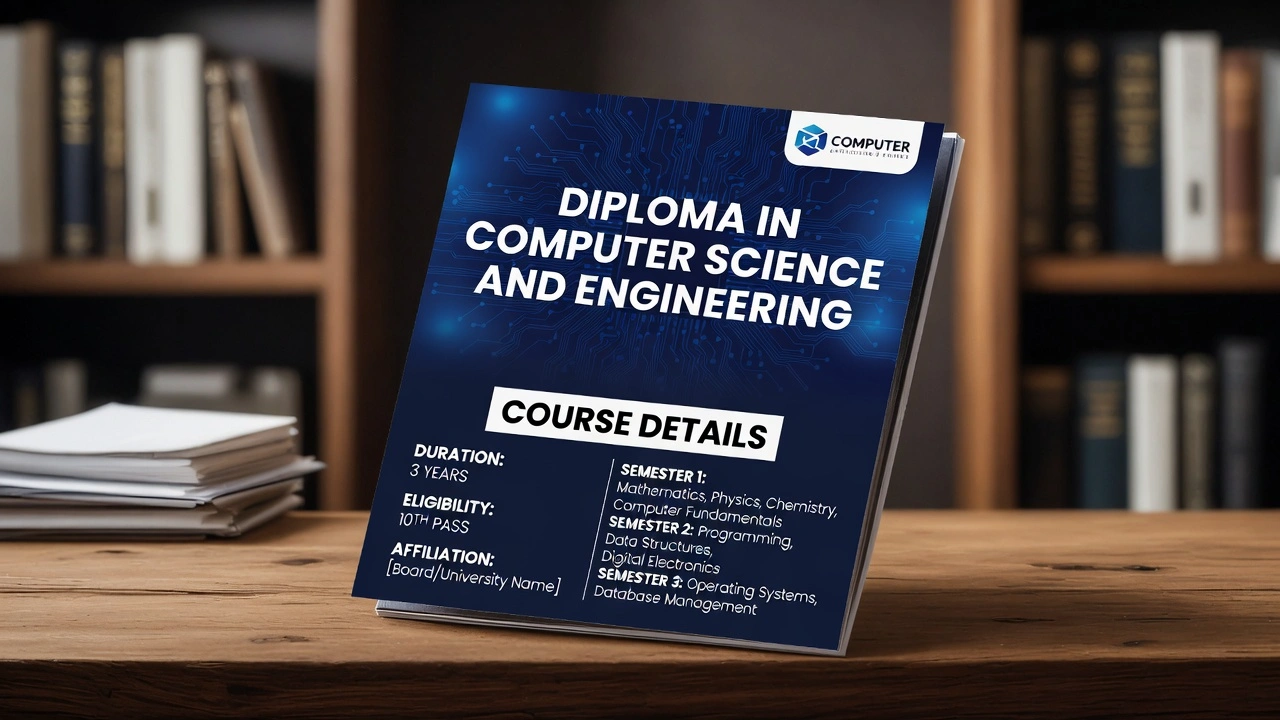
The Diploma in Computer Science and Engineering is a 3-year program providing a full understanding of computer systems, software, and hardware. It equips students with the skills and knowledge for a career in computer science and engineering. Eligibility varies depending on whether you apply after 10th or 12th grade.
After the 10th, a 3-year diploma is required. After 12th, you may be eligible for lateral entry into the second year. Approximate fees in India range from INR 50,000 to INR 2,00,000 per year, depending on the institution. All India Council for Technical Education (AICTE) approval is mandatory for technical programs in India, ensuring quality standards.
| Feature | Details |
|---|---|
| Duration | 3 years |
| Eligibility after 10th | 10th grade pass with a minimum 35% marks |
| Eligibility after 12th | 12th grade pass with a minimum 45% marks in science and mathematics |
| Approximate Fees (INR) | INR 50,000 to INR 2,00,000 per year |
| AICTE Approval | Mandatory for all technical programs in India |
| Job Roles | Software developer, hardware engineer, network administrator, database administrator |
| Average Salary | INR 3,00,000 to INR 6,00,000 per year |
| Top Colleges | National Institute of Technology (NIT), Indian Institute of Technology (IIT), Delhi Technological University (DTU) |
| Admission Process | Merit-based admission, entrance exams like JEE Main and JEE Advanced |
| Specializations | Artificial intelligence, machine learning, data science, cybersecurity, cloud computing |
Diploma in Computer Science and Engineering Eligibility Criteria
Eligibility for a diploma in computer science and engineering depends on your entry point: after 10th grade, 12th grade science, or 12th vocational. Generally, you need 55% to 60% marks in your qualifying exams. For 12th grade students, mathematics, physics, and chemistry are usually mandatory. Reserved categories (SC/ST) may have a 5% relaxation in minimum marks. Age limits typically range from 15 to 21 years old.
| Entry Point | Qualifying Exam | Minimum Marks Required | Subjects Required |
|---|---|---|---|
| After 10th | SSC or equivalent | 55% | Mathematics, Science |
| After 12th Science | HSC or equivalent | 60% in PCM | Physics, Chemistry, Mathematics |
| After 12th Vocational | HSC Vocational or equivalent | 55% in relevant trade | Relevant vocational trade |
| After ITI | ITI certificate or equivalent | 60% in relevant trade | Relevant ITI trade |
| After 10th + ITI | SSC + ITI certificate or equivalent | 55% in SSC and 60% in ITI | Mathematics, Science, and relevant ITI trade |
| After 12th Science with JEE Main | HSC or equivalent with JEE Main score | 60% in PCM and a valid JEE Main score | Physics, Chemistry, Mathematics |
| After 12th Vocational with JEE Main | HSC Vocational or equivalent with JEE Main score | 55% in relevant trade and valid JEE Main score | Relevant vocational trade |
| SC/ST category after 10th | SSC or equivalent | 50% | Mathematics, Science |
| SC/ST category after 12th Science | HSC or equivalent | 55% in PCM | Physics, Chemistry, Mathematics |
| SC/ST category after 12th Vocational | HSC Vocational or equivalent | 50% in relevant trade | Relevant vocational trade |
Diploma in Computer Science and Engineering Admission Process
The admission process for a Diploma in Computer Science and Engineering in Indian polytechnic colleges generally involves the following steps:
- Eligibility
Candidates must meet the basic eligibility criteria, which usually include passing Class 10 with at least 35% marks, including Mathematics and Science. - Application
Applicants need to fill out the application form, either online or offline, and submit it along with the required documents and application fee. - Entrance Examination
Depending on the state or institution, candidates may need to appear for a state-level polytechnic entrance exam. Some colleges also grant admission based on Class 10 merit. (JEE is typically not required for diploma admissions.) Top institutes may set cut-off criteria based on merit and institutional standards. - Merit List and Counselling
Merit lists are prepared based on entrance exam scores or qualifying examination marks. Shortlisted candidates are invited for counselling, which includes:
- Document verification (Class 10 mark sheet, transfer certificate, caste certificate if applicable)
- Filling in preferred colleges and courses
- Seat Allocation
Seats are allotted based on merit rank, candidate preferences, and seat availability. Some institutes may conduct spot admissions if seats remain vacant. - Fee Payment
After seat allotment, candidates must pay the admission fee to confirm their seat.
- Government colleges: Approximately INR 5,000 to INR 20,000 per year
- Private colleges: Approximately INR 50,000 to INR 1,00,000 per year
Some private institutions may also offer direct admission or management quota seats at higher fee structures.
After completing these steps, candidates must report to the allotted college, submit original documents, and complete the final admission formalities. The entire process usually takes a few months, with the academic session typically beginning in July or August. Applicants should check the official websites of state polytechnic authorities or respective colleges for the latest updates.
Top Government Colleges for Diploma in Computer Science and Engineering
These top 10 government polytechnic colleges in India offer a diploma in computer science and engineering. They are known for academic quality, infrastructure, and industry connections. Annual fees range from Rs 10,000 to Rs 50,000. Admission is primarily merit-based, with some colleges considering entrance exam scores. Most colleges offer 60-120 seats per year. All listed colleges are AICTE-approved.
| Rank | College Name | City/State | Annual Fees (INR) | Admission Mode | Available Seats (CSE Branch, Approx.) |
| 1 | Government Polytechnic, Mumbai | Mumbai, Maharashtra | 10,000–15,000 | Maharashtra Polytechnic CET (or merit) | 120–180 |
| 2 | Government Polytechnic, Pune | Pune, Maharashtra | 10,000–20,000 | Maharashtra Polytechnic CET | 120–180 |
| 3 | Pusa Institute of Technology (formerly Pusa Polytechnic) | New Delhi | 8,000–15,000 | Delhi CET | 60–120 |
| 4 | Veermata Jijabai Technological Institute (VJTI) Polytechnic Wing / Associated | Mumbai, Maharashtra | 15,000–25,000 | Maharashtra Polytechnic CET | 60–120 |
| 5 | Government Polytechnic, Chennai | Chennai, Tamil Nadu | 5,000–15,000 | Tamil Nadu Polytechnic Counselling (merit/entrance) | 60–120 |
| 6 | Government Polytechnic, Aurangabad | Aurangabad, Maharashtra | 10,000–18,000 | Maharashtra Polytechnic CET | 60–120 |
| 7 | Government Polytechnic, Nagpur | Nagpur, Maharashtra | 10,000–20,000 | Maharashtra Polytechnic CET | 60–120 |
| 8 | Acharya Narendra Dev College of Polytechnic (or similar Delhi govts) | New Delhi | 10,000–20,000 | Delhi CET | 60–100 |
| 9 | Government Polytechnic, Lucknow | Lucknow, Uttar Pradesh | 10,000–25,000 | JEECUP (Uttar Pradesh) | 60–120 |
| 10 | Government Polytechnic, Hyderabad / Central Institute of Tool Design (or state equiv.) | Hyderabad, Telangana | 5,000–15,000 | TS POLYCET | 60–120 |
Top Private Colleges for Diploma in Computer Science and Engineering
The following private polytechnic colleges in India offer a diploma in computer science and engineering. They are known for academic quality, infrastructure, and industry connections. The colleges are AICTE approved. Annual fees vary, with some offering scholarships and financial aid. Admission is either merit-based or through entrance exams, and seats are limited.
| Rank | College Name | City | State | Annual Fees (INR) | Admission Mode | Available Seats (Approx., CSE Branch) |
| 1 | Lovely Professional University (LPU) | Phagwara/Jalandhar | Punjab | 80,000–1,20,000 | LPUNEST (university entrance) or merit-based | 120–200 |
| 2 | Galgotias University | Greater Noida | Uttar Pradesh | 80,000–1,20,000 | Merit-based / University entrance test | 100–150 |
| 3 | Chandigarh University | Mohali/Chandigarh | Punjab | 70,000–1,10,000 | CUCET (university test) or merit-based | 90–150 |
| 4 | Parul University | Vadodara | Gujarat | 60,000–1,00,000 | Merit-based / University entrance | 100–120 |
| 5 | Shri Ramswaroop Memorial University (SRMU) | Lucknow | Uttar Pradesh | 50,000–80,000 | Merit-based / University counselling | 60–120 |
| 6 | Amity University (select campuses with diploma) | Noida / others | Uttar Pradesh | 80,000–1,20,000 | Amity entrance / merit-based | 60–100 |
| 7 | DY Patil Polytechnic / University-affiliated | Pune / Navi Mumbai | Maharashtra | 60,000–1,00,000 | Merit-based or state CET counselling | 60–120 |
| 8 | Ajeenkya DY Patil University / Polytechnic wing | Pune | Maharashtra | 70,000–1,10,000 | Merit-based / Entrance test | 60–100 |
| 9 | Sigma University / Similar Gujarat privates | Vadodara | Gujarat | 50,000–90,000 | Merit-based | 60–100 |
| 10 | Aditya Institute of Technology (private polytechnic) | Delhi | Delhi | 40,000–80,000 | Delhi CET or merit-based | 60–90 |
Diploma in Computer Science and Engineering Syllabus PDF
Here is the latest Diploma in Computer Science and Engineering syllabus, which you can download. The syllabus explains the semester-wise subjects and curriculum you will follow in this course.
Diploma in Computer Science and Engineering Syllabus
Diploma in Computer Science and Engineering Subjects List and Syllabus: A Year-Wise Breakdown
The Diploma in Computer Science and Engineering is a three-year program providing a full understanding of computer systems, software, and hardware. The course is divided into six semesters, each covering core and elective subjects.
Core subjects include programming languages like C, C++, and Java, as well as computer systems, data structures, and algorithms. Elective subjects include web development, database management, and computer networks. The program includes practical labs and projects for hands-on experience.
| Semester | Subject Code | Subject Name | Subject Type | Credit Hours |
| Semester 1 | CSHS101 | Communication Skills | HS | 3 |
| Semester 1 | CSBS102 | Applied Physics | BS | 3 |
| Semester 1 | CSES103 | IT Systems and Computer Programming | ES | 2 |
| Semester 1 | CSES104 | Fundamentals of Electronics Engineering | ES | 2 |
| Semester 1 | CSBS105 | Applied Mathematics-I | BS | 3 |
| Semester 1 | CSHS111 | Communication Skills Lab | HS (Practical) | 1 |
| Semester 1 | CSBS112 | Applied Physics Lab | BS (Practical) | 1 |
| Semester 1 | CSES113 | IT Systems and Computer Programming Lab | ES (Practical) | 2 |
| Semester 1 | CSES114 | Fundamentals of Electronics Engineering Lab | ES (Practical) | 1 |
| Semester 1 | CSES116 | Engineering Graphics | ES (Practical) | 2 |
| Semester 2 | CSES201 | Engineering Mechanics | ES | 3 |
| Semester 2 | CSBS202 | Applied Chemistry | BS | 3 |
| Semester 2 | CSES203 | Fundamentals of Mechanical Engineering | ES | 3 |
| Semester 2 | CSES204 | Fundamentals of Electrical Engineering | ES | 2 |
| Semester 2 | CSBS205 | Applied Mathematics-II | BS | 3 |
| Semester 2 | CSES211 | Engineering Mechanics Lab | ES (Practical) | 1 |
| Semester 2 | CSBS212 | Applied Chemistry Lab | BS (Practical) | 1 |
| Semester 2 | CSES214 | Fundamentals of Electrical Engineering Lab | ES (Practical) | 1 |
| Semester 2 | CSES217 | Engineering Workshop Practice | ES (Practical) | 2 |
| Semester 2 | CSHS218 | Sports and Yoga | HS (Practical) | 1 |
| Semester 2 | CSAU200 | Environmental Science | AU | 0 |
| Semester 3 | CSPC301 | Computer Oriented Numerical Methods | PC | 3 |
| Semester 3 | CSPC302 | Operating System | PC | 3 |
| Semester 3 | CSPC303 | Object Oriented Programming | PC | 3 |
| Semester 3 | CSPC304 | Cyber Security | PC | 3 |
| Semester 3 | CSPC305 | Digital Electronics and Microprocessors | PC | 2 |
| Semester 3 | CSPC311 | Computer Oriented Numerical Methods Lab | PC (Practical) | 1 |
| Semester 3 | CSPC312 | Operating System Lab | PC (Practical) | 1 |
| Semester 3 | CSPC313 | Object Oriented Programming Lab | PC (Practical) | 1 |
| Semester 3 | CSPC315 | Digital Electronics and Microprocessors Lab | PC (Practical) | 1 |
| Semester 3 | CSSI316 | Summer Internship-I | SI | 2 |
| Semester 4 | CSPC401 | Data Structures and Algorithms | PC | 3 |
| Semester 4 | CSPC402 | Database Management System | PC | 3 |
| Semester 4 | CSPC403 | Computer Networks | PC | 3 |
| Semester 4 | CSPE404 | Artificial Intelligence | PE | 3 |
| Semester 4 | CSPC405 | Computer Organization and Architecture | PC | 2 |
| Semester 4 | CSPC411 | Data Structures and Algorithms Lab | PC (Practical) | 1 |
| Semester 4 | CSPC412 | Database Management System Lab | PC (Practical) | 1 |
| Semester 4 | CSPC413 | Computer Networks Lab | PC (Practical) | 1 |
| Semester 4 | CSPC415 | Computer Hardware Lab | PC (Practical) | 1 |
| Semester 4 | CSPR416 | Minor Project | PR | 2 |
| Semester 4 | CSAU400 | Indian Knowledge and Tradition | AU | 0 |
| Semester 5 | CSPE501 | Computer Graphics | PE | 3 |
| Semester 5 | CSPC502 | Web Technologies | PC | 3 |
| Semester 5 | CSPE503 | Java Programming | PE | 2 |
| Semester 5 | CSOE504 | Soft Computing Techniques | OE | 3 |
| Semester 5 | CSHS505 | Entrepreneurship and Start-up | HS | 3 |
| Semester 5 | CSPE511 | Computer Graphics Lab | PE (Practical) | 1 |
| Semester 5 | CSPC512 | Web Technologies Lab | PC (Practical) | 1 |
| Semester 5 | CSPE513 | Java Programming Lab | PE (Practical) | 1 |
| Semester 5 | CSSI516 | Summer Internship-II | SI | 2 |
| Semester 5 | CSPR517 | Major Project-I | PR | 1 |
| Semester 6 | CSPC601 | Software Engineering | PC | 3 |
| Semester 6 | CSPC602 | Visual Programming | PC | 3 |
| Semester 6 | CSPC603 | Introduction to E-Governance | PC | 3 |
| Semester 6 | CSOE604 | Microcontroller and Embedded System | OE | 3 |
| Semester 6 | CSPC611 | Software Engineering Lab | PC (Practical) | 2 |
| Semester 6 | CSPC612 | Visual Programming Lab | PC (Practical) | 2 |
| Semester 6 | CSSE616 | Seminar | SE | 1 |
| Semester 6 | CSPR617 | Major Project-II | PR | 3 |
| Semester 6 | CSAU600 | Indian Constitution | AU | 0 |
Notes:
- Total Credits: Approximately 120 (20 per semester), aligning with AICTE guidelines.
- Electives: Program Electives (PE) and Open Electives (OE) allow specialization; lists vary but may include options like Mobile App Development, IoT, or Cloud Computing.
- Assessment: Typically 40-60% internal (IA: assignments, labs) and 40-60% external (UE: exams), with practicals focusing on hands-on skills.
- Syllabus Details: Detailed topics for each subject (e.g., C/C++ in OOP, SQL in DBMS) are institution-specific but follow national standards.
Diploma in Computer Science and Engineering Fees: Government vs Private Colleges in India
The fee structure for a diploma in computer science and engineering varies significantly between government and private colleges in India. Government colleges, such as the National Institutes of Technology (NITs), offer subsidized fees, ranging from Rs 1,50,000 to Rs 2,50,000 per year.
Private colleges, like BITS Pilani, can charge between Rs 2,50,000 to Rs 5,00,000 per year. Other expenses, including hostel fees, examination fees, and miscellaneous charges, can add up to Rs 1,00,000 to Rs 2,00,000 per year. Many colleges offer scholarships and financial aid.
| Fee Component | Government College (INR) | Private College (INR) | Other Expenses (INR) |
|---|---|---|---|
| Tuition Fees | Rs 1,20,000 per year (NIT Trichy) | Rs 3,00,000 per year (BITS Pilani) | Rs 10,000 to Rs 20,000 per semester |
| Hostel Fees | Rs 60,000 per year (IIT Delhi) | Rs 1,20,000 per year (Manipal Institute of Technology) | Rs 5,000 to Rs 10,000 per month |
| Examination Fees | Rs 5,000 per semester (NIT Surathkal) | Rs 10,000 per semester (Vellore Institute of Technology) | Rs 1,000 to Rs 2,000 per semester |
| Miscellaneous Fees | Rs 10,000 per year (IIT Bombay) | Rs 20,000 per year (Birla Institute of Technology and Science) | Rs 5,000 to Rs 10,000 per year |
| Total Fees | Rs 2,00,000 per year (NIT Warangal) | Rs 4,50,000 per year (SRM Institute of Science and Technology) | Rs 1,50,000 to Rs 3,00,000 per year |
| Scholarship | Merit-based scholarship up to Rs 50,000 per year (IIT Kanpur) | Merit-based scholarship up to Rs 1,00,000 per year (Jamia Millia Islamia) | Rs 10,000 to Rs 50,000 per year |
| Financial Aid | Education loan up to Rs 1,00,000 per year (State Bank of India) | Education loan up to Rs 2,00,000 per year (HDFC Bank) | Rs 50,000 to Rs 1,00,000 per year |
Career Options after Completing a Diploma in CSE
After completing a diploma in computer science and engineering, several further education options can enhance career prospects and salary potential. One popular option is lateral entry into the second year of a B.Tech program.
You could also enrol in an advanced diploma course in computer science engineering for specialised training. Other specialised diploma courses include cybersecurity, data science, or artificial intelligence.
- B.Tech in Computer Science and Engineering through lateral entry, which costs around 50,000 – 2,00,000 INR per year.
- Advanced Diploma in Computer Science Engineering, which focuses on emerging technologies like blockchain, IoT, and cloud computing, with fees ranging from 30,000 – 1,50,000 INR per year.
- Diploma in Cyber Security, which covers topics like network security, cryptography, and threat analysis, with fees around 20,000 – 1,00,000 INR per year.
- Diploma in Data Science, which provides training in data analysis, machine learning, and visualisation, with fees ranging from 25,000 – 1,20,000 INR per year.
- Diploma in Artificial Intelligence and Machine Learning, which covers topics like deep learning, natural language processing, and computer vision, with fees around 30,000 – 1,50,000 INR per year.
- M.Sc in Computer Science, which provides advanced training in computer science and research, with fees ranging from 20,000 – 1,00,000 INR per year.
- M.Tech in Computer Science and Engineering, which focuses on specialised areas like software engineering, computer networks, or database systems, with fees around 30,000 – 1,50,000 INR per year.
- PG Diploma in Computer Science, which provides training in emerging technologies and industry-specific skills, with fees ranging from 15,000 – 80,000 INR per year.
With the increasing demand for skilled IT professionals, further education can lead to better job opportunities and higher salaries, ranging from 3,00,000 – 10,00,000 INR per year, depending on the role and industry. It also provides specialised skills and knowledge, making you more competitive.
Frequently Asked Questions (FAQs)
Q1. What is the course level of diploma in computer science and engineering?
The course level of diploma in computer science and engineering is Diploma. The National Institutional Ranking Framework (NIRF) is mentioned as an entrance exam for this course.
Q2. What are the details of the top government colleges for diploma in computer science and engineering in India?
The details of the top government colleges for diploma in computer science and engineering in India include college name, city, state, and annual fees.
Q3. Is there any information available about the admission process for diploma in computer science and engineering in India?
No specific information is available about the admission process for diploma in computer science and engineering in India, as the provided data is incomplete.
Q4. What can be said about the diploma computer science engineering subjects list and syllabus?
The diploma computer science engineering subjects list and syllabus is supposed to be provided in a year-wise breakdown, but the specific details are .
Q5. Are there any higher education options available after completing a diploma in computer science and engineering?
Higher education options are available after completing a diploma in computer science and engineering, but the specific options are not listed in the provided data.
Frequently Asked Questions (FAQs)
Q: What is the typical duration of a Diploma in Computer Science and Engineering program in India?
A Diploma in Computer Science and Engineering typically spans 3 years in India, divided into 6 semesters. Some lateral entry options for 12th-grade science students or ITI holders might reduce the duration to 2 years, allowing direct admission into the second year.
Q: What are the approximate fees for this diploma course in government and private institutions for 2026?
For 2026, government polytechnics might charge ₹10,000-₹30,000 annually. Private institutions could range from ₹40,000-₹1,00,000 per year, depending on facilities and location. These figures are estimates and can vary significantly across states and colleges.
Q: Are there any entrance exams required for admission to a Diploma in Computer Science and Engineering?
Yes, many states conduct common entrance tests like JEECUP (Uttar Pradesh), DET (Haryana), or various state polytechnic entrance exams. Some private colleges might offer direct admission based on 10th-grade marks, while others conduct their own aptitude tests. NTA does not conduct a national exam for this diploma.
Q: What is the career scope after completing a Diploma in Computer Science and Engineering in India?
Graduates can work as Junior Software Developers, Web Developers, Network Support Engineers, or IT Support Specialists. Opportunities exist in IT companies, government sectors, and manufacturing units. Many also opt for lateral entry into B.Tech/BE programs, recognized by AICTE and UGC.
Q: What is the expected starting salary for a Diploma holder in Computer Science and Engineering in India (2026)?
In 2026, a diploma holder can expect an average starting salary ranging from ₹1.8 LPA to ₹3.5 LPA in India. This varies based on skills, company type, location (e.g., Bangalore vs. Tier 2 city), and practical experience gained during the diploma. Higher packages are possible with specialized skills.
Q: Is there any scope for pursuing higher education or employment abroad after this diploma?
While a diploma itself has limited direct recognition abroad for higher studies, it serves as a strong foundation. Graduates can pursue a Bachelor’s degree (B.Tech/BE) in India and then explore Master’s programs or job opportunities overseas. Some countries might offer bridging courses or specific diploma-level jobs.