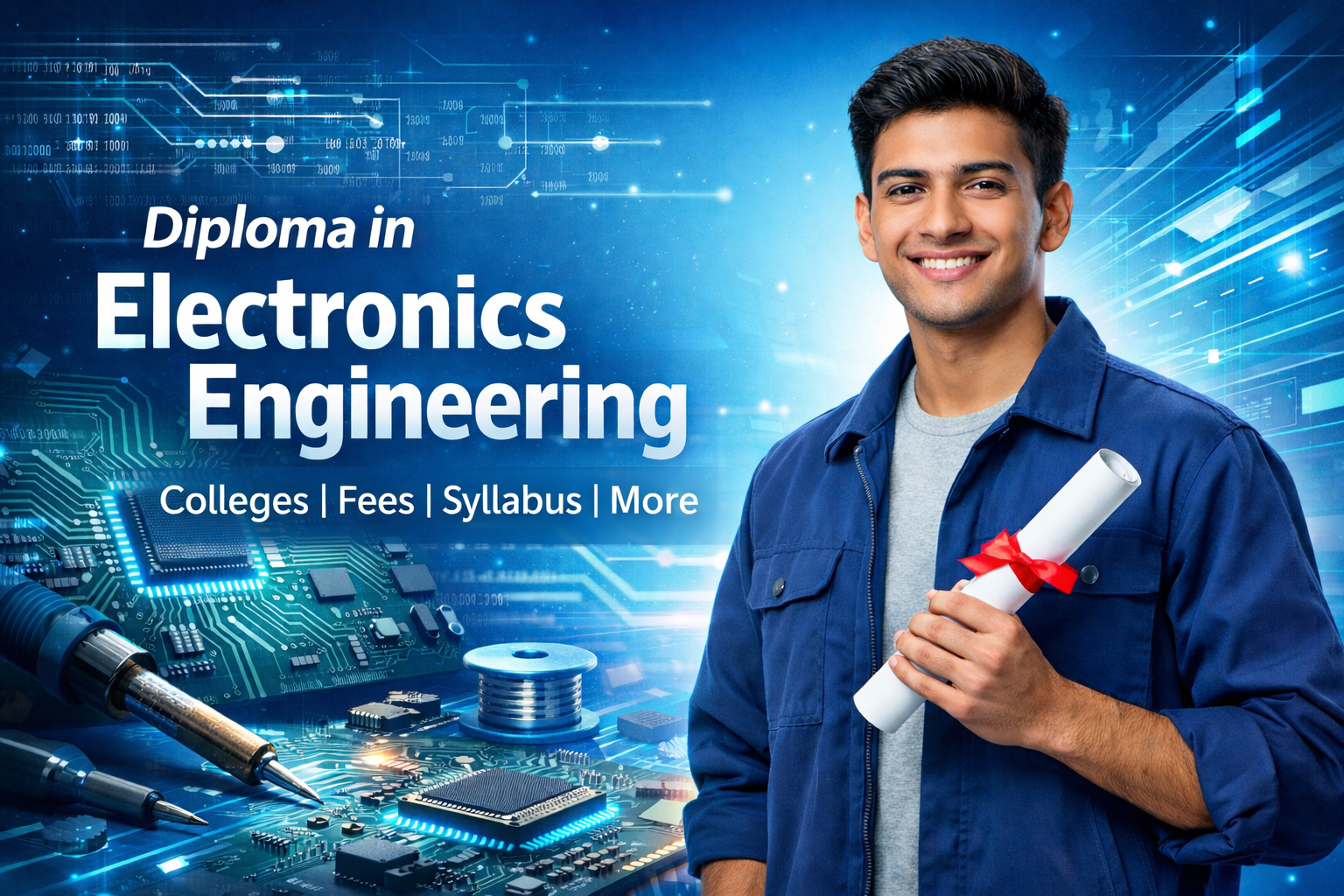
Diploma in Electronics Engineering: Courses, Colleges, Career Scope & Salary in India
With the increasing reliance on technology, the demand for skilled electronics engineers is growing, making a diploma in electronics a valuable qualification. A diploma in electronics engineering is a three-year program focusing on practical skills and industry knowledge through hands-on training, workshops, and industry visits. To be eligible for a diploma in electronics, applicants typically need a 10th-grade (or equivalent) certificate with a minimum of 45% aggregate marks, or a 12th-grade certificate in the science stream with 50% aggregate marks.
🔔 Diploma in Electronics Engineering Admission Alerts 2026
- Eligibility: Candidates for Diploma in Electrical Engineering must have passed 10th standard with at least 50% and a Diploma Entrance Exam.
- Application Status: Findmycollege.com is currently accepting applications for Diploma in Electronics Engineering for the 2026 academic year.
- Exam Information: JEE Main 2026 Admit Card details are available for various engineering programs, including those related to Electronics.
- Top Colleges: Explore top engineering colleges in India for 2026, including IIT Madras and IIT Delhi, offering relevant programs.
Graduates with a diploma in electronics engineering have diverse career opportunities as technicians, service engineers, and field engineers in electronics and related industries. A diploma in electronics can also lead to a B.Tech/B.E. Degree through lateral entry, granting direct admission to the second year of these programs. The annual fee for a diploma in electronics engineering in India ranges from ₹50,000 to ₹2,00,000. This article explores diploma in electronics engineering courses, colleges, career prospects, and salaries in India, including syllabus details and placement information.
Diploma in Electronics Engineering: Course Overview
The Diploma in Electronics Engineering is a 3-year program providing students with practical skills and industry-relevant knowledge in electronics. The course equips students with the skills to pursue careers in electronics and related industries, covering electronic devices and circuits, digital electronics, microcontrollers, and communication engineering.
| Degree Full Form | Diploma in Electronics Engineering |
| Degree Type | Diploma Program |
| Typical Duration | 3 Years |
| Eligibility (India) | 10th standard pass with at least 50% and Diploma Entrance Exam |
| Common Entrance Exams (India) | Diploma Entrance Exam (specific to state/college) |
| Average Annual Fees (India) | ₹8,000 – ₹80,000 |
| Career Options | Electronics Technician, Service Engineer, Field Engineer, PSU Jobs (after GATE 2026) |
| Top Recruiting Companies | Top international companies with presence in India, PSUs (through GATE 2026) |
| UGC/AICTE Approved | Ensures quality of education and recognition |
| Further Education | Lateral entry to B.Tech/B.E. Programs |
Diploma in Electronics Engineering: Eligibility Criteria
Eligibility criteria for a diploma in electronics engineering in India depend on the institution and admission type. Generally, candidates must have passed their 10th or 12th standard examinations with a minimum percentage of marks in science and mathematics. Some institutions may have additional requirements or higher cutoffs.
| Category | Qualification | Minimum Marks Required | Age Limit |
|---|---|---|---|
| 10th Pass | SSC or equivalent | 35% | 15 years |
| 12th Pass | HSC (Science stream) | 50% in PCM | 17 years |
| ITI | ITI certificate in relevant trade | 60% | 18 years |
| Government Polytechnic | 10th or 12th with science and maths | 45% | 16 years |
| Private Polytechnic | 10th or 12th with science and maths | 50% | 17 years |
| Lateral Entry | ITI or 12th (vocational) | 55% | 18 years |
| Diploma after 12th | 12th (Science stream) with maths | 60% | 18 years |
| Government Aided Institution | 10th or 12th with science and maths | 50% | 17 years |
| Private Institution with Scholarship | 10th or 12th with science and maths | 65% | 18 years |
| Institution with Entrance Exam | 10th or 12th with science and maths | 55% and valid entrance score | 17 years |
Diploma in Electronics Engineering: Admission Process
The admission process for a diploma in electronics engineering in India involves merit-based and entrance exam-based admissions. Merit-based admissions consider the candidate’s performance in their 10th or 12th standard exams. Entrance exam-based admissions require candidates to appear for specific exams, such as state-level polytechnic entrance exams.
To apply, candidates must complete the application form, submitting documents like mark sheets, certificates, and identification proof. The application process includes registering on the official website, completing the form, uploading documents, and paying the fee.
Popular Entrance Exams for Diploma in Electronics Engineering
| Exam Name | State/Region | Tentative Date (2026) |
|---|---|---|
| JEECUP (UPJEE Polytechnic) | Uttar Pradesh (most popular, large number of seats) | May 15 – 22, 2026 |
| TS POLYCET | Telangana | May 2026 (likely mid-May, e.g., around May 13 based on patterns) |
| Delhi CET | Delhi | July 2026 |
| AP POLYCET | Andhra Pradesh | April/May 2026 |
| BCECE (DCECE Polytechnic) | Bihar | June 2026 |
| JEXPO | West Bengal | May/June 2026 |
| HP PAT | Himachal Pradesh | May 2026 |
| CG PPT | Chhattisgarh | May/June 2026 |
| Assam PAT | Assam | May/June 2026 |
| Haryana DET / HSTES | Haryana | May/June 2026 |
Top Government Colleges for Diploma in Electronics Engineering in India
The following table lists top government colleges in India offering a diploma in electronics engineering, along with their fees, admission mode and other details:
| College Name (City) | Total Fees | Admission Mode |
|---|---|---|
| Government Polytechnic Mumbai (Mumbai, Maharashtra) | ₹18,000 – ₹45,000 | Maharashtra Polytechnic CAP rounds |
| Government Polytechnic Pune (Pune, Maharashtra) | ₹24,000 – ₹30,000 | Maharashtra Polytechnic CAP rounds |
| Government Polytechnic Chennai (Chennai, Tamil Nadu) | ₹10,000 – ₹30,000 | Tamil Nadu Polytechnic Admission |
| Pusa Polytechnic (Delhi) | ₹15,000 – ₹40,000 | Delhi CET (Common Entrance Test) or merit-based |
| Government Polytechnic Hyderabad (Hyderabad, Telangana) | ₹10,000 – ₹25,000 | TS POLYCET entrance exam |
| Government Polytechnic Bangalore (Bangalore, Karnataka) | ₹10,000 – ₹20,000 | Karnataka DCET or merit-based |
| Government Polytechnic Ahmedabad (Ahmedabad, Gujarat) | ₹8,000 – ₹15,000 | Gujarat Polytechnic Admission (merit/entrance) |
| Government Polytechnic Kolkata (Kolkata, West Bengal) | ₹10,000 – ₹25,000 | JEXPO entrance exam |
| Veermata Jijabai Technological Institute (VJTI) Polytechnic Wing (Mumbai, Maharashtra) | ₹20,000 – ₹50,000 | Maharashtra Polytechnic CAP rounds |
| Government Polytechnic Thiruvananthapuram (Thiruvananthapuram, Kerala) | ₹10,000 – ₹30,000 | Kerala Polytechnic Admission (merit-based) |
| Sahu Jain Government Polytechnic (Kanpur, Uttar Pradesh) | ₹15,000 – ₹40,000 | JEECUP (UP Polytechnic Entrance) |
| Government Polytechnic Lucknow (Lucknow, Uttar Pradesh) | ₹15,000 – ₹35,000 | JEECUP entrance exam |
| Government Polytechnic Amravati (Amravati, Maharashtra) | ₹20,000 – ₹40,000 | Maharashtra Polytechnic CAP rounds |
Top Private Colleges for Diploma in Electronics Engineering in India
The following table lists top private colleges in India offering a diploma in electronics engineering, along with their fees and other details:
| College Name (City) | Total Fees | Admission Mode |
|---|---|---|
| Lovely Professional University (Phagwara, Punjab) | ₹1.8 Lakhs – ₹2.5 Lakhs | LPUNEST / Merit-based |
| Chandigarh University (Mohali / Chandigarh, Punjab) | ₹1.8 Lakhs – ₹2.5 Lakhs | CUCET / Merit-based |
| Amity Polytechnic / Amity University (Noida / Greater Noida, Uttar Pradesh) | ₹1.5 Lakhs – ₹3 Lakhs | Merit-based / Amity Entrance or direct |
| SRM Institute of Science and Technology (Chennai, Tamil Nadu) | ₹2 Lakhs – ₹3 Lakhs | Merit-based / SRMJEEE or direct |
| VIT University (Vellore, Tamil Nadu) | ₹2.5 Lakhs – ₹3.5 Lakhs | Merit-based / VITEEE or direct |
| Manipal Institute of Technology / Manipal University (Manipal, Karnataka) | ₹2.5 Lakhs – ₹4 Lakhs | Merit-based / MET or direct |
| Sharda University (Greater Noida, Uttar Pradesh) | ₹2 Lakhs – ₹2.8 Lakhs | Merit-based / SUAT or direct |
| JSS Academy of Technical Education (Noida, Uttar Pradesh) | ₹2 Lakhs – ₹2.7 Lakhs | Merit-based / Entrance or direct |
| Sikkim Manipal Institute of Technology (Gangtok, Sikkim) | ₹1.8 Lakhs – ₹2.4 Lakhs | Merit-based / Direct |
Diploma in Electronics Engineering: Year-wise Syllabus Breakdown
The diploma in electronics engineering is a three-year program providing a full understanding of electronics engineering principles and practices. The curriculum equips students with the knowledge and skills to design, develop, and test electronic systems and devices, focusing on theoretical and practical aspects.
| Year | Semester | Core Subjects | Electives / Optional | Practical Labs / Projects |
|---|---|---|---|---|
| 1st Year | 1st Semester | Basic Electronics, Engineering Mathematics, Communication Skills, Engineering Physics, Engineering Chemistry | Introduction to Programming, Computer Fundamentals, Environmental Science, Engineering Graphics | Basic Electronics Lab, Workshop Practice, Engineering Physics Lab, Engineering Chemistry Lab |
| 1st Year | 2nd Semester | Electronic Devices and Circuits, Digital Electronics, C Programming, Electronic Measurements and Instruments, Digital Logic Design | Data Structures, Algorithms, Computer Organization, Computer Architecture | Electronic Devices and Circuits Lab, Digital Electronics Lab, Electronic Measurements and Instruments Lab, Digital Logic Design Lab |
| 2nd Year | 3rd Semester | Microcontrollers, Electrical Machines, Data Structures, Control Systems, Microwave Engineering | Computer Networks, Database Management Systems, Antenna and Wave Propagation, Optical Communication | Microcontroller Lab, Electrical Machines Lab, Control Systems Lab, Microwave Engineering Lab |
| 2nd Year | 4th Semester | Power Electronics, Communication Engineering, Object Oriented Programming, Communication Systems, Digital Signal Processing | Web Development, Cyber Security, Image Processing, Pattern Recognition | Power Electronics Lab, Communication Engineering Lab, Communication Systems Lab, Digital Signal Processing Lab |
| 3rd Year | 5th Semester | Embedded Systems, Industrial Automation, VLSI Design, Wireless Communication, Computer Vision | Artificial Intelligence, Internet of Things, Machine Learning, Data Mining | Embedded Systems Lab, Industrial Automation Lab, Wireless Communication Lab, Computer Vision Lab |
| 3rd Year | 6th Semester | Project Work, Industrial Training / Capstone Project, Industrial Internship | Entrepreneurship, Project Management, Technical Writing, Presentation Skills | Project Lab, Industrial Training / Capstone Project Lab |
Core Subjects Taught in Diploma in Electronics Engineering
Take a detailed look at some of the core subjects in this course below:
| Subject Name | Subject Description |
|---|---|
| Basic Electronics | Introduces fundamental concepts of electronic components, circuits, and basic principles of electronics. |
| Electronic Devices and Circuits | Covers semiconductor devices (diodes, transistors, FETs) and their applications in analog circuits like amplifiers and rectifiers. |
| Digital Electronics | Focuses on binary logic, logic gates, combinational/sequential circuits, flip-flops, counters, and digital system design. |
| Analog Electronics / Linear Integrated Circuits | Explores operational amplifiers, timers (e.g., IC 555), waveform generators, and linear IC applications in signal processing. |
| Communication Engineering / Systems | Deals with principles of analog/digital communication, modulation techniques (AM, FM), transmitters, receivers, and noise effects. |
| Microcontrollers / Microprocessors | Studies architecture, programming, interfacing, and applications of microcontrollers (e.g., 8051) and microprocessors for embedded systems. |
| Embedded Systems | Introduces design and programming of embedded hardware/software systems, including real-time applications and interfacing. |
| VLSI Design / Basics of VLSI | Provides fundamentals of very large-scale integration, IC fabrication, digital/analog VLSI circuits, and tools for chip design. |
| Industrial Electronics / Automation | Focuses on electronic control in industries, PLCs, sensors, actuators, and automation systems. |
| Electronic Measurements and Instrumentation | Covers principles of measuring instruments, transducers, bridges, oscilloscopes, and error analysis in electronic measurements. |
| Network Theory / Analysis | Explores electrical networks, theorems (Thevenin, Norton), transient/steady-state analysis, and filters. |
| Microwave Engineering | Introduces high-frequency devices, waveguides, antennas, microwave components, and radar basics. |
| Wireless Communication | Discusses modern wireless technologies, mobile systems, modulation schemes, and propagation in wireless channels. |
Diploma in Electronics Engineering: Fee Structure Comparison – Government vs Private Colleges
The fee structure for a diploma in electronics engineering differs significantly between government and private colleges in India. Here is a tabular comparison of some popular options with various fee components:
| College Type | Tuition Fees (INR) | Hostel Fees (INR) | Other Expenses (INR) | Total Fees (INR) |
|---|---|---|---|---|
| Government Polytechnic Mumbai (Government) | ₹18,000 – ₹32,600 (total for 3 years) | ₹8,000 – ₹15,000 (annual) | ₹3,000 – ₹10,000 (annual) | ₹21,000 – ₹45,000 |
| Government Polytechnic Pune (Government) | ₹8,000 – ₹10,000 (annual) | ₹8,000 – ₹12,000 (annual) | ₹3,000 – ₹8,000 (annual) | ₹24,000 – ₹35,000 (total) |
| Lovely Professional University (Private) | ₹60,000 – ₹70,000 (annual; scholarships via LPUNEST can reduce significantly) | ₹70,000 – ₹1 Lakh (annual) | ₹15,000 – ₹30,000 (annual.) | ₹1.8 Lakhs – ₹2.5 Lakhs (total) |
| Amity Polytechnic / Amity University Greater Noida (Private) | ₹50,000 – ₹70,000 (annual) | ₹60,000 – ₹80,000 (annual) | ₹12,000 – ₹25,000 (annual) | ₹1.5 Lakhs – ₹2.1 Lakhs (total) |
| Chandigarh University (Private) | ₹60,000 – ₹85,000 (annual; merit scholarships available) | ₹70,000 – ₹1 Lakh (annual) | ₹15,000 – ₹30,000 (annual) | ₹1.8 Lakhs – ₹2.5 Lakhs (total) |
Career Scope and Job Opportunities after Diploma in Electronics Engineering in India
Graduates holding a diploma in electronics engineering in India have diverse career opportunities. They can pursue roles such as electronics technicians, service engineers, maintenance technicians, and telecommunication technicians. Here is a quick overview:
| Job Role | Industry | Average Salary |
|---|---|---|
| Electronics Technician | Manufacturing, Service | ₹2 – ₹4 LPA |
| Service Engineer | Consumer Electronics, Telecom | ₹2.5 – ₹5 LPA |
| Maintenance Technician | Industrial Automation, Manufacturing | ₹2.2 – ₹4.5 LPA |
| Telecommunication Technician | Telecom, Networking | ₹2.5 – ₹5.5 LPA |
| Field Engineer | Telecom, Automation | ₹3 – ₹6 LPA |
| Embedded Systems Developer | Automotive, IoT | ₹3.5 – ₹7 LPA |
| Technical Support Engineer | Consumer Electronics, IT | ₹2.8 – ₹5.8 LPA |
| Quality Control Engineer | Manufacturing, Quality Assurance | ₹3.2 – ₹6.5 LPA |
| R&D Engineer | Research and Development, Innovation | ₹4 – ₹8 LPA |
| Design Engineer | Product Design, Development | ₹3.5 – ₹7.5 LPA |
Lateral Entry into B.Tech After Diploma in Electronics Engineering
Lateral entry allows diploma holders in Electronics Engineering to join the second year (3rd semester) of a B.Tech or B.E. Program directly, completing the degree in 3 years instead of 4. This pathway, approved by AICTE, recognizes the technical foundation from the 3-year diploma and is ideal for upskilling in areas like power systems, renewable energy, EVs, and automation. Eligibility typically requires a diploma from an AICTE-recognized institution with 45–50% aggregate marks (relaxations for reserved categories), though some universities demand 50–60%. There is generally no strict age limit, and the diploma must align with Electrical or related branches.
Admission occurs via state-level entrance exams, merit-based on diploma marks, or university-specific tests. Counseling follows for seat allotment in government and private colleges like Jadavpur University, Manipal Institute of Technology, Lovely Professional University, and Chandigarh University. This upgrade boosts career prospects, enabling higher roles, better salaries (₹4–10 LPA starting post-degree), and eligibility for GATE, PSUs, or further studies.
Pros and Cons of Diploma in Electronics Engineering
A Diploma in Electronics Engineering offers multiple advantages, but also brings along some challenges. Heres ia a pros and cons comparison for a deeper understanding:
Pros
- Quick workforce entry – Start working as a technician or junior engineer at 18–19, gaining 1–2 years of experience over B.Tech graduates.
- Low cost – Government polytechnics charge only ₹20,000–₹50,000 total, often with scholarships for reserved categories.
- Strong practical training – Heavy focus on labs, workshops, and industrial exposure makes you job-ready immediately.
- Easy lateral entry to B.Tech – Join second year directly, completing a degree in 3 more years for better roles and pay.
- Steady demand – Good opportunities in power sector, renewables, EVs, railways, manufacturing, and construction.
Cons
- Lower starting salary – Typically ₹2–5 LPA vs. ₹4–10+ LPA for B.Tech graduates.
- Limited access to advanced roles – R&D, design, managerial, and many PSU/government jobs prefer or require a degree.
- Less theoretical knowledge – Weaker foundation in advanced concepts, which can make further studies or specialization more challenging.
- High competition & fieldwork – Top jobs often go to degree holders; many roles involve site work, shifts, and physical demands.
- Restricted international mobility – Overseas employers and skilled migration pathways usually favor bachelor’s degrees.
Frequently Asked Questions (FAQs)
Q1. What is the typical duration of a Diploma in Electronics Engineering program?
The typical duration of a Diploma in Electronics Engineering program is 3 years.
Q2. What are the eligibility criteria for admission to a Diploma in Electronics Engineering program?
To be eligible for admission, candidates must have passed their 10th or equivalent examination with at least 45% aggregate marks, or their 12th (Science stream) with at least 50% aggregate marks. The minimum age requirement is 15 years.
Q3. What is the fee structure for Government and Private Polytechnic colleges offering a Diploma in Electronics Engineering?
Government polytechnic colleges in India typically charge low fees for a Diploma in Electronics Engineering, ranging from ₹10,000–₹50,000 total for 3 years, while private polytechnic colleges have higher fees, usually ₹50,000–₹2,00,000 in total.
Q4. What are the average salary ranges for job roles after completing a Diploma in Electronics Engineering?
The average salary ranges for job roles after completing a Diploma in Electronics Engineering are: ₹2 – ₹4 LPA for Electronics Technicians, ₹2.5 – ₹5 LPA for Service Engineers, ₹3 – ₹6 LPA for Field Engineers, and ₹3.5 – ₹7 LPA for Embedded Systems Developers.
Q5. What are the core subjects covered in the first year of a Diploma in Electronics Engineering program?
In the first year, the core subjects covered include Basic Electronics, Engineering Mathematics, and Communication Skills in the first semester, and Electronic Devices and Circuits, Digital Electronics, and C Programming in the second semester.
Q: What is the average tuition fee for a Diploma in Electronics Engineering in India in 2026?
The average tuition fee for a Diploma in Electronics Engineering in India for 2026 is estimated to range from ₹30,000 to ₹80,000 per year, depending on the institution. Government polytechnics typically have lower fees, around ₹10,000-₹25,000 annually, while private colleges might charge upwards of ₹50,000 per year for the Diploma in Electronics Engineering program.
Q: What are the eligibility criteria and entrance exams for Diploma in Electronics Engineering in India?
To be eligible for a Diploma in Electronics Engineering, students typically need to have passed their 10th standard (SSLC/Matriculation) with a minimum of 35-45% marks, often with Science and Mathematics as compulsory subjects. Many states conduct common entrance tests like DET (Diploma Entrance Test) or polytechnic entrance exams. Some private colleges offering the Diploma in Electronics Engineering may offer direct admission based on 10th-grade scores.
Q: Which are the top government polytechnic colleges for Diploma in Electronics Engineering in India?
Some of the top government polytechnic colleges for Diploma in Electronics Engineering in India include Government Polytechnic Mumbai, Delhi Institute of Tool Engineering (DITE), and Government Polytechnic, Pune. These institutions are renowned for their strong curriculum, experienced faculty, and high placement rates, often exceeding 70% for the Diploma in Electronics Engineering graduates.
Q: What is the average salary after Diploma in Electronics Engineering in India in 2026?
The average starting salary for a Diploma in Electronics Engineering graduate in India in 2026 is projected to be between ₹2.0 LPA and ₹3.5 LPA. With 2-3 years of experience, professionals in Diploma in Electronics Engineering can expect to earn ₹4.0 LPA to ₹6.0 LPA, especially in sectors like manufacturing, telecommunications, and consumer electronics.
Q: What are the career opportunities and job roles after Diploma in Electronics Engineering?
After completing a Diploma in Electronics Engineering, graduates can find roles as Junior Engineers, Electronics Technicians, Field Service Engineers, or Production Supervisors. Industries like telecommunications, consumer electronics, power generation, and automation offer numerous opportunities. The Diploma in Electronics Engineering opens doors to roles in circuit design, testing, maintenance, and quality control, with a projected 6% growth in relevant jobs by 2026.
Q: Can I pursue higher education or work abroad after a Diploma in Electronics Engineering from India?
Yes, after completing a Diploma in Electronics Engineering, students can pursue a B.Tech/BE degree through lateral entry, typically entering directly into the second year of the 4-year program. For working abroad, countries like the UAE, Singapore, and some European nations offer opportunities for skilled technicians. While direct work visas can be challenging, a Diploma in Electronics Engineering combined with 2-3 years of experience enhances prospects for international roles.