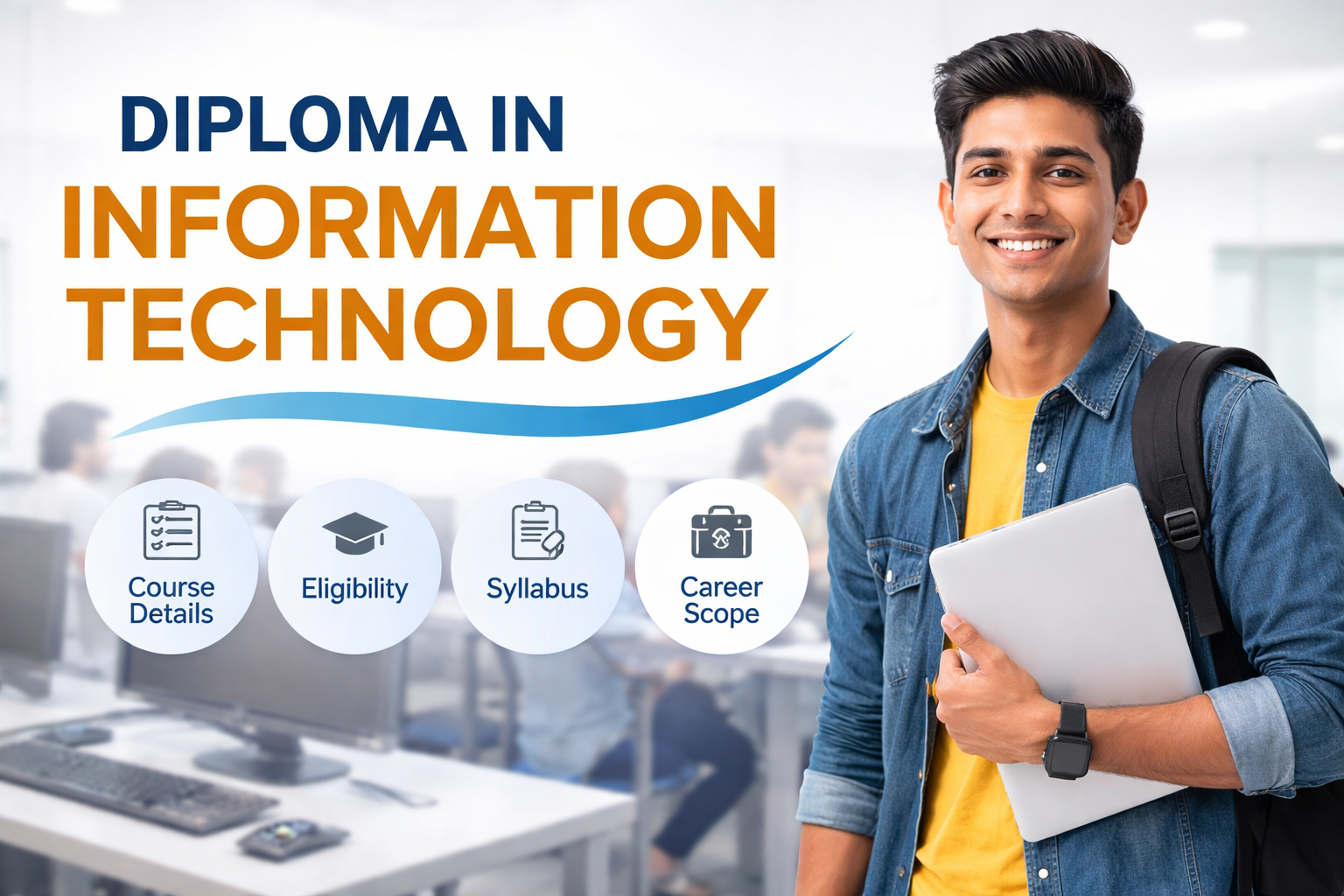
Diploma in Information Technology: Course Details, Eligibility, Admission, Syllabus, Career Scope and Salary
Diploma in Information Technology is one of the most popular technical diploma courses for students who want to build a career in the IT and software industry. With the rapid growth of digital technologies, computer applications, and online services, the demand for skilled IT professionals has increased significantly across the world.
This course provides fundamental knowledge of computer systems, programming languages, networking, database management, and software development. It is ideal for students who want to enter the technology field quickly after completing Class 10 or Class 12.
In this detailed guide, you will learn everything about Diploma in Information Technology, including course structure, eligibility criteria, admission process, syllabus, top colleges, job opportunities, salary, and future scope.
What is Diploma in Information Technology?
Diploma in Information Technology is a technical diploma program that focuses on computer science fundamentals, software development, networking, and IT infrastructure. The course is designed to provide both theoretical knowledge and practical skills required in the IT industry.
Students learn how computer systems work, how software is developed, and how data is managed in modern organizations. The course also introduces students to programming languages, operating systems, web development, and cybersecurity basics.
The program is usually offered by polytechnic institutes and technical colleges. Many institutes follow guidelines set by the All India Council for Technical Education to maintain academic standards.
Why Choose Diploma in Information Technology?
Information Technology has become one of the fastest-growing career fields globally. Choosing a Diploma in Information Technology offers several advantages for students interested in computers and technology.
Early Career Opportunities
Students can start working in the IT industry immediately after completing the diploma.
Strong Industry Demand
Companies in every sector require IT professionals for software, networking, and data management.
Practical Learning Approach
The course focuses heavily on practical training through lab work and projects.
Pathway to Higher Education
Students can pursue advanced studies like B.Tech or BCA through lateral entry.
Affordable Course Fees
Diploma courses are generally more affordable compared to full-degree programs.
Key Highlights of Diploma in Information Technology
| Particulars | Details |
|---|---|
| Course Name | Diploma in Information Technology |
| Course Level | Diploma |
| Duration | 3 Years |
| Eligibility | Class 10 or Class 12 |
| Admission Process | Merit-Based / Entrance-Based |
| Average Fees | INR 10,000 to INR 1,50,000 per year |
| Course Type | Technical |
| Career Options | Software Developer, IT Support, Web Developer |
Duration of Diploma in Information Technology
The Diploma in Information Technology course is generally completed in 3 years, divided into six semesters.
Students who complete Class 12 with science subjects may get lateral entry into the second year, reducing the course duration to 2 years.
Each semester includes:
-
Theory subjects
-
Practical lab sessions
-
Mini projects
-
Final year project
Eligibility Criteria for Diploma in Information Technology
Eligibility requirements may vary slightly between institutions, but the general criteria include:
Educational Qualification
-
Candidates must have passed Class 10 from a recognized board.
-
Some institutes also accept Class 12 students.
Minimum Marks
-
Most institutes require at least 35% to 50% marks in Class 10.
Subject Requirements
Mathematics and Science are important subjects for admission into technical diploma courses.
Admission Process for Diploma in Information Technology
Admission to Diploma in Information Technology is usually based on merit or entrance exams conducted by state technical boards.
Step 1: Application Form
Candidates must fill out the application form online or offline.
Step 2: Merit List or Entrance Exam
Some institutes prepare merit lists based on Class 10 marks, while others conduct entrance tests.
Step 3: Counseling Process
Shortlisted candidates are called for counseling to select colleges and branches.
Step 4: Document Verification
Students must submit academic certificates and identity proof.
Step 5: Final Admission
After verification, students confirm admission by paying course fees.
Types of Diploma in Information Technology Courses
There are different modes available for studying Diploma in IT.
Full-Time Diploma
Regular classroom-based program with practical lab training.
Part-Time Diploma
Suitable for working professionals who want to upgrade technical skills.
Online Diploma
Some institutes offer online or hybrid learning formats.
Diploma in Information Technology Syllabus
The syllabus is designed to build strong technical knowledge in computing and software development.
First Year Subjects
-
Computer Fundamentals
-
Programming in C
-
Mathematics for Computing
-
Digital Electronics
-
Operating Systems
-
Communication Skills
Second Year Subjects
-
Data Structures
-
Database Management Systems
-
Object-Oriented Programming
-
Computer Networks
-
Web Development
-
Software Engineering
Third Year Subjects
-
Java Programming
-
Python Programming
-
Network Security
-
Cloud Computing Basics
-
Mobile Application Development
-
Project Work
The syllabus includes practical labs to help students gain hands-on experience.
Core Subjects Explained in Detail
Programming Languages
Programming is the foundation of IT. Students learn languages such as C, Java, and Python to develop software and applications.
Database Management Systems
This subject teaches how to store, manage, and retrieve data using database tools like SQL.
Web Development
Students learn how to create websites using HTML, CSS, and basic scripting languages.
Computer Networks
Networking concepts help students understand how computers connect and communicate across networks.
Software Engineering
This subject introduces software development life cycle models, testing methods, and project management concepts.
Practical Training and Projects
Practical knowledge is one of the most important parts of Diploma in Information Technology.
Students work on:
-
Programming assignments
-
Website development projects
-
Database projects
-
Networking simulations
-
Final year software projects
These projects help students prepare for real-world industry work.
Skills Required for Diploma in Information Technology Students
Students should develop the following skills to succeed in IT careers:
-
Programming Skills
-
Logical Thinking
-
Problem-Solving Ability
-
Analytical Skills
-
Basic Mathematics Knowledge
-
Communication Skills
-
Teamwork Skills
Continuous practice and hands-on learning are essential in IT.
Career Opportunities After Diploma in Information Technology
Diploma graduates can explore many job roles in the IT sector.
Software Developer
Works on designing and developing software applications.
Web Developer
Creates and maintains websites and web applications.
IT Support Technician
Provides technical support for hardware and software systems.
Network Technician
Manages computer networks and troubleshooting tasks.
Database Assistant
Helps in managing and maintaining databases.
Top Recruiters for Diploma in Information Technology
Diploma holders can work in both private and government sectors.
Common recruiters include:
-
IT Companies
-
Software Development Firms
-
Telecom Companies
-
E-commerce Companies
-
Government IT Departments
Many startups also hire diploma graduates for technical roles.
Salary After Diploma in Information Technology
Salary depends on skills, experience, and job role.
| Experience Level | Average Salary (INR) |
|---|---|
| Freshers | 1.8 – 3.5 LPA |
| 2–5 Years | 3 – 6 LPA |
| 5+ Years | 6 – 12 LPA |
Students who upgrade skills in programming and cloud technologies often receive higher salaries.
Higher Studies Options After Diploma in Information Technology
Students can pursue higher education after completing the diploma.
B.Tech in Information Technology
Students can get lateral entry into the second year of B.Tech.
BCA (Bachelor of Computer Applications)
A good option for students interested in software and programming.
Certification Courses
Popular certifications include:
-
Cloud Computing
-
Cybersecurity
-
Data Analytics
-
Full Stack Development
Higher studies improve career growth opportunities.
Diploma in Information Technology vs Diploma in Computer Science
| Feature | Diploma in IT | Diploma in Computer Science |
|---|---|---|
| Focus | IT Systems and Applications | Core Computer Science |
| Subjects | Networking, Databases, Web | Algorithms, Programming |
| Career Roles | IT Support, Web Development | Software Development |
Both courses offer strong technical career opportunities.
Advantages of Diploma in Information Technology
-
Early entry into the IT industry
-
Affordable technical education
-
Strong practical training
-
Wide career options
-
Opportunity for higher education
Diploma programs are ideal for students who want skill-based education.
Challenges in Information Technology Careers
While IT offers excellent opportunities, students should be aware of some challenges:
-
Continuous learning requirement
-
Rapid technology changes
-
High competition
-
Long working hours in some roles
Regular skill upgrades help overcome these challenges.
Future Scope of Diploma in Information Technology
The IT industry continues to grow rapidly with advancements in:
-
Artificial Intelligence
-
Cloud Computing
-
Cybersecurity
-
Data Science
-
Internet of Things
These technologies are creating new job opportunities for skilled IT professionals.
Students who keep learning new technologies will have strong career growth.
Tips to Succeed in Diploma in Information Technology
Students can follow these tips for better career success:
-
Practice programming regularly
-
Build real-world projects
-
Learn new technologies online
-
Participate in internships
-
Improve communication skills
Technical skills combined with practical experience improve job opportunities.
Conclusion
Diploma in Information Technology is an excellent technical course for students who want to build a strong foundation in the IT and software industry. The course provides practical knowledge in programming, networking, databases, and web development, making students job-ready in a short time.
With the rapid expansion of digital technology and online services, the demand for IT professionals is increasing across industries. Students who continuously upgrade their skills and gain practical experience can achieve successful careers in the Information Technology field.
This diploma program also provides strong pathways for higher education and specialization, making it a flexible and career-oriented course for future technology professionals.
FAQs
1. What is a Diploma in Information Technology course?
Diploma in Information Technology is a technical program that teaches computer fundamentals, programming, networking, databases, and software development skills, helping students build careers in the IT industry after completing Class 10 or Class 12.
2. What is the duration of the Diploma in Information Technology course?
The Diploma in Information Technology course usually lasts three years, divided into six semesters, including theory subjects, practical lab training, and projects to develop technical knowledge and real-world computing skills.
3. What is the eligibility for Diploma in Information Technology?
Candidates must pass Class 10 from a recognized board with basic knowledge of mathematics and science. Some institutes also allow Class 12 students or provide lateral entry options for eligible candidates.
4. What subjects are included in the Diploma in Information Technology syllabus?
The syllabus includes programming languages, database management, computer networks, operating systems, web development, software engineering, cybersecurity basics, and project work to build strong technical and problem-solving skills.
5. What are the career options after Diploma in Information Technology?
Students can work as software developers, web developers, IT support technicians, network technicians, or database assistants in IT companies, startups, telecom sectors, and government organizations after completing the diploma course.
6. Can I pursue higher studies after Diploma in Information Technology?
Yes, students can pursue higher education such as B.Tech in Information Technology through lateral entry, BCA programs, or professional certifications in cloud computing, cybersecurity, and data analytics for better career growth.
7. What is the average salary after Diploma in Information Technology?
Fresh diploma graduates typically earn between 1.8 to 3.5 lakh per annum, depending on skills, job role, and company. Salary increases with experience, advanced certifications, and strong programming or technical expertise.
8. Is Diploma in Information Technology good for future careers?
Yes, Diploma in Information Technology offers strong career opportunities because the IT industry continues growing rapidly, creating demand for skilled professionals in software development, networking, cybersecurity, cloud computing, and digital technologies.
9. What skills are required for Diploma in Information Technology students?
Students need programming knowledge, logical thinking, analytical skills, problem-solving ability, communication skills, and interest in computers. Continuous practice and learning new technologies are important for success in the IT field.
10. What is the difference between Diploma in Information Technology and Diploma in Computer Science?
Diploma in Information Technology focuses more on applications like networking, databases, and IT systems, while Diploma in Computer Science emphasizes programming, algorithms, and core computing concepts, though both offer similar technical career opportunities.

Simran is currently working as a Senior Content Writer at Findmycollege , where she creates engaging and research-driven learning resources for students. She has completed her Graduation in Journalism from Delhi University. With 4 years of experience in the EdTech industry, she has previously contributed to leading platforms like Leverage Edu and Aakash. Her expertise lies in simplifying Engineering and Medical entrance exam content to guide aspirants in their preparation journey. Beyond writing, Simran enjoys sketching, watching movies, and finding creative inspiration in everyday life.
View all posts →