GATE 2026 Expected Cutoff Branch Wise for CS, ME, EE, CE and ECE
The Graduate Aptitude Test in Engineering (GATE) 2026 is one of the most competitive exams for engineering graduates in India. Thousands of students appear for the exam every year to secure admission to M.Tech programs in IITs, NITs, IIITs, and other top institutes or to get opportunities in PSU recruitment.
After the exam, one of the most searched topics among aspirants is the GATE 2026 expected cutoff. The cutoff marks determine whether a candidate qualifies for the exam and becomes eligible for further admission or recruitment processes.
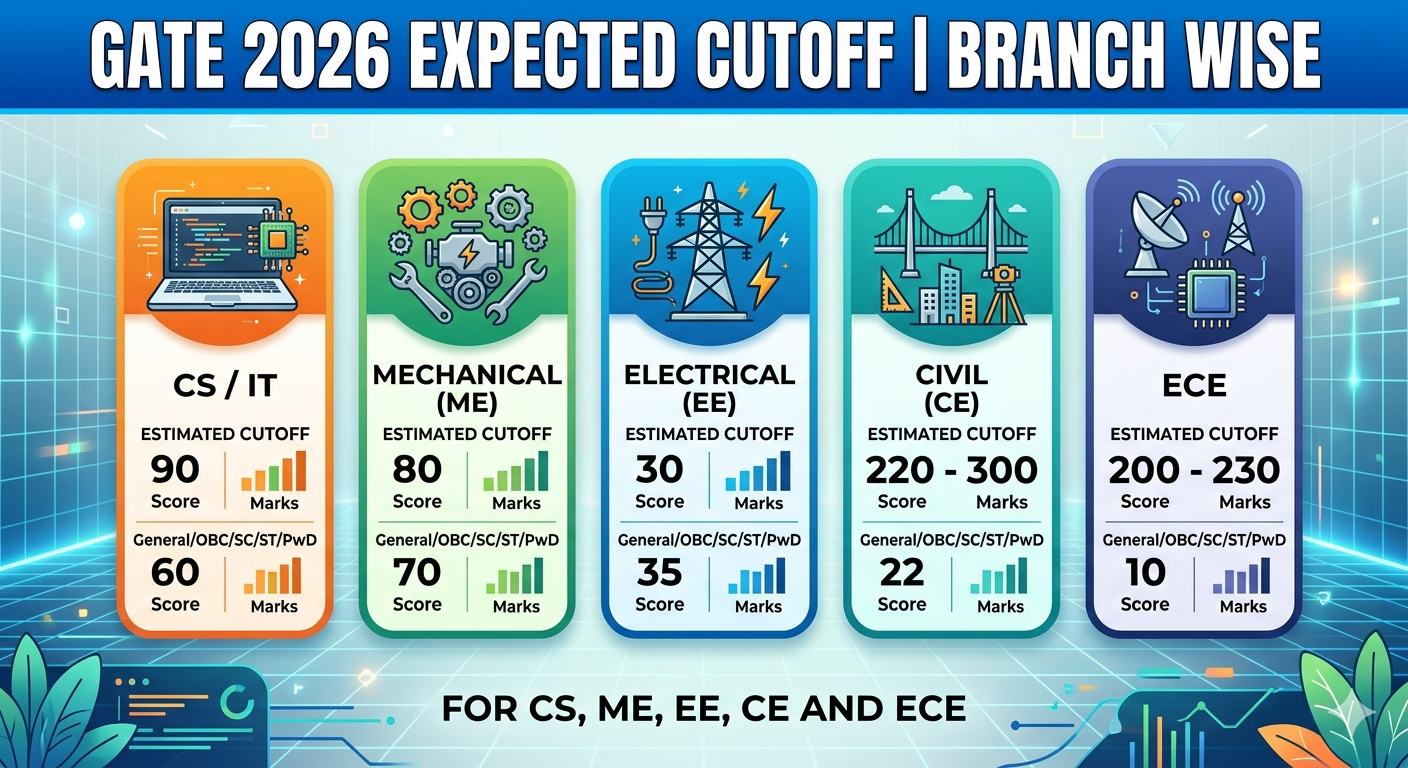
In this article, we provide a branch-wise expected cutoff for GATE 2026 for the most popular engineering streams: Computer Science (CS), Mechanical Engineering (ME), Electrical Engineering (EE), Civil Engineering (CE), and Electronics & Communication Engineering (ECE).
The expected cutoff values are based on previous year trends, difficulty level of the exam, number of candidates, and expert analysis.
GATE 2026 Expected Cutoff for Computer Science (CS)
Computer Science and Information Technology (CS/IT) is the most competitive paper in the GATE exam every year. In GATE 2026, more than 1.5 lakh candidates appeared for the CS paper, making it the largest branch in terms of participation.
The difficulty level of the CS paper in GATE 2026 was moderate. However, experts noticed a slight increase in numerical aptitude and problem-based questions, especially in subjects like Algorithms, Data Structures, and Operating Systems. Because of this balanced difficulty level, the cutoff is expected to remain close to previous years.
The expected qualifying cutoff for the General category is around 29–30 marks out of 100. Candidates from OBC-NCL and SC/ST categories usually have slightly lower qualifying marks according to GATE norms.
Qualifying the cutoff means the candidate has passed the exam, but getting admission into top IITs requires a much higher GATE score. Most top IITs require a GATE score above 750 for CS programs because the competition is extremely high.
Many CS candidates also aim for research opportunities, AI/ML programs, and high-paying tech jobs after completing M.Tech from premier institutes.
| College / Target | General | OBC-NCL | SC/ST |
|---|---|---|---|
| Qualifying Cutoff (Marks/100) | 29.5 | 26.5 | 19.6 |
| IIT Bombay | 800 | 700 | 550 |
| IIT Delhi | 780 | 680 | 530 |
| IIT Madras | 770 | 670 | 520 |
| IIT Kanpur | 760 | 660 | 510 |
| IIT Kharagpur | 750 | 650 | 500 |
| IISc Bangalore | 790 | 690 | 540 |
| NIT Trichy | 650 | 570 | 420 |
| NIT Warangal | 640 | 560 | 410 |
| Top PSU (BARC) | 600 | 530 | 400 |
Students who want admission to top institutes like IIT Bombay or IISc Bangalore should aim for a GATE score above 780–800.
GATE 2026 Expected Cutoff for Mechanical Engineering (ME)
Mechanical Engineering is the second largest GATE paper in terms of the number of candidates appearing for the exam. In GATE 2026, around 1.2 lakh students appeared for the Mechanical Engineering paper.
The overall difficulty level of the ME paper was moderately difficult. Experts reported that questions from Manufacturing Engineering and Thermodynamics had slightly higher weightage compared to previous years. Subjects like Strength of Materials and Engineering Mathematics also played an important role.
Based on exam analysis and previous cutoff trends, the expected qualifying cutoff for the General category is around 28–29 marks.
Although ME cutoffs for IIT admissions are usually 80–120 GATE score points lower than Computer Science, Mechanical Engineering candidates still have excellent career opportunities.
Many Public Sector Undertakings (PSUs) recruit Mechanical Engineers through GATE every year. Major PSUs include ONGC, BHEL, HAL, NTPC, and GAIL.
| College / Target | General | OBC-NCL | SC/ST |
|---|---|---|---|
| Qualifying Cutoff (Marks/100) | 28.7 | 25.8 | 19.1 |
| IIT Bombay | 700 | 600 | 480 |
| IIT Delhi | 680 | 580 | 460 |
| IIT Madras | 670 | 570 | 450 |
| IIT Kanpur | 660 | 560 | 440 |
| IIT Kharagpur | 650 | 550 | 430 |
| NIT Trichy | 560 | 480 | 380 |
| NIT Warangal | 550 | 470 | 370 |
| ONGC | 520 | 450 | 350 |
| BHEL | 500 | 430 | 350 |
Candidates targeting PSU jobs through GATE ME should aim for a score above 500–520.
GATE 2026 Expected Cutoff for Electrical Engineering (EE)
Electrical Engineering is one of the most technical and analytical GATE papers. In GATE 2026, around 98,000 candidates appeared for the Electrical Engineering exam.
The difficulty level of the EE paper was moderate to tough. Topics like Power Systems and Control Systems had higher weightage, while questions from Electrical Machines and Power Electronics were slightly more conceptual.
Because of this difficulty level, the expected qualifying cutoff for the General category is around 30–31 marks.
Electrical Engineering is also one of the best branches for PSU recruitment through GATE. Several large power sector companies recruit Electrical Engineers every year.
Major PSUs that recruit through GATE EE include NTPC, Power Grid Corporation, NHPC, and PGCIL. These organizations offer stable government jobs with high salary packages.
| College / Target | General | OBC-NCL | SC/ST |
|---|---|---|---|
| Qualifying Cutoff (Marks/100) | 30.1 | 27.0 | 20.0 |
| IIT Bombay | 750 | 650 | 500 |
| IIT Delhi | 730 | 630 | 490 |
| IIT Madras | 720 | 620 | 480 |
| IIT Kanpur | 710 | 610 | 470 |
| IIT Kharagpur | 700 | 600 | 460 |
| NIT Trichy | 580 | 500 | 380 |
| NTPC | 550 | 480 | 370 |
| Power Grid | 560 | 490 | 380 |
Students aiming for top IITs in Electrical Engineering should target a GATE score above 720–750.
GATE 2026 Expected Cutoff for Civil Engineering (CE)
Civil Engineering is another important branch in the GATE exam. In GATE 2026, approximately 85,000 candidates appeared for the Civil Engineering paper.
Compared to branches like Computer Science and Electrical Engineering, Civil Engineering is slightly less competitive for IIT admissions. However, it offers excellent career opportunities in government organizations and infrastructure projects.
The GATE 2026 CE paper was moderate in difficulty. Topics like Structural Analysis and Geotechnical Engineering had higher weightage, while Environmental Engineering questions were relatively easier.
Based on expert analysis, the expected qualifying cutoff for the General category is around 27–28 marks.
Civil Engineering graduates also have strong opportunities in government organizations such as CPWD, PWD, Indian Railways, and state engineering services.
| College / Target | General | OBC-NCL | SC/ST |
|---|---|---|---|
| Qualifying Cutoff (Marks/100) | 27.3 | 24.5 | 18.2 |
| IIT Bombay | 650 | 560 | 430 |
| IIT Delhi | 630 | 540 | 420 |
| IIT Madras | 620 | 530 | 410 |
| IIT Kanpur | 610 | 520 | 400 |
| IIT Kharagpur | 600 | 510 | 390 |
| NIT Trichy | 520 | 440 | 360 |
| NIT Warangal | 510 | 430 | 350 |
Candidates targeting top IITs for Civil Engineering should aim for a GATE score above 620–650.
GATE 2026 Expected Cutoff for Electronics and Communication (ECE)
Electronics and Communication Engineering (ECE) is the third largest GATE paper, with around 1.1 lakh candidates appearing in GATE 2026.
The ECE paper difficulty level was moderate, with a balanced distribution of questions across major subjects such as:
- Analog Electronics
- Digital Circuits
- Signals and Systems
- Communication Systems
Because of this balanced difficulty level, the expected qualifying cutoff for the General category is around 25 marks.
ECE is a very versatile branch because candidates have opportunities in both higher education and the electronics industry.
With the growing semiconductor industry in India, demand for ECE engineers is increasing. Many companies like Intel, Qualcomm, and other semiconductor firms recruit candidates with strong electronics backgrounds.
| College / Target | General | OBC-NCL | SC/ST |
|---|---|---|---|
| Qualifying Cutoff (Marks/100) | 25.0 | 22.5 | 16.6 |
| IIT Bombay | 720 | 620 | 490 |
| IIT Delhi | 700 | 600 | 470 |
| IIT Madras | 690 | 590 | 460 |
| IIT Kanpur | 680 | 580 | 450 |
| IIT Kharagpur | 670 | 570 | 440 |
| NIT Trichy | 580 | 500 | 380 |
| NIT Warangal | 570 | 490 | 370 |
Students aiming for top IIT ECE programs should target a GATE score above 700.
How Paper Difficulty Affects Expected Cutoffs?
Paper difficulty is the single biggest factor affecting cutoffs. When a paper is tough, fewer candidates score high marks. This pushes all cutoffs lower. When a paper is easy, more candidates score well and cutoffs rise.
For GATE 2026, the difficulty analysis by coaching institutes suggests the following. CS paper was moderate with 60% questions of medium difficulty. EE paper was moderate to tough with more numerical questions. ME paper was moderate with some tricky questions in Manufacturing. CE paper was easy to moderate. ECE paper was moderate.
| Branch | 2026 Paper Difficulty | Impact on Cutoff vs 2025 |
|---|---|---|
| CS | Moderate | Slight increase expected |
| EE | Moderate to Tough | May remain stable or drop slightly |
| ME | Moderate | Slight increase expected |
| CE | Easy to Moderate | Likely increase |
| ECE | Moderate | May remain stable |
Target Score Recommendations for GATE 2026 Aspirants
When preparing for the GATE 2026 exam, it is important for candidates to set a clear target score. The expected cutoff only tells you the minimum marks required to qualify the exam, but it does not guarantee admission to top institutes or recruitment in PSUs.
Therefore, aspirants should always aim for scores significantly higher than the expected cutoff. This is because the GATE cutoff can change every year depending on factors like exam difficulty, number of candidates appearing for the exam, and overall performance of students.
Setting a target score also helps candidates plan their preparation strategy more effectively. For example, students who want admission into top IITs like IIT Bombay, IIT Delhi, or IIT Madras should aim for a much higher score compared to those targeting NITs or other engineering colleges.
Similarly, candidates interested in Public Sector Undertakings (PSUs) should focus on achieving a competitive GATE score, since PSU recruitment is highly competitive and usually requires a higher score.
The table below shows recommended target scores for different goals, including top IITs, any IIT, top NITs, PSUs, and general NIT admissions. These target scores are based on previous admission trends and expected GATE 2026 cutoff ranges.
| Goal | CS Target | EE Target | ECE Target | ME Target | CE Target |
|---|---|---|---|---|---|
| Top 3 IIT | 820+ | 760+ | 730+ | 710+ | 660+ |
| Any IIT | 700+ | 650+ | 620+ | 600+ | 550+ |
| Top NIT | 660+ | 590+ | 590+ | 570+ | 530+ |
| Top PSU | 620+ | 570+ | 540+ | 540+ | 500+ |
| Any NIT | 500+ | 450+ | 430+ | 420+ | 400+ |
Targeting the Top 3 IITs
If your goal is to secure admission into top IITs such as IIT Bombay, IIT Delhi, or IIT Madras, you should aim for a very high GATE score. These institutes receive applications from the top rankers across the country, so competition is extremely tough. For example, Computer Science candidates may need a score of 820 or higher to have a strong chance of admission.
Targeting Any IIT
Students who want admission into any IIT for M.Tech programs should aim for scores around 700+ for CS, 650+ for EE, and 600+ for ME and ECE. This score range increases the chances of getting admission into mid-tier IITs.
Targeting Top NITs
Top NITs such as NIT Trichy, NIT Warangal, and NIT Surathkal are also highly competitive. Candidates should aim for scores between 570 and 660 depending on the branch to secure admission in these institutes.
Targeting PSU Jobs
Many government companies recruit engineers through GATE scores. These include NTPC, BHEL, ONGC, Power Grid, and GAIL. To get shortlisted for PSU interviews, candidates generally need a score above 540 to 620 depending on the branch.
Targeting Any NIT
If your goal is simply to secure admission into any NIT, a GATE score between 400 and 500 can be sufficient depending on the branch and category.
Conclusion
The GATE 2026 expected cutoff for CS, ME, EE, CE, and ECE provides a helpful estimate of the minimum marks required to qualify the exam. However, candidates should remember that qualifying the cutoff is only the first step toward admission into top institutes or securing PSU jobs. To increase their chances of getting into IITs, NITs, or leading government organizations, aspirants should aim for scores well above the expected cutoff.
The final cutoff will depend on factors such as exam difficulty, number of candidates, and overall performance. With consistent preparation, strong fundamentals, and regular practice, students can achieve a competitive GATE score in 2026.
FAQs
1. What is the expected GATE 2026 cutoff for Computer Science?
The expected qualifying cutoff for GATE 2026 Computer Science (CS) is around 29–30 marks for the General category. For OBC-NCL it may be around 26–27, while SC/ST candidates may qualify with about 19–20 marks.
2. What is the expected GATE 2026 cutoff for Mechanical Engineering?
The expected cutoff for GATE 2026 Mechanical Engineering (ME) is likely to be 28–29 marks for the General category. OBC candidates may need around 25–26 marks, while SC/ST candidates may qualify around 19 marks.
3. How many marks are required to qualify GATE 2026?
To qualify GATE 2026, candidates usually need around 25–31 marks depending on the branch for the General category. Reserved category candidates generally have lower qualifying cutoffs according to GATE exam guidelines.
4. What GATE score is required for IIT admission?
For admission into top IITs through GATE, candidates generally need a score between 650 and 800+ depending on the branch and institute. Highly competitive branches like CS often require higher scores.
5. What GATE score is needed for NIT admission?
For admission into top NITs like NIT Trichy or NIT Warangal, candidates usually need a GATE score between 550 and 650 depending on the branch, category, and seat availability.
6. Is the GATE cutoff the same every year?
No, the GATE cutoff changes every year. It depends on several factors such as exam difficulty level, number of candidates appearing, and overall performance of students in the exam.
7. Which branch usually has the highest GATE cutoff?
Generally, Computer Science and Mechanical Engineering have higher GATE cutoffs because a large number of candidates appear for these branches and the competition for top institutes is very high.
8. Can I get PSU jobs through GATE 2026?
Yes, many Public Sector Undertakings (PSUs) recruit engineers through GATE scores. Companies like NTPC, BHEL, ONGC, and Power Grid select candidates with high GATE scores for technical positions.
9. Is qualifying GATE enough for IIT admission?
No, qualifying GATE only means you passed the exam. To get admission into IITs or IISc, candidates must score much higher than the qualifying cutoff due to limited seats and high competition.
10. How can I score above the GATE cutoff?
To score above the GATE cutoff, candidates should build strong fundamentals, practice previous year GATE questions, take mock tests regularly, and revise important concepts to improve accuracy and speed.