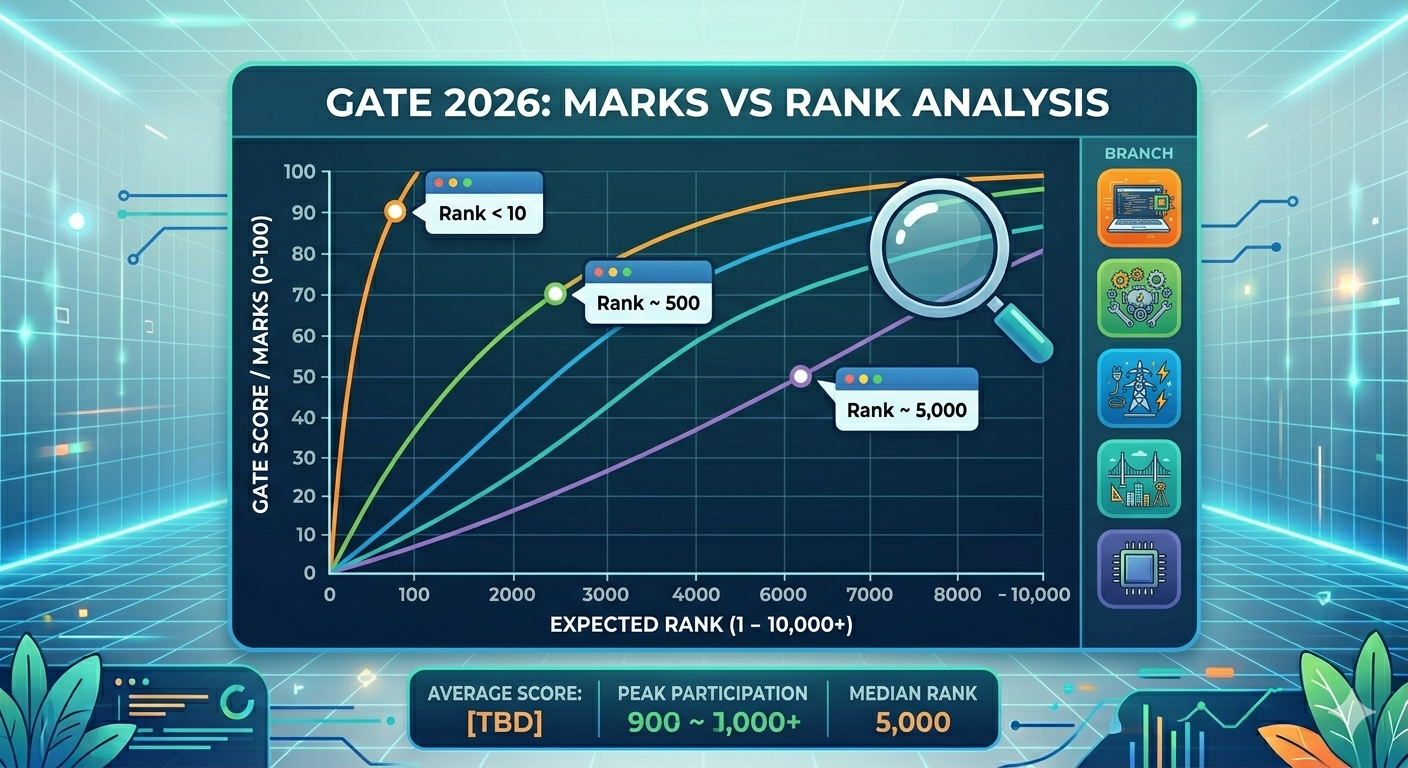
GATE 2026 Marks vs Rank Analysis for All Branches
The GATE 2026 Marks vs Rank Analysis helps candidates understand how their marks in the exam may convert into ranks. Every year, lakhs of engineering graduates appear for the Graduate Aptitude Test in Engineering (GATE) to get admission into MTech programs at top institutes like IITs, NITs, and IIITs or to secure jobs in Public Sector Undertakings (PSUs). Because the competition is very high, students often want to know how many marks are required to achieve a good rank in the exam.
Marks vs rank analysis is usually prepared using previous years’ trends, exam difficulty level, and the number of candidates appearing for the exam. Even a small difference in marks can lead to a large difference in rank, especially in highly competitive branches. Understanding this relationship helps students set realistic preparation goals.
This blog gives a clear overview of the expected marks vs rank trends for GATE 2026 across major branches such as Computer Science, Mechanical, Civil, Electrical, and Electronics. It will help aspirants estimate their possible rank and plan their preparation strategy more effectively.
GATE Marks vs Rank Analysis: Overview
In the GATE exam, marks are calculated out of 100 based on the candidate’s performance in different sections such as General Aptitude, Engineering Mathematics, and core subjects. The rank is then assigned according to the marks scored compared to other candidates who appeared for the same paper.
In general, higher marks result in a better rank. However, the marks vs rank relationship can change every year depending on several factors. These factors include the difficulty level of the exam, the total number of candidates appearing, and the overall performance of students. If the paper is difficult, candidates may secure a good rank with slightly lower marks. On the other hand, if the paper is easier, higher marks may be required to achieve the same rank.
Marks vs rank analysis is usually prepared by studying previous years’ GATE data. This helps experts estimate the expected marks required to achieve certain ranks in the upcoming exam. Aspirants can use this analysis to set a target score and plan their preparation strategy effectively.
Expected GATE 2026 Marks vs Rank (Overall Estimate)
| GATE Marks | Expected Rank Range |
|---|---|
| 90+ | 1 – 20 |
| 85 – 90 | 20 – 100 |
| 80 – 85 | 100 – 300 |
| 75 – 80 | 300 – 700 |
| 70 – 75 | 700 – 1200 |
| 65 – 70 | 1200 – 2000 |
| 60 – 65 | 2000 – 3500 |
| 55 – 60 | 3500 – 5500 |
| 50 – 55 | 5500 – 8000 |
| 45 – 50 | 8000 – 12000 |
| 40 – 45 | 12000 – 18000 |
Branch Wise GATE 2026 Marks vs Rank Analysis
The GATE 2026 Marks vs Rank Analysis can vary significantly across different branches. Each engineering branch has a different number of candidates, competition level, and exam difficulty. Because of these differences, the marks required to achieve a particular rank are not the same for every branch.
For example, branches like Computer Science and Mechanical Engineering usually have a very large number of candidates. This means that even a small difference in marks can change the rank significantly. On the other hand, in some branches with fewer candidates, the marks vs rank variation may be slightly wider.
Understanding branch-wise marks vs rank trends is very useful for aspirants. It helps them estimate the marks required to achieve a certain rank in their specific branch. Students can also use this information to set a target score during their preparation for GATE 2026.
Below is the expected branch-wise marks vs rank analysis for some of the major GATE branches based on previous years’ trends.
People Also Read

GATE 2026 Marks vs Rank for Computer Science (CS)
Computer Science is one of the most competitive branches in the GATE exam. Every year, a large number of candidates appear for the CS paper because of strong career opportunities in both higher education and industry. Due to this high competition, the marks required to achieve top ranks are usually higher compared to many other branches.
Candidates aiming for top IITs in Computer Science generally need very high marks. Even a small difference of 2–3 marks can cause a large difference in rank.
| Marks | Expected Rank (CS) |
|---|---|
| 85+ | Top 100 |
| 75 – 85 | 100 – 500 |
| 65 – 75 | 500 – 1500 |
| 55 – 65 | 1500 – 3500 |
| 45 – 55 | 3500 – 7000 |
Students targeting a rank under 500 in Computer Science should usually aim for 75 marks or more depending on the difficulty level of the exam.
GATE 2026 Marks vs Rank for Mechanical Engineering (ME)
Mechanical Engineering is another branch with a very high number of GATE applicants every year. Because of this large competition, the marks vs rank difference can be quite significant.
The Mechanical Engineering paper often includes questions from subjects like Thermodynamics, Strength of Materials, Fluid Mechanics, and Manufacturing. Candidates who perform well in these core subjects can secure better marks and ranks.
| Marks | Expected Rank (ME) |
|---|---|
| 85+ | Top 100 |
| 75 – 85 | 100 – 600 |
| 65 – 75 | 600 – 2000 |
| 55 – 65 | 2000 – 4500 |
| 45 – 55 | 4500 – 8000 |
Candidates aiming for top IIT Mechanical programs generally need a rank under 500, which usually requires 75+ marks in the exam.
GATE 2026 Marks vs Rank for Electrical Engineering (EE)
Electrical Engineering is considered one of the toughest GATE papers because it includes many concept-based and numerical questions. The competition is also strong because many candidates from Electrical and related branches appear for the exam.
Subjects like Network Theory, Control Systems, Power Systems, and Electrical Machines play an important role in determining the final score.
| Marks | Expected Rank (EE) |
|---|---|
| 85+ | Top 80 |
| 75 – 85 | 80 – 400 |
| 65 – 75 | 400 – 1500 |
| 55 – 65 | 1500 – 3500 |
| 45 – 55 | 3500 – 7000 |
Students who want admission into top IIT Electrical programs should target 75–80 marks or higher depending on the difficulty level of the exam.
GATE 2026 Marks vs Rank for Civil Engineering (CE)
Civil Engineering has a large number of candidates every year because many students from civil and related fields appear for the exam. The paper usually includes subjects like Structural Engineering, Geotechnical Engineering, Environmental Engineering, and Transportation Engineering.
Marks vs rank trends in Civil Engineering can vary depending on the difficulty of structural and numerical questions.
| Marks | Expected Rank (CE) |
|---|---|
| 85+ | Top 50 |
| 75 – 85 | 50 – 300 |
| 65 – 75 | 300 – 1200 |
| 55 – 65 | 1200 – 3000 |
| 45 – 55 | 3000 – 6000 |
Candidates aiming for top ranks in Civil Engineering should usually target 75+ marks to secure a rank under 300.
GATE 2026 Marks vs Rank for Electronics and Communication (ECE)
Electronics and Communication Engineering is another highly competitive branch in GATE. The paper covers a wide range of subjects including Analog Electronics, Digital Electronics, Signals and Systems, Communication Systems, and Control Systems.
Because the paper often contains tricky conceptual questions, the marks vs rank trend can vary depending on the exam difficulty.
| Marks | Expected Rank (ECE) |
|---|---|
| 80+ | Top 100 |
| 70 – 80 | 100 – 500 |
| 60 – 70 | 500 – 2000 |
| 50 – 60 | 2000 – 4500 |
| 40 – 50 | 4500 – 8000 |
Students targeting top IIT ECE programs should aim for 70–80 marks or higher to secure a strong rank.
GATE Marks vs Rank vs Score: What is the Difference?
Many students preparing for the exam often get confused between GATE marks, rank, and score. Although these terms are related, they have different meanings and purposes in the admission process.
GATE Marks are the actual marks a candidate obtains in the exam out of 100. The marks are calculated based on the number of correct answers and the negative marking for incorrect answers. The GATE paper usually contains questions from General Aptitude, Engineering Mathematics, and core engineering subjects. The marks show the raw performance of a candidate in the exam.
GATE Rank is the position of a candidate compared to all other candidates who appeared for the same paper. The rank is determined based on the marks obtained. Candidates with higher marks receive better ranks. For example, the student with the highest marks in a particular paper will get Rank 1, while others are ranked accordingly.
GATE Score is a normalized value that is calculated using a specific formula. The score is usually given out of 1000 and is used by institutes and PSUs during the admission and recruitment process. The score takes into account factors such as the difficulty level of the paper and the performance of candidates.
In simple terms:
- Marks show how many marks you scored in the exam.
- Rank shows your position among all candidates.
- Score is a normalized value used for admissions and job opportunities.
Understanding this difference is important because many institutes consider the GATE score and rank rather than just the raw marks when offering admissions.
Factors Affecting GATE 2026 Marks vs Rank
The relationship between marks and rank in the GATE exam does not remain exactly the same every year. Several factors influence how marks translate into ranks.
1. Difficulty Level of the Exam
The difficulty level of the GATE paper plays a major role in determining marks vs rank trends. If the paper is very difficult, candidates may get good ranks even with lower marks. On the other hand, if the paper is easier, students may need higher marks to secure the same rank.
2. Number of Candidates Appearing
The total number of candidates appearing for the exam also affects the marks vs rank distribution. If more candidates appear for a particular branch, the competition becomes stronger and the ranks may change more rapidly with small differences in marks.
3. Performance of Candidates
The overall performance of candidates in a particular year also impacts the marks vs rank analysis. If many students score high marks, the cutoff and rank distribution may shift accordingly.
4. Normalization Process
For some GATE papers conducted in multiple sessions, normalization is used to ensure fairness. This process adjusts marks based on the difficulty level of different sessions, which can slightly affect the final marks and ranks.
5. Branch Competition Level
Different branches have different levels of competition. Popular branches like Computer Science and Mechanical Engineering usually have more candidates, which can make the marks vs rank difference smaller.
What is a Good Rank in GATE 2026?
A good rank in GATE 2026 depends on the goals of the candidate, such as pursuing higher studies in top institutes or securing a job in a Public Sector Undertaking (PSU).
Generally, ranks can be categorized into different ranges based on opportunities available.
- Rank under 100 is considered excellent and usually allows candidates to get admission into top IITs for popular MTech programs. Candidates with such ranks are also highly competitive for PSU recruitment.
- Rank under 500 is also considered very good and can provide opportunities in several IITs and top NITs. Many PSUs shortlist candidates within this rank range depending on the branch.
- Rank under 1000 is still a strong rank and can help candidates get admission into good IIT programs, NITs, and IIITs. Students with this rank usually have many options for higher studies.
- Rank under 3000 can still provide admission opportunities in many NITs, IIITs, and other government engineering institutes.
- Rank under 5000 may offer admission in several good state engineering colleges and some emerging institutes.
How Many Marks Are Required for Top IITs in GATE 2026?
Getting admission into top IITs for MTech programs is one of the main goals for many GATE aspirants. Since IITs are among the most prestigious engineering institutes in India, the competition for admission is extremely high. Candidates usually need a very strong GATE rank and score to secure a seat in popular programs.
In most branches, candidates aiming for top IITs such as IIT Bombay, IIT Delhi, IIT Madras, IIT Kanpur, and IIT Kharagpur should aim for very high marks in the GATE exam. While the exact marks required may vary depending on the branch, exam difficulty, and number of applicants, past trends give a good estimate.
Generally, candidates targeting top IIT MTech programs should aim for the following marks range:
| Branch | Marks Required for Top IITs (Expected) |
|---|---|
| Computer Science (CS) | 75 – 85+ |
| Mechanical Engineering (ME) | 70 – 80+ |
| Electrical Engineering (EE) | 70 – 80+ |
| Civil Engineering (CE) | 70 – 80+ |
| Electronics & Communication (ECE) | 65 – 75+ |
Candidates who score within this range usually have a strong chance of getting a rank under 500, which significantly improves their chances of admission to top IITs.
However, admission also depends on factors such as the specific specialization chosen, seat availability, and the cutoff for that particular year. Highly popular specializations like Computer Science, Artificial Intelligence, Data Science, and VLSI often have higher cutoff ranks.
Therefore, aspirants preparing for GATE 2026 should ideally target 75 marks or higher to remain competitive for admission to top IITs.
Tips to Achieve a Good Rank in GATE 2026
Securing a good rank in the GATE exam requires consistent preparation, strong conceptual understanding, and effective exam strategy. Candidates who plan their preparation properly and follow a disciplined study routine usually perform better in the exam.
Here are some useful tips to help candidates achieve a good rank in GATE 2026.
Build Strong Concepts
GATE is a concept-based exam, and most questions test the fundamental understanding of engineering subjects. Instead of memorizing formulas, candidates should focus on understanding the concepts clearly. Strong conceptual knowledge helps in solving both theoretical and numerical problems.
Focus on High-Weightage Subjects
Some subjects carry more weightage in the GATE exam. Candidates should identify these subjects in their branch and focus on them during preparation. Subjects like Engineering Mathematics and core technical subjects often contribute a large portion of the total marks.
Practice Previous Year Question Papers
Solving previous year GATE papers is one of the most effective preparation strategies. It helps candidates understand the exam pattern, question types, and important topics. Practicing these questions also improves speed and accuracy.
Take Regular Mock Tests
Mock tests play a very important role in GATE preparation. They help candidates evaluate their preparation level and identify weak areas. Taking regular mock tests also improves time management skills and helps students get familiar with the actual exam environment.
Revise Regularly
Revision is essential for remembering formulas, concepts, and problem-solving techniques. Candidates should create short notes and revise them regularly to keep important topics fresh in their memory.
Improve Time Management
During the exam, managing time effectively is very important. Candidates should practice solving questions within a limited time while preparing. This helps them learn how to allocate time to different sections during the exam.
Maintain Accuracy
Since GATE has negative marking for incorrect answers, accuracy is very important. Candidates should avoid guessing answers and focus on solving questions carefully.
Stay Consistent in Preparation
Consistency is one of the most important factors for success in GATE. Instead of studying irregularly, candidates should maintain a daily study routine and gradually improve their preparation over time.
How to Use Marks vs Rank Data for College Selection?
Once you know your approximate rank, you can shortlist colleges. Here is a quick guide linking rank ranges to college tiers.
| AIR Range | College Tier | Examples |
|---|---|---|
| 1-100 | Top 5 IITs + IISc | IIT Bombay, Delhi, Madras, Kanpur, IISc |
| 100-500 | Other old IITs | IIT Kharagpur, Roorkee, Guwahati, BHU |
| 500-1,500 | New IITs + Top NITs | IIT Hyderabad, Indore, NIT Trichy, Warangal |
| 1,500-3,000 | Good NITs + IIITs | NIT Surathkal, Calicut, Allahabad, IIIT Hyderabad |
| 3,000-8,000 | Remaining NITs | NIT Durgapur, Patna, Raipur, Jamshedpur |
| 8,000+ | State universities and private colleges | DTU, NSUT, BITS, state engineering colleges |
FAQs
1. What is the relationship between GATE marks and rank?
GATE marks determine a candidate’s rank in the exam. Higher marks usually result in a better rank. However, the final rank also depends on exam difficulty, number of candidates, and overall performance.
2. How many marks are required for a top 100 rank in GATE?
To achieve a top 100 rank in GATE, candidates usually need around 80–90 marks depending on the branch and exam difficulty. Highly competitive branches may require even higher marks.
3. What is considered a good rank in GATE 2026?
A good rank in GATE 2026 generally means a rank under 1000. This rank can help candidates secure admission in IITs, NITs, or other reputed institutes for MTech programs.
4. How many marks are required to get into IIT through GATE?
For admission into top IITs, candidates usually need around 70–85 marks depending on the branch. Popular programs like Computer Science may require higher marks and better ranks.
5. Is GATE score different from GATE marks?
Yes, GATE marks and score are different. Marks are the actual marks obtained out of 100, while the GATE score is a normalized value out of 1000 used for admissions.
6. Does GATE marks vs rank change every year?
Yes, GATE marks vs rank changes every year depending on factors such as exam difficulty, number of candidates appearing, and overall performance of students in the exam.
7. What rank can I get with 70 marks in GATE?
With around 70 marks in GATE, candidates may achieve a rank between 500 and 1500 depending on the branch, competition level, and difficulty of the exam that year.
8. How many candidates appear for GATE every year?
Around 7–9 lakh candidates register for the GATE exam every year. However, the number of candidates who actually appear for the exam is usually slightly lower.
9. Can I get PSU jobs through GATE rank?
Yes, many Public Sector Undertakings recruit candidates based on their GATE rank and score. Generally, candidates with ranks under 200–500 have better chances for PSU recruitment.
10. Why is GATE marks vs rank analysis important?
GATE marks vs rank analysis helps candidates estimate the rank they may achieve based on their marks. It also helps students set target scores and plan their preparation strategy effectively.