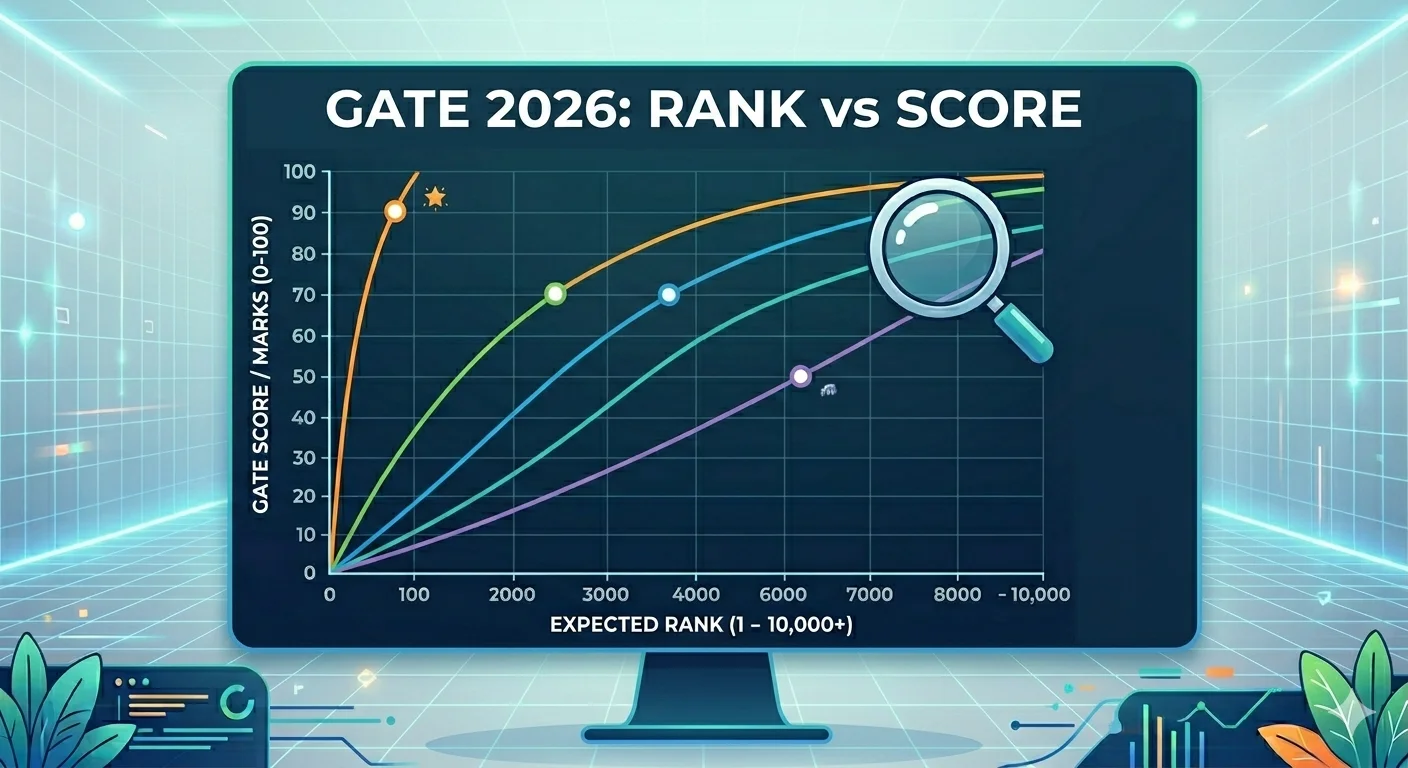
GATE 2026 Rank vs Score: Expected Analysis, Marks vs Rank Trends, and Preparation Tips
The GATE 2026 Rank vs Score analysis helps candidates understand how their performance in the exam converts into an All India Rank (AIR). Every year, lakhs of engineering graduates and final-year students appear for the Graduate Aptitude Test in Engineering (GATE) to secure admission to MTech, ME, and PhD programs at top institutes such as IITs, NITs, IIITs, and other centrally funded technical institutions.
In addition to academic admissions, the GATE score is also used by several Public Sector Undertakings (PSUs) for recruiting engineers into technical and managerial roles. Because of these opportunities, it is important for aspirants to understand how marks, score, and rank are related.
While GATE marks are the raw marks obtained out of 100, the GATE score is a normalized value out of 1000, and the rank represents a candidate’s position among all test-takers in a particular paper. Understanding the GATE 2026 Rank vs Score trend helps candidates estimate their admission chances and set realistic preparation targets.
What is GATE Score and How is it Calculated?
The GATE Rank, also called All India Rank (AIR), shows a candidate’s position among all candidates who appeared for the exam in a specific paper.
For example:
- AIR 1 means the candidate has scored the highest marks in that paper.
- AIR 100 means 99 candidates have scored higher marks.
A lower rank means better performance in the exam. Candidates with a higher rank usually have better chances of getting admission to top IITs and NITs.
The rank is calculated based on the marks obtained by candidates and their performance compared to others in the same paper.
GATE 2026 Rank vs Score Analysis (Expected Trends)
The GATE 2026 Rank vs Score analysis helps candidates understand what score is needed to achieve a certain rank.
Below is an expected trend based on previous years’ data.
| GATE Score | Expected Rank |
|---|---|
| 900+ | 1 – 100 |
| 850 – 900 | 100 – 300 |
| 800 – 850 | 300 – 800 |
| 750 – 800 | 800 – 1500 |
| 700 – 750 | 1500 – 3000 |
| 650 – 700 | 3000 – 5000 |
| 600 – 650 | 5000 – 8000 |
| 550 – 600 | 8000 – 12000 |
| 500 – 550 | 12000 – 18000 |
These numbers are approximate estimates. The actual rank may vary depending on the difficulty level of the exam and the number of candidates appearing in GATE 2026.
GATE Marks vs Rank vs Score: What is the Difference?
Many students get confused between marks, score, and rank in GATE. These three terms represent different things.
GATE Marks
Marks are the raw marks obtained by a candidate out of 100 in the exam.
GATE Score
The score is a normalized value calculated from the marks. It is scaled to 1000.
GATE Rank
The rank shows the position of a candidate among all candidates who appeared in that paper.
Example:
| Marks | Score | Rank |
|---|---|---|
| 85+ | 900+ | Top 100 |
| 75 – 85 | 850 – 900 | Top 300 |
| 65 – 75 | 800 – 850 | Top 1000 |
| 55 – 65 | 700 – 800 | Top 3000 |
Understanding this difference helps candidates analyze their performance better.
People Also Read




Expected GATE 2026 Marks vs Rank Analysis
In the GATE exam, the total marks are 100, and even a small difference in marks can significantly impact the rank. This happens because lakhs of students appear for the exam, and the competition is very high, especially in popular branches like Computer Science, Mechanical Engineering, and Electrical Engineering.
Generally, candidates who score above 80 marks are likely to secure a top rank within the top 100. Similarly, marks between 65 and 75 often place candidates within the top 1000 ranks. Candidates scoring between 50 and 65 marks may secure ranks between 1000 and 5000, depending on the difficulty level of the exam.
Below is an expected marks vs rank trend based on previous years’ analysis:
| GATE Marks | Expected Rank |
|---|---|
| 85+ | Top 100 |
| 75 – 85 | 100 – 300 |
| 65 – 75 | 300 – 1000 |
| 55 – 65 | 1000 – 3000 |
| 45 – 55 | 3000 – 8000 |
| 35 – 45 | 8000 – 15000 |
It is important to remember that these numbers are only estimates. The actual rank can vary depending on the difficulty level of the paper and the performance of other candidates.
By understanding the marks vs rank trend, students can set a target marks goal during their preparation and work toward achieving a competitive rank in GATE 2026.
Factors Affecting GATE 2026 Rank vs Score
Several factors influence the relationship between GATE marks, score, and rank. These factors determine how marks are converted into a normalized score and how that score translates into an All India Rank.
Exam Difficulty Level
The difficulty level of the question paper is one of the most important factors affecting rank vs score. If the exam is very difficult, the marks required for a good rank may be lower. On the other hand, if the paper is easier, candidates may need higher marks to secure a top rank.
Number of Candidates Appearing
The total number of candidates appearing for the exam also impacts rank distribution. When more students take the exam, the competition becomes tougher, and even small differences in marks can result in large differences in rank.
Performance of Candidates
The overall performance of candidates in a particular year also affects rank vs score. If many candidates perform well and score high marks, the cutoff and required score for top ranks may increase.
Normalization Process
In some papers, the GATE exam is conducted in multiple sessions. In such cases, a normalization process is used to adjust scores so that candidates from different sessions are evaluated fairly. This normalization can slightly affect the final score and rank.
Branch-Wise Competition
Competition level varies across different engineering branches. For example, Computer Science and Electronics usually have more candidates compared to some other branches. Because of this, achieving a high rank in these branches may require higher marks and scores.
Cutoff Trends
The qualifying cutoff for each branch also affects how ranks are distributed. If the cutoff increases in a particular year, the marks required to secure a certain rank may also change.
What is a Good GATE Score for IITs, NITs, and IIITs in 2026?
A good GATE score in 2026 depends on the institute and branch you want to study. Different institutes have different cutoffs, and popular branches usually require a higher score because of high competition.
For admission to top IITs, candidates generally need a GATE score above 800. With this score range, students may get admission to popular branches such as Computer Science, Mechanical Engineering, Electrical Engineering, and Civil Engineering.
For mid-tier IITs and top NITs, a GATE score between 700 and 800 is usually considered competitive. Candidates with this score often have good chances of getting admission to several specializations.
For NITs and IIITs, a GATE score between 600 and 700 can provide good admission opportunities, especially in less competitive branches.
Candidates with a GATE score between 500 and 600 may still get admission to some NITs, IIITs, and state engineering colleges. However, the exact score required can change every year depending on the exam difficulty and number of candidates.
To increase the chances of getting admission into top institutes, students should aim for a score above 700 or 750 in GATE 2026.
How GATE Rank Determines MTech Admission in Top Institutes?
The GATE rank plays a very important role in MTech admission at top engineering institutes in India. Most institutes use the GATE rank and score as the main criteria for shortlisting candidates.
During the admission process, candidates must apply to different institutes through their official admission portals or centralized counseling systems. Institutes prepare a merit list based on the GATE rank, score, and sometimes academic background.
Candidates with a higher rank (lower number) usually get the first preference during seat allocation. This means they have a better chance of getting admission into top institutes and popular branches.
For example:
- Candidates with rank under 500 often have strong chances of getting admission into top IITs.
- Candidates with rank between 500 and 2000 may get admission into good IITs and top NITs.
- Candidates with rank between 2000 and 5000 usually get opportunities in NITs, IIITs, and some IIT specializations.
- Candidates with rank above 5000 can target state universities and other engineering institutes.
Therefore, achieving a good GATE rank is crucial for securing admission to top MTech programs.
Target Score Strategy to Get a Good Rank in GATE 2026
Creating a target score strategy is an effective way to plan your GATE preparation. A clear score target helps students stay focused and measure their progress during preparation. Candidates who want admission to top IITs should aim for a GATE score of 850 or higher, which generally corresponds to a rank within the top 500 or top 1000.
Students targeting NITs and IIITs can aim for a score between 650 and 750, which usually results in a decent rank for many branches. Here is a simple target strategy for GATE 2026 aspirants:
| Target Rank | Target Score |
|---|---|
| Top 100 | 900+ |
| Top 500 | 850+ |
| Top 1000 | 800+ |
| Top 3000 | 700+ |
| Top 8000 | 600+ |
While planning your preparation, it is important to set weekly and monthly study goals. Regular mock tests and performance analysis can help you understand whether you are on track to achieve your target score.
Tips to Improve Your GATE 2026 Rank and Score
Improving your GATE 2026 rank and score requires consistent preparation and the right study strategy. Here are some useful tips that can help aspirants perform better in the exam.
Understand the Syllabus Clearly
Start by carefully reading the official GATE syllabus. Identify important topics and create a structured study plan.
Focus on Conceptual Understanding
GATE questions often test fundamental concepts. Make sure you clearly understand the basic principles of each subject.
Practice Previous Year Question Papers
Solving previous GATE papers helps you understand the exam pattern and frequently asked topics.
Take Regular Mock Tests
Mock tests help improve speed, accuracy, and time management. They also help you identify your weak areas.
Revise Important Topics Regularly
Revision is essential to retain concepts and formulas. Create short notes for quick revision before the exam.
Analyze Your Performance
After every test, analyze your mistakes and focus on improving those areas.
Following these strategies consistently can significantly improve your GATE score and rank in 2026.
Common Mistakes to Avoid While Preparing for GATE 2026
Many candidates work hard for the GATE exam but still fail to achieve their desired rank because of common preparation mistakes. Avoiding these mistakes can improve your chances of success.
Ignoring Basic Concepts
Some students focus only on solving problems without understanding the basic concepts. This can make it difficult to solve new or complex questions.
Not Practicing Enough Questions
Practice is very important for GATE preparation. Without regular problem-solving, it becomes difficult to improve accuracy and speed.
Skipping Mock Tests
Mock tests simulate the real exam environment. Avoiding them can lead to poor time management during the actual exam.
Poor Time Management
Many candidates spend too much time on difficult questions and miss easier ones. Learning how to manage time during the exam is very important.
Lack of Regular Revision
Without revision, it is easy to forget important formulas and concepts. Regular revision ensures better retention.
Avoiding these mistakes can help students perform more confidently in GATE 2026.
Previous Year GATE Rank vs Score Trends
Analyzing previous year GATE rank vs score trends helps candidates understand the approximate score required to achieve a certain rank.
Although the exact numbers change every year, the general trend remains similar. Candidates who score above 800 usually secure top ranks within the top 1000 in many branches.
Similarly, candidates scoring around 700 to 750 often achieve ranks within the top 3000. Scores between 600 and 700 may result in ranks between 3000 and 8000, depending on the branch and exam difficulty.
Looking at previous trends helps students set realistic score targets and preparation goals. It also helps them understand how competitive the exam is.
However, candidates should remember that rank vs score trends can vary every year depending on factors such as the number of candidates, exam difficulty, and overall performance.
Therefore, it is always better to aim for a higher score to increase your chances of getting a good rank in GATE 2026.
FAQs
1. What is the difference between GATE marks, score, and rank?
GATE marks are the raw marks obtained out of 100 in the exam. The GATE score is a normalized value out of 1000, while the GATE rank represents a candidate’s position among all test-takers.
2. What GATE score is required to get admission into IITs in 2026?
For admission into top IITs, candidates generally need a GATE score above 800. However, the exact score required depends on the branch, institute, exam difficulty level, and overall performance of candidates.
3. Is 700 a good GATE score for MTech admission?
Yes, a GATE score of 700 is considered a good score. With this score, candidates may get admission to several NITs, IIITs, and some IIT specializations depending on branch competition and seat availability.
4. How does GATE rank affect MTech admission in engineering colleges?
GATE rank plays a major role in MTech admissions. Institutes allocate seats based on rank and score. Candidates with better ranks usually get priority in choosing top institutes and preferred specializations.
5. How many marks are required for a top 100 rank in GATE?
Generally, candidates need around 80 to 85 marks or more to secure a top 100 rank in many branches. However, the required marks may vary depending on exam difficulty and candidate performance.
6. Does the GATE score change every year?
Yes, the GATE score can change every year because it depends on factors such as exam difficulty, number of candidates appearing, normalization process, and the overall performance of candidates in that year.
7. Can I get admission in NITs with a 600 GATE score?
Yes, a GATE score of around 600 can help candidates get admission in several NITs and IIITs, especially in less competitive branches. Admission chances depend on branch choice and institute cutoffs.
8. Why is GATE score normalized?
GATE score normalization is done to ensure fairness when the exam is conducted in multiple sessions. It adjusts marks based on difficulty level so that candidates from different sessions are evaluated equally.
9. How important are previous year GATE rank vs score trends?
Previous year GATE rank vs score trends help candidates estimate the score required for a particular rank. These trends help students set realistic preparation goals and plan their study strategy.
10. What is the best strategy to achieve a good GATE rank in 2026?
The best strategy includes understanding the syllabus, building strong concepts, practicing previous year papers, taking mock tests regularly, and revising important topics frequently to improve accuracy and performance in the exam.

Simran is currently working as a Senior Content Writer at Findmycollege , where she creates engaging and research-driven learning resources for students. She has completed her Graduation in Journalism from Delhi University. With 4 years of experience in the EdTech industry, she has previously contributed to leading platforms like Leverage Edu and Aakash. Her expertise lies in simplifying Engineering and Medical entrance exam content to guide aspirants in their preparation journey. Beyond writing, Simran enjoys sketching, watching movies, and finding creative inspiration in everyday life.
View all posts →